
DiGRA
The Digital Games Research Association: the international association of academics and professionals who study digital games. Its Digital Library holds the proceedings of the DiGRA conferences since 2002.
Documents
You Are What You Play? A Quantitative Study into Game Design Preferences across Gender and Their Interaction with Gaming Habits
Vermeulen and colleagues examine whether differences in game design preferences between women and men are driven by gender itself or by prior gaming experience.
- The study finds that female non-core players diverge significantly from all other groups, while male core players, female core players, and male non-core players show broadly similar design preferences.
- Prior experience with core genres such as shooters, action-adventure, and RPGs appears to reshape gender-based preferences substantially, suggesting that familiarity and access matter at least as much as gender in explaining player engagement.
- Women and non-core players are more irritated by in-game violence and favor easy-to-master, low-complexity games, with female non-core players showing the most extreme preferences and male core players the least.
Players and the Love Game: Conceptualizing Cheating with Erotic Role Players in World of Warcraft
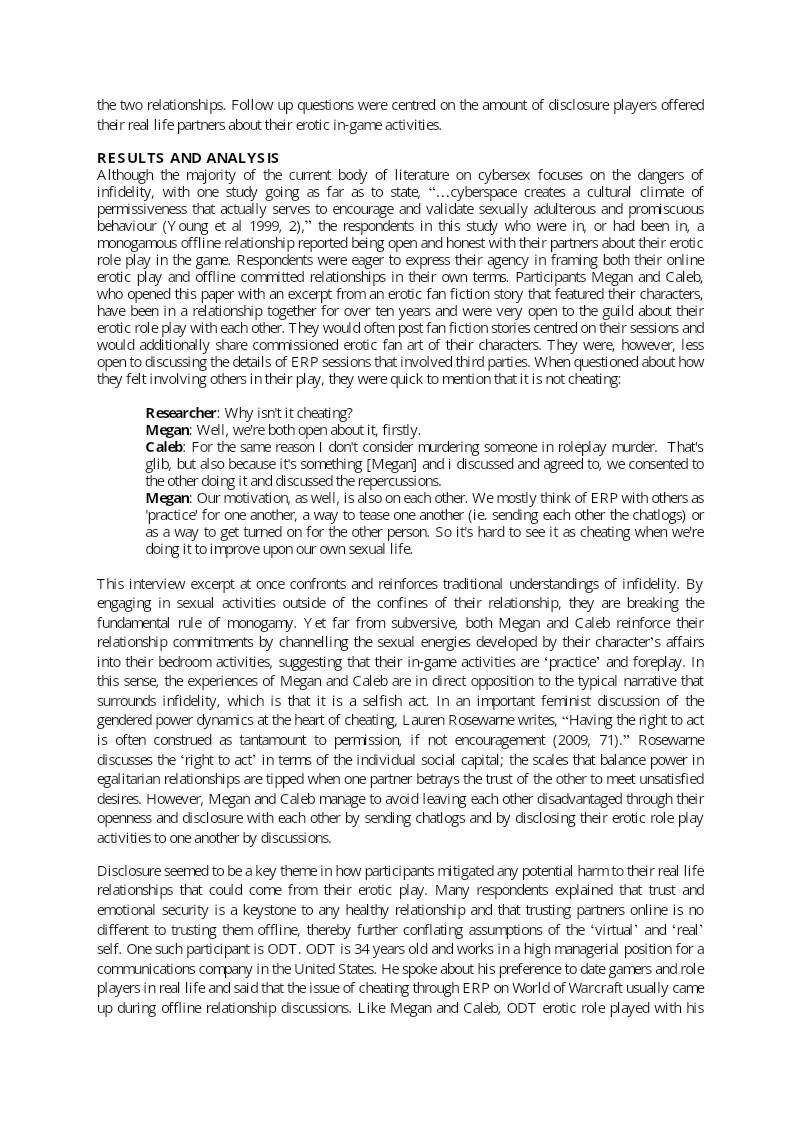
This paper explores how erotic role-play (ERP) within World of Warcraft challenges and reinforces traditional Western concepts of monogamy and fidelity.
- Based on roughly nine months of fieldwork in one active role-playing World of Warcraft guild, the study interviewed 14 self-identified erotic role players (mean age 29, ages early twenties to mid-forties), mostly based in North America.
- Many participants in committed offline relationships did not consider in-game sexual activity to be infidelity, especially when they had been open with partners about it.
- Participants tied their sense of fidelity to disclosure, consent, and mutual trust rather than to the physical act itself, and some argued that an online encounter never consummated in the flesh is not unfaithful.
Doing It Themselves! A Mixed-Method Study into the Motivations of Players to 'Create' in the Context of Gaming
This mixed-method study investigates the motivations of players to create user-generated content (UGC) within digital games, focusing on Spore (PC, Mac) and LittleBigPlanet (PS3).
- Players who create content in games tend to be highly engaged: over 81% of survey respondents had used a level editor, and roughly one in five had contributed to game development in some form.
- Challenge was the highest-scoring motivation among respondents, followed by Arousal and a newly introduced Create construct, which correlated strongly with both Challenge and Arousal.
- Players are broadly omnivorous in genre preferences, with first-person shooters, action-adventures, and racing games ranking highest among respondents.


Return to Darkness: Representations of Africa in Resident Evil 5
This analysis examines the representations of Africa and the zombie figure in the 2009 video game Resident Evil 5, arguing that the game, despite being developed by a Japanese company, perpetuates colonial fantasies and Western stereotypes of Africa.
- The paper argues that Resident Evil 5 (Capcom, 2009) re-enacts familiar 'Darkest Africa' tropes, homogenising a diverse continent into a single faceless setting in which Africa is passive and in need of Western intervention, with the Western protagonist cast as saviour.
- Despite the authors finding no evidence of intended racial stereotyping and noting the developers' surprise at the controversy, they contend that lack of intent does not negate the game's reproduction of colonial imagery.
- The analysis traces the zombie's origins to Haitian voodoo and reads it as a metaphor for slavery, subjugation, and colonial anxieties about revolt, drawing on scholars Kyle Bishop, Jon Stratton, and Diane Carr.
Kairotopos: A Reflection on Greek Space/Time Concepts as Design Implications in Minecraft
The analysis explores the application of ancient Greek concepts of space (chora, topos, kenon) and time (chronos, kairos) to understand the design and player experience within Minecraft.
- The report's central argument is that Minecraft's default landscape is largely undifferentiated 'chora', which players must transform through technical skill into meaningful 'topos'.
- This transformation makes possible 'kairos' moments in which judgment, or 'phronesis', governs action, with progression toward 'kairotopos' resembling the well-played game and the experience of flow.
- Minecraft's default structure chiefly supplies 'chronochora', leaving players to reach kairotopic experiences through their own judgment rather than through the game's design.
Danger Close: Contesting Ideologies and Contemporary Military Conflict in First-Person Shooters
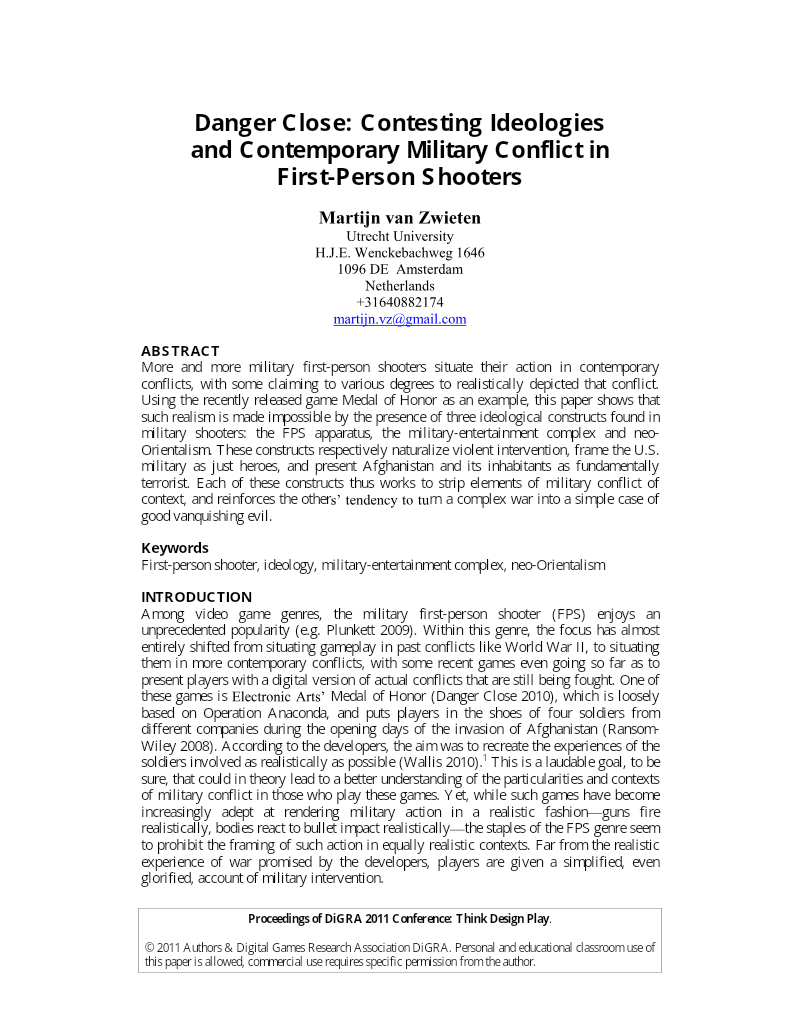
Danger Close examines how the military first-person shooter Medal of Honor (2010) embeds ideological assumptions within its gameplay and presentation, despite its developers' claims of realism.
- The report argues that Medal of Honor (2010) embeds ideological assumptions despite its developers' claims of realism, driven by three interlocking forces: first-person shooter genre conventions, the military-entertainment complex, and neo-Orientalist framings of Afghans as a generic enemy Other.
- These forces strip the Afghan conflict of historical and political context, recasting the invasion of Afghanistan as a simple contest between good and evil.
- Gameplay mechanics such as the first-person gun perspective, invincible player avatars, headshot bonuses, and repetitive kill sequences (exemplified by the sniper mission "Friends from Afar") position the player as a super-human warrior and naturalize domination through destruction.
Player Typology in Theory and Practice
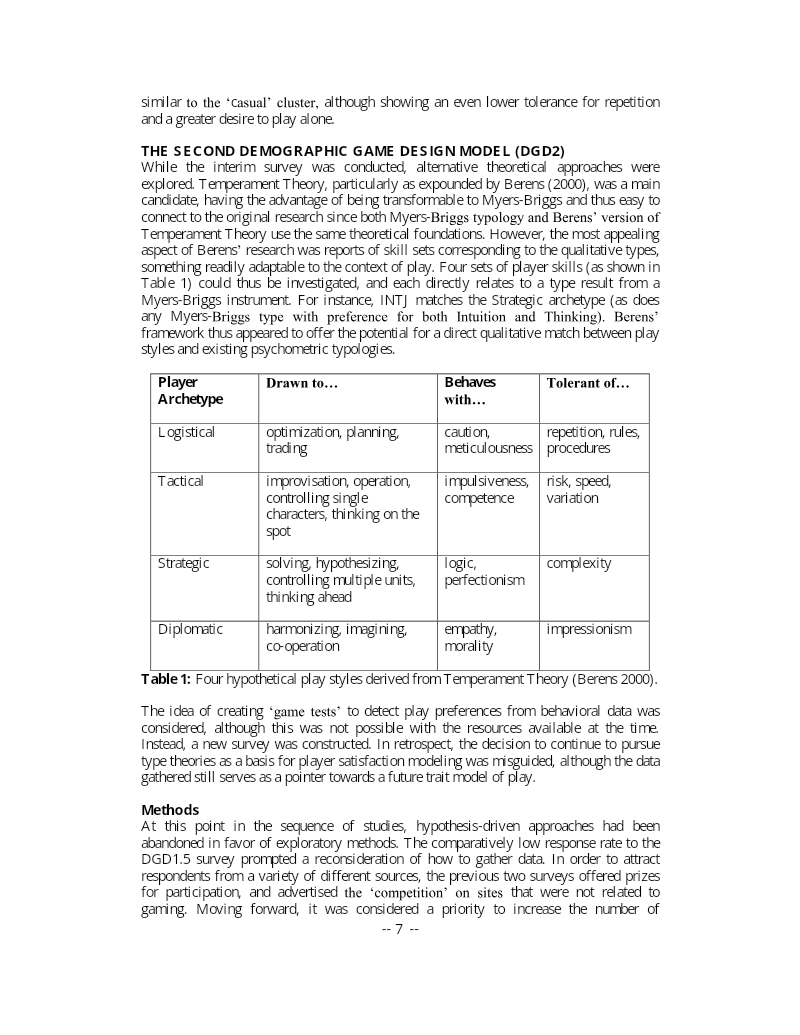
The document proposes a foundational shift in understanding player behavior, advocating for a trait-based player typology rooted in psychometric principles rather as opposed to less robust type theories.
- The authors argue that type-based frameworks such as Myers-Briggs and Bartle's player types are inadequate, and propose a trait-based theory of play instead, motivated partly by Zammitto's finding that personality accounts for only 2.6 to 7.5 percent of game preferences.
- The empirical base is a self-selected, self-reported survey of 1,040 respondents (DGD2), which the authors themselves treat as directions for future research rather than settled conclusions.
- Self-labels of "hardcore" and "casual" span all four play styles, leading the authors to conclude that the hardcore/casual division can no longer serve as an organizing framework.

Playful Crowdsourcing for Energy-Efficient Automotive Navigation
This work-in-progress paper describes a playful, web-based simulation game designed to crowdsource route data for energy-efficient automotive navigation in the context of electromobility.
- A playful, web-based simulation game is proposed to crowdsource route data for energy-efficient navigation of electric vehicles, where players complete randomized routes as fictive drivers such as parcel couriers or mobile nursing workers.
- The game follows the 'games with a purpose' tradition, aiming both to gather usable routing data and to encourage players to reflect on energy-efficient driving, addressing the limited cruising range of electric vehicles.
- The system enriches route waypoints with geographic and topographic data, including altitude, drawn from LinkedGeoData, OpenStreetMap, GeoNames, and Topocoding, and feeds the enriched routes and simulated car movement into an energy-efficiency calculator that also sets the highscore.
In the Army Now: Narrative Elements and Realism in Military First-Person Shooters
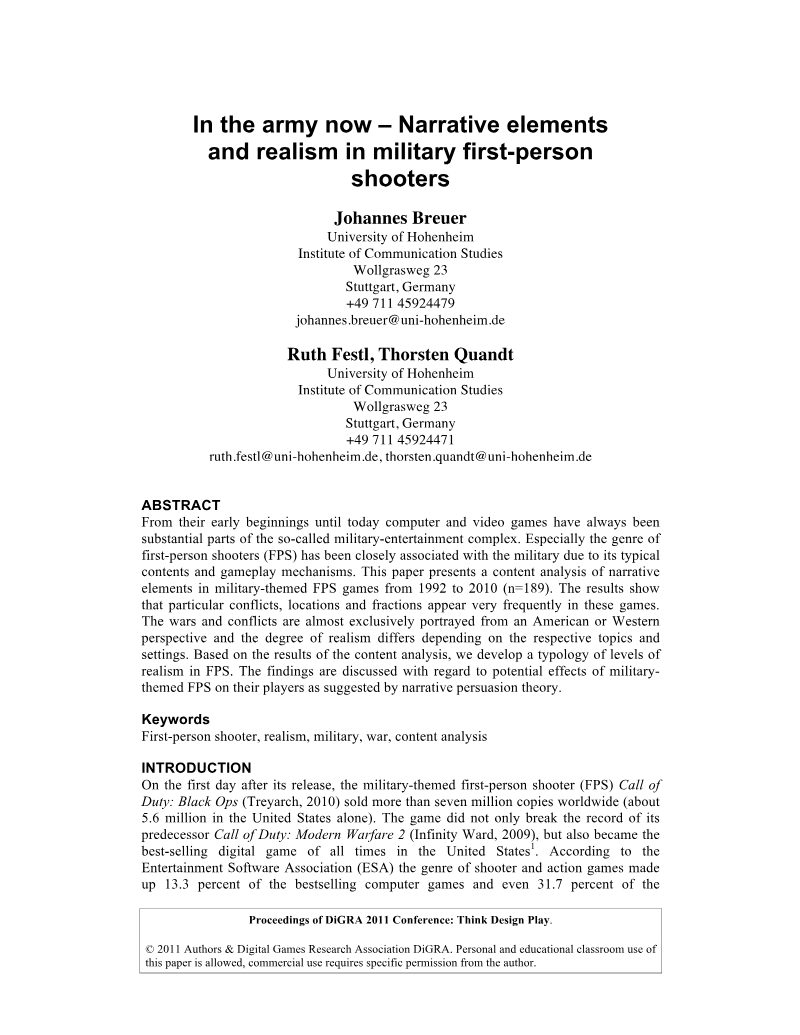
A content analysis of 189 military-themed first-person shooter (FPS) games released between 1992 and 2011 reveals a consistent pattern in narrative elements and realism, addressing a gap in empirical data regarding the "military-entertainment complex."
- Analysis of 189 military first-person shooters released between 1992 and 2010 found that World War II settings account for 63.6 percent of depicted conflicts.
- Protagonists are overwhelmingly American (82.3 percent) and white (95.5 percent), and the most common enemies are Germans (28.8 percent) and Russians (15.9 percent).
- The range of adversaries diversified after 2001, with Middle Eastern and North American opponents appearing more often in war-on-terror and future-conflict titles.
Forbidden or Promising Fruit? An Experimental Study into the Effects of Warning Labels on the Purchase Intention of Digital Gamers
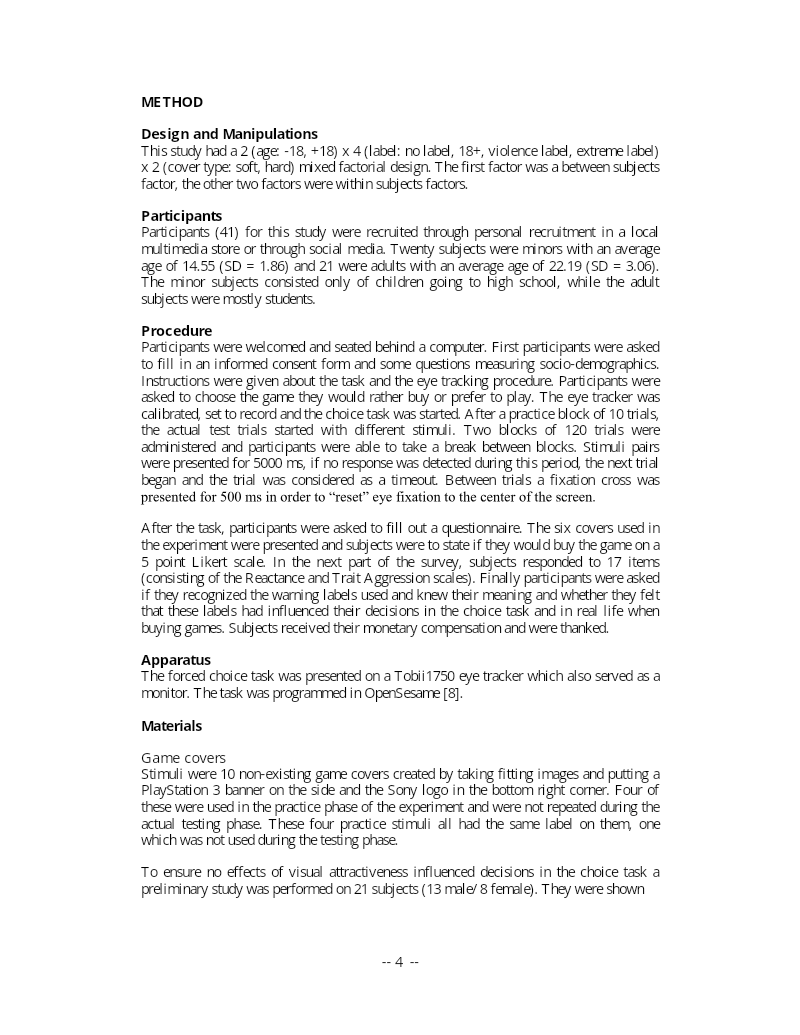
This experimental study explores the effects of warning labels on the purchase intention and desirability of digital game covers, specifically examining whether such labels act as a deterrent or create a "forbidden fruit" effect.
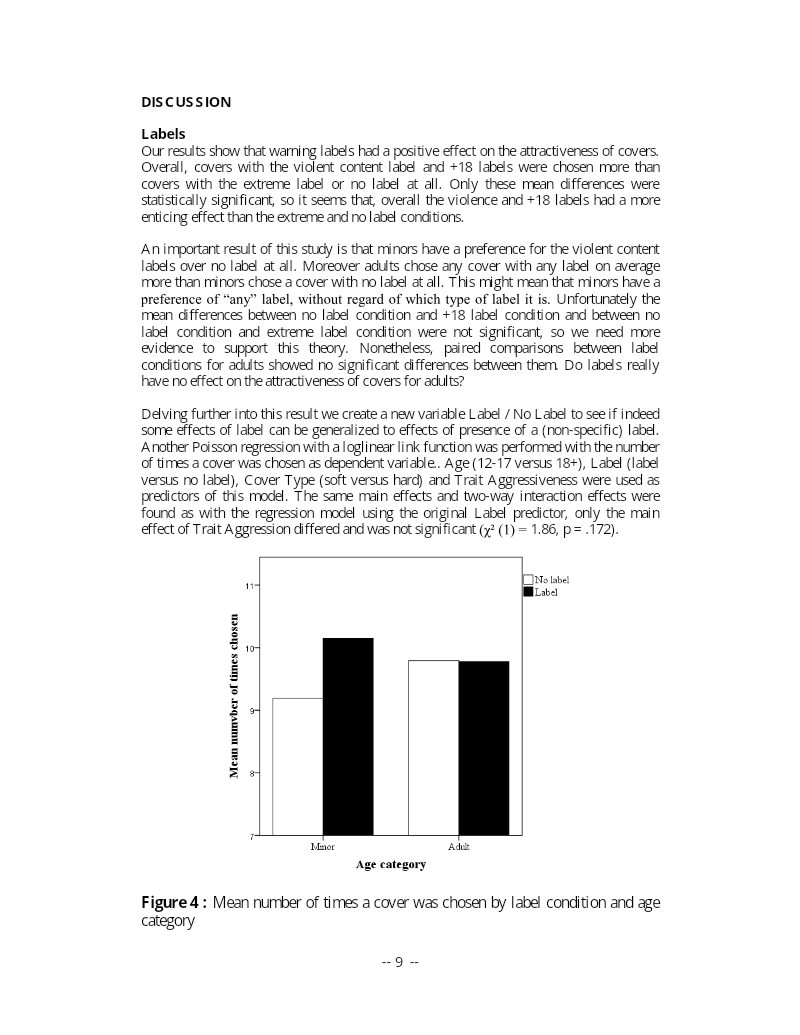
- Warning labels increased cover preference among minors (aged 12–17) but produced no comparable effect among adults in this 41-participant Dutch forced-choice experiment (20 minors, 21 adults), consistent with the forbidden fruit hypothesis.
- Violence and 18+ labels drew the most choices, while a fictional 'extreme' label had no measurable influence, likely because participants did not recognize it.
- Label effects appeared only among minors and only on soft covers (those depicting less violence), indicating the effect was concentrated in specific conditions.

Meaning Making Through Constraint: Modernist Poetics and Game Design Analysis
The document, "Meaning Making Through Constraint: Modernist Poetics and Game Design Analysis," posits that deliberate constraints in game design, particularly within "masocore" titles, are crucial for generating meaning, fostering player mastery, and encouraging deep engagement.
- Constraint is presented as the mechanism through which poetry and games generate meaning, not as a limitation: narrowed rule systems focus attention and invite interpretation or mastery.
- The central thesis holds that constraint and freedom are interdependent rather than opposed, and that a work's openness to multiple readings comes from deliberate design choices rather than the absence of rules.
- The analysis draws on Oulipo and Queneau's combinatorial poems, and on masocore platformers Limbo, VVVVVV, and Super Meat Boy, to connect constrained writing traditions with game design.
Epistemic Games & Applied Drama: Converging Conventions for Serious Play
This paper argues that epistemic games, as articulated by David Shaffer, and applied drama traditions such as Dorothy Heathcote's process drama, Mantle of the Expert, and the Commission Model share a set of converging conventions that can bridge the conceptual gap between digital games and non-theatrical drama used in…
- The paper argues that epistemic games (David Shaffer) and applied drama traditions (Heathcote's process drama, Mantle of the Expert, the Commission Model) share converging conventions, including pre-text, performance framing, role protection, and authentic professional problem-solving, that can bridge digital games and non-theatrical drama.
- The central thesis is that recognizing these affinities can inform the design of serious games for training and learning.
- The argument is largely conceptual and interpretive, relying on comparison rather than quantitative establishment; a six-stage comparison of Mantle of the Expert with epistemic games shows structural similarities, especially in authentic professional framing and role identification.