1 free read left. Create a free account for unlimited reading + AI research.
Create free accountArticle DiGRA
1 free read left. Create a free account for unlimited reading + AI research.
Create free accountArticleDiGRA
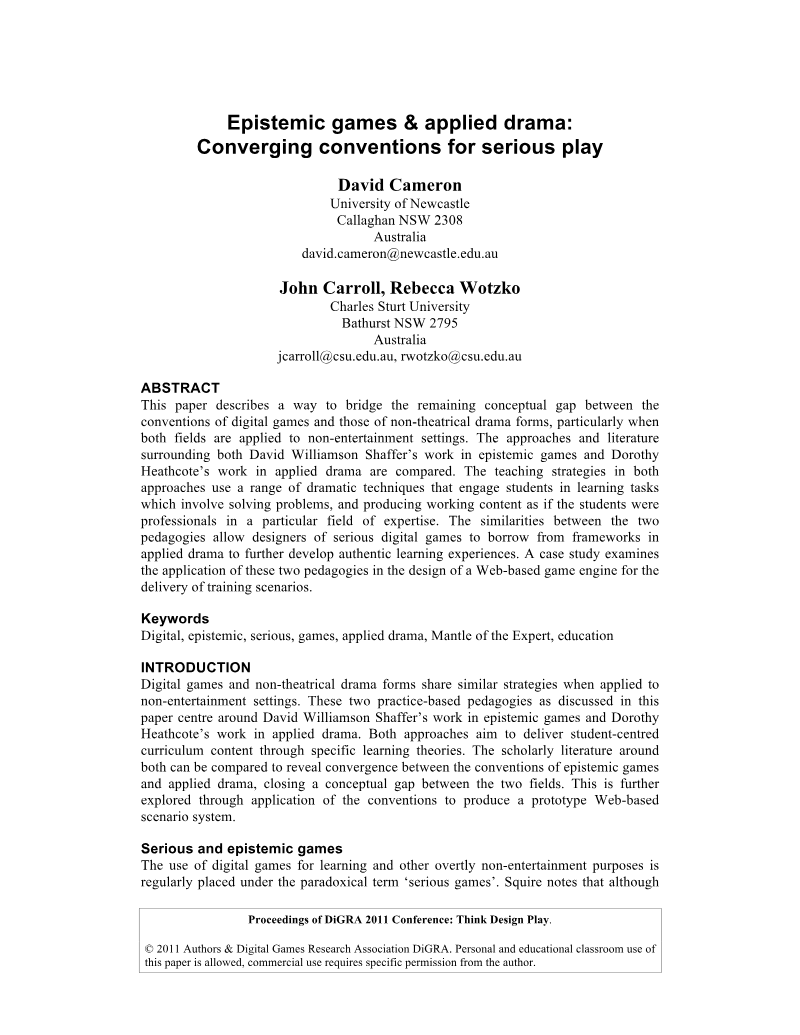
The paper argues that epistemic games and applied drama share conventions that can bridge digital games and non-theatrical drama.
This paper argues that epistemic games, as articulated by David Shaffer, and applied drama traditions such as Dorothy Heathcote's process drama, Mantle of the Expert, and the Commission Model share a set of converging conventions that can bridge the conceptual gap between digital games and non-theatrical drama used in non-entertainment settings. Among these shared conventions are pre-text, performance framing, role protection, and authentic professional problem-solving. The authors acknowledge that the "serious games" label remains contested and that digital simulations and games increasingly overlap, and they draw on Jesse Schell's six game mechanics to show how game design parallels dramatic practice. The central thesis is that recognizing these affinities can inform the design of serious games for training and learning.
The argument rests substantially on conceptual comparison. The authors examine how digital media conventions, including programmability, networkability, persistence, and invisible audiences, create affinity spaces in which real and virtual learning environments blend. A six-stage comparison of Mantle of the Expert with epistemic games reveals significant structural similarities, particularly in the use of authentic professional framing and role identification. These findings are largely descriptive and interpretive rather than quantitatively established.
The principal empirical illustration is CADGE, a prototype role-based crisis communication simulation developed with the Australian Defence Force and piloted in 2011 with undergraduate media students. Participants took on journalist or public relations roles during a fictional flood emergency, responding to facilitator-triggered content such as conflicting tweets and a YouTube clip depicting a failing dam. Focus-group and journal feedback was generally positive, with students describing the scenario as intense and realistic despite technical shortcomings. The authors are explicit that formal evaluation was still ongoing, so the pilot serves to illustrate converging conventions rather than to demonstrate measured learning outcomes.

DiGRA · 2026

DiGRA · 2026



DiGRA · 2026



DiGRA · 2026



DiGRA · 2026



DiGRA · 2026



DiGRA · 2026



DiGRA · 2026



DiGRA · 2026

DiGRA · 2026



DiGRA · 2026



DiGRA · 2026
DiGRA · 2009