
DiGRA
The Digital Games Research Association: the international association of academics and professionals who study digital games. Its Digital Library holds the proceedings of the DiGRA conferences since 2002.
Documents

Paidia to Ludus, Non-Commodity to Commodity: Uncovering the Residue of Player Developed Custom Game Modes in 'Zombies' and 'ARAMs'
The document explores the co-creative dynamics between players and developers, specifically focusing on how player-developed custom game modes transition from "paidia" (spontaneous, non-commodity play) to "ludus" (structured, commodified play) within established game architectures.
- The paper argues that game studies has mapped Caillois's ludus/paidia distinction onto competitive games versus open-world sandboxes, overlooking the paidiac innovation behind many commercially successful modes.
- Its central claim is that modes such as Halo's "Zombies" and League of Legends' "All Random All Mid" (ARAM) originated as player-built custom game rule sets in a non-commodity setting before developers absorbed them into official platforms.
- After absorption, these modes became more structured and competitive and generated substantial economic value for platform owners, according to the paper.
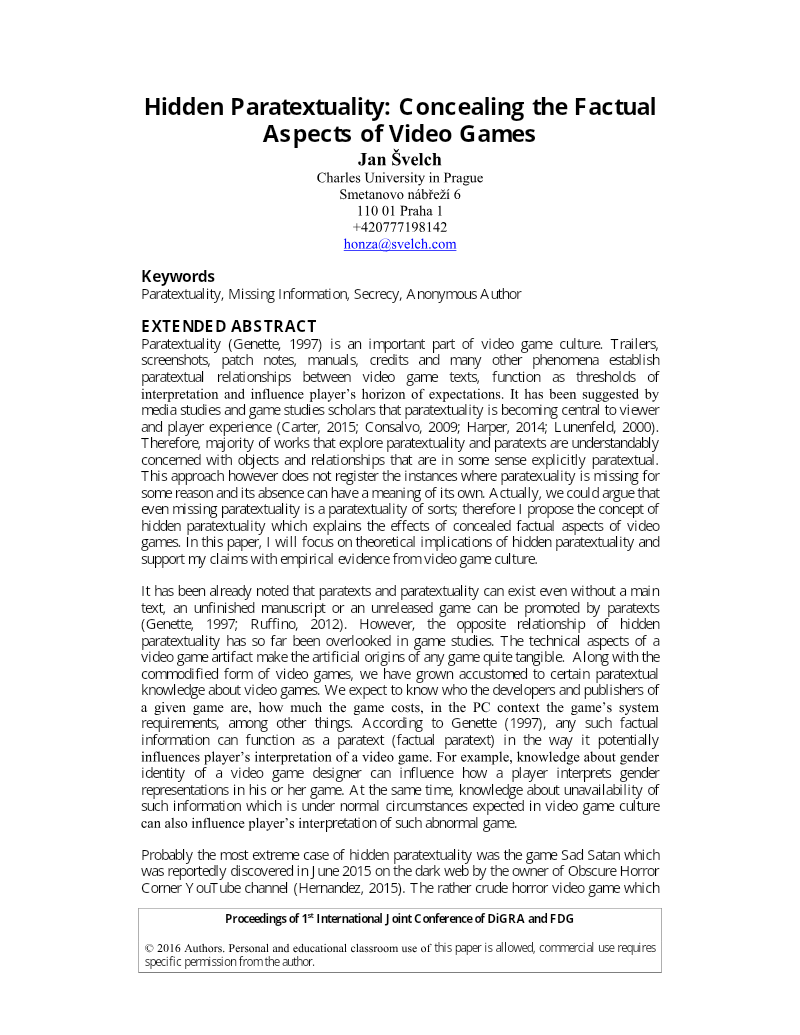
Hidden Paratextuality: Concealing the Factual Aspects of Video Games
Jan Švelch's paper introduces the concept of "hidden paratextuality," arguing that the absence of expected factual information about video games can itself carry meaning and shape how players interpret a game.
- Jan Švelch's paper introduces "hidden paratextuality," arguing that missing factual information about video games, such as developer identity, price, and system requirements, can itself carry meaning and shape player interpretation.
- Building on Gérard Genette's paratext theory, the paper contends that game studies has focused on explicit paratexts like trailers, manuals, patch notes, and credits while overlooking what is conspicuously absent.
- The author argues that the unavailability of factual paratexts creates a distinct paratextual quality that establishes its own threshold of interpretation.

Debris: Exploring the Video Game Values That Can Help Reduce Mental Illness Stigma
This document explores the potential of video games to reduce mental illness stigma, specifically focusing on psychosis among youth aged 14-24.
- Youths aged 14 to 24 face the highest risk of first-episode psychosis, yet treatment delays remain substantial, making early intervention critical.
- In Ontario, the median Duration of Untreated Psychosis was 22 weeks, and help-seeking was initiated by family or friends in 53% of cases, by police in 15%, and by the individuals themselves in 33%.
- Stigma and low awareness are key barriers to help-seeking, as young people often feel responsible for their illness and fail to recognize symptoms or navigate the mental health system.



Towards Diversity: Interventions in Curriculum and Pedagogy of an Introductory Game Design Course
This paper investigates interventions in the curriculum and pedagogy of an introductory game design course at the University of the Witwatersrand, Johannesburg, South Africa, aiming to address the lack of diversity in both game design education and the broader industry.
- The paper argues that systemic changes to teaching practice, rather than content alone, can meaningfully broaden participation in game design and produce more socially aware designers.
- The study is an action-research project on an introductory course, "Key Concepts in Game Design," at the University of the Witwatersrand in Johannesburg, following cycles of observing, reflecting, and intervening.
- The paper contends that the games industry in South Africa and internationally remains dominated by particular demographics across gender, race, and economic lines, and that games are often wrongly perceived as an elite pursuit.

Ethics of Online Cheating: From Chess to Esports and Back
The document provides a comparative analysis of cheating in two competitive online games: chess and League of Legends.
- In chess, cheating is mostly done through third-party programs that calculate optimal moves under time pressure, reflecting a game of strategy without physical challenge.
- In League of Legends, the most common cheating methods are distributed denial-of-service attacks against opponents' connections and code manipulation through hacks and scripts, reflecting the game's real-time, team-based, kinesthetic demands.
- Both games share false accounts and intentional losing, which the authors attribute to their common use of Elo-based ranking systems.

Playful Animals: An Invitation to Participate
The document, "Playful Animals: An Invitation to Participate," proposes the establishment of a subfield within games studies dedicated to playful interactions between humans and animals, particularly through technologically mediated experiences.
- The paper argues for establishing animal-inclusive playful design as a legitimate subfield within games studies, grounded in the view that play is voluntary and shared and therefore a suitable framework for designing interactions with animals.
- Playful design principles can be applied to existing animal artefacts such as pet toys, zoo enrichment, and interactive tablets, which the author treats as current examples of this work.
- Posthumanist theories are proposed as tools for challenging anthropocentric worldviews and placing humans and nonhumans on more equal ontological footing.

For a Proportion Principle-based Gameplay Design
The document proposes a novel approach to gameplay design by integrating the mathematical Golden Mean, or Phi, as a foundational principle.
- The paper proposes using the Golden Mean (Phi) as a structural design principle for videogame gameplay, an area it describes as largely unexplored, and positions it alongside established frameworks such as the MDA model, Fullerton's Playcentric Approach, and Björk and Holopainen's design patterns.
- The central contribution is a method for structuring game elements through proportion so that levels and challenges grow in a controlled way, producing dynamic adaptation with potential relevance to procedural content generation and adaptive play.
- It specifically proposes Dynamic Symmetry and the Whirling Spiral from Hambidge's work to govern how levels and challenges scale, targeting mission- or stage-based platformers and casual games, drawing on Dormans' Mission/Space model and Smith and colleagues' rhythm-based and 2D platformer models.
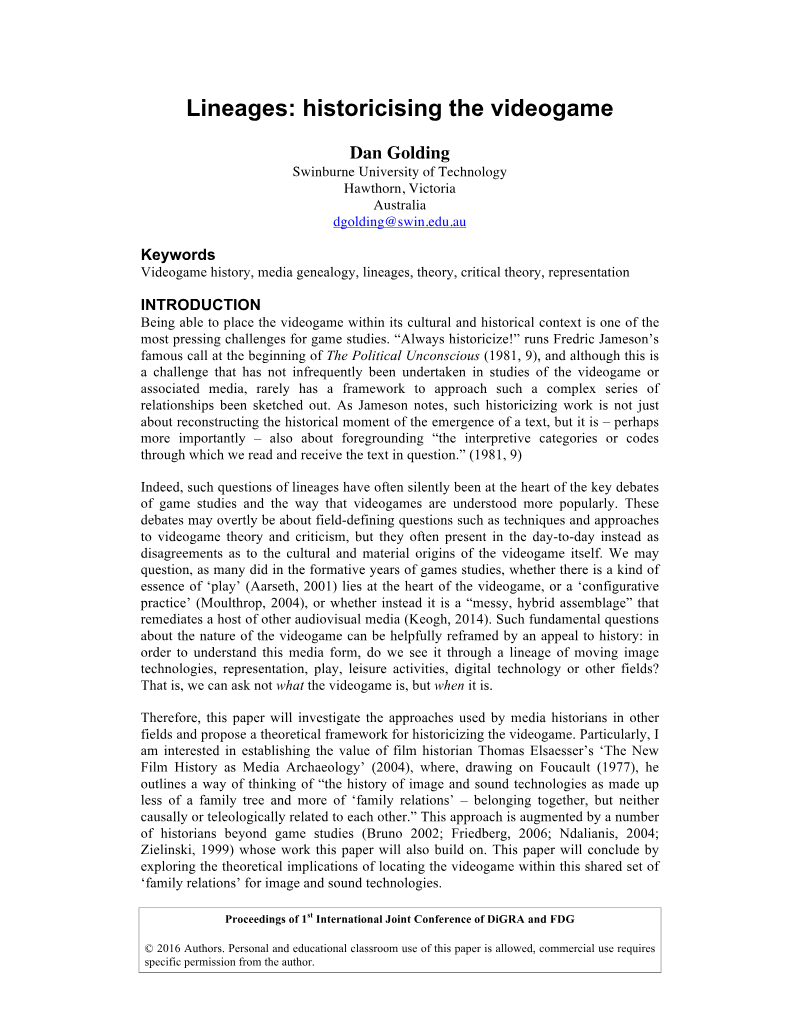
Lineages: Historicising the Videogame
This paper argues that game studies must historicise the videogame by situating it within cultural and material contexts, rather than only asking what the videogame essentially is.
- The paper argues that game studies should historicise the videogame by situating it within cultural and material contexts, asking when it emerged and through which lineages it should be understood, rather than only asking what it essentially is.
- Its central aim is to propose a theoretical framework for historicising the videogame, built by adapting methods from media historians in other fields.
- The framework draws on Thomas Elsaesser's idea that image and sound technologies form 'family relations' rather than a single family tree, with technologies grouped together without being causally or teleologically linked.

On Becoming "Like eSports": Twitch as a Platform for the Speedrunning Community
This extended abstract examines how the speedrunning community relates to Twitch as a platform, asking what "Twitch-worthy" gameplay looks like.
- Twitch, acquired by Amazon in 2014, has changed how gameplay is shared because streamers broadcast uncut and live rather than curating highlight reels as on YouTube.
- The paper asks what 'Twitch-worthy' speedrunning gameplay looks like, building on Postigo's concept of 'YouTube-worthy' play.
- Speedrunning (completing games as fast as possible without cheats) has migrated from video archives such as SpeedDemosArchive and YouTube to Twitch, where speedrunning streams now make up a notable share of creators and viewers.

Realism and the Everyday in Digital Games
This paper refines Alexander Galloway's theory of social realism in digital games by emphasizing the critical role of representational modes and the concept of the everyday.
- Martin revises Alexander Galloway's theory of 'social realism' in digital games, arguing that realism's critical potential emerges only when the mode of representation, the everyday, and Lukács's concept of the social totality are considered together.
- The paper critiques Galloway's account for neglecting representation, conflating realism with critique in general, and relying on a 'congruence requirement' that ties the everyday life depicted in a game to players' own everyday experience.
- Drawing on Lukács's defence of literary realism and Yuri Lotman's view of everyday life as a boundary zone where personal habits collide with dominant codes, Martin frames realism as a means of linking individual lives to the totality of social relations.
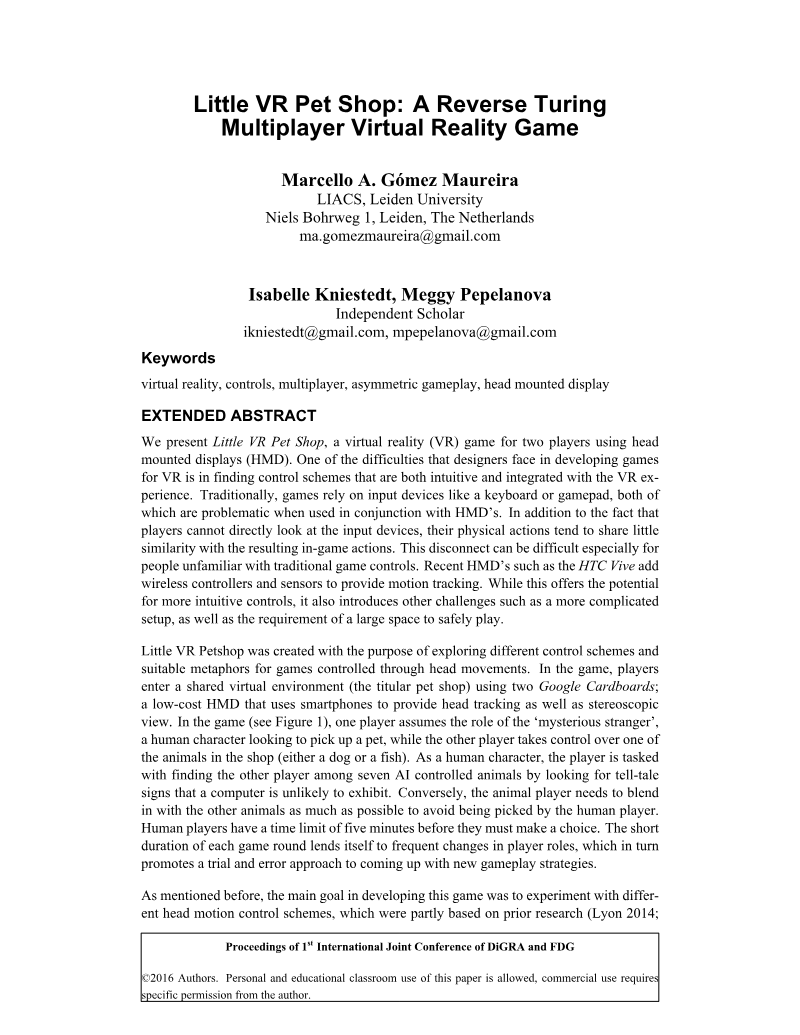
Little VR Pet Shop: A Reverse Turing Multiplayer Virtual Reality Game
The document presents "Little VR Pet Shop," a multiplayer virtual reality game designed to explore intuitive control schemes and suitable metaphors for games controlled through head movements, particularly for low-cost head-mounted displays (HMDs) like Google Cardboard.
- Little VR Pet Shop is a two-player VR game built for low-cost Google Cardboard headsets that use smartphones for head tracking, with one human player identifying the real human among seven AI-controlled animals while a disguised dog or fish player tries to avoid selection within five minutes.
- The game tests three head-driven control schemes: the human walks by gazing at ground markers and pressing the headset trigger, the dog tilts its head toward the ground and looks in its travel direction to mimic sniffing, and the fish swims toward the gaze direction through slow sideways head shaking.
- Across two user-testing iterations with 68 participants, the human control scheme was rated the most comfortable and accurate, while the fish scheme was rated the most entertaining even though fish players often felt insufficiently in control of their movement.
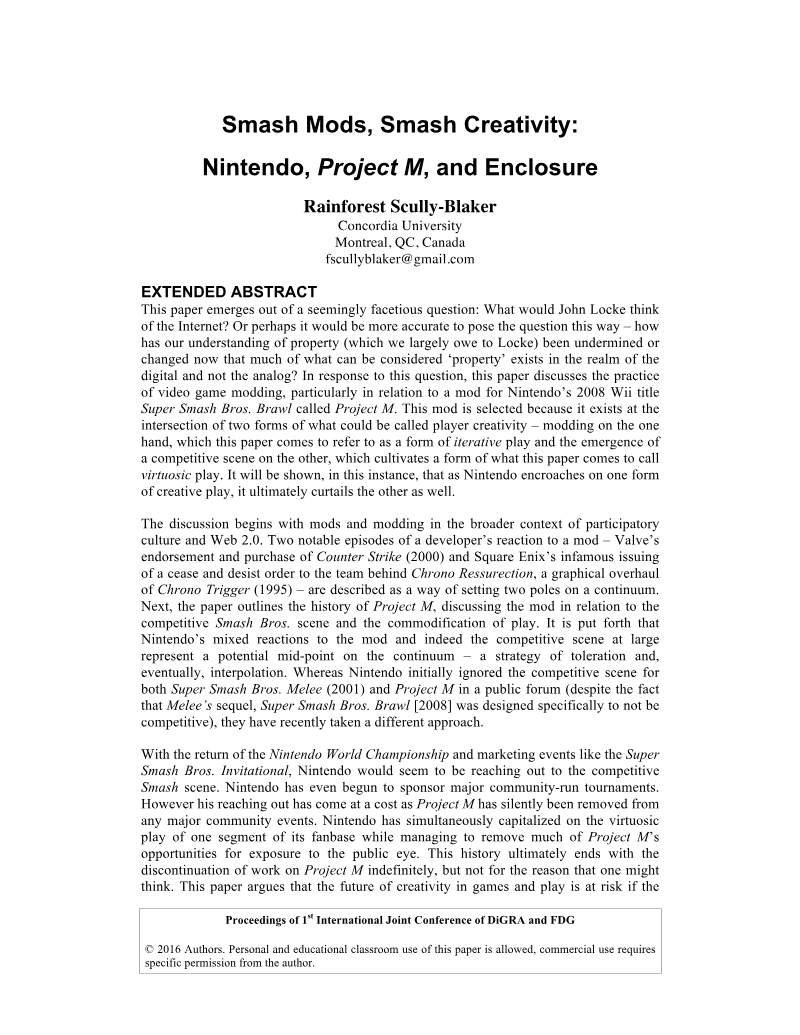
Smash Mods, Smash Creativity: Nintendo, Project M, and Enclosure
This paper examines the evolving concept of property in the digital age, specifically through the lens of video game modding and its interaction with intellectual property rights.
- The paper argues that creative play in games takes two linked forms, iterative play through modding and virtuosic play through a competitive scene, and that Nintendo's enclosure of the first ultimately curtails the second.
- Project M, a community modification of Super Smash Bros. Brawl (2008) for the Wii, is used as the central case study of how player-made content interacts with corporate control of games.
- Nintendo initially ignored the competitive community around Melee and Project M, even though Brawl was designed to be non-competitive, before shifting toward engagement.
Do you work at DiGRA? Get a free report of how these documents are read and cited here.