
DiGRA
The Digital Games Research Association: the international association of academics and professionals who study digital games. Its Digital Library holds the proceedings of the DiGRA conferences since 2002.
Documents
Ludification of Work or Labourisation of Play: On Work-Play Interferences
The document explores the increasingly blurred boundaries between work and play, moving beyond traditional definitions that separate the two as distinct, often opposing, activities.
- The paper argues that existing concepts like gamification and ludification capture only one direction of a two-way relationship, and proposes 'laborization' as the counterpart in which work practices permeate play.
- It introduces 'work/play interference,' borrowed from the physics of superposed waves, to describe the transformative and impure character of contemporary practices where play and work overlay rather than remain separate.
- The analysis is conceptual and theoretical, drawing on game studies, media theory, and philosophy of play, rather than on original empirical data.
Creeds, Souls & Worlds of Worship: Players' Appropriations of Religious Worldviews through Game Forums
This paper investigates how players appropriate religious elements within video games in relation to their personal worldviews and how these appropriations are discussed on internet forums.
- The study analyzes 92 recent forum threads with religious content, drawn from up to twenty threads on each of five platforms: GameFAQs, Gamespot, NeoGAF, IGN, and gaming-related subreddits.
- Using grounded theory coding and Stuart Hall's active audience decoding theory, the researchers identified three forms of player engagement with game religiosity: debunking, debating, and confronting.
- Debunkers minimized religious content's significance, with religious players separating faith from fiction and non-religious players equating angels and demons with trolls and pixies.
Much Ado About Nothing? Analysis of the Polish Internet Discourse About "Hatred"
The analysis examines the Polish internet discourse surrounding the video game "Hatred" following its initial trailer release, focusing on how transgressive content influences and reshapes the boundaries of gaming discourse.
- The study argues that moral commotion around transgressive content, here the Polish reception of the trailer for the isometric shooter "Hatred" by Destructive Creations, acts as a catalyst for renegotiating interpretive frameworks and shifting the boundaries of Polish gaming discourse.
- The analysis draws on Pierre Bourdieu's theory of cultural economy and taste together with Aaron Julius's concept of transgressive content, treating transgression as either a tool that subverts or one that reinforces a social group's taste.
- The research used computer-aided content analysis and critical discourse analysis, conducted in September and October 2015, covering material published between October 2014 and September 2015.
The Politics of #Gamergate's Avatar
Vivian James, the mascot of the Gamergate movement, is examined here as a politically charged avatar that serves as a rallying point and a defensive shield for a decentralised harassment campaign.
- The paper is a qualitative, text- and image-based study of online artifacts, fan art, cosplay, and secondary literature rather than survey data, and it frames Gamergate as a decentralised harassment campaign disguised as a critique of unethical games journalism.
- The authors argue that Vivian James, Gamergate's avatar, presents the movement as inclusive and socially aware while her design and rhetoric reinforce hypermasculine norms.
- Vivian James is read as a policing mechanism for women's and feminine gamer identities, with her masculine performativity exposing the sexist assumptions underlying the movement.
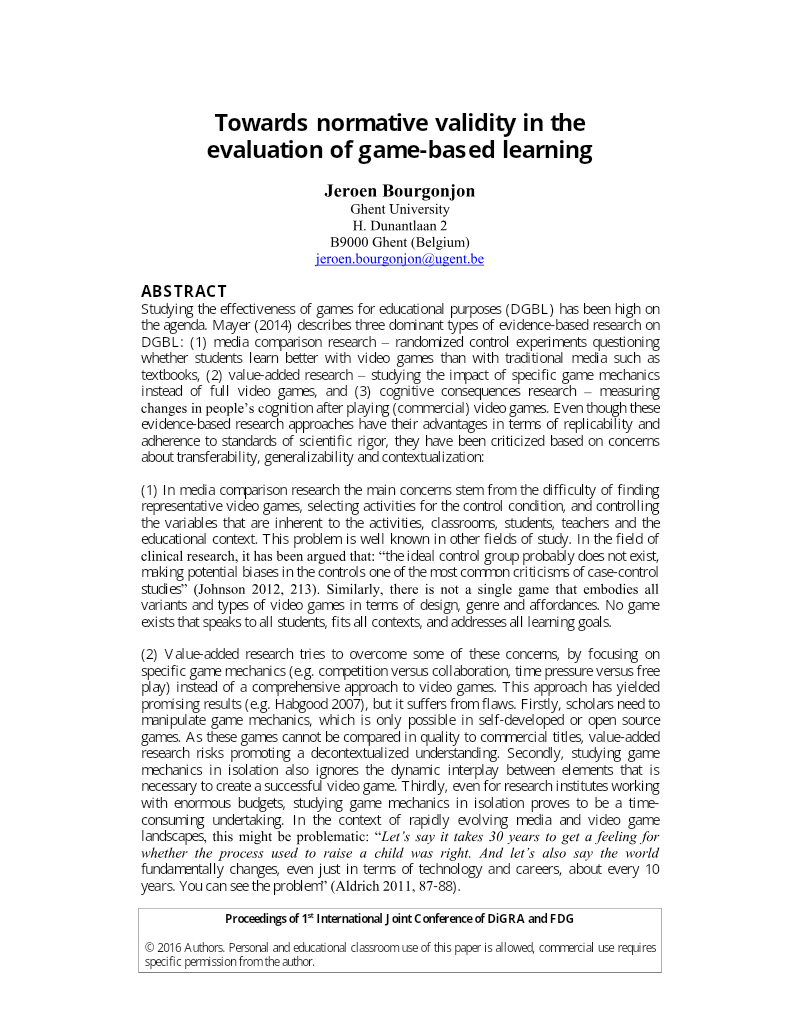
Towards Normative Validity in the Evaluation of Game-Based Learning
This paper argues that evidence-based research on digital game-based learning (DGBL), while methodologically rigorous, is insufficient on its own for guiding educational decisions, and that researchers must also attend to normative validity, asking whether they are measuring what is actually valued in education.
- Evidence-based DGBL research, though methodologically rigorous, is insufficient on its own to guide educational decisions; researchers must also assess normative validity, i.e., whether they measure what education actually values.
- Media comparison studies struggle to select representative games, define appropriate control conditions, and control for the many contextual variables present in classrooms.
- Value-added studies isolate specific game mechanics but often rely on self-developed games of lower quality than commercial titles, ignore interactions among design elements, and are slow relative to fast-changing technology.
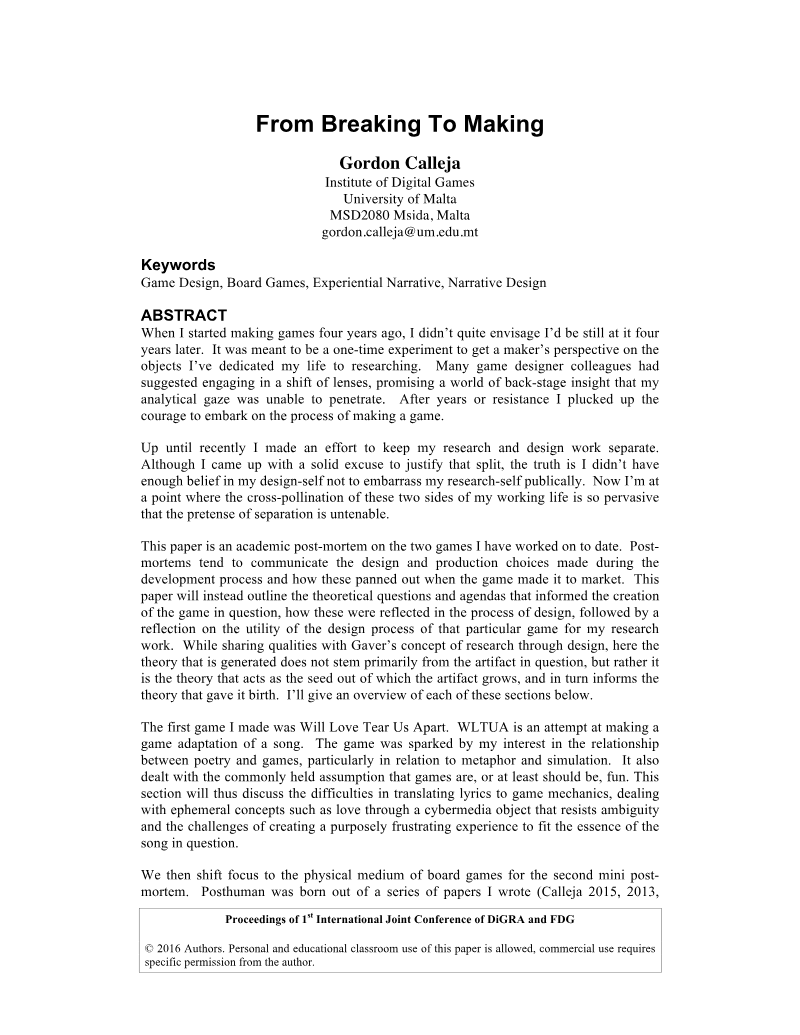
From Breaking to Making
The document presents an academic post-mortem on two game design projects, "Will Love Tear Us Apart" (WLTUA) and "Posthuman," undertaken by a researcher to gain a maker's perspective on games.
- The paper is an academic reflection by Gordon Calleja of the University of Malta on two games he designed, tracing how his theoretical research shaped their creation and how making them informed his scholarship, rather than cataloguing production decisions or market outcomes.
- Its central thesis is that theory seeds the artifact and the artifact then refines the theory, a relationship the author distinguishes from Gaver's research through design.
- The first project, Will Love Tear Us Apart, adapts a song into a game, motivated by the relationship between poetry and games (especially metaphor and simulation) and the assumption that games should be fun, with difficulty centered on translating lyrics into mechanics and representing ephemeral concepts like love.
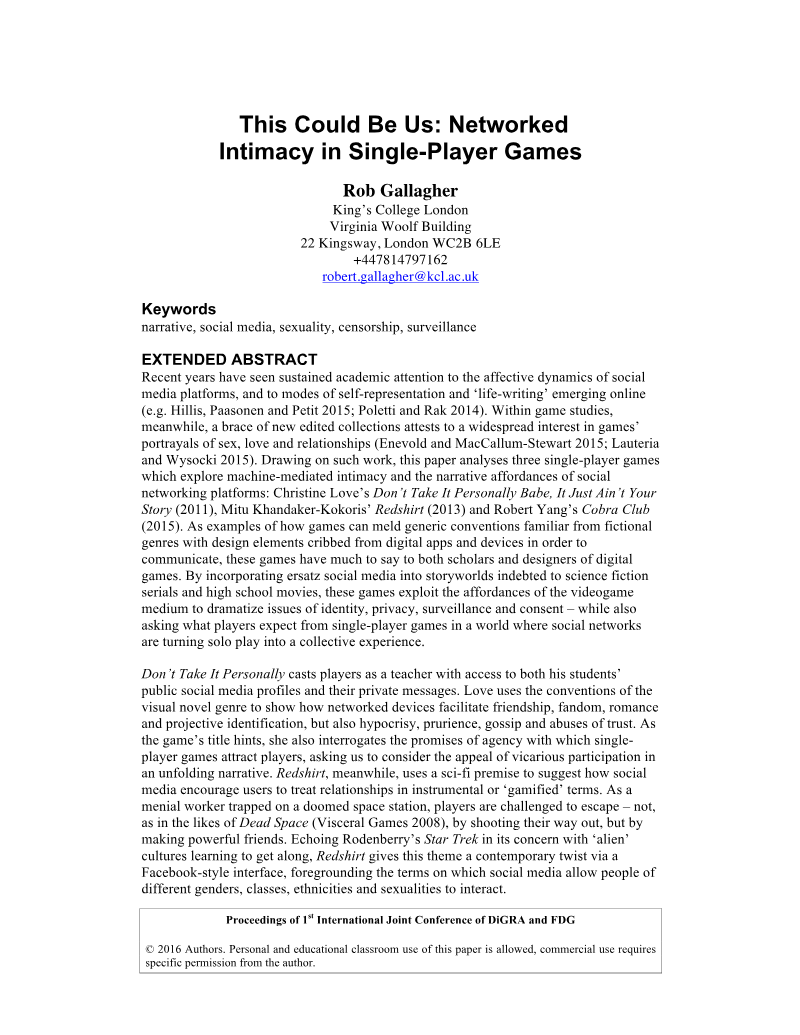
This Could Be Us: Networked Intimacy in Single-Player Games
This extended abstract argues that single-player games remain relevant in a networked era because they can explore the complexities of online intimacy in ways multiplayer and social games seem unwilling or unable to.
- The paper argues that three single-player games—Christine Love's Don't Take It Personally Babe, It Just Ain't Your Story (2011), Mitu Khandaker-Kokoris' Redshirt (2013), and Robert Yang's Cobra Club (2015)—use the interface and narrative conventions of digital platforms to explore identity, privacy, surveillance, and consent.
- Don't Take It Personally Babe frames the player as a teacher with access to students' public and private online lives, exposing how networked devices enable warmth alongside gossip, hypocrisy, and abuse of trust, while questioning the agency that single-player games promise.
- Redshirt uses a Facebook-style interface on a doomed space station, where escape depends on cultivating powerful contacts, critiquing the instrumental, gamified treatment of relationships on social platforms.
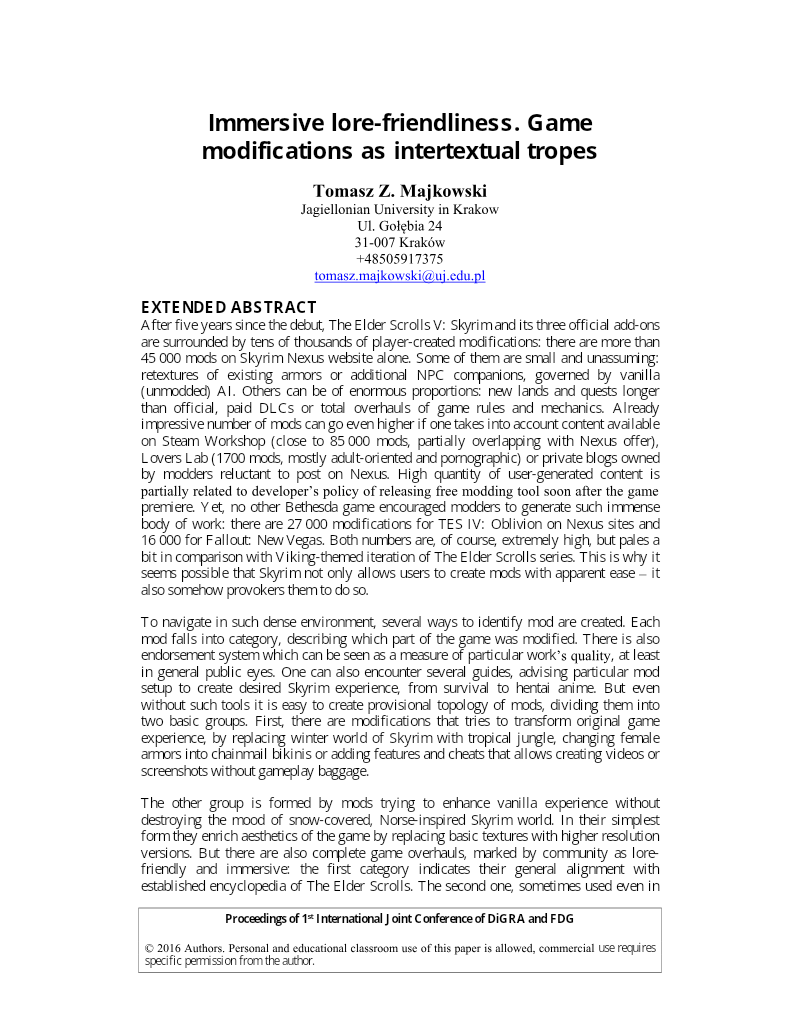
Immersive Lore-Friendliness: Game Modifications as Intertextual Tropes
The document explores the phenomenon of "lore-friendly" and "immersive" game modifications (mods) in The Elder Scrolls V: Skyrim, analyzing them as intertextual tropes that address perceived dissonances within the vanilla game experience.
- The paper frames lore-friendly, immersive Skyrim mods as intertextual interpretations: modders identify dissonance between the game's aesthetics, narrative, and mechanics and add or alter content to resolve it, drawing on Michael Riffaterre's concept of the interpretant.
- Playing Skyrim without these mods is treated as feeling unfinished, since the intertext (earlier Elder Scrolls lore, game conventions, gamer expectations, and medieval Scandinavian knowledge) is absent from the play experience.
- The Skyrim Nexus hosts more than 45,000 mods and the Steam Workshop roughly 85,000 items, with partial overlap, compared with about 27,000 Nexus mods for Oblivion and about 16,000 for Fallout: New Vegas.
Paratextuality 2.0: Updating Genette's Framework for Complex Game Systems
Since Consalvo's 2007 introduction of the term, game studies has labeled nearly every video game epiphenomenon a "paratext," including guides, manuals, patch notes, trailers, demos, developer diaries, easter eggs, and online discussions.
- The paper argues that 'paratext,' borrowed from Gérard Genette and widely applied in game studies since Consalvo's 2007 introduction, has lost analytical precision because it now covers nearly every video game ancillary, from manuals and patch notes to trailers and online discussions.
- The core problem identified is Genette's linking of a typology of textual relationships to a typology of texts, which causes ancillary materials to be treated as subordinate merely because of their relationship to a main work, a hierarchy the author considers anachronistic given the prominence of backstories and transmedia storytelling in contemporary games.
- The author proposes abandoning the term 'paratext' and instead analyzing paratextuality as a relationship, specifying the sources of textual transcendence in the links connecting texts to social and historical context rather than relying on a vague notion of ancillary status.
Developing the Developers: Education, Creativity and the Gaming Habitus
This research investigates the contested meaning of creativity within digital games higher education, focusing on the development of a "gaming habitus" among students and staff.
- The study identifies three core creative tensions in games higher education: preparing students for industry employment versus encouraging artistic exploration, the field's uncertain academic status as a vocational discipline, and the influence of the 'gaming habitus' itself.
- Students increasingly narrow their creative ambitions as graduation approaches, developing strategies to keep their visions within commercial limits.
- Favouring independent over corporate work may be a way for students and staff to assert integrity against market influence, raising broader questions about universities' intellectual credibility.
I Cried to Dream Again: Discovery and Meaning-Making in Walking Simulators
The document "I Cried to Dream Again: Discovery and Meaning-Making in Walking Simulators" argues for a re-evaluation of walking simulators as complex, self-contained game worlds that engage players through experiential aesthetics and exploration mechanics.
- The paper argues that walking simulators such as Dear Esther (The Chinese Room, 2012) and Proteus (Ed Key and David Kanaga, 2013) should be recognised as complex, self-contained game worlds rather than dismissed as minimal experiences.
- Its central claim is that the peaceful, single-player, first-person, non-competitive gameplay enabled by the island setting heightens affective, narrative, spatial, and kinaesthetic involvement for players.
- The island works as a practical design tool: its tension between desirability and inaccessibility limits the game world while drawing on players' cultural associations that shape expectations and reception.
Changing Roles in Gaming: Twitch and New Gaming Audiences
The document explores the evolving nature of audience engagement with video games, specifically focusing on the phenomenon of live game streaming platforms like Twitch.tv.
- Live game streaming on platforms such as Twitch lets audiences engage with games without the moment-to-moment participation traditionally associated with play, with viewer roles spanning from spectator to active influencer.
- Chat-based audience input can influence gameplay, as shown by experiments like "Twitch Plays" titles, Choice Chamber, and City Stream, which turn single-player experiences into social ones through collective voting or control.
- The authors propose that audience input could supplement game AI, with human judgment filling gaps where procedural generation falls short in variety or contextual awareness.
Do you work at DiGRA? Get a free report of how these documents are read and cited here.