
Board Game Studies Journal
Open-access peer-reviewed journal on the history and study of board games, published with Sciendo (De Gruyter).
Documents
The Crux of the Cruciform: Retracing the Early History of Chaupar and Pachisi
"The Crux of the Cruciform" argues that the widespread belief in the ancient origins of South Asian cruciform games such as caupaṛ and paccīsī is largely unsupported by the surviving evidence.
- The widely held belief in ancient origins for South Asian cruciform games like caupaṛ and paccīsī is largely unsupported; the earliest secure attestations date only to the 15th–16th centuries, most notably Abul Fazl's Ain-i-Akbari (c. 1590).
- Claims of greater antiquity typically stem from retroprojection, misreading of sources, or nationalist narratives, and most purported early evidence (Vijayanagara graffiti, Ellora sculpture, Mesoamerican and Central Asian links) is either misinterpreted or unsubstantiated.
- The Mahābhārata's dice episode was retrospectively reimagined as caupaṛ in later commentaries and Mughal illustrations such as the Razmnāma (c. 1586), though the original text describes a different dice game.
Some Misconceptions About Ancient Roman Games
Ulrich Schädler's examination of popular claims about ancient Roman and Egyptian games argues that a number of widely repeated assertions lack reliable evidentiary support.
- Ulrich Schädler's analysis argues that many widely repeated claims about ancient Roman and Egyptian games lack reliable evidentiary support, often because modern writers project conclusions onto sources that do not bear them out.
- The Sethos I temple carvings, long cited as proof that Mancala and Nine Men's Morris were played in Pharaonic Egypt around the fourteenth century BCE, cannot be securely dated, and many are Coptic or Islamic in origin, undermining their use as early evidence.
- The special "dux" piece attributed to the Roman game ludus latrunculorum and the Stanway "doctor's game" with an eight-by-twelve grid and an extra piece per side both rest on conjecture that conflicts with surviving ancient testimony.
A Game on the Edge: An Attempt to Unravel the Gordian Knot of Tafl Games
The tafl family of board games, once common across Viking-age Scandinavia, the British Isles, and parts of northern Europe, has long suffered from confusion over its names, rules, and history.
- The tafl family, once widespread across Viking-age Scandinavia, the British Isles, and northern Europe, suffers from confusion over its names, rules, and history, much of which stems from interpretation and translation of the sources rather than the sources themselves.
- Old English 'tæfl' may have referred to as many as seven distinct games, yet scholarship has often flattened them into one category or rendered them as 'chess,' obscuring real differences between them.
- Archaeological finds of 7x7 peg boards and 6x6 stone boards from Ireland and Scotland, dated roughly to the 7th–12th centuries, point to a shared design tradition linking these games to the Viking-associated hnefatafl.
Debunking the Diffusion of Senet
Walter Crist's "Debunking the Diffusion of Senet" examines and corrects persistent scholarly and popular claims about senet, the ancient Egyptian board game often presented as the oldest known board game and as an ancestor of later games.
- Senet cannot be demonstrated to be the oldest board game: the Ballas mehen board, dating to the late fourth millennium BCE, predates the earliest securely dated senet, which appears in First Dynasty contexts, while predynastic evidence from el-Mahasna remains ambiguous.
- Many scholarly and popular claims about senet rest on "factoids"—assertions repeated until they are taken as fact—rather than on archaeological evidence, and the paper aims to correct them.
- Senet's presence in the Levant is attributed to periods of Egyptian activity rather than indigenous origin, whereas its adoption on Cyprus reflects local indigenization.
Misconceptions in the History of Mancala Games: Antiquity and Ubiquity
The paper argues that mancala games do not form a single historically related family and that their antiquity cannot yet be confirmed by archaeological or historical evidence.
- Mancala games do not form a single historically related family; resemblance in board form alone is an unreliable basis for claiming shared origins, and historical links are persuasive only where specific rules, practices, and appearances coincide.
- Antiquity of mancala cannot yet be confirmed by archaeological or historical evidence, and the surviving record supports separate histories for distinct games with ages reaching back several centuries rather than millennia.
- Early claims such as Eritrean boards linked to the 6th and 7th centuries CE are judged speculative because they lack supporting evidence like depictions of play or accompanying games.
Simulating Saratoga: How Saratoga-Themed Board Games Function as Experiential Historiography
Maurice Suckling's study argues that Saratoga-themed board games, nine or ten titles published between 1974 and 2019, function as experiential historiography: even when designed primarily for entertainment, they embody and communicate interpretive positions about the 1777 campaign and its wider significance.
- Maurice Suckling argues that nine or ten Saratoga-themed board games published between 1974 and 2019 act as experiential historiography, embedding interpretive positions on the 1777 campaign even when designed primarily for entertainment.
- The campaign is framed as consequential for drawing France, Spain, and the Dutch into the war and exposing British strategic strain, though historians such as Corbett have disputed whether it was a true turning point.
- Design mechanisms carry historiographical weight: block design, activation points, random events, initiative rules, and fog-of-war modeling determine whether outcomes appear driven by individual commanders or by structural forces.
Remembering Yugoslavia: Board Game Monopoly and Cultural Memory
Zala Pavšič's study examines the 1986 Yugoslav edition of Monopoly, published by Kocka, as a site of cultural memory, arguing that the meaning of a board game lies as much in how its players receive it as in its physical design.
- The 1986 Yugoslav edition of Monopoly, published by Kocka, is treated as a site of cultural memory, with its meaning shaped as much by how players receive it as by its physical design.
- Claims that the board encoded Slovenian superiority were largely retrospective projections of later nationalist stereotypes rather than explicit political messages in the original game.
- The board's field ordering, running roughly south to north and ascending in value, reads as a neutral geographic and economic arrangement to many players.
Wrested from Oblivion: General Ludwik Mierosławski's Strategy Game Rediscovered
Ludwik Mierosławski, a Polish insurgent and military theorist, devised a simplified strategy game while imprisoned in Berlin after the failed 1846 Greater Poland Uprising.
- Ludwik Mierosławski, a Polish insurgent imprisoned in Berlin after the failed 1846 Greater Poland Uprising, devised a simplified strategy game that distilled earlier European war-games such as those of Hellwig, Venturini, and Reisswitz, and likely adapted J. A. Messmer's 1819 "Het strategisch spel."
- The game differed from the more elaborate Prussian Kriegsspiel tradition: it used an abstract triangular grid modeled on the 1849 Hungarian War of Independence and a superiority-based combat system with no dice.
- The game was first drafted in 1847 and revised repeatedly; the 1847 and 1849 editions drew little attention, while the 1850 and 1857 editions, published in Paris and promoted via the Dumaine bookstore and newspaper ads, earned favorable notices in French military journals.
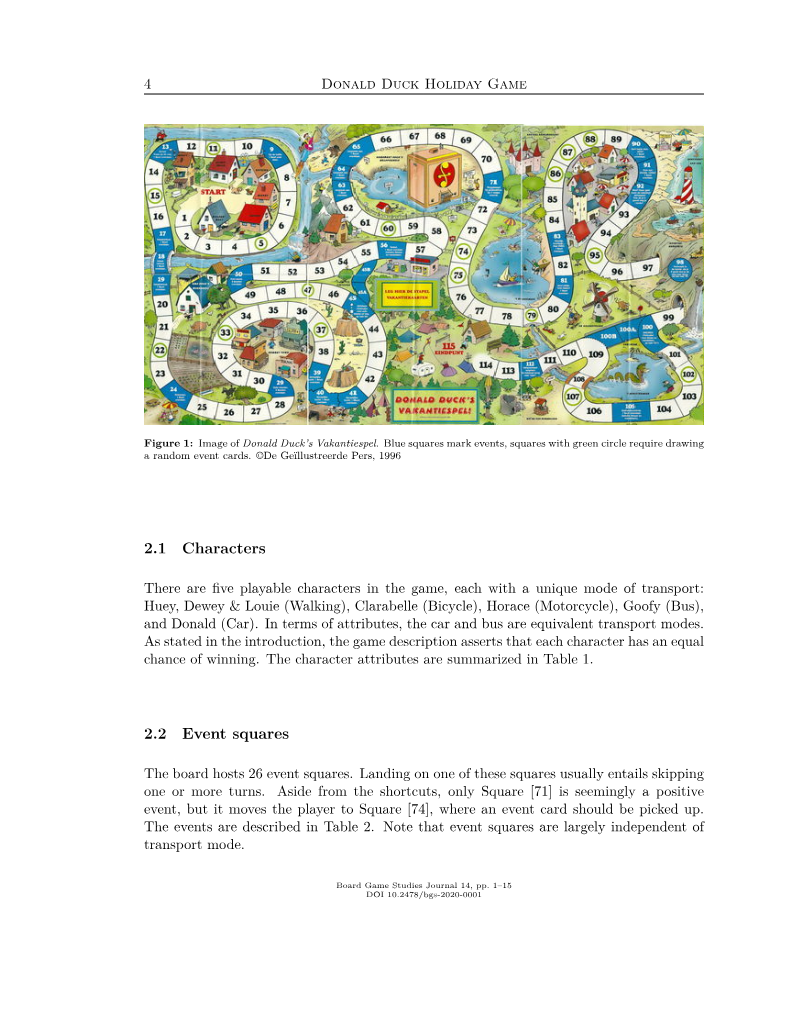
Donald Duck Holiday Game: A Numerical Analysis of a Game of the Goose Role-Playing Variant
The paper examines the 1996 Donald Duck Holiday Game, a role-playing variant of the historical Game of the Goose, using a Monte Carlo simulation of 10,000 games for each player count from two to five.
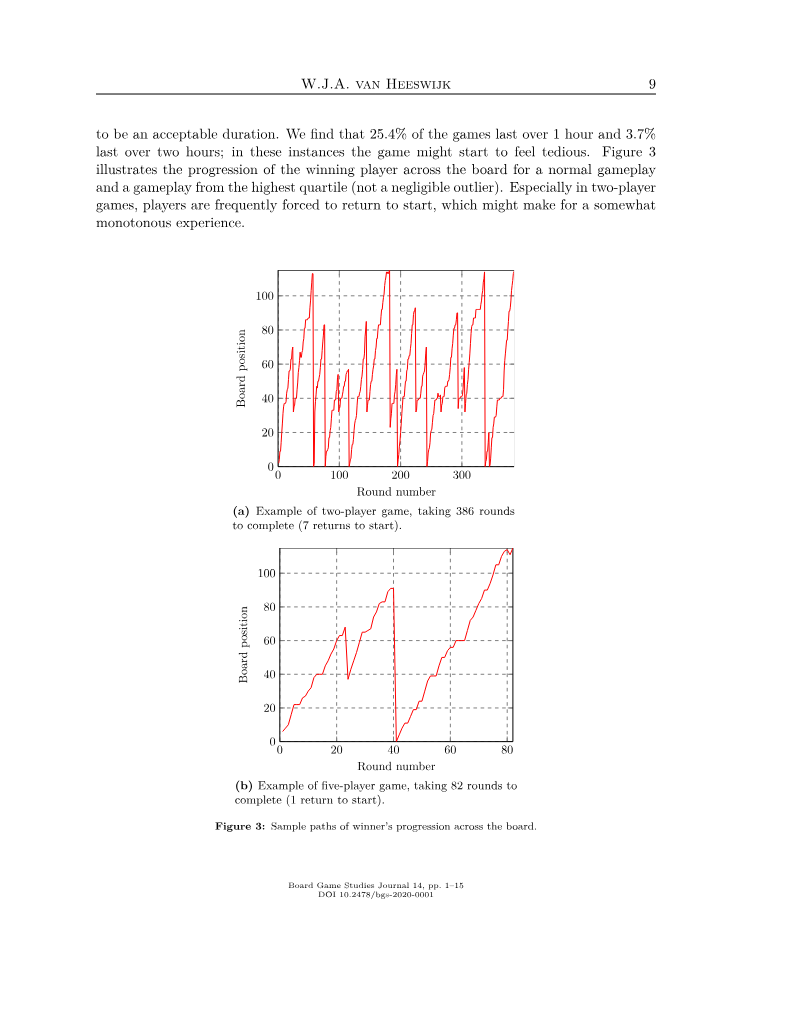
- A Monte Carlo simulation of 10,000 games per player count (two to five players) found average game lengths ranging from 69 rounds with five players to 123 rounds with two, with lengthy outliers reaching several hundred rounds.
- Over 25% of simulated games exceed one hour of estimated human play, making duration the study's most significant concern for a game intended as a family activity.
- Character balance is the clearest deficiency: the bus and car characters (Goofy and Donald) win roughly 30% more often than the others, mainly because walking, bicycle, and motorcycle characters are disproportionately hurt by predominantly negative random event cards.
The Sellers of Catan: The Impact of the Settlers of Catan on the United States Leisure and Business Landscape, 1995-2019
Settlers of Catan, released in the United States in 1995 after winning Germany's Spiel des Jahres, is examined here as a pivotal product in the transition of hobby board games into mainstream American leisure and retail culture between 1995 and 2019.
- Settlers of Catan, released in the US in 1995 after winning Germany's Spiel des Jahres, became a gateway game that bridged hobby board games and mainstream American leisure between 1995 and 2019.
- By the early 2010s Catan was culturally ubiquitous through big-box retail expansion and pop-culture appearances, yet it lost standing among hobby gamers who favor newer designs and mechanics.
- Catan's franchise expanded into Star Trek Catan, A Game of Thrones Catan, scenario and children's editions, and mobile apps, with core expansions totaling roughly $383, a price point that reduced the publisher's incentive to alter the core design.
Turkish Great Chess and Chinese Whispers: Misadventures of a Chess Variant
The document examines Turkish Great Chess (šaṭranǧ-i kabīr), a 52-piece Ottoman chess variant, and how its rules became distorted as they passed through Western sources.
- The earliest reliable account of Turkish Great Chess is an 1806 Turkish text (printed 1805–6, reviewed in 1808), which the authors argue is sufficient to refute errors that accumulated in later European references.
- Western descriptions of the game drifted through German accounts from 1808 onward and secondary works by van der Linde (1874–1881), Murray (1913), Gollon (1968), and Cazaux and Knowlton (2017), each adding unsupported details about board size, piece movement, and setup.
- A plausible cause of the distortion is the misreading of the "elephant" as the rook, a confusion that spread through subsequent texts.
Board Games Before Ur?
Thierry Depaulis's article in the Board Game Studies Journal (vol.
- Depaulis argues that the perforated, cupmarked Neolithic stone slabs from Levantine sites such as 'Ain Ghazal, Beidha and Wadi Tbeik are more plausibly fireboards used with drill sticks, not early gameboards, a conclusion supported by a 2012 study of Kfar HaHoresh artifacts.
- The article contends that the earliest documented board games are race games appearing in the archaeological record from roughly 3250 BCE, and that Neolithic societies lacked the arithmetical and abstract mapping capacities needed to design such games.
- Depaulis critiques Gary Rollefson and St. John Simpson for relying on comparisons with mancala, which the proposed Neolithic examples do not closely resemble, and notes that the gap of more than six millennia before the known games is unbridged by evidence.