1 free read left. Create a free account for unlimited reading + AI research.
Create free accountArticle Board Game Studies Journal
1 free read left. Create a free account for unlimited reading + AI research.
Create free accountArticleBoard Game Studies Journal
Thierry Depaulis examines whether any board games predate the Royal Game of Ur, dated to c. 2500 BCE.
Thierry Depaulis's article in the Board Game Studies Journal (vol. 14, 2020) examines whether any board games predate the Royal Game of Ur (c. 2500 BCE), and in particular whether Neolithic perforated stone slabs from the Levant can be classed as early gameboards. The author's thesis is that they cannot: the slabs with cupmarks, found at sites such as 'Ain Ghazal, Beidha, Wadi Tbeik, Wadi Abu Tulayaha and Ghwair I, are more plausibly fireboards used with drill sticks, a conclusion supported by a 2012 study of Kfar HaHoresh artifacts. The author also argues that the earliest documented board games were race games, which appear in the archaeological record from roughly 3250 BCE, and that Neolithic societies lacked the arithmetical and abstract mapping capacities needed to design such games.
The article reviews the chronology of ancient games, including senet, mehen and the twenty-squares game attested in Egypt, Mesopotamia and the Indus civilization, and classifies board games by mechanics, with race games (unilinear tracks played with dice) dominating the record until the early Common Era. Depaulis critiques the work of Gary Rollefson and St. John Simpson, noting that their identifications rely on comparisons with mancala, a family of games for which the proposed Neolithic examples offer no real parallel, and that the proposed time gap of more than six millennia is unbridged by evidence.
The author's most credible alternative candidate is a terracotta board from Tell Majnuna, Syria, dated to c. 3600 BCE, which may be a genuine early gameboard, though its interpretation as a calculator remains possible. Drawing on cognitive-archaeology frameworks by Merlin Donald and Peter Damerow, the article proposes that dice games preceded board games, and that formal board games emerged no earlier than about 3500 BCE. The scope is primarily Near Eastern and Egyptian archaeology, with the conclusions presented as hypotheses pending further excavation.
Board Game Studies Journal · 2025
Board Game Studies Journal · 2025
Board Game Studies Journal · 2025
Board Game Studies Journal · 2025
Board Game Studies Journal · 2025
Board Game Studies Journal · 2025
Board Game Studies Journal · 2024
Board Game Studies Journal · 2024
Board Game Studies Journal · 2024
Board Game Studies Journal · 2024
Board Game Studies Journal · 2024
Board Game Studies Journal · 2023



European Conference on Games Based Learning (ECGBL) · 2026
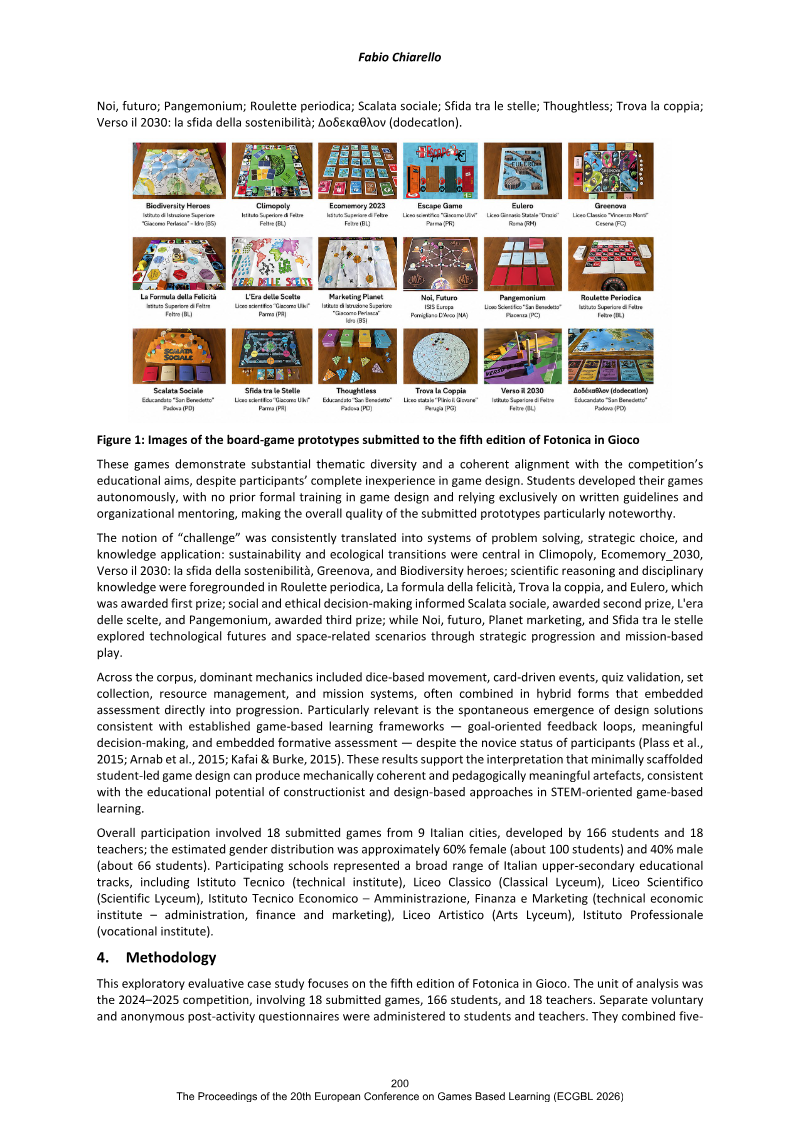
European Conference on Games Based Learning (ECGBL) · 2026



European Conference on Games Based Learning (ECGBL) · 2026






Comments