1 free read left. Create a free account for unlimited reading + AI research.
Create free accountArticle Board Game Studies Journal
1 free read left. Create a free account for unlimited reading + AI research.
Create free accountArticleBoard Game Studies Journal
Mancala boards share a simple, abstract form of two or four rows of holes and seed-like counters. The paper argues that this resemblance alone is an unreliable basis for claiming shared origins.
The paper argues that mancala games do not form a single historically related family and that their antiquity cannot yet be confirmed by archaeological or historical evidence. Although mancala boards share a simple, abstract form of two or four rows of holes and seed-like counters, the author contends that resemblance alone is an unreliable basis for claiming shared origins. Historical links are persuasive only where specific rule sets, practices, and appearances coincide, as with the transatlantic connections between West Africa and the Caribbean, the Swahili trade networks that spread bao, and the Maldivian ohvalhu, which can be dated to before 1153 CE. Across the wider world, the surviving evidence supports separate histories for distinct mancala games, with ages reaching back several centuries but not yet millennia.
The argument rests heavily on critical reassessment of the archaeological record. Early claims, such as the Eritrean boards linked to the sixth and seventh centuries CE, are judged speculative because they lack supporting evidence like depictions of play or accompanying games. Many Roman-era and Egyptian holed boards previously identified as mancala have instead been reclassified as the game of five lines, the Near Eastern game of ṭāb, or marble-lane features. The paper also challenges the popular notion of an Egyptian origin, noting that graffiti boards on monuments are not reliably tied to the builders or the period of construction, and that no visual or literary Egyptian evidence attests to mancala play.
The study also addresses the broader question of whether complex societies produce board games. Early anthropological claims by Roberts, Arth, and Bush (1959) that simple societies avoid strategic games were undermined in part by the widespread presence of mancala among pastoral and hunter-gatherer groups, and by museum collections that revealed biases in the ethnographic dataset. The author concludes that the link between state formation and the invention of board games is largely an artifact of archaeology's focus on monumental and elite contexts, since board games appear both before and outside early states, and such evidence is likely underreported.
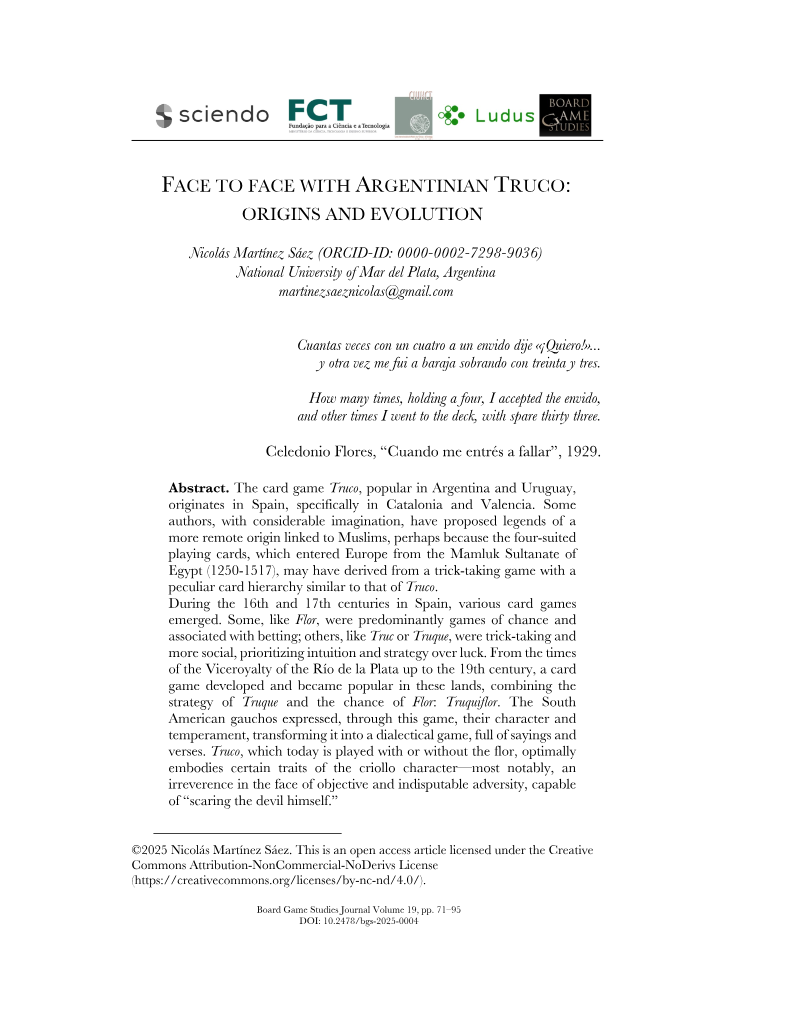
Board Game Studies Journal · 2025
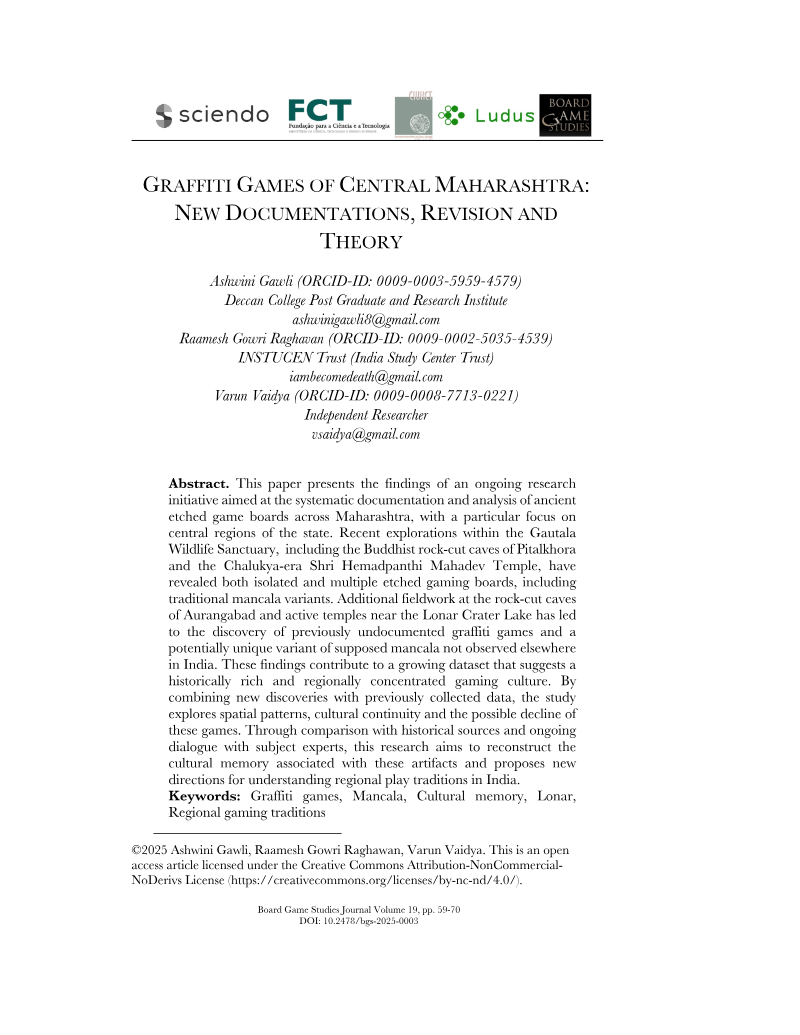
Board Game Studies Journal · 2025
Board Game Studies Journal · 2025
Board Game Studies Journal · 2025
Board Game Studies Journal · 2025
Board Game Studies Journal · 2025
Board Game Studies Journal · 2024
Board Game Studies Journal · 2024
Board Game Studies Journal · 2024
Board Game Studies Journal · 2024
Board Game Studies Journal · 2024
Board Game Studies Journal · 2023
European Conference on Games Based Learning (ECGBL) · 2026



European Conference on Games Based Learning (ECGBL) · 2026



European Conference on Games Based Learning (ECGBL) · 2026