1 free read left. Create a free account for unlimited reading + AI research.
Create free accountArticle Board Game Studies Journal
1 free read left. Create a free account for unlimited reading + AI research.
Create free accountArticleBoard Game Studies Journal
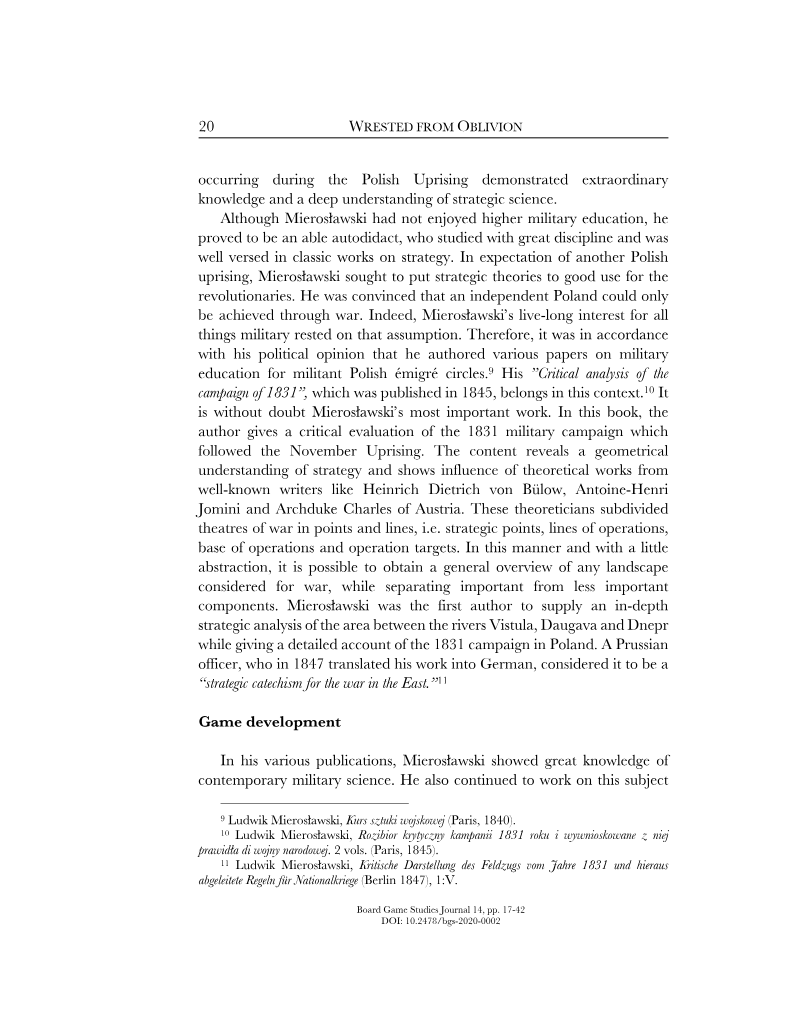
Ludwik Mierosławski created the game while imprisoned in Berlin after the failed 1846 Greater Poland Uprising. It distilled earlier European war-games.
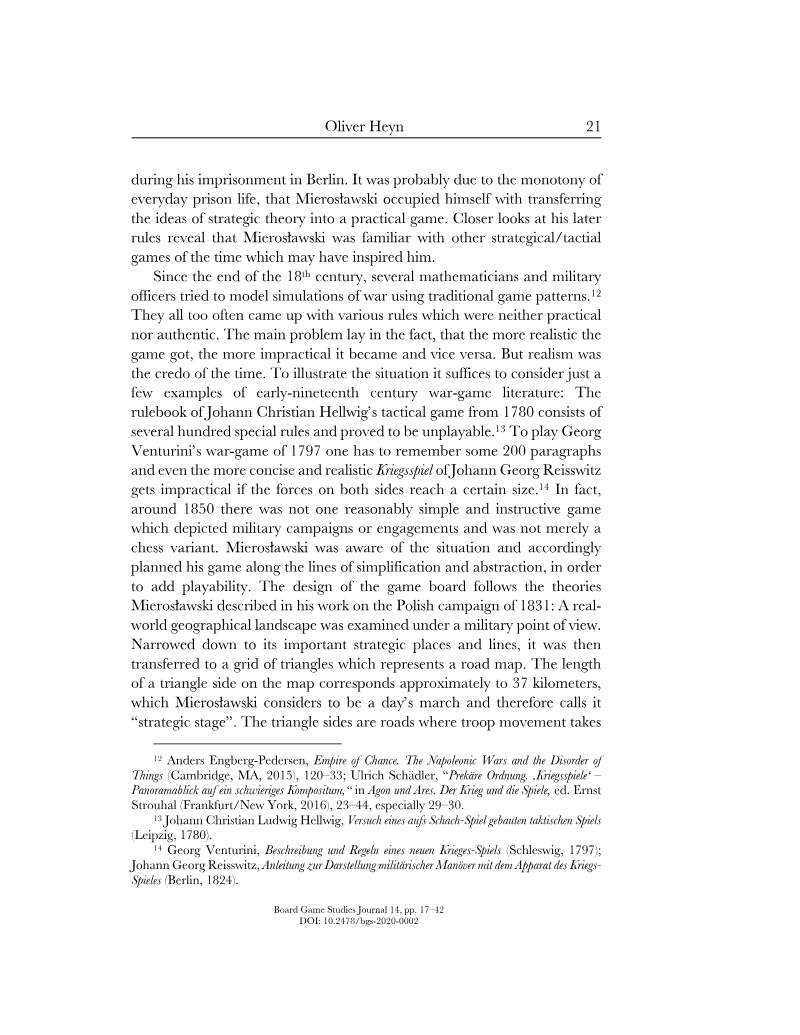
Ludwik Mierosławski, a Polish insurgent and military theorist, devised a simplified strategy game while imprisoned in Berlin after the failed 1846 Greater Poland Uprising. This article argues that his game was a practical distillation of earlier European war-games, including those of Hellwig, Venturini, and Reisswitz, and an adaptation of J. A. Messmer's 1819 "Het strategisch spel," which Mierosławski likely knew. The game was built on an abstract triangular grid modeled on the 1849 Hungarian War of Independence and used a superiority-based combat system without dice, features that set it apart from the more elaborate Prussian Kriegsspiel tradition.
The game was first drafted in 1847 and revised repeatedly. Its early editions of 1847 and 1849 attracted little attention, but the third (1850) and fourth (1857) editions, published in Paris and promoted through the Dumaine bookstore and newspaper advertising, earned favorable notices in French military journals and endorsements from some educators. An 1858 commission of the Société pour l'instruction publique praised its educational value but questioned its suitability for public classrooms because of concerns about discipline. No sales records survive, so its commercial success cannot be measured, and by 1859 advertising had stopped and Mierosławski had abandoned the project.
Mierosławski's later career included advocacy of Kriegsspiel-style map maneuvers, and he claimed to have inspired France's adoption of wargaming after the German victories. Between 1873 and 1891 the contemporary press credited him as Kriegsspiel's inventor in France, yet the game was largely forgotten: only four copies of its rules survive in libraries worldwide, and standard biographies of him omit it. The rules feature three piece types, movement constrained by road quality, and fortress-based combat values. The supporting material, including bibliographic references, the preserved Bibliothèque nationale de France game board, original pieces, and an 1857 advertisement, documents the game's marketing and supports its present rediscovery.
Board Game Studies Journal · 2025
Board Game Studies Journal · 2025
Board Game Studies Journal · 2025
Board Game Studies Journal · 2025
Board Game Studies Journal · 2025
Board Game Studies Journal · 2025
Board Game Studies Journal · 2024
Board Game Studies Journal · 2024
Board Game Studies Journal · 2024
Board Game Studies Journal · 2024
Board Game Studies Journal · 2024
Board Game Studies Journal · 2023
DiGRA · 2020