
Board Game Studies Journal
Open-access peer-reviewed journal on the history and study of board games, published with Sciendo (De Gruyter).
Documents
Le Symbolisme des Jeux chez Filippo Picinelli
Jean-Marie Lhôte's article in the Board Game Studies Journal examines how seventeenth-century emblem literature treated games, focusing on Filippo Picinelli (1604–1678), an Augustinian canon whose encyclopedic work Mundus symbolicus (1653, expanded in 1669) read the world as a book of symbols.
- Games appear in sixteenth- and seventeenth-century emblem literature only rarely, and this scarcity is attributed to the genre's serious, quasi-sacred character, which largely excluded recreational subjects.
- In Filippo Picinelli's encyclopedic Mundus symbolicus (1653, expanded 1669), games are treated almost exclusively as vehicles for moral and spiritual instruction rather than as objects of play in their own right.
- Book XVIII, "Instrumenta lusoria," devotes nine chapters to game-related subjects, including dice, latrunculi, balls, the hoop, and the spinning top, with chess included in the 1653 Italian edition.
Stranger Games: The Life and Times of the Spintriae
Eddie Duggan's 2017 paper in the Board Game Studies Journal examines the Roman spintriae, small bronze or copper-alloy tokens bearing erotic obverse scenes and Roman numeral reverses, with the central aim of determining whether these objects were gaming counters, brothel tokens, or something else entirely.
- Eddie Duggan's 2017 Board Game Studies Journal paper examines the Roman spintriae, bronze or copper-alloy tokens with erotic obverse scenes and Roman numeral reverses, asking whether they were gaming counters, brothel tokens, or something else.
- Ted Buttrey's 1973 catalogue recorded roughly two dozen spintriae in the British Museum and found that obverse scenes and reverse numerals bear no meaningful relationship to each other, a finding the paper treats as pivotal to interpreting their function.
- Buttrey dated the imperial portrait series sharing dies with the erotic tokens to about 22–37 AD and favored a gaming function, while Simonetta and Riva proposed a brothel use with production between 70 and 95 AD.
A Note on Chess in 19th Century Turkestan
Georgi Markov's article examines a brief 1877 note by A. Chernevski, published in the Shakhmatny Listok, which describes two chess variants played in Samarkand, then part of Russian Turkestan and now in Uzbekistan.
- Chernevski's 1877 note in the Shakhmatny Listok describes two chess variants played in Samarkand, then part of Russian Turkestan (now Uzbekistan): the 'Bukharan game,' a lightly modified shatranj, and the 'Persian game with a queen.'
- The Bukharan game features an obligatory first move of the queen to d3, no castling, and bishops that leap over intervening squares, giving them long-range movement unattested elsewhere.
- The 'Persian game with a queen' differs from the 1846 Chess Player's Chronicle account of Persian chess, including an obligatory opening double move of the queen's pawns and a three-move castling procedure involving a knight-like king leap.
Pente Grammai and the 'Holy Line'
The ancient Greek board game pente grammai, and the proverbial phrase "moving from the holy line," form the subject of this study, which argues that the phrase describes a deliberate and often unusual move, typically an aggressive gamble, rather than an ordinary advance toward the goal.
- The study argues that the proverbial phrase "moving from the holy line" describes a deliberate, often unusual and aggressive gamble in the ancient Greek board game pente grammai, rather than an ordinary advance toward the goal.
- Its central method privileges archaic and classical sources (Alcaeus, Epicharmus, Sophron, Plato's Laws) over later lexicographic and commentary traditions, which the author finds frequently contradictory.
- Later authorities diverge on the board: Pollux (second century CE) places the holy line in the middle of the board, while Eustathius (twelfth century) holds that the goal is to reach that line last, a claim the author admits cannot be proven but finds consistent with archaeological evidence of five-lined boards.
Die Kenntnis des Dominospiels in Europa: Archäologie, Geschichte, Bibliographie
Ingram Braun's study examines the history of domino in Europe, a subject the author argues has never been systematically researched.
- The study argues that the history of domino in Europe has never been systematically researched and aims to combine archaeological finds, written sources, pictorial material, and commercial records into one critical account.
- The oldest known European archaeological domino is a limestone piece from Einbeck dated to around 1500, while the bone pieces from the Mary Rose (1545) and Southampton have disputed dating.
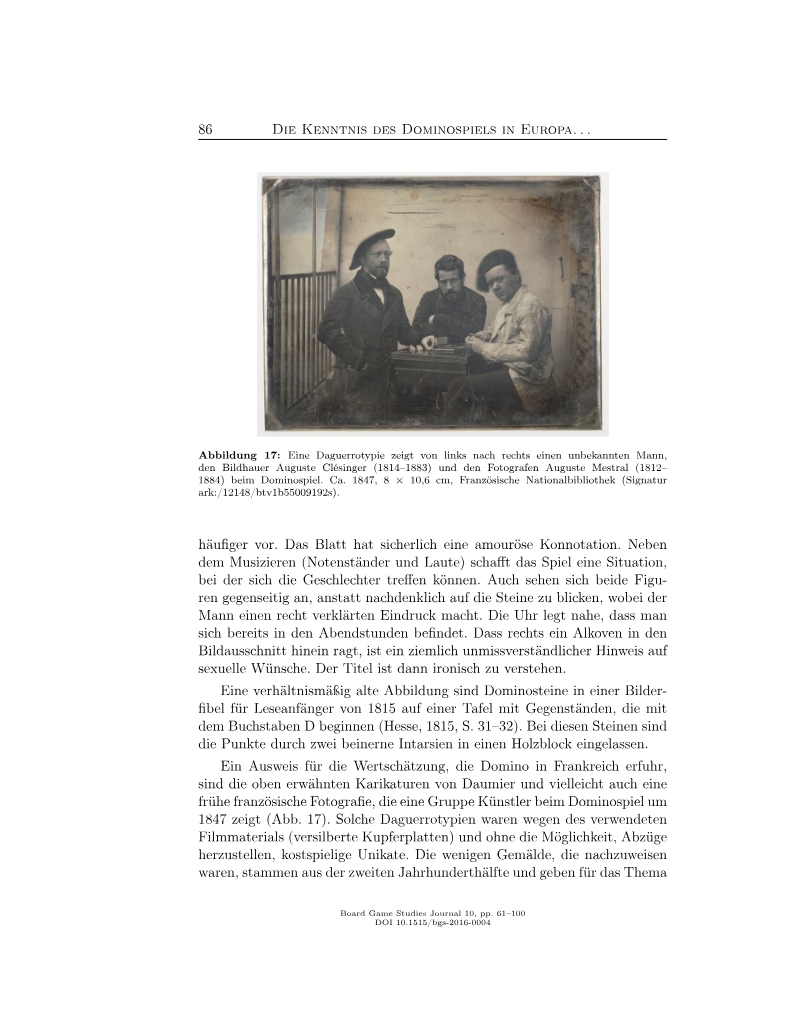
- Written references to domino appear around 1760 in France and Germany, where French sources describe an upper-class competitive pastime and German sources initially treat it as a children's game.
Four-King Chess with Dice Is Neither Unrealistic nor Messed Up
Harald Wiese's paper defends four-king chess with dice (catura ṅga) against the charges that its dice and four-army format make it unrealistic or corrupted.
- The paper defends four-king chess with dice (catura ṅga) against charges that its dice and four-army format are unrealistic, arguing it may have been designed to illustrate Kautilya's mandala theory of interstate relations, though it concedes no historical evidence shows which came first.
- The author treats the Tithitattva and Manasollasa, which describe the board layout and pairing of allied colors, as supporting evidence that the game and Kautilya's Arthaśāstra shared a teaching purpose for strategic principles among Indian rulers.
- The dice are interpreted as a symbol of the uncertainty of war and peace, consistent with the Arthaśāstra's distinction between controllable human policy and uncontrollable divine fortune.
Board to Page to Board: Native American Antecedents of Two Proprietary Board Games
Winkelman's article argues that two proprietary board games have Native American antecedents rather than the European origins usually assumed. The first claim is that the German "hat" game Fang den Hut!
- The article argues that Lizzie Magie's The Landlord's Game (1902/1904) descends from Zohn Ahl, a Kiowa game documented by Stewart Culin in Chess and Playing-Cards (1898), rather than from European sources.
- The structural case for Zohn Ahl rests on shared features: a closed circuit with no finish line, a zero-sum counter-based scoring system, and a 40-point square track.
- Culin's suggestion that the game be adapted to "the parlor of civilization" is treated by the author as a notable hint of later transmission from Indigenous games to commercial ones.
Measuring Drama in Goose-like Games
This study proposes objective, simulation-based criteria for measuring "drama" in chance-driven race games, extending a concept originally defined for skill-based abstract games such as Chess.
- The study adapts 'drama'—a trailing player's ability to recover and win—from skill-based games like Chess to chance-driven race games, arguing it matters even when randomness replaces skill.
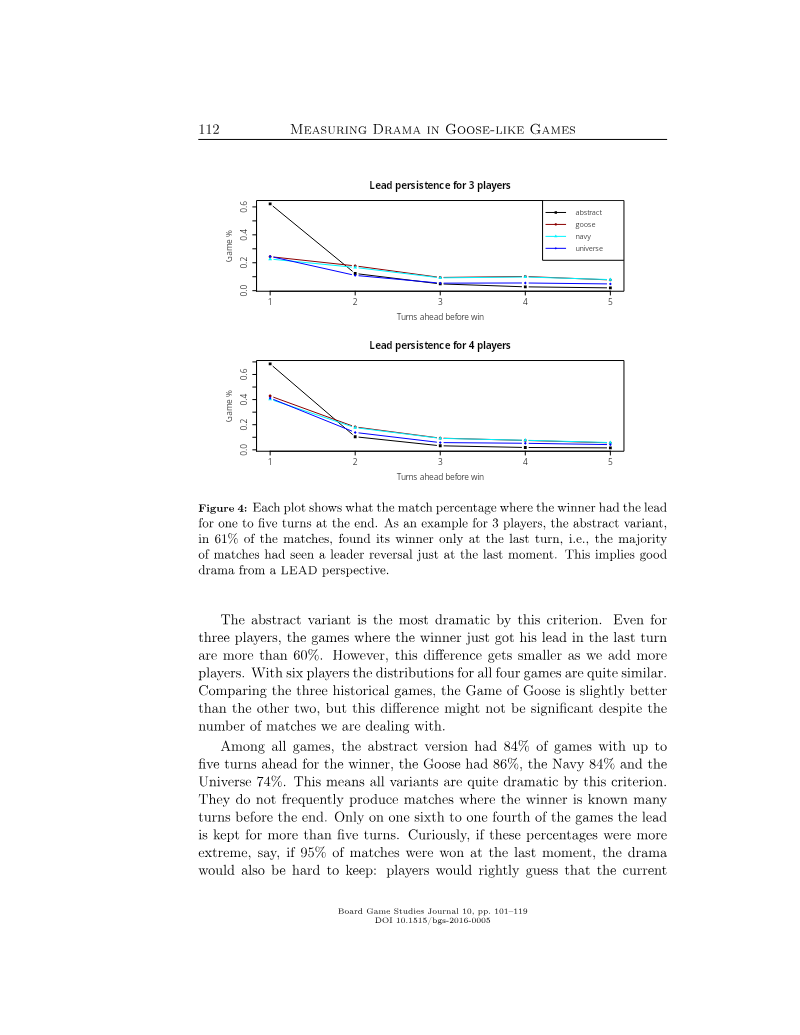
- Analysis of over 10 million computer-simulated matches (written in R, with 3 to 8 players per variant) tested the Game of Goose family against two pedagogical historical variants and an abstract variant with no special rules.
- On the WIN criterion (balance of winning chances across seating positions), the classic Goose game performed best, while all historical variants showed small deviations, with the second player holding a consistent, statistically significant advantage.
The Game of the Sphere or of the Universe: A Spiral Race Game from 17th Century France
This paper by Adrian Seville examines Le Jeu de la Sphère ou de l'Univers, a spiral race game published in Paris in 1661 by Estienne Vouillemont, an engraver of maps for the King.
- The 1661 Parisian spiral race game Le Jeu de la Sphère ou de l'Univers, published by engraver Estienne Vouillemont, gives roughly equal weight to Ptolemaic natural philosophy, biblical references, astrology, and classical mythology.
- Despite its title's reference to Tycho Brahe, the game shows no trace of the Tychonic planetary scheme, Copernican heliocentrism, or Galilean influence, and is firmly geocentric.
- Vouillemont's suggested reading list, including Sacrobosco and Clavius, supports the game's geocentric framing, and its outer spheres appear to derive from a mid-seventeenth-century map compendium rather than directly from Tycho.