
Board Game Studies Journal
Open-access peer-reviewed journal on the history and study of board games, published with Sciendo (De Gruyter).
Documents
Une « Triple Enceinte » Et L'inscription Funéraire De Agate Filia Comites Gattilanis À Milan
The document, a Board Game Studies article by Francesco Muscolino, examines a previously overlooked engraved pattern on the Milanese funerary slab of Agate, daughter of the Ostrogothic comes Gattila, dated to 512 AD and discovered in 1783 near Milan's Duomo.
- The article identifies a previously unrecorded "triple enceinte" board, a three-ring game pattern associated with nine men's morris (filetto) or a tabula lusoria, incised on the Milanese funerary slab of Agate, daughter of the Ostrogothic comes Gattila.
- The slab is dated to 512 AD and bears an inscription with a consular date of 511; it was discovered in 1783 near Milan's Duomo.
- Technical evidence, including the contrast between fine scratched board lines and deeper, broader letter grooves, suggests the board and inscription were not made simultaneously and that the board most probably predates the 1783 discovery.
A Playful Coroplast? A New Look at the Terracotta Group of the Early Roman Board-Game Players NAM 4200 and Related Finds
This study reconsiders a 1st-century AD Athenian terracotta group, NAM 4200, which shows two seated board-game players and a standing dwarf.
- NAM 4200 is a 1st-century AD Athenian terracotta group showing two seated board-game players and a standing dwarf, reportedly found in 1855 near the royal palace in a large cemetery, and is treated as a rare Roman-period depiction of play.
- The author argues the group is a deliberate, meaningful composition rather than a generic genre scene, with the board tentatively identified as Poleis or a precursor to the Roman ludus latrunculorum and the figures' elite garments serving as a contextual clue.
- The most original claim is that the impressed motifs on the chairs are intentional: a rosette on the male's seat and a long-necked bird, probably a goose, on the female's, read as evoking defeat or exploitation (feather-plucking) and as tied to Aphrodite and good fortune.
Why So Serious? An Extraordinary Cone Shell Group from Mycenae and the Problem of Identifying Mycenaean Board Gaming Material
Pliatsika's article examines a remarkable deposit from Room Θ3 of House Θ at Mycenae, excavated in 1974, which contained 545 Conus mediterraneus ventricosus shells, 353 of them intentionally ground, pierced, and hollowed, nine filled with lead, alongside twelve small lead objects.
- The Mycenae Room Θ3 deposit contained 545 Conus mediterraneus ventricosus shells, 353 of them intentionally ground, pierced, and hollowed, nine filled with lead, alongside twelve small lead objects, dated to the mid-to-late 13th century BC before a destruction event.
- The author's central thesis is that these modified shells and associated stone and lead objects may be Mycenaean board-gaming implements, rather than the balance weights or ritual objects scholars have usually assigned to such material.
- Modified shells make up roughly 60 to 70 percent of Argolid assemblages such as Asprochoma and Prosymna, but only 3 to 28 percent at Perati, where association with child burials has been read as evidence of a children's game.
Board Games Equipment from Archaeological Contexts in Archaic Attica
Archaic Attic gaming equipment, including dice and painted gaming tables from burial and other contexts, is examined in this study of board game equipment from the Archaic period in Attica (roughly the 7th to early 6th century BC).
- Attic tombs began containing board game equipment in the early 7th century BC, with the earliest securely dated examples from Vari and Anavyssos belonging to the second quarter of the 7th century, making Attica the most precisely dated group of such finds in Greece (though dice appeared earlier in tomb deposits at Eleutherna in Crete).
- The study's empirical core is a catalogue of black-figured gaming tables from the Kerameikos, Vari, Copenhagen, Merenda, and La Tour-de-Peilz, plus black-figured pottery dice from Sounion, Heidelberg, Brauron, and the Acropolis.
- Outside the Attic funerary examples, gaming boards are found overwhelmingly in public or sanctuary settings rather than in tombs.
The Knucklebone and the Goose: Playing and Jeopardy for the Boy of Lilaia
The early third-century BC marble statue of a boy from Lilaia in Phocis, now in the National Archaeological Museum in Athens, serves as the focal point for an examination of the iconography linking children, games, divination, and possible healing in Greek religious life.
- The early third-century BC marble statue of a boy from Lilaia (National Archaeological Museum, Athens) is interpreted as a votive dedication, likely from a sanctuary of a kourotrophic deity near the Kephissos river sources, showing a child holding an astragalus (knucklebone) and a goose or duck.
- The authors reject an earlier link to an inscribed base dedicated to the boy Andriskos and place the figure within a documented group of Greek and Hellenistic child-and-bird representations, including the goose-strangling boy attributed to Boethos.
- Stylistic comparisons with fourth- and third-century BC parallels from Brauron, Dodona, and Thessaly support the dating, while freshly cut hair offered to local deities and a likely original painting of the knucklebone point to a rite of passage or festival.
Amulets, Gaming Pieces, Toys or Offerings? Thoughts on Animal Figurines and Funerary Practices in the Late Bronze Age Aegean
This article, published in the Board Game Studies Journal in 2022, asks whether a set of objects from a Late Bronze Age tomb assemblage at Katsambas on Crete, along with related animal figurines and shells from Aegean and Eastern Mediterranean burials, functioned as gaming pieces, amulets, ornaments, toys, or votive offerings.
- The study concludes that the evidence does not support a single confident interpretation of the Katsambas Late Bronze Age objects: a gaming-set reading is plausible, but the items came from separate contexts and their link to a specific burial is not firmly established.
- The faience bovine figurine from Katsambas is argued to be a personal ornament or amulet, based on parallels with beads and pendants from Mycenae, Tiryns, and Thebes.
- Couchant animal figurines such as the large Mycenaean ivory lion and the Phaistos ivory examples are judged unlikely to be game pieces, since clear Aegean game boards are absent, unlike the Egyptian mehen and senet evidence often invoked for comparison.
Back to the Game: Reframing Play and Games in Context
This introductory volume to the Board Game Studies Journal assembles papers originating from the 21st International Society for Board Game Studies conference, held in Athens in April 2018, and from the ERC-funded Locus Ludi project on play and games in Classical Antiquity.
- The volume's central argument is that gaming objects such as dice, counters, and carved stone boards can only be understood within their archaeological, funerary, sacred, and cultural contexts, since identical artefacts may serve ludic, ritual, educational, or symbolic functions depending on where they are found.
- Its archaeological section identifies multifunctionality of objects and the blurred boundary between games and religious practice as recurring methodological problems in interpreting game evidence.
- Several pavement designs in Athens long presumed to be game boards may date no earlier than Late Antiquity, which prompts reconsideration of earlier chronologies.
Catacomb Games: Reused Game Boards or Funerary Inscriptions?
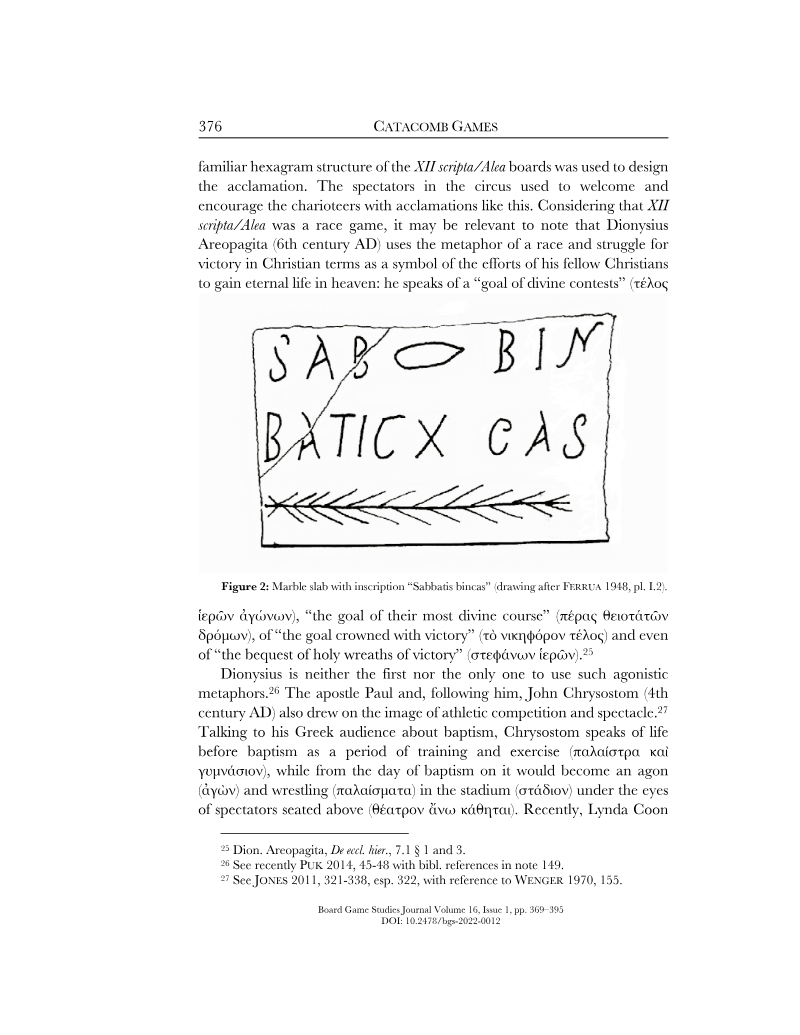
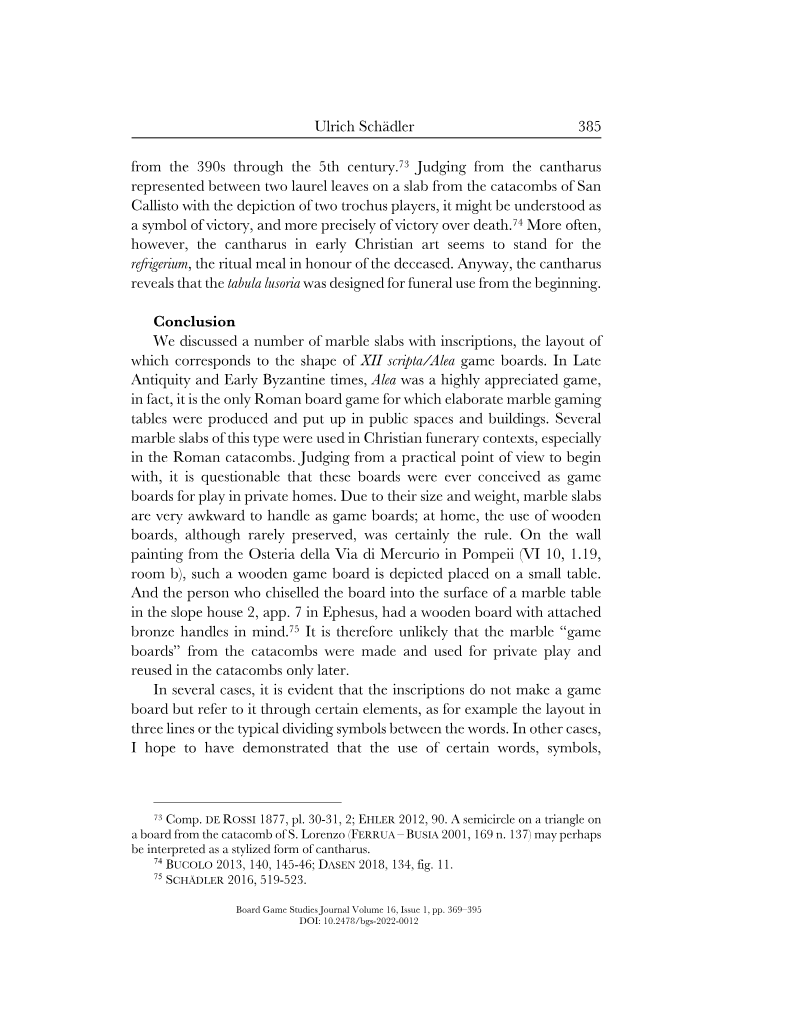
Ulrich Schädler's article in the 2022 Board Game Studies Journal challenges the long-standing assumption that marble slabs with XII scripta/Alea layouts found in Roman Christian catacombs were reused game boards.
- Schädler's 2022 Board Game Studies Journal article argues that marble slabs with XII scripta/Alea layouts from Roman Christian catacombs were produced as funerary objects from the outset, not reused domestic game boards.
- The marble boards weigh roughly 20 to 50 kilograms and lack the raised rims typical of wooden game boards, making them impractical for everyday play.
- Many inscriptions follow the hexagram format popular in Late Antique funerary epigraphy, and game imagery of fortune, life stages, and the circus was readily adapted to Christian ideas of martyrdom and triumph.
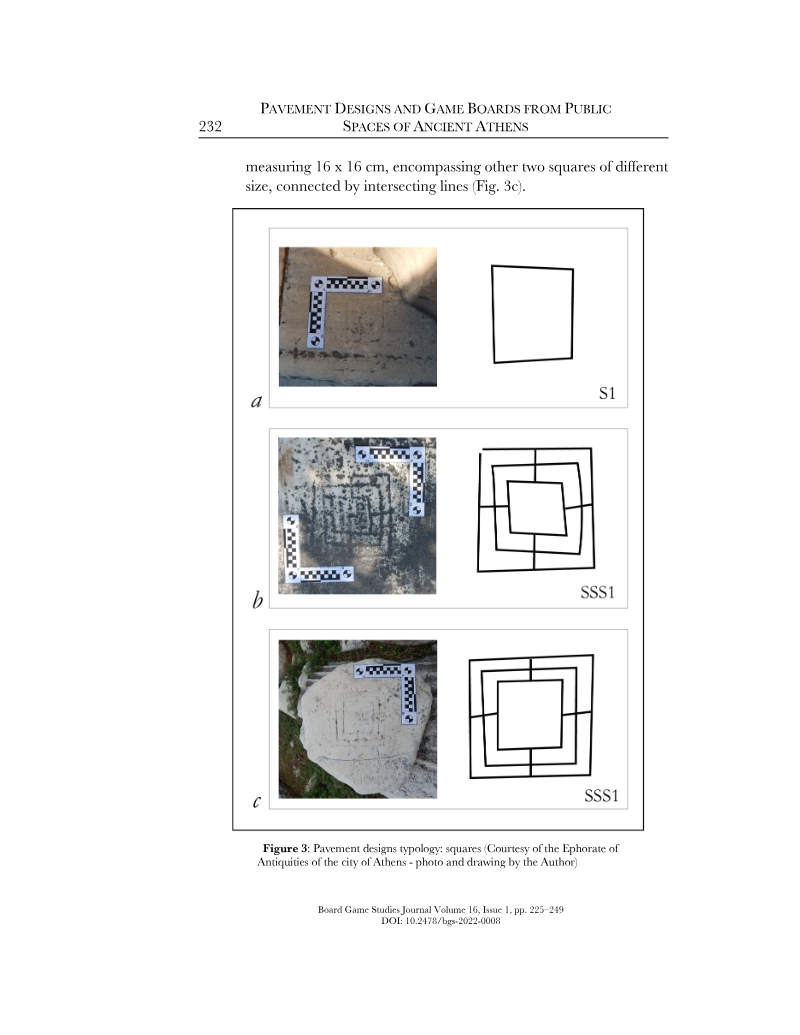
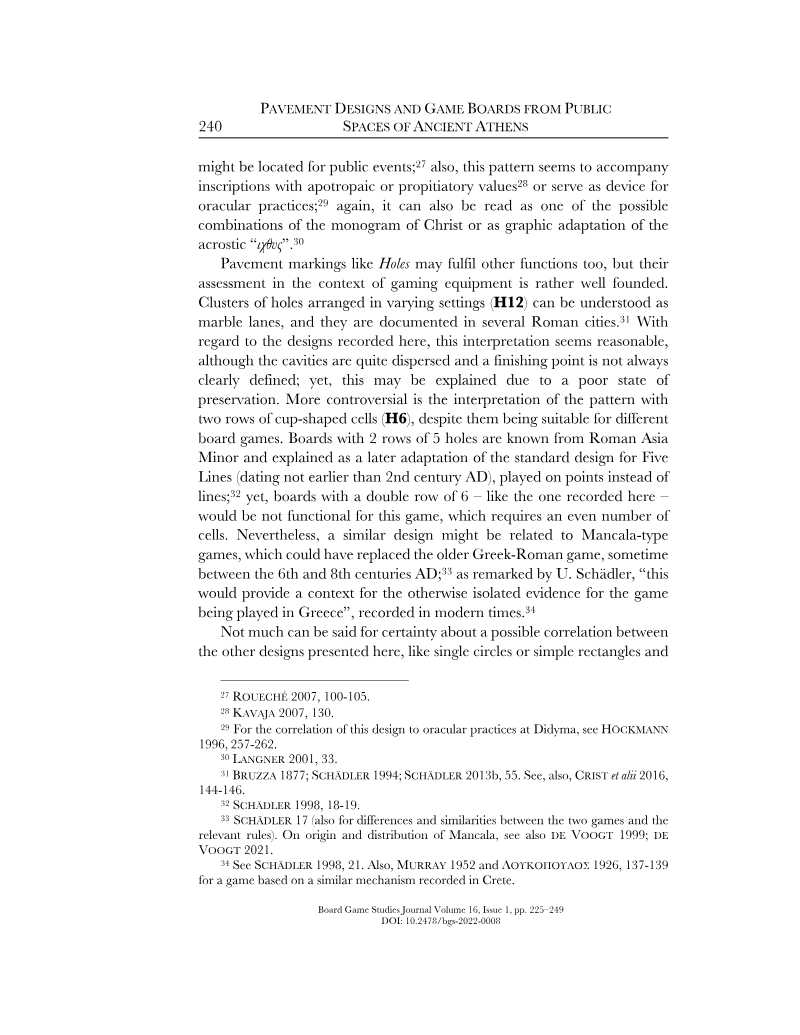
Pavement Designs and Game Boards from Public Spaces of Ancient Athens: A Review Across the Board
Barbara Carè's study examines carved pavement designs in key public spaces of ancient Athens, including the Roman Agora, the Horologion, the Hephaisteion, and Hadrian's Library complex.
- Barbara Carè's study argues that many carved pavement designs in ancient Athenian public spaces, especially circles and squares, have been too readily identified as game boards and dated to the Classical period, and calls for those interpretations to be revised.
- The study separates designs with firm links to known board games (rectangles with two rows of five squares, three-row layouts, concentric squares, and square grids) from ambiguous forms such as circles and clusters of holes, reflecting its methodological caution.
- Because evidence for ancient game rules is scarce and associated finds are poorly preserved, the author offers a systematic typology to support more reliable identification and chronological placement of these designs.
Games and Oracular Practices Around the Hearth: The "Table of Offerings" from the So-Called Temple 4 at Kition-Kathari (Cyprus)
At Kition-Kathari on Cyprus, the so-called Temple 4 is re-examined in this study as a multifunctional building rather than a purely cultic space.
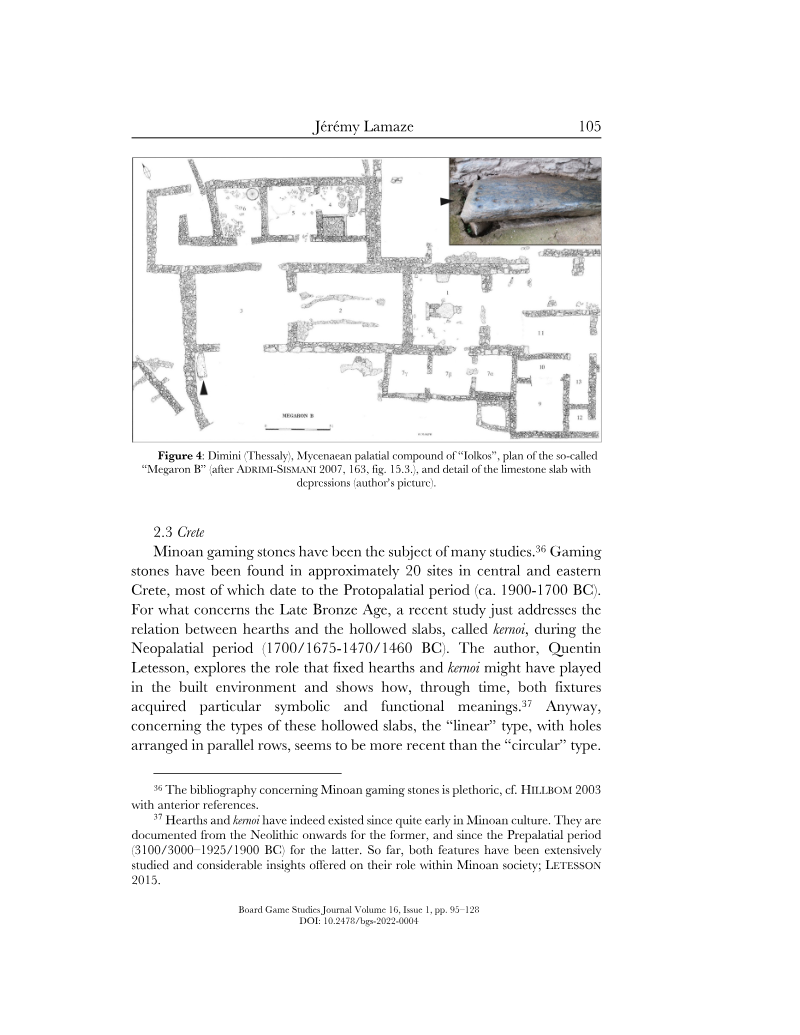
- The so-called Temple 4 at Kition-Kathari on Cyprus is reinterpreted as a multifunctional building combining domestic, commensal, and ritual activity, with a trapezoidal stone table (once read as an offering table) reinterpreted as a gaming surface.
- The chronology of Floor I remains unresolved, with dates ranging between the traditional 1050–1000 BC and the revised 1000–850 BC.
- Over a hundred pierced anchor stones, seven from Temple 4 alone, are interpreted as mariners' ex-votos, alongside ship graffiti likely invoking safe passage.
Game Board or Abacus? Greek Counter Culture Revisited
The article reconsiders the function of the "five lines" board depicted in Greek art, using a late fifth-century BC funerary altar from Krannon in Thessaly as its central case.
- The article reinterprets a late fifth-century BC funerary altar from Krannon in Thessaly, long read as a game board, as evidence of a counting device used in elementary education, based on the seated figure and attendant boy with the board between them.
- The authors distinguish counting boards from game boards mainly by the presence of numerals or monetary symbols, as on the large public abacus from Oropos, whose high values and sanctuary setting suggest a reckoning function.
- Comparison with roughly 170 archaic Attic vases (c. 540–480 BC), most showing warriors such as Achilles and Ajax playing games on block-like stones, underpins the argument about how these boards were used.
A Boeotian Die in Context: Gaming Pieces, Jewellery, Seals, Spindle Whorls and Bird Bowls in a Female Burial of Status
The article examines a clay die recovered from a rich Archaic female burial (grave T.171) at Akraiphia in Boeotia, a find notable for its 25-dot face in place of the conventional six and for being the first known die from the region.
- The clay die from grave T.171 at Akraiphia in Boeotia is the first known die from the region and has a 25-dot face instead of the conventional six, making it a notable find.
- The author argues that the die, together with shells, pebbles, a terracotta figurine, jewellery, faience seals and spindle whorls, forms a gaming assemblage that could signal elite status in a female burial.
- The tomb's 48 vessels, dominated by Boeotian bird bowls and Late Corinthian ware, date the grave to around the mid-sixth century BC.