1 free read left. Create a free account for unlimited reading + AI research.
Create free accountArticle Board Game Studies Journal
1 free read left. Create a free account for unlimited reading + AI research.
Create free accountArticleBoard Game Studies Journal
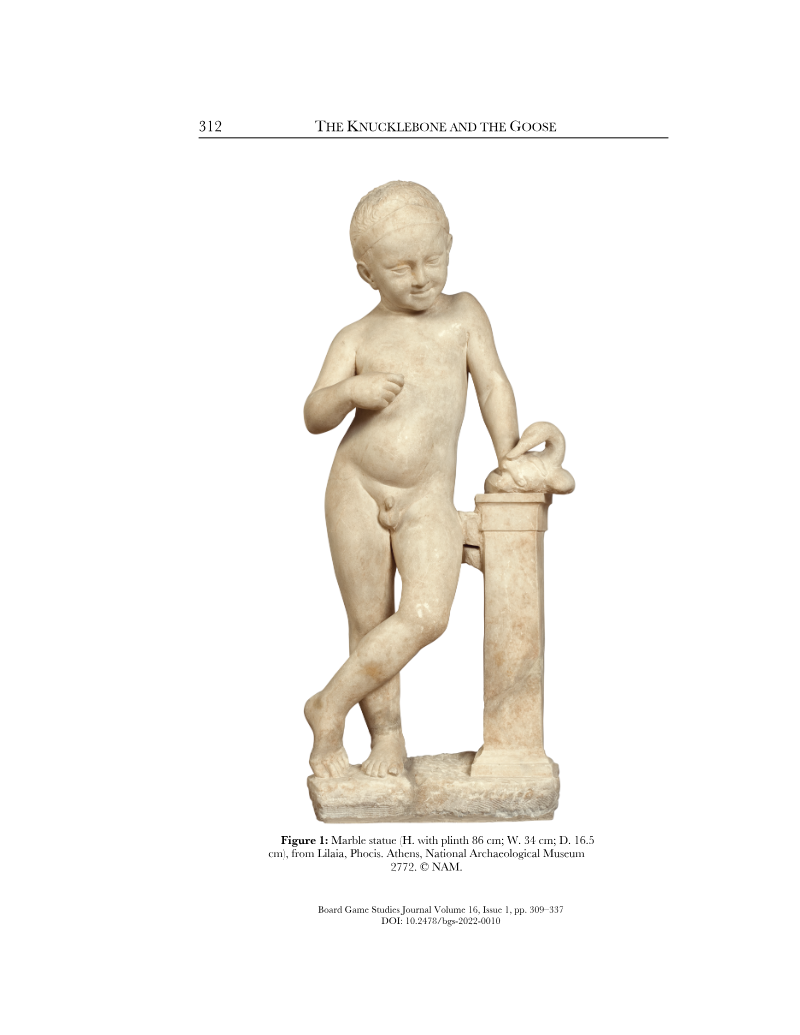
The statue shows a child from Lilaia with an astragalus in one hand and a goose or duck in the other. It is held in the National Archaeological Museum, Athens.
The early third-century BC marble statue of a boy from Lilaia in Phocis, now in the National Archaeological Museum in Athens, serves as the focal point for an examination of the iconography linking children, games, divination, and possible healing in Greek religious life. Its subject, a child holding an astragalus (knucklebone) in one hand and a goose or duck in the other, is interpreted as a votive dedication, likely from a sanctuary of a kourotrophic deity near the sources of the Kephissos river. The authors reject an earlier association with an inscribed base dedicated to the boy Andriskos and situate the figure within a well-documented group of Greek and Hellenistic child-and-bird representations, including the goose-strangling boy attributed to Boethos.
Stylistic comparison with fourth- and third-century BC Attic and Greek parallels, such as statuettes from Brauron, Dodona, and Thessaly, supports this dating and context. The freshly cut hair offered to local deities and the likely original painting of the knucklebone, overlooked until recent re-examination, point toward a rite of passage or festival. The authors argue that knucklebones, associated with figures such as Artemis, functioned simultaneously as children's playthings, divinatory instruments, and dedicatory objects, and that throwing them constituted a game governed by probability, with its asymmetric faces reflecting "unusual" and "normal" outcomes.
The goose, identified as likely a Ruddy Shelduck or Egyptian Goose (chenalopex), is understood to carry protective and oracular associations. Taken together, the statue may commemorate a healing or an averted danger, possibly connected to the god Ianiskos or to Asclepian votive traditions. A discussion of geese offered to deities such as Isis and Aphrodite suggests that poorer worshippers used geese in place of the oxen and deer favored by the wealthy. An appendix by Irini Poupaki identifies the marble as Parian-type, though its translucency suggests a non-Lychnitic source, possibly the open-air Lakkes or Marathi quarries, and notes traces of red and brown paint.
Board Game Studies Journal · 2025
Board Game Studies Journal · 2025
Board Game Studies Journal · 2025
Board Game Studies Journal · 2025
Board Game Studies Journal · 2025
Board Game Studies Journal · 2025
Board Game Studies Journal · 2024
Board Game Studies Journal · 2024
Board Game Studies Journal · 2024
Board Game Studies Journal · 2024
Board Game Studies Journal · 2024
Board Game Studies Journal · 2023
Board Game Studies Journal · 2022



European Conference on Games Based Learning (ECGBL) · 2026



European Conference on Games Based Learning (ECGBL) · 2026