1 free read left. Create a free account for unlimited reading + AI research.
Create free accountArticle Board Game Studies Journal
1 free read left. Create a free account for unlimited reading + AI research.
Create free accountArticleBoard Game Studies Journal
The article reconsiders the "five lines" board in Greek art, using a late fifth-century BC funerary altar from Krannon in Thessaly as its central case.
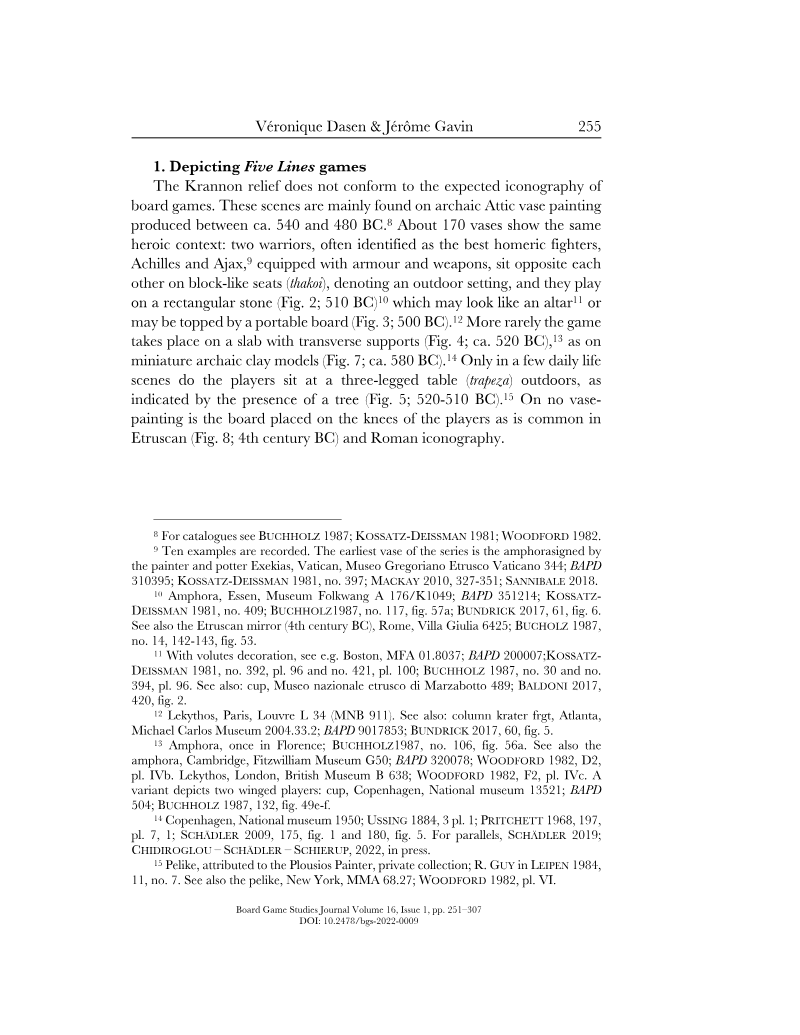
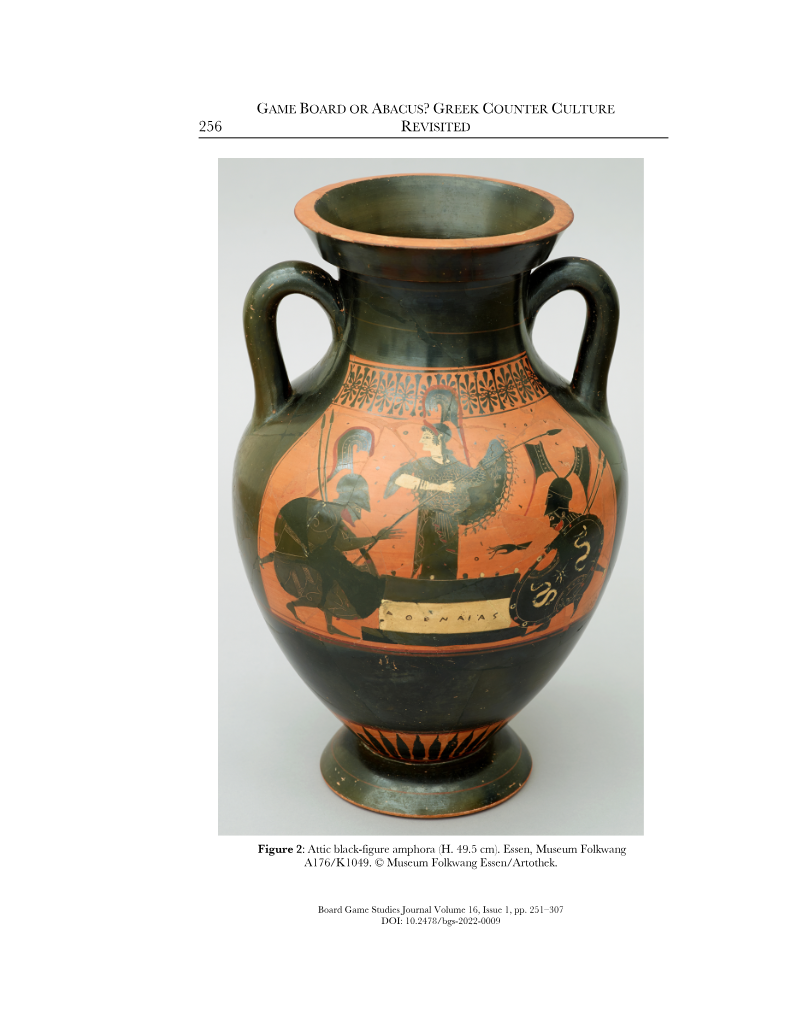
The article reconsiders the function of the "five lines" board depicted in Greek art, using a late fifth-century BC funerary altar from Krannon in Thessaly as its central case. Where scholars have usually read such boards as game boards, the authors argue that the seated bearded figure and the attendant boy, with the board positioned horizontally between them, point toward a counting device used in elementary education. Their argument draws on comparison with roughly 170 archaic Attic vases (c. 540–480 BC), most of which show warriors such as Achilles and Ajax playing games on block-like stones, and on gravestones of professionals such as doctors, music teachers, and mathematicians.
The authors' key criterion for distinguishing a counting board from a game board is the presence of numerals or monetary symbols, as on the large public abacus from Oropos, whose high values and sanctuary setting suggest a reckoning function. They contend that the same material can serve either purpose, since the terms abax and trapeza applied to both reckoning and gaming, and they propose that Greek counting boards were oriented horizontally, with five lines and a semicircular zone. That semicircle, they suggest, mediated the conversion between talents and drachmae within a decimal system, and the board could support all four basic operations. Worked examples in the text illustrate multiplication (263 × 9 = 2367) and division (2628 ÷ 3 = 876), with pebbles placed on and between lines.
Beyond the Krannon evidence, the study examines terminology such as psephoi, pessoi, and petteia, which the authors read as names for structural systems rather than specific materials, and they cite epigrams, a red-figure bell-krater showing pebble-based oracle consultation, and Byzantine texts linking game grids to cosmic symbolism. Their overall conclusion is that arithmetic, play, voting, and divination shared a counter-based culture in which children were often taught reckoning and games together, and that stone abaci were later reinterpreted as game boards in Roman and Byzantine contexts. The bibliography, which draws on scholarship in ancient games and Greek mathematics, supports the study's interdisciplinary scope.
Board Game Studies Journal · 2025
Board Game Studies Journal · 2025
Board Game Studies Journal · 2025
Board Game Studies Journal · 2025
Board Game Studies Journal · 2025
Board Game Studies Journal · 2025
Board Game Studies Journal · 2024
Board Game Studies Journal · 2024
Board Game Studies Journal · 2024
Board Game Studies Journal · 2024
Board Game Studies Journal · 2024
Board Game Studies Journal · 2023



European Conference on Games Based Learning (ECGBL) · 2026



European Conference on Games Based Learning (ECGBL) · 2026



European Conference on Games Based Learning (ECGBL) · 2026