Player Behavior

169 documents·85 publishers

Documents

Page 1
Report33 pages

Mistplay Mobile Gaming Spender Report 2024: Decoding Mobile IAP Spenders

The mobile gaming landscape in 2024 is defined by a shift toward a more discerning consumer base, as economic headwinds prompt 32% of all spenders and 41% of high-value spenders to plan for reduced in-game expenditures. While gameplay progression and relaxation remain the primary motivators for engagement, publishers face increasing pressure to justify costs. Retention and monetization now depend heavily on the first month of play, during which 79% of spenders make their initial purchase. However, player churn is rising due to perceived imbalances in game mechanics, lack of progression value, and aggressive pricing structures that alienate low-to-mid-value segments.

To combat these challenges, the industry is pivoting toward value-driven incentives and personalized engagement strategies. Loyalty programs have emerged as a critical tool for sustainability, with 79% of spenders actively engaging with rewards and 60% of high-value players indicating a higher likelihood of spending when redeemable rewards are offered. While social recommendations and paid advertisements remain the primary drivers for game discovery and initial installs, they rarely influence long-term spending. Instead, financial commitment is triggered by tailored in-app deals and limited-time promotions that align with specific gameplay milestones.

Strategic growth in the current market requires a move toward diversified revenue streams and direct-to-consumer models. Implementing web shops can increase revenue by up to 25% by bypassing traditional app store fees and offering more flexible pricing. Although RPG and Strategy genres continue to dominate high-value spending through deep progression systems, success across all segments now requires a focus on lifetime value through frequent, lower-cost purchase options and transparent, fair-play mechanics. By prioritizing loyalty-driven in-app purchase strategies, publishers can maintain stability despite a more cautious spending environment.

  • Economic pressure is causing 32% of all spenders and 41% of high-value spenders to plan for reduced in-game expenditures in 2024.
  • The first month of play is critical for monetization, as 79% of spenders make their initial purchase during this period.
  • Loyalty programs are essential for retention, with 79% of spenders engaging with rewards and 60% of high-value players reporting increased spending likelihood when redeemable rewards are offered.
  • Implementing web shops can boost revenue by up to 25% by bypassing app store fees and enabling more flexible pricing structures.
  • Player churn is rising due to aggressive pricing, perceived mechanical imbalances, and a lack of progression value, particularly among low-to-mid-value segments.
+1
MistplayMar 2024
Page 1
Report53 pages

Mobile App Trends 2024: Japan Edition

The Japanese mobile app market maintains its status as a global powerhouse, generating $17.9 billion in consumer spending and 2.5 billion downloads in 2023. Despite a marginal decline in annual installs, the market demonstrated a strong recovery in the first quarter of 2024, characterized by a 3.5% rise in spending and a 3% increase in downloads. This growth is underpinned by high user engagement and a notable 30% ATT opt-in rate within the gaming sector, signaling a resilient ecosystem for data-driven marketing and monetization.

Mobile gaming remains the primary revenue driver, with RPGs accounting for nearly half of all consumer spend and achieving a high average revenue per monthly active user of $5.09. However, the landscape is evolving toward deeper immersion, as evidenced by simulation games reaching average session lengths of over 40 minutes. Simultaneously, the finance and e-commerce sectors are experiencing rapid expansion. Finance apps saw a 53.5% spending surge in early 2024, while e-commerce lifetime value in Japan reached $9.67 by the end of the first month, nearly doubling global medians.

Strategic shifts in user acquisition are evident across all segments, with a marked transition toward paid channels. The paid-to-organic install ratio for gaming reached 2.31 in early 2024, while finance and e-commerce also saw significant increases in paid acquisition efforts. This trend is complemented by the emergence of Connected TV as a critical performance channel. With ad spend projected to reach 170 billion yen by 2025, advertisers are increasingly reallocating budgets from social media to CTV to leverage its high viewership and its proven ability to assist in driving mobile app installs through sophisticated measurement and AI-driven creative optimization.

  • The Japanese mobile market generated $17.9 billion in consumer spending in 2023, with Q1 2024 showing a 3.5% increase in spending and a 3% rise in downloads.
  • Mobile gaming remains the primary revenue driver, with RPGs capturing nearly 50% of consumer spend and simulation games achieving session lengths exceeding 40 minutes.
  • Finance apps experienced a 53.5% surge in spending in early 2024, while e-commerce apps reached a first-month lifetime value of $9.67, nearly double the global median.
  • Connected TV is emerging as a critical performance channel, with ad spend projected to reach 170 billion yen by 2025 as advertisers shift budgets away from social media.
  • User acquisition strategies have shifted heavily toward paid channels, evidenced by a 2.31 paid-to-organic install ratio in the gaming sector during early 2024.
+1
Sensor TowerMar 2024
Page 1
Report21 pages

2023 Roblox Report: Behind the Data

The 2023 Roblox Report, produced by GameAnalytics, provides a comprehensive analysis of player behavior and performance benchmarks across the Roblox platform. The study is based on 2023 data from thousands of games that utilize the GameAnalytics SDK, representing over 50% of total player engagement on the platform. The dataset includes a significant sample of high-performing titles, featuring 300 games with over one million monthly active users and 60 titles exceeding ten million monthly sessions.

The findings reveal a highly fluid player base, with 47% of users accessing the platform via both mobile and desktop devices. Engagement is characterized by high frequency rather than single long sessions; over 50% of players engage at least twice daily, and the top 5% of games successfully bring players back more than 3.5 times per day. While the average session length for half of the tracked games is under six minutes, elite titles in the 95th percentile sustain engagement for nearly 30 minutes per session.

Monetization remains a significant challenge on the platform. Only 4.2% of players spend Robux within games, and more than half of those spenders contribute less than $1 annually. However, a small segment of high-value "power spenders" drives the majority of revenue, with the top 5% of games earning approximately $77 per playing player annually. Retention is identified as a universal struggle across the platform regardless of game quality; Day 1 retention typically ranges between 12% and 15%, dropping to near 1% by Day 90. The report concludes that success on Roblox requires optimizing for cross-platform play, implementing aggressive LiveOps to counter natural retention decay, and focusing on session frequency to drive monetization.

  • Retention is a universal challenge on Roblox, with Day 1 retention averaging 12% to 15% and falling to approximately 1% by Day 90.
  • Monetization is highly concentrated, as only 4.2% of players spend Robux, with over half of those spenders contributing less than $1 annually.
  • Top-tier games in the 95th percentile generate approximately $77 per playing player annually, significantly outperforming the broader platform average.
  • Player engagement is driven by frequency rather than session length, with over 50% of users playing at least twice daily and top games achieving over 3.5 sessions per day.
  • While the median session length for half of tracked games is under six minutes, elite titles in the 95th percentile sustain sessions of nearly 30 minutes.
+1
GameAnalyticsMar 2024
Page 1
Report32 pages

Gaming Report 2024: Meet the Moment

The global video game market, valued at $196 billion in 2023, is entering a period of sustained expansion with a projected annual growth rate of 6% through 2028. This upward trajectory is primarily fueled by younger demographics who increasingly utilize gaming environments as essential hubs for social interaction, creative expression, and commerce. To capitalize on this shift, industry leaders must pivot away from traditional, siloed development toward immersive, cross-platform ecosystems that prioritize interoperability and the integration of user-generated content. Expanding intellectual property across diverse media formats is now a critical requirement for maintaining relevance and maximizing consumer engagement.

The industry is simultaneously undergoing a structural transition toward a hardware-agnostic model, necessitated by the rise of cloud-based distribution and the demand for seamless, multi-channel experiences. As market saturation intensifies, the high failure rates observed in mobile gaming underscore the need for more rigorous operational discipline. Companies are increasingly required to align product development, finance, and marketing functions through data-driven strategies. By leveraging artificial intelligence to optimize user acquisition and retention, organizations can better navigate the volatility of the current landscape and address the growing disparity between headcount expansion and actual revenue growth.

To secure long-term viability, gaming organizations are modernizing their internal structures by standardizing development tools and fostering entrepreneurial autonomy. This evolution includes a holistic integration of generative AI into core workflows to improve operational efficiency and scale production capabilities. Furthermore, as competition for specialized talent intensifies, firms are refining their compensation and support models to align with broader technology industry standards. These combined technological and organizational shifts are essential for navigating current market turbulence and ensuring that gaming entities remain competitive in an increasingly complex and interconnected digital economy.

  • The global video game market reached a $196 billion valuation in 2023 and is projected to grow at an annual rate of 6% through 2028.
  • Industry growth is driven by younger demographics treating gaming environments as primary hubs for social interaction, commerce, and creative expression.
  • Market leaders must transition from siloed development to immersive, cross-platform ecosystems that prioritize interoperability and user-generated content.
  • The industry is shifting toward a hardware-agnostic model, requiring companies to adopt cloud-based distribution and seamless multi-channel experiences.
  • Organizations must integrate generative AI into core workflows to improve operational efficiency, scale production, and address the disconnect between headcount growth and revenue.
+2
Bain & CompanyJan 2024
Page 1
Report53 pages

The Xsolla Report: State of Play – Summer Edition 2024

The Summer Edition of the Xsolla Report demonstrates that indie game development has entered a phase of rapid democratization and commercial viability. Accessible engines such as Unity, Unreal, and the fast‑growing Godot now dominate production pipelines, enabling more than 8 000 titles to launch in 2023. Coupled with free or low‑cost asset stores and cloud backend services, indie studios can cut development time and costs dramatically, accelerating time‑to‑market and allowing them to compete with larger studios.

Sales data confirm the shift: indie titles generated over $15 million in lifetime revenue on Steam alone, and now account for 31 % of total Steam earnings. Action, adventure, and RPG genres remain the most lucrative, while indie games enjoy higher average Steam ratings (≈72 %) than AAA titles. The market share of indie games on PC and console platforms rose from 13 % in 2021 to 18 % in the United States, underscoring a growing consumer appetite for independent titles.

Influencer marketing has become the primary driver of discovery and purchase decisions, with YouTube still commanding the highest impact but TikTok and Instagram offering more cost‑effective alternatives. The sector’s marketing spend is projected to triple, reaching $24 billion by 2024. Meanwhile, the convergence of education and gaming—through MOOCs, online academies, and immersive technologies—has expanded the talent pipeline, raising average developer salaries from $60 k in 2010 to $95 k in 2024.

Geographically, the report focuses on North America and Europe, with a particular emphasis on U.S. market dynamics, while the time frame spans 2021–2024. The findings highlight that strategic adaptability, influencer partnerships, and cloud‑based commerce tools are essential for publishers, developers, and investors to capture the expanding indie market.

  • Indie games now account for 31% of total Steam earnings, with their U.S. market share on PC and console platforms rising from 13% in 2021 to 18% in 2024.
  • Marketing spend for the indie sector is projected to triple to $24 billion by 2024, with influencer partnerships on YouTube, TikTok, and Instagram serving as the primary drivers of discovery.
  • Indie titles are outperforming AAA games in quality perception, maintaining an average Steam rating of approximately 72%.
  • The democratization of development via engines like Unity, Unreal, and Godot, alongside cloud backend services, enabled the launch of over 8,000 indie titles in 2023.
  • The talent pipeline has expanded through educational convergence, contributing to a rise in average developer salaries from $60,000 in 2010 to $95,000 in 2024.
+1
XsollaJan 2024
Page 1
Report32 pages

Gaming Report 2024: Meet the Moment – How Gamers Are Changing the Game

The report demonstrates that the global video‑game market reached $196 billion in 2023 and is expected to grow at roughly 6 % per year through 2028. Growth is driven by a youthful demographic—80 % of players aged 2‑18—who devote nearly one third of their entertainment time to gaming. These gamers increasingly engage in immersive, cross‑platform ecosystems that combine social interaction, co‑creation and real‑world extensions of game IP. Their spending per hour can be up to five times higher when they participate in multiple activities, underscoring the commercial value of integrated experiences.

Key findings reveal that 70 % of players use multiple devices and 90 % desire a single consolidated marketplace, with half willing to pay for it. Publishers are therefore urged to develop device‑agnostic platforms, strengthen direct relationships with players and employ data‑driven marketing. In the mobile sector, an 80 % failure rate after three years contrasts sharply with a 10–25 % failure rate in software and retail, highlighting the need for highly targeted paid performance marketing, rigorous A/B testing and tight alignment across development, finance and marketing teams. Long‑term acquisition and retention strategies, coupled with generative AI for ad creation and optimization, are identified as critical success factors.

Operating models at leading studios are shifting toward standardised core tools, autonomous entrepreneurial teams with clear milestones and strategic embedding of generative AI. Talent attraction now demands a comprehensive package that includes purpose, competitive pay, work‑life balance, learning paths and ESG commitments to remain competitive with the broader tech industry. The report’s thesis is that understanding diverse gamer segments, delivering interoperable cross‑platform experiences and investing in data‑driven, AI‑enhanced operations are essential for capturing the rapidly expanding, monetarily active gaming audience.

  • The global video game market reached $196 billion in 2023 and is projected to grow at an annual rate of approximately 6% through 2028.
  • Engagement in immersive, cross-platform ecosystems is highly lucrative, as players spend up to five times more per hour when participating in multiple activities rather than gaming alone.
  • Mobile game titles face an 80% failure rate after three years, necessitating rigorous A/B testing, targeted performance marketing, and tight alignment between development and finance teams.
  • Consumer demand for platform interoperability is high, with 90% of players desiring a single consolidated marketplace and 50% willing to pay for such a service.
  • Youth aged 2–18 represent 80% of the player base and dedicate nearly one-third of their total entertainment time to gaming.
+1
Bain & CompanyJan 2024
Page 1
Report35 pages

How Consumers Engage with Games Today: Newzoo’s Global Gamer Study 2024

Gaming dominates contemporary culture, with eight in ten global consumers actively playing or engaging in related activities. The study identifies a highly engaged, high‑spending cohort—particularly Gen Alpha and Gen Z players—who devote an average of 5.2 hours per week to gaming, outpacing social media use. These younger generations also participate in content viewing and community interaction, favoring adventure‑type titles that deliver trend‑driven experiences.

Gen Z’s motivations center on expansive open worlds (66–73%) and deep storytelling (65–68%), with optional tasks, high‑speed action, competitive duels (71%) and cooperative goals (68%) also prominent. Their average daily playtime on PC/console is 2.1 hours, and 22 % spend $25 or more monthly, demonstrating a willingness to pay upfront. In contrast, mobile players prefer free‑to‑play models and lower spend levels.

A significant segment of PC/console gamers—about one third—are “new game seekers.” They spend 7–8 hours weekly, often across two or three platforms, and are predominantly Gen Z (42%) and Baby Boomers. These players allocate over $25 monthly on average, favor adventure, fighting, shooter, racing and battle‑royale titles with high graphics fidelity and survival themes. They consume gaming media at a rate exceeding 90 % and show strong loyalty to franchise titles such as Call of Duty, FIFA, and Roblox.

The findings underscore that Gen Alpha and Gen Z represent a sizable, spend‑capable audience for expansive, socially driven experiences. Simultaneously, the new‑game‑seeker cohort highlights opportunities for high‑quality, cross‑genre titles that appeal to both younger and older demographics across PC, console, and mobile platforms.

  • Gen Z and Gen Alpha players spend an average of 5.2 hours per week gaming, surpassing their time spent on social media.
  • Approximately 22% of Gen Z players spend $25 or more monthly on games, showing a strong preference for upfront payments compared to the free-to-play model favored by mobile gamers.
  • One-third of PC/console gamers are 'new game seekers' who spend 7–8 hours weekly across multiple platforms and consistently invest over $25 monthly.
  • Gen Z motivations are driven by open-world environments (66–73%), deep storytelling (65–68%), competitive duels (71%), and cooperative goals (68%).
  • New game seekers are predominantly Gen Z (42%) and Baby Boomers who show high loyalty to major franchises like Call of Duty, FIFA, and Roblox.
+1
NewzooJan 2024
Page 1
Report12 pages

Inside Gaming: It's Personal!

The report examines how video games increasingly serve as a platform for personal identity and self‑expression, noting that nearly two thirds of gamers feel they can be more authentic while playing. It argues that this trend fuels a 30 % rise in time spent gaming among those who view games as a space for true self‑presentation, compared with previous years. The analysis draws on a global survey of 5,000 entertainment and gaming consumers and proprietary first‑party data from Fandom for 2024. Findings highlight that in‑game customization is the most powerful driver of self‑expression, with 76 % of players citing character personalization as a key tool; gamertags and usernames follow at 48 %, while communication features, signatures, emblems, emotions, and gestures each attract between 30‑35 % of respondents. The study also identifies a disconnect: many gamers believe they can be authentic online yet perceive their in‑person gamer persona as distinct from their real‑life personality. Brands are encouraged to bridge this gap by creating opportunities that translate virtual identity into physical expression—such as cosplay collaborations, cosmetic product lines, or skill‑building experiences that mirror in‑game achievements. The report covers a global audience across all major gaming segments, focusing on the 2024 period and emphasizing actionable insights for marketers seeking to align brand experiences with gamers’ desire for authenticity.

  • Nearly two-thirds of gamers report feeling more authentic while playing than in their daily lives, a sentiment that has driven a 30% increase in time spent gaming among those who view these platforms as spaces for self-presentation.
  • In-game character customization is the primary driver of self-expression for 76% of players, significantly outpacing other features like usernames (48%) and communication tools or emotes (30–35%).
  • Fandom’s 2024 data indicates a psychological disconnect where gamers maintain distinct online personas that they perceive as separate from their real-life identities.
  • Marketers can capitalize on the desire for authenticity by creating physical-world extensions of virtual identities, such as cosplay collaborations, branded cosmetic lines, or skill-building programs that mirror in-game achievements.
  • These insights are based on a 2024 global survey of 5,000 entertainment and gaming consumers, combined with proprietary first-party data from Fandom.
+2
FandomJan 2024
Page 1
Report17 pages

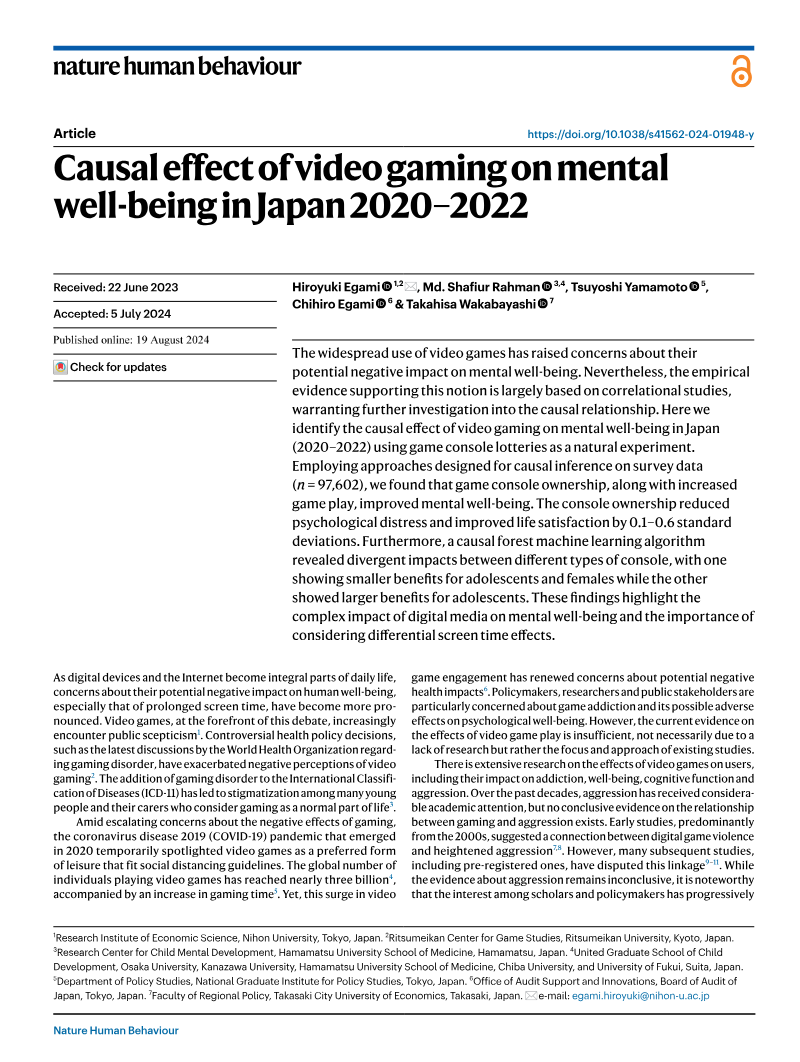
Causal Effect of Video Gaming on Mental Well-Being in Japan 2020–2022

Evidence from a natural experiment conducted in Japan between 2020 and 2022 demonstrates that video game ownership and increased play time exert a positive causal influence on mental well-being and life satisfaction. By leveraging the unique lottery-based distribution of gaming consoles during pandemic-related supply shortages, researchers analyzed data from over 97,000 respondents to isolate the effects of gaming from self-selection bias. The findings indicate that winning a console lottery reduced psychological distress by 0.1 to 0.6 standard deviations, directly challenging traditional correlational studies that often associate gaming with negative mental health outcomes.

The magnitude of these psychological benefits varies significantly across different demographic groups and hardware platforms. Machine learning analysis reveals that the Nintendo Switch offers more pronounced well-being improvements for adolescents and female users, whereas the PlayStation 5 provides stronger positive effects for adult males and dedicated gamers. While the overall impact of gaming remains positive, the data suggests a threshold of diminishing returns, as the benefits to mental health and life satisfaction begin to decline after three hours of daily play.

The scope of this research is specifically focused on the Japanese market during the COVID-19 pandemic, a period characterized by heightened social isolation and restricted physical activity. These environmental factors may have amplified the observed positive effects, as gaming served as a primary tool for digital engagement and stress mitigation. Despite these contextual considerations, the use of instrumental variable causal forests and propensity score matching provides a rigorous statistical foundation for the conclusion that moderate video game consumption serves as an effective intervention for improving psychological health.

  • Winning a gaming console lottery during the 2020–2022 Japanese supply shortages reduced psychological distress by 0.1 to 0.6 standard deviations, establishing a positive causal link between gaming and mental well-being.
  • The positive impact of video games on mental health and life satisfaction follows a threshold effect, with benefits beginning to decline after three hours of daily play.
  • Nintendo Switch ownership provides the most pronounced well-being improvements for adolescents and female users, while the PlayStation 5 yields stronger benefits for adult males and dedicated gamers.
  • The study utilized data from over 97,000 respondents to isolate the effects of gaming from self-selection bias, effectively challenging prior correlational research that linked gaming to negative mental health outcomes.
  • The observed psychological benefits were likely amplified by the COVID-19 pandemic environment in Japan, where gaming functioned as a critical tool for digital engagement and stress mitigation during periods of social isolation.
Springer Science and Business Media LLCJan 2024
Page 1
Report111 pages

Annual Universe of Positive Gaming Experiences 2024

Stillfront Group’s 2024 fiscal year marks a pivotal transition into a synergy-driven operational phase, characterized by a major geographic reorganization into Europe, North America, and MENA & APAC business areas. This strategic shift aims to drive efficiency and mitigate a 2% organic revenue decline, which resulted in total net revenues of 6,737 MSEK. The financial year was defined by a significant net loss of 7,378 MSEK, primarily driven by a 6.9 billion SEK goodwill impairment in the North American segment due to lower-than-expected growth. Despite these non-cash charges, the group maintained a resilient financial foundation, generating over 1 billion SEK in free cash flow and improving gross margins to 80% through successful direct-to-consumer initiatives.

The group’s portfolio remains focused on free-to-play franchises, with North America and Europe accounting for 71% of player bookings. To reduce dependency on third-party platforms, which still facilitate 54% of revenue, management is prioritizing its internal payment systems and the "Stillops" platform for cost optimization. A comprehensive cost-savings program is underway, targeting up to 250 MSEK in annual savings by late 2025. Leadership has also stabilized under a new CEO and a board that remains fully compliant with the Swedish Code of Corporate Governance, focusing on organic growth and franchise scaling over dividend distributions.

Sustainability and governance have been deeply integrated into the corporate strategy in preparation for the EU’s Corporate Sustainability Reporting Directive. The group achieved Science Based Targets initiative validation, reducing market-based greenhouse gas emissions by 7% and more than doubling its renewable energy share to 37%. While social metrics show a stable workforce with improved turnover rates and high data security standards, challenges remain in gender diversity at the executive level. Executive remuneration is now tied to long-term sustainability targets, including employee satisfaction and data privacy, ensuring that environmental and social governance remains central to the group’s long-term value creation.

  • Stillfront Group reported a net loss of 7,378 MSEK for fiscal year 2024, largely driven by a 6.9 billion SEK goodwill impairment in its North American segment.
  • Total net revenues reached 6,737 MSEK, reflecting a 2% organic revenue decline that prompted a major geographic reorganization into Europe, North America, and MENA & APAC.
  • Despite the net loss, the company generated over 1 billion SEK in free cash flow and improved gross margins to 80% through direct-to-consumer initiatives.
  • Management is executing a cost-savings program targeting 250 MSEK in annual savings by late 2025 while prioritizing internal payment systems to reduce reliance on third-party platforms, which currently account for 54% of revenue.
  • The company is shifting focus toward organic growth and franchise scaling, with 71% of player bookings currently concentrated in North America and Europe.
+1
StillfrontJan 2024
Page 1
Report9 pages

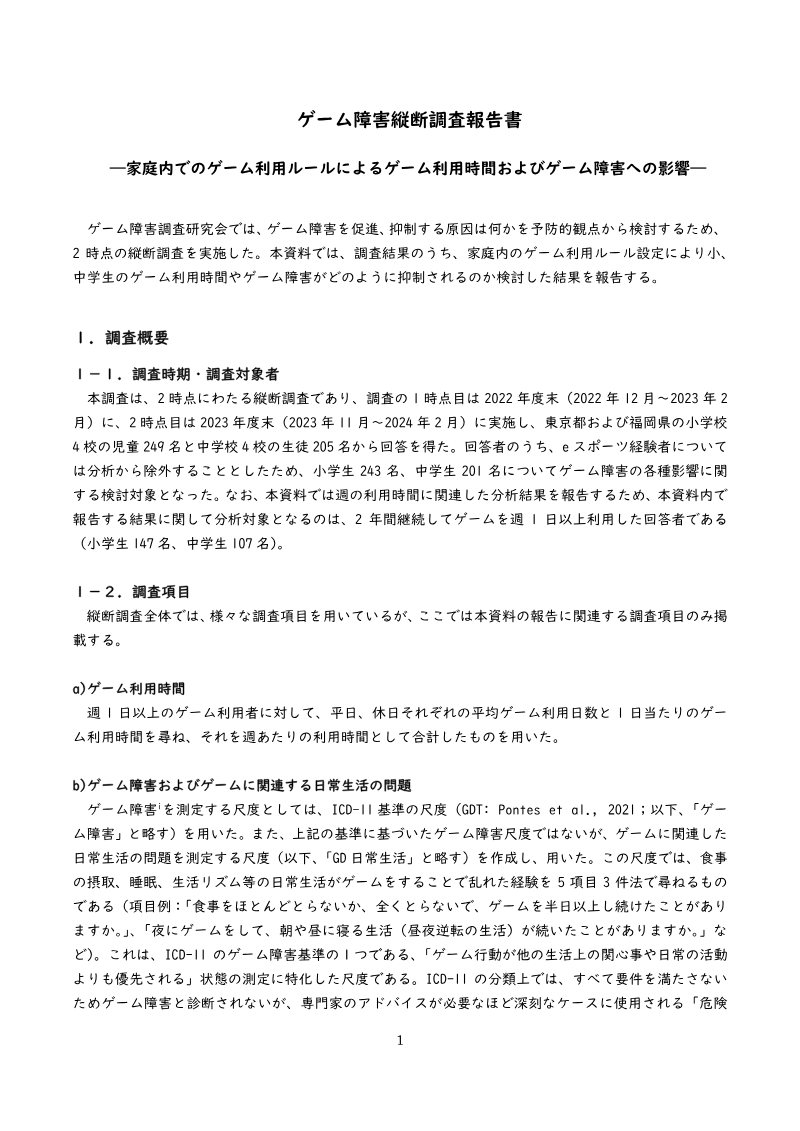
Longitudinal Survey Report on Gaming Disorder: Japan

The study investigates how household rules governing video‑game use influence weekly play time and the emergence of gaming disorder among Japanese elementary and middle‑school students. By tracking participants over two survey waves—late 2022 to early 2023 and late 2023 to early 2024—the research tests whether specifying permissible gaming periods or prohibiting certain times can curb excessive play and related daily‑life problems.

A longitudinal sample was drawn from four elementary schools and four middle schools in Tokyo and Fukuoka, yielding 243 elementary and 201 middle‑school respondents after excluding esports players. Analyses focused on the 147 elementary and 107 middle‑school students who reported gaming at least once per week across both waves. Weekly gaming hours were calculated from weekday and weekend use, while gaming disorder was measured with the ICD‑11‑based Gaming Disorder Test and a custom scale assessing disruptions to sleep, meals, and routine. The presence of two rule types—“allowed‑time” (e.g., one hour per day) and “prohibited‑time” (e.g., no gaming after midnight)—was recorded at each wave and examined using cross‑lagged models and mixed‑design ANOVAs.

Results show that higher weekly gaming hours predict later increases in gaming‑disorder scores for both age groups (standardized coefficients .12 for elementary and .11 for middle‑school students), while disorder does not feed back into later play time. Gaming hours and daily‑life problems mutually reinforce each other, forming a negative feedback

  • Increased weekly gaming hours serve as a significant predictor for higher gaming disorder scores, with standardized coefficients of .12 for elementary students and .11 for middle-school students.
  • Gaming hours and daily-life problems, such as disruptions to sleep and meals, create a negative feedback loop where each factor mutually reinforces the other.
  • Gaming disorder symptoms do not appear to influence or increase future weekly play time, suggesting that excessive play is the primary driver of disorder rather than a consequence of it.
  • The study tracked 254 total students—147 elementary and 107 middle-schoolers—who played games at least once per week across two survey waves between late 2022 and early 2024.
  • Research methodology utilized the ICD-11-based Gaming Disorder Test and a custom scale to measure the impact of household rules, specifically 'allowed-time' limits and 'prohibited-time' restrictions.
+1
CESA – Computer Entertainment Supplier's AssociationJan 2024
Page 1
Whitepaper127 pages

Guide to Game Literacy: Improving Understanding of Games

The guide establishes game literacy as the capacity to comprehend, critique, and responsibly engage with video games, extending traditional media‑literacy to encompass rules, interactive systems, cultural influence, and self‑control. It argues that cultivating this competency is essential for healthy digital participation and for linking gaming to broader STEAM learning and career pathways.

Empirical evidence from a 2023 Korean survey shows that 86 % of adolescents play video games, with 71 % classified as general users, 12 % as adaptive, and 3 % as problematic. Parental awareness markedly differentiates groups—78.5 % of adaptive gamers report informed parents versus 60.2 % among problematic gamers—underscoring the need for literacy programs targeting youths, parents, teachers, and administrators. The curriculum is organized around four pillars: understanding games and culture, education‑facilitating games, game ethics, and game careers, and is delivered through age‑specific, spiral‑learning modules from early childhood through high school, complemented by specialized teacher training.

A coordinated ecosystem involving schools, families, policymakers, developers, researchers, and sponsors is presented as vital for fostering “good gamers.” Internationally, the framework draws on initiatives such as Finland’s Assembly festival, Germany’s Schau Hin, the UK’s BFI/Futurelab programs, and North American platforms, while highlighting Korea’s G‑School teacher‑training system and the “Good Gamer” rating‑compliance program. Comparative analysis of rating bodies—from Europe’s PEGI and Germany’s USK to the ESRB, CERO, IGRS, and Singapore’s classifications—demonstrates a universal aim to shield minors through age‑tiered content limits.

Economic context is provided by the United Kingdom, the world’s fifth‑largest gaming market, which generated roughly £4 billion in 2022 and is projected to reach £10 billion by 2030, with the gamer population expanding from 33.4 million in 2019 to an estimated 38.5 million by 2025. Together, these findings support the thesis that comprehensive, multi‑stakeholder game‑literacy education is a prerequisite for a sustainable, ethically aware, and economically vibrant gaming culture worldwide.
  • Parental involvement is a critical determinant of healthy gaming habits, as 78.5% of adaptive gamers have informed parents compared to only 60.2% of those classified as problematic.
  • The UK gaming market is projected to grow from £4 billion in 2022 to £10 billion by 2030, with the national gamer population expected to reach 38.5 million by 2025.
  • A 2023 Korean survey indicates that 86% of adolescents play video games, with the user base segmented into 71% general users, 12% adaptive users, and 3% problematic users.
  • Effective game literacy requires a multi-stakeholder ecosystem involving schools, families, policymakers, and developers to promote ethical engagement and link gaming to STEAM career pathways.
  • Global efforts to protect minors rely on a standardized approach to age-tiered content regulation, utilizing systems such as PEGI (Europe), USK (Germany), ESRB (North America), CERO (Japan), and IGRS (China).
K-GAMES – Korea Association of Game IndustryJan 2024

Publishers

Related Topics