Monetization reports and market data
Documents
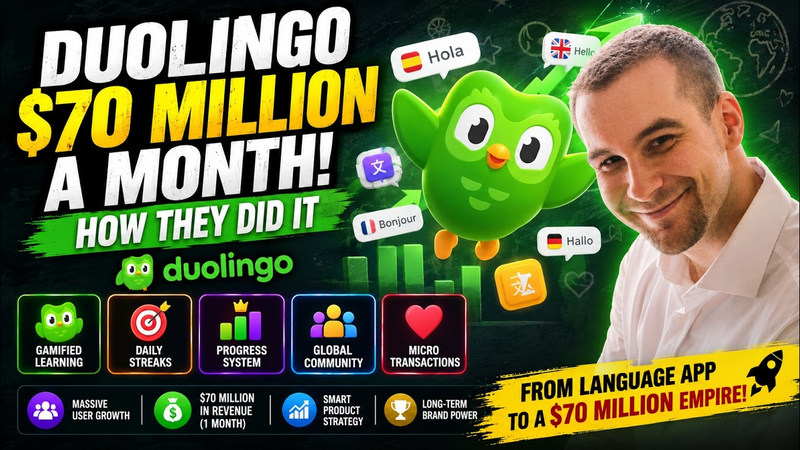
🦉Making $70 Mil. a month ? How Duolingo is plundering all the game mechanics 👀
Duolingo has successfully transitioned from a traditional language-learning tool into a highly gamified application, achieving record-breaking performance with approximately $70 million in monthly revenue, 20 million monthly downloads, and 90 million daily active users.
- Duolingo has achieved $70 million in monthly revenue, 20 million monthly downloads, and 90 million daily active users by integrating sophisticated mobile game mechanics into an educational utility app.
- The platform utilizes a progression-based 'saga' map and an energy system that replaces restrictive life mechanics to drive consistent daily engagement.
- Retention is bolstered by reward structures modeled after titles like Brawl Stars, including daily quest systems, chest-based rewards, and collectible virtual item albums.
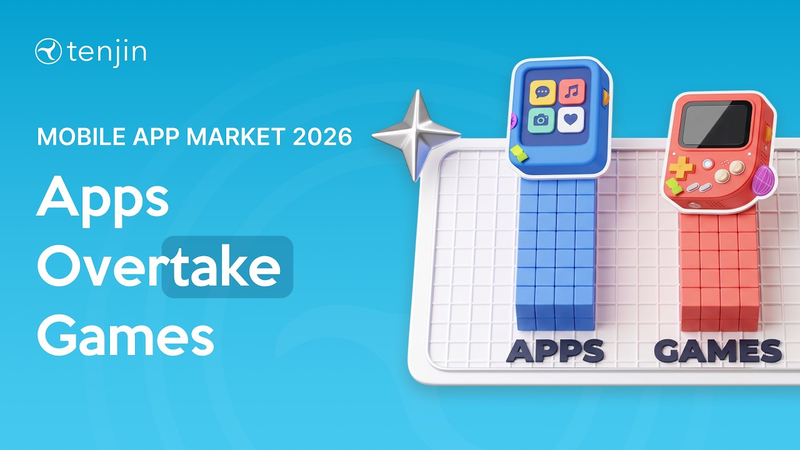
Mobile App Trends 2026: Downloads & Revenue by Category and Country
The mobile app market is currently defined by a stark concentration of wealth, where the top ten non-gaming applications on Google Play capture 39% of total revenue.
- The mobile app market is experiencing a high-risk, high-reward environment where top-tier apps, such as TikTok, ChatGPT, and Gemini, account for 39% of total non-gaming revenue.
- New app submissions to Google Play and iOS surged by approximately 100% over a 15-month period, rising from 46,000 new apps per month in March 2025 to 110,000 by July 2026, largely driven by the rise of 'vibe coding'.
- Growth in the non-gaming sector is increasingly driven by maximizing the lifetime value of existing users rather than expanding the total user base, as evidenced by a widening gap between download volume and revenue growth.
Could Game Pass get a tier with ads soon?
Microsoft is reportedly evaluating a tiered Xbox Game Pass model for 2027, potentially introducing an ad-supported subscription option to supplement its standard offerings.
- Microsoft is reportedly considering a new, lower-priced Xbox Game Pass tier that includes advertisements and excludes day-one game releases, potentially signaling a shift away from their previous high-price subscription strategy.
- Roblox is expanding its platform strategy by allowing developers to release standalone applications for their games on PC, console, and mobile, a move that complicates the traditional relationship between game engines and storefronts.
- The Triple-I Initiative, a showcase focused on mid-market indie games, is transitioning to a twice-yearly event schedule starting October 8, aiming to highlight titles that generate significant wishlists without relying on major AAA publishers.
How 15 People Built a $50M Mobile Studio After a Failed Sale | Michael Martinez, FunCraft
FunCraft demonstrates that a lean, high-output mobile studio can achieve significant financial scale by prioritizing operational efficiency and rapid iteration over traditional development cycles.
- FunCraft achieved a $50 million annual revenue run rate with a lean team of only 15 people, resulting in $2.4 million in revenue per employee.
- The studio utilizes a proprietary HTML5 engine to maintain a rapid development cycle, allowing for the launch of new titles in as little as six weeks.
- The business model relies on a portfolio-based strategy that aggregates revenue across multiple turn-based titles rather than depending on a single hit franchise.
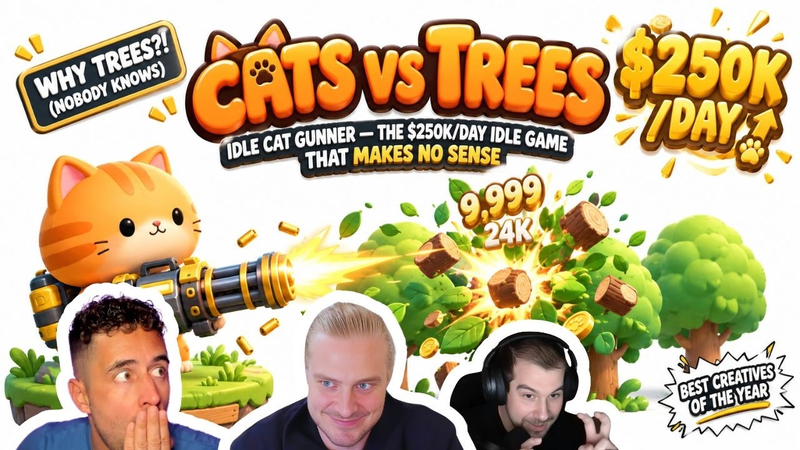
🐱 A Cat Shooting Trees: Idle Cat Gunner & the best creatives of the Year
Idle Cat Gunner has emerged as a dominant force in the mobile idle gaming sector, currently securing the number two position for in-app purchase revenue within its category.
- Idle Cat Gunner currently generates between $200,000 and $250,000 in daily revenue, securing the number two position for in-app purchase revenue in the mobile idle gaming category.
- The game utilizes a minimalist design that removes complex mechanics like enemy AI and defensive requirements, focusing instead on a simplified merge-weaponry progression loop.
- Monetization is driven by a multi-faceted architecture that includes battle passes, auto-upgrade packages, tiered offers, rewarded ads, and offer walls.

D2C is a go to market strategy, not a trend | Inês Ramalho from Xsolla
Direct-to-consumer (D2C) strategies have transitioned from an emerging trend to a fundamental go-to-market necessity for gaming studios of all sizes.
- Direct-to-consumer (D2C) web shops have transitioned from an emerging trend to a standard go-to-market strategy for game studios of all sizes, with Xsolla currently supporting over 700 such storefronts.
- D2C strategies allow developers to bypass traditional app store fees and gain access to granular player data, providing transparency into spending habits and engagement that is often unavailable in the 'black box' environment of major app stores.
- The primary operational challenge for studios adopting D2C is managing the complexities of global payments, legal compliance, and regulatory requirements, while the primary player-facing challenge is building trust in the external checkout process.

Why Rewarded UA Is Built for Indie Studios
Rewarded user acquisition (UA) has emerged as a critical growth strategy for indie and small mobile game studios, offering a viable alternative to the high-cost, long-payback environments of traditional performance networks.
- Rewarded user acquisition (UA) offers indie studios a competitive advantage over traditional performance networks by providing lower breakeven points and faster paths to ROI, which is critical for studios with limited cash flow.
- Rewarded users should be segmented separately from organic or video-network users because they exhibit higher retention rates and a greater tolerance for ad exposure due to their incentivized nature.
- Standard 7- or 14-day segmentation models are ineffective for rewarded traffic, as the majority of user behavior and monetization occurs within the first 1 to 3 months.
The state of Japan's video game industry, plus how GTA 6 influenced Valor Mortis' $40 price point
Japan’s video game industry remains a global powerhouse, anchored by the enduring success of console giants like Nintendo and Capcom.
- Japan’s video game market generates $17 billion annually, with the $12 billion mobile sector facing increased competition from Chinese developers like Tencent and NetEase.
- PC gaming in Japan has more than doubled its market share since 2019, driven by pandemic-era consumer habits and increased publisher support.
- Lyrical Games is pricing its upcoming title, Valor Mortis, at $40 to position it as a high-value 'triple-I' alternative to massive AAA releases like GTA 6.
TWIG #401: Blizzard Goes All In, Roblox Breaks Out of Its Own App and Aniimo Nails Launch Day
The gaming industry is currently defined by a tension between aggressive expansion strategies from established giants and the emergence of high-performing independent titles.
- Blizzard Entertainment is aggressively expanding its production pipeline under Microsoft, with active development on multiple World of Warcraft iterations, a new Diablo title, and an open-world StarCraft shooter.
- Independent titles are finding significant market success by differentiating from platform shooters, evidenced by Wardogs reaching 2.2 million sales with 430,000 peak concurrent users and Aniimo hitting 125,000 concurrent users on Steam.
- Roblox is attempting to break out of its walled garden by launching standalone apps and browser-based play to improve discoverability and compete with broader free-to-play ecosystems.
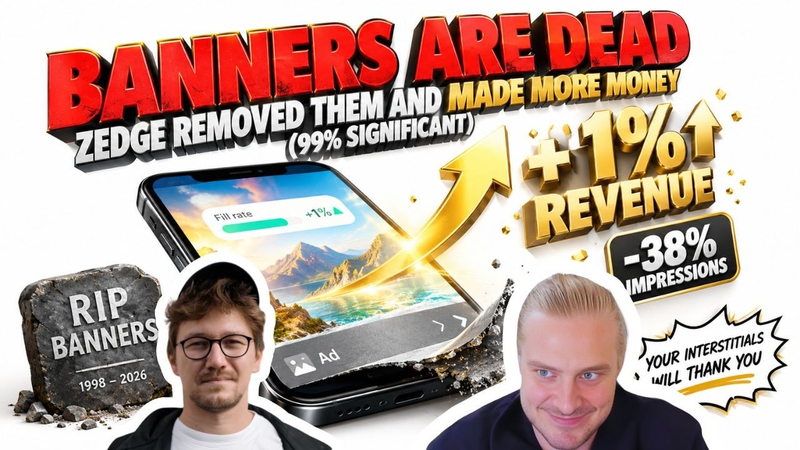
🪦 Are Banners Dead? Zedge Removed Them, Cut 38% of Impressions, and Made MORE Money
A recent experiment conducted by Zedge, a personalization app with 721 million installs, challenges the long-standing industry assumption that banner advertisements are a necessary component of mobile monetization.
- Zedge removed all banner advertisements from its app, resulting in a 38% reduction in total ad impressions while simultaneously increasing overall revenue by 1%.
- The removal of banners led to a 1.77% improvement in primary user engagement metrics, suggesting that banner-free environments foster better user retention.
- Eliminating banners consolidated ad demand into higher-value formats like interstitial and rewarded video ads, which saw significant gains in fill rates and performance.

Blizzard is Microsoft's Hidden Weapon?
Recent industry developments highlight significant shifts in consumer behavior, corporate restructuring, and studio leadership performance.
- Blizzard Entertainment achieved its third-highest fiscal year revenue in history during FY26, marking the studio's first back-to-back growth years since FY17.
- Blizzard's financial turnaround was driven by re-entering the Chinese market, a disciplined release cadence of one to two major titles annually, and a successful rebranding of the Overwatch franchise.
- Grand Theft Auto 6 consumer demand is skewing toward premium products, with pre-orders for the $100 Ultimate Edition currently outpacing the $80 standard version.

The Real Math on Cohort Financing (And Why You're Losing Money)
Cohort financing serves as a critical growth engine for mobile game studios, enabling them to scale user acquisition (UA) beyond the limitations of organic cash flow.
- Prioritize structural flexibility and clear exit clauses over headline interest rates when selecting a financing partner to ensure the studio can navigate periods of underperformance.
- Avoid duration mismatches by ensuring that financing terms align with the actual growth trajectory of the game, as using short-term debt for long-term strategies risks liquidity crises.
- Maintain a conservative financial buffer to protect core operational costs, such as payroll and server expenses, from aggressive lender amortization triggered by cohort underperformance.