Mergers & Acquisitions reports and market data
Documents
Ubisoft’s $1.25B Tencent Bailout: A Masterclass in Corporate Defense—or Malfeasance?
Ubisoft is currently navigating a complex financial restructuring involving a $1.25 billion investment from the Chinese conglomerate Tencent.
- Ubisoft has secured a $1.25 billion investment from Tencent, which involves moving core intellectual properties like Assassin’s Creed, Far Cry, and Rainbow Six into a newly created subsidiary.
- Tencent has acquired a 25% stake in this new subsidiary, a move designed to provide immediate liquidity to Ubisoft while insulating the company from potential hostile takeovers.
- The deal is structured as a subsidiary investment rather than a direct buyout to bypass French foreign investment regulations and avoid triggering change-of-control provisions.
Week in Mobile Games E48 - Nintendo Switch 2 release date reaction & Tencent's bizarre Ubisoft deal
The Nintendo Switch 2 is positioned to redefine the console market upon its June 5th launch, carrying a base price of $450.
- The Nintendo Switch 2 is scheduled for a June 5th launch with a $450 base price, featuring 4K output, 120fps support, 256GB storage, magnetic Joy-Cons, and face-tracking cameras.
- Tencent has increased its strategic influence over Ubisoft through a $1.25 billion investment structure, reflecting a broader industry trend of consolidation.
- Market analysts project the Nintendo Switch 2 platform will generate $7 to $8 billion in total content potential.

TWIG #325 Ubisoft Bails Out, AppLovin Fights Back, Roblox Becomes an Ad Network
The global gaming industry is currently navigating a period of intense structural realignment, characterized by aggressive monetization shifts, strategic corporate restructuring, and evolving regulatory landscapes.
- Ubisoft has secured a $1.25 billion investment from Tencent, a defensive move designed to maintain founder control and bypass regulatory scrutiny through a subsidiary structure.
- Roblox is scaling its advertising business via programmatic partnerships with Google to monetize its Gen Alpha user base, though it continues to struggle with regional CPM disparities.
- Mobile developers are increasingly bypassing platform fees by pivoting to direct-to-consumer web stores and rewarded advertising to offset the impact of post-IDFA data limitations.
Video game investors on 2025: "It's tough, but there is optimism"
The investment landscape for the video game industry in 2025 is characterized by a shift toward a new, more disciplined normal.
- The era of speculative, easy capital for concepts like the metaverse and Web3 has ended, replaced by a requirement for financial self-sufficiency and high-quality, playable prototypes.
- Early-stage venture capital volume remains resilient and currently exceeds pre-pandemic levels, despite a broader decline in total deal values across the industry.
- Investors are shifting their preference away from AAA veterans seeking large budgets toward 'scrappy' founders with proven entrepreneurial track records.

TWIG #322 Farmville, Pokemon Go, and Female Gamers
The mobile gaming landscape is currently defined by high-stakes consolidation and a strategic pivot toward sustainable monetization.
- The mobile gaming industry is shifting away from hypercasual models toward hybrid monetization and in-app purchases, as evidenced by Tripledot’s acquisition of AppLovin’s gaming division.
- Firms transitioning from hypercasual to live-service models face a critical 100-day window to implement effective monetization strategies to mitigate the risks of integrating fragmented portfolios.
- Revenue growth in the mobile sector is increasingly concentrated in the United States and is driven by hybrid monetization rather than pure download volume.

Pocket Gamer Reacts: Breaking down Scopely's blockbuster $3.5bn deal for Niantic's games business
Scopely’s acquisition of Niantic’s games business for $3.5 billion represents a major consolidation within the mobile gaming sector, signaling a strategic pivot for both organizations.
- Scopely has acquired Niantic’s games business for $3.5 billion, taking over the development and live-service operations for titles including Pokémon GO, Monster Hunter Now, and Pikmin Bloom.
- Pokémon GO remains the primary financial anchor of the deal, having generated over $8.5 billion in lifetime gross revenue.
- Niantic is pivoting to focus on geospatial AI technology, supported by a $250 million funding round that includes a strategic investment from Scopely.
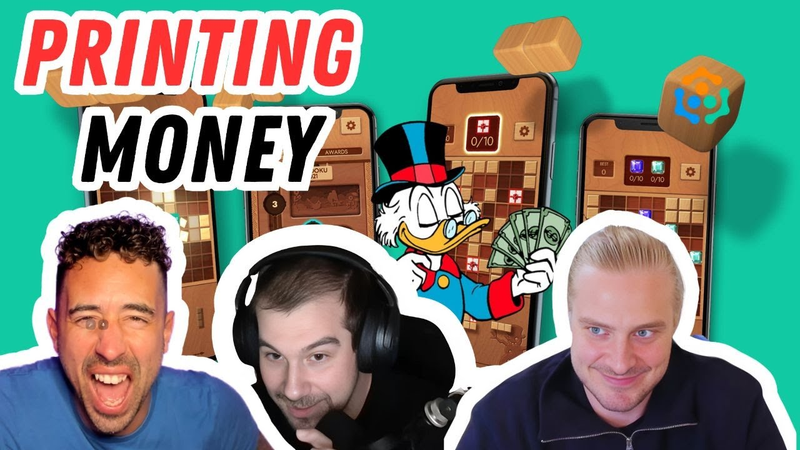
Who is Tripledot & what do they do? The History, games portfolio & estimated profits
Tripledot Studios, a UK-based developer founded in 2017, has established itself as a dominant force in the casual gaming sector by prioritizing high-volume, ad-monetized titles.
- Tripledot Studios generates an estimated $320 to $380 million in annual revenue with profit margins of approximately 40%, resulting in $150 to $200 million in yearly profit.
- The company maintains a dominant position in the casual gaming market with 10 million monthly downloads and 8.3 million daily active users.
- Tripledot’s core business model relies on high-volume, ad-monetized evergreen puzzle games like Woodoku, Triple Tile, and Math Crossword, which bypass the 30% platform tax associated with in-app purchases.

Week in Mobile Games E45 - Tripledot's surprise acquisition of AppLovin's games business
Tripledot Studios is significantly expanding its market footprint through the acquisition of AppLovin’s games division in a transaction valued at $900 million, split between $500 million in cash and $400 million in equity.
- Tripledot is set to acquire AppLovin’s games business in a deal valued at approximately $500 million in cash and $400 million in buyer equity, with the potential for $250 million in additional financing via a promissory note.
- Ludia plans to hire 50 new staff members over the next year and pursue M&A activity to acquire mobile studios following its management-led buyout from Jam City.
- Shift Up’s 'Goddess of Victory: Nikke' has surpassed $1 billion in lifetime mobile revenue, with Japanese players contributing 58% of total spending.

TWIG #321 AppLovin’s SHOCK Acquirer, Monster’s Gone WILD, and Guitar Hero’s $1B CORPSE
The global gaming industry is currently navigating a period of intense structural realignment, characterized by strategic consolidation and a pivot toward high-stakes intellectual property.
- Savvy Games Group’s $3.5 billion acquisition of Scopely signals a shift toward long-term institutional investment from Saudi Arabia, prioritizing permanent industry influence over short-term vanity projects.
- Tripledot acquired AppLovin’s game division for $900 million, reflecting a broader trend of unexpected market consolidation as companies seek to scale operations.
- Supercell is shuttering Space Ape to centralize operations in London, signaling a strategic pivot away from niche puzzle games toward ambitious, real-time action titles.


Games Investment Review: Q1 2025 Executive Summary Report
The Q1 2025 Games Investment Review provides a comprehensive analysis of global financial activity within the video game industry, covering investments, mergers and acquisitions (M&A), and initial public offerings (IPOs).
- Global gaming investment and M&A activity reached $7.8 billion across 245 transactions in Q1 2025, marking the highest quarterly total since late 2023.
- Investment value surged 370% quarter-over-quarter to $4.4 billion, largely driven by a single $3.0 billion mid-to-late-stage investment in Infinite Reality.
- New fund announcements hit a three-year peak of $21.8 billion, with 65% of that capital concentrated within just five major funds.
Week in Mobile Games E43 - NetEase scales back, Jam City's Ludia sale, & why Savvy wants Pokémon Go
The global mobile gaming industry is undergoing a period of significant structural realignment characterized by aggressive cost-cutting, divestment, and a pivot toward core competencies.
- Niantic is reportedly exploring the sale of its gaming portfolio, including Pokémon GO, to Scopely as it seeks to pivot toward becoming a pure technology provider.
- NetEase is scaling back its U.S.-based development operations to refocus on domestic production, signaling a shift away from expensive Western studio acquisitions.
- Unity’s stock price surged despite a 25 percent decline in revenue and substantial losses, driven by investor confidence in the company's new cost-reduction and portfolio adjustment measures.

TWIG #319 Scopely 💰 Niantic, Marvel Rivals Drama, and Xbox in Downfall?
The gaming industry is currently navigating a period of significant structural realignment, characterized by aggressive consolidation, shifting consumer demographics, and the struggle to maintain growth in a stagnant market.
- The console market has shifted into a zero-sum environment where Sony is consistently gaining market share at the expense of Microsoft.
- Niantic’s gaming division is currently the subject of acquisition rumors at a valuation of $3.5 billion, highlighting the ongoing struggle to sustain growth in the location-based augmented reality sector.
- Chinese firms like NetEase are pivoting away from costly Western satellite studios, signaling a broader industry-wide shift toward lean operations and away from speculative expansion.