Marketing reports and market data
Documents

Winning the Game: Leveraging Contextual Bandits for Creative Optimization - Joseph Iris, Persona.ly.
Contextual bandits represent a sophisticated evolution in machine learning for creative optimization within the mobile gaming industry.
- Contextual bandits, a subset of reinforcement learning, outperform traditional A/B testing by dynamically allocating traffic to creative variations to minimize exploration costs while maximizing performance goals.
- Contextual bandit algorithms improve upon standard Thompson sampling by incorporating additional data layers—such as user behavior, app context, and creative metadata—to tailor ad delivery to specific audience segments.
- Machine learning models can automatically identify creative preferences for different user cohorts, as demonstrated by an Alien Invasion campaign where idle and RPG players were served distinct, game-relevant creative mechanics without manual intervention.

Kicking off 2024 for iOS Device IDs, Privacy Manifests & SKAN - David Philippson, Dataseat.
The evolution of iOS advertising is defined by a consistent, long-term shift toward user privacy and the systematic elimination of device-level tracking.
- Apple is mandating privacy manifests and 'required reasons' APIs by spring 2024, which explicitly prohibit fingerprinting regardless of user consent status.
- App developers are now legally and operationally responsible for auditing all third-party SDKs to ensure compliance with Apple's data collection and tracking disclosure requirements.
- Common app functionalities, such as checking disk space for updates, now trigger mandatory privacy manifest disclosures regarding data collection and tracking domains.

Introducing Kwalee's New Publishing Platform - Muhammad Waqas Khan, Kwalee.
Kwalee is launching a new publishing platform designed to serve as an intuitive, data-driven ecosystem for mobile game developers.
- Kwalee has launched a centralized, zero-cost publishing platform designed to provide independent mobile developers with data-driven insights and professional resources.
- The platform features a three-step submission process and a lightweight, automated SDK that provides developers with real-time dashboard analytics and KPI tracking.
- Developers gain direct access to Kwalee’s internal engineering, QA, and creative teams, alongside a centralized file management system and the Kwalee Academy educational hub.

Leveraging Data Analytics for Game Advertising & Marketing - Summer Liu, SocialPeta.
This analysis of global game advertising trends throughout 2023 highlights a significant increase in user acquisition activity, characterized by a 49% year-over-year growth in active advertisers.
- Active game advertisers grew by 49% year-over-year in 2023, with publishers producing an average of over 150 creatives per advertiser annually.
- The demand for constant content freshness is high, as new ad creatives accounted for more than 80% of total output in the second half of 2023.
- Video remains the dominant advertising format at 70% of all creatives, with the majority of these assets lasting 30 seconds or less.

How to create authenticity in video advertising | Itai Raveh from Uplifted
The modern digital advertising landscape is undergoing a significant shift away from high-production, cinematic commercials toward authentic, user-generated content (UGC).
- Advertisers are shifting from high-production cinematic commercials to authentic, user-generated content (UGC) to combat consumer 'ad blindness' and skip rates.
- Following iOS 14 privacy restrictions that limited behavioral data, creative assets have become the primary mechanism for targeting specific demographics.
- Brands can effectively target audiences by producing a high volume of diverse creatives featuring varied topics, ages, and backgrounds, allowing the content itself to act as the targeting filter.

Panel: Mobile Gaming Revolution: Tackling UA Challenges & Pioneering Future Opportunities.
The mobile gaming industry is currently navigating a critical transition as traditional reliance on device identifiers and probabilistic matching becomes increasingly untenable.
- The mobile gaming industry is shifting away from device identifiers and probabilistic matching toward a privacy-first architecture to comply with mandates like the Digital Markets Act.
- Adopting Consent Management Platforms can increase eCPMs by 10% to 120% by enabling access to premium brand-advertiser budgets.
- Publishers must integrate technical solutions such as Google Consent Mode and Apple’s SKAdNetwork to mitigate policy-driven disruptions and maintain measurement capabilities.

Levelling up in the new era: Unlocking Success Amidst Evolving Marketing & Privacy Regulation.
The mobile gaming industry is currently navigating a transformative period defined by stringent privacy regulations and shifting market policies.
- The Digital Markets Act (DMA) is expected to be the most significant industry disruptor over the next 18 months, potentially enabling third-party app stores and alternative payment systems that bypass traditional platform fees.
- Privacy-centric frameworks like Apple’s App Tracking Transparency (ATT) and Google’s Consent Management Platform (CMP) have restricted traditional performance marketing, contributing to a measurable decline in consumer spending since 2021.
- Developers should mitigate reliance on platform-gated advertising by diversifying user acquisition through influencer partnerships, out-of-home advertising, and community-building platforms such as Discord and Reddit.
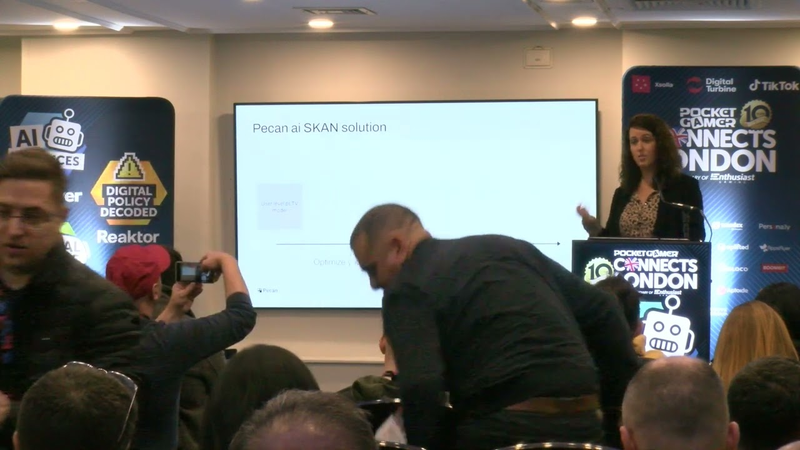
How to Leverage Predictive Analytics to Enhance iOS Marketing Performance - Keren Gritzman, Pecan.ai
Predictive analytics serves as a critical tool for mobile game developers seeking to regain marketing visibility and optimize user acquisition in the post-Apple App Tracking Transparency (ATT) landscape.
- Apple’s SKAdNetwork (SKAN) limits attribution to aggregated, delayed data within the first 24 hours, forcing marketers to rely on incomplete short-term metrics like Day 1 or Day 7 ROAS.
- Machine learning models can analyze early engagement and revenue patterns to forecast long-term metrics such as Day 30, 90, or 180 Lifetime Value (LTV).
- Integrating predictive signals into a customized SKAN conversion schema allows marketers to distribute predicted revenue across campaigns, enabling budget decisions based on long-term value rather than immediate snapshots.

Evolution of Mobile UA: AI Lessons From Gamelight - Valentina Bailly & Julia Scurtul.
The evolution of mobile user acquisition (UA) is increasingly defined by the integration of sophisticated artificial intelligence, which shifts the industry away from manual, demographic-based targeting toward automated, data-driven personalization.
- AI-driven targeting significantly outperforms manual methods by identifying non-obvious audience segments, resulting in performance gains such as a 400% increase in day-seven ARPU for top-grossing RPG titles.
- Gamelight optimizes user acquisition by analyzing real-time behavioral data and limiting recommendations to four games per user, which maximizes ROAS and ARPU by focusing on high-intent, loyal players.
- Unlike traditional demographic-based targeting, AI models continuously self-optimize using historical and real-time data, which minimizes the campaign learning phase and allows for immediate performance adjustments.

Click is not a Click: Measure the True Value of Your app Campaigns - Ben Jeger, Moloco
The modern mobile app marketing landscape faces a significant measurement crisis characterized by the decoupling of user intent from recorded engagement metrics.
- Traditional click-through rates (CTR) have become unreliable due to the widespread practice of automated background click-firing, which artificially inflates engagement metrics to maintain attribution in privacy-restricted environments.
- The 2021 introduction of Apple’s App Tracking Transparency (ATT) framework accelerated the decoupling of user intent from recorded engagement, forcing marketers to rely on flawed data that obscures actual campaign performance.
- Ad networks and publishers are incentivized to prioritize volume over quality, leading to deceptive creative practices like fake 'X' buttons and interstitial loops that degrade long-term user retention.

From Prototype to Stardom Early Stage UA Tactics for New Game Prototypes - Product Madness.
The process of transitioning a game from an early-stage prototype to a successful global launch requires a disciplined, data-driven approach to user acquisition (UA).
- Integrate User Acquisition (UA) strategies during the prototype phase to validate marketability and keep product development grounded in player demand rather than internal vision.
- Conduct thorough market analysis before development by identifying genre competitors, their revenue and download shares, and requesting CPI and CPM benchmarks from UA channel managers.
- Use early-stage creative testing—such as gameplay-focused videos illustrating the core loop—to gauge audience interest and validate design choices before a full live build is completed.

AI video is Already App-ening - João Vieira da Costa, Replai.io
The integration of generative AI into video creative production is transforming mobile game marketing by shifting workflows from subjective, gut-based decision-making to data-driven, scalable factory processes.
- Generative AI and computer vision enable mobile game studios to automate the production of thousands of video variations per month, shifting creative workflows from subjective decision-making to data-driven processes.
- The 'data-to-video' pipeline uses computer vision to automatically tag in-game elements like characters and calls to action, creating a metadata-based source of truth that links specific visual components to performance metrics.
- Studios can now internalize creative production previously outsourced to agencies by using AI to execute complex tasks such as automated resizes, text translation, lip-syncing, and cultural adaptation.