Marketing reports and market data
Documents

Why Slay the Spire 2 exploded: Review
Slay the Spire 2 has established a new benchmark for indie success, generating over $100 million in revenue within its first two weeks of early access.
- Slay the Spire 2 generated over $100 million in revenue within its first two weeks of early access, with long-term projections estimating total earnings between $250 million and $500 million.
- The game’s launch was driven by massive organic momentum, supported by 2.5 million wishlists and a pre-existing community of 670,000 Reddit users.
- The title achieved significant market visibility during its initial launch week, recording 4 million hours of viewership on Twitch.

Influencer Marketing in mobile games actually explained by Marion Balinoff
Influencer marketing in the mobile gaming sector functions most effectively when treated as a performance-driven channel rather than a branding exercise.
- Treat influencer marketing as a performance-driven channel with a specific goal of achieving a 25% increase in daily organic installs.
- Concentrate campaign activity into a three-day window to generate the momentum necessary to trigger algorithmic recognition in app stores.
- Prioritize YouTube over other platforms because direct links in descriptions and pinned comments minimize friction and maximize conversion rates.

Podcast: Deploying AI personalization at scale (with Christina Augustine)
AI-enabled personalization has transitioned from static, cohort-based segmentation to a dynamic, real-time model that treats consumers as unique individuals.
- The shift from predictive models to generative AI agents allows brands to move beyond static cohort-based segmentation toward real-time, individualized marketing based on immediate behavioral signals.
- Conversational shopping agents are increasingly used to improve purchase confidence and reduce friction, particularly for complex B2B sales or large-assortment retail where guided selling is required.
- Data quality remains the primary bottleneck for deploying AI personalization at scale, as brands must move from passive click-tracking to active mechanisms that capture explicit customer intent.

Gaming Is Becoming The Commerce Layer
The gaming industry is undergoing a structural transformation, evolving from a pure entertainment medium into a foundational commerce layer that connects developers, brands, and global players.
- Gaming is transitioning from a pure entertainment medium into a central commerce layer that connects developers, brands, and players through integrated marketplace infrastructure.
- Direct-to-consumer (D2C) web shops have become a strategic necessity for mobile game developers to own the player experience and bypass traditional platform constraints.
- Casual games are showing high adoption rates for web shops because their user base is already accustomed to e-commerce behaviors like browsing, adding to carts, and checking out.

The Prosperous Society, Part 1: The Primacy of Distribution
The digital economy is undergoing a fundamental structural shift as generative artificial intelligence collapses the marginal cost of software and content production toward zero.
- As generative AI reduces the marginal cost of software production toward zero, the primary economic constraint shifts from production capacity to distribution efficiency.
- Human attention is a finite, non-scalable resource; as AI enables a massive increase in product volume, competition for this attention drives up the cost of customer acquisition.
- Economic savings gained from cheaper AI-driven development are frequently competed away, as firms must reallocate those funds into distribution and marketing to remain visible in a crowded market.

📈🤌 Why studios now spend 40% on Rewarded UA?
Rewarded user acquisition has transitioned from a peripheral growth tactic into a foundational pillar of modern mobile game marketing, with studios frequently dedicating 30% to 40% of their total acquisition budgets to these channels.
- Studios are allocating 30% to 40% of their total user acquisition budgets to rewarded models, shifting from a peripheral tactic to a core growth pillar.
- Rewarded playtime models allow developers to reach break-even points two to three times faster than traditional advertising methods.
- Integration of rewarded offer walls into mid-core and strategy titles with robust meta-economies consistently generates a 5% to 15% revenue uplift.

How Better Measurement Will Unlock the Next Wave of Brands in Gaming
Gaming represents a massive, underutilized advertising frontier that currently reaches over three billion people globally yet captures only five percent of total ad spend.
- Gaming reaches over three billion people globally but currently captures only five percent of total advertising spend, representing a significant underutilization of the channel.
- Consumers who purchase virtual items with physical counterparts exhibit an 86 percent conversion rate, demonstrating the potential for gaming to drive bottom-line revenue.
- The industry is at an inflection point similar to early social media advertising, where growth is currently constrained by a lack of standardized, transparent measurement and technical maturity.

Solomon Started a GDC Event: From 0 to 400 Attendees!
The Product LiveOps & Growth Symposium has evolved from an intimate dinner into a significant 400-person gathering at the Game Developers Conference, driven by a strategic focus on addressing a critical content gap in product and live-ops leadership.
- The Product LiveOps & Growth Symposium scaled from a small dinner to a 400-person, two-day GDC event by identifying a 10% content gap in existing GDC programming regarding product management and live operations.
- Curated community events are becoming a critical competitive moat in the gaming industry, as AI-generated content increases noise and decreases the value of generic information.
- Sponsorships from major infrastructure providers like AWS were secured by aligning the event with their mandate to move beyond technical infrastructure and engage directly with line-of-business decision-makers.
Winning on Google Discover: A Data-Driven Guide for Gaming Media
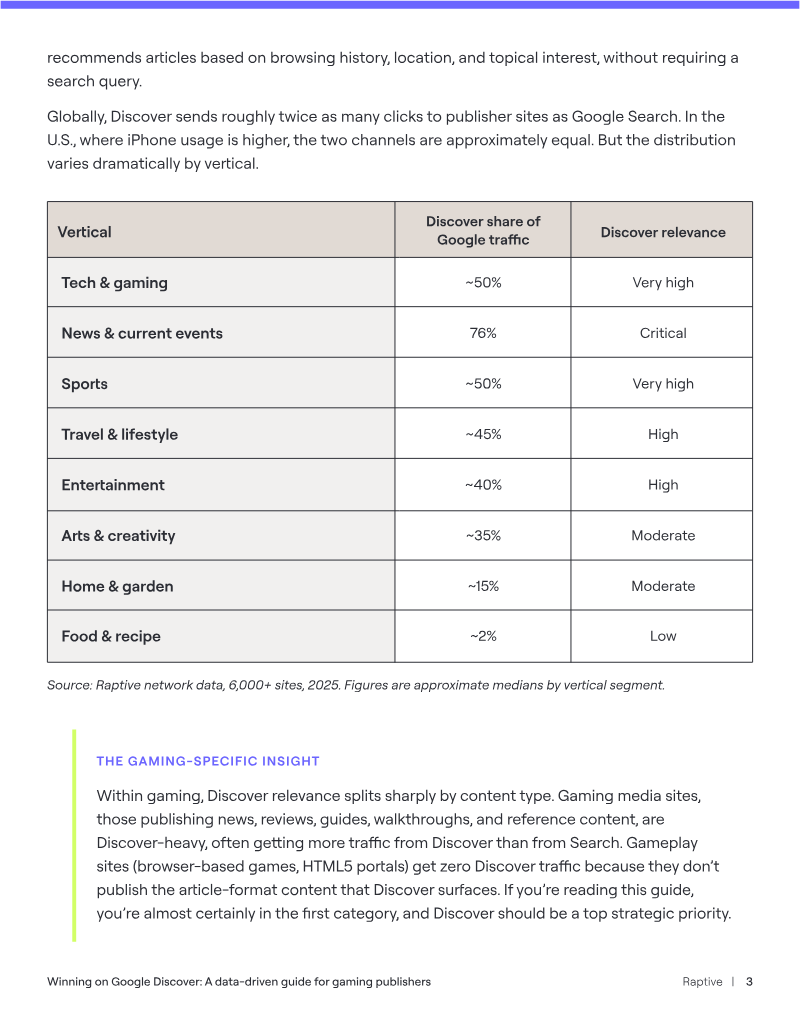
The brief explains how Google’s February 5, 2026 “Discover core update” expands the personalized content feed and shifts traffic from traditional search to Discover, especially for gaming media.
- Google Discover now accounts for roughly 50% of Google traffic for gaming sites within the Raptive network, following a February 5, 2026 core update that shifted traffic away from traditional search.
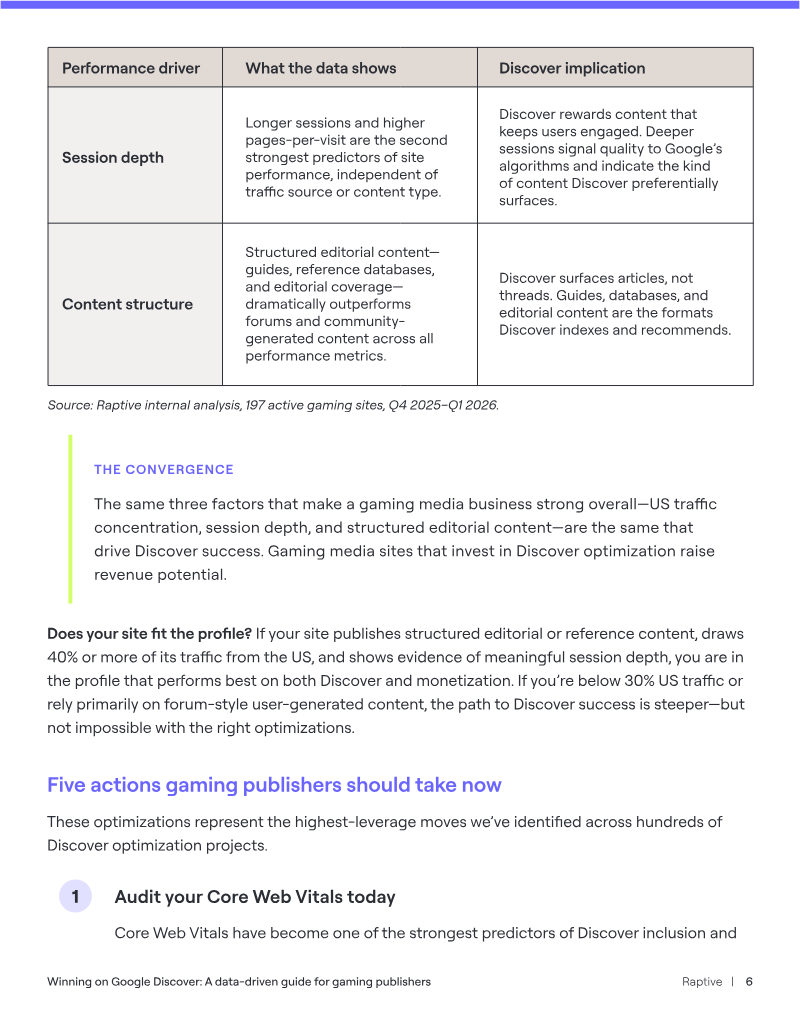
- Sites that prioritize high U.S. traffic concentration, deep session depth, and structured editorial content like guides and databases experience superior Discover performance and revenue stability.
- Following the February 2026 update, 20% more gaming sites began receiving Discover feed impressions, with smaller publishers seeing notable traffic growth.

D2C Trends: Apple bringing back fees & Why is that a good thing!
The direct-to-consumer (D2C) model has emerged as a critical strategy for game publishers seeking to enhance profit margins and gain greater control over player relationships.
- Approximately 50 percent of surveyed game studios currently generate up to 20 percent of their total revenue through web-based D2C channels.
- Apple and Google are moving to implement platform fees on off-platform transactions globally, following precedents set in Japan and Brazil, effectively ending the current window of fee-free steering in the U.S.
- Publishers should treat web stores as permanent e-commerce infrastructure rather than temporary workarounds to ensure long-term profitability amidst the standardization of platform fees.

Google ODM & ICM Explained
This analysis examines Google’s iOS measurement suite, specifically On-Device Measurement (ODM), ODM 2.0, and Integrated Conversion Measurement (ICM).
- Integrated Conversion Measurement (ICM) allows Google to share modeled conversion data with Mobile Measurement Partners (MMPs), which increases the number of attributed conversions visible in MMP dashboards.
- On-Device Measurement 1 (ODM1) uses first-party data like hashed emails and phone numbers to link ad clicks to in-app actions, but it requires significant developer implementation and is primarily effective for apps that collect extensive user data.
- On-Device Measurement 2 (ODM2) functions as an automatic backend update that leverages temporary anonymous signals to improve Google's internal models, requiring only that developers maintain an up-to-date Firebase SDK.

Meta Is Back in the Game. Here's What That Actually Means.
Meta has fundamentally restructured its gaming organization to prioritize industry-specific expertise over geographic models, a shift necessitated by the performance challenges introduced by Apple’s App Tracking Transparency.
- Meta has restructured its gaming organization to prioritize industry-specific expertise over geographic models to counter the performance challenges caused by Apple’s App Tracking Transparency.
- Developers must adopt a 'creative velocity' strategy, treating ad asset production as a high-volume factory process to provide algorithms with the signals needed to acquire high-lifetime-value users.
- Marketing teams must shift away from last-click attribution, which causes budget misallocation, and instead utilize rigorous incrementality testing like geo-lift studies to validate true return on investment.