Europe reports and market data
Documents
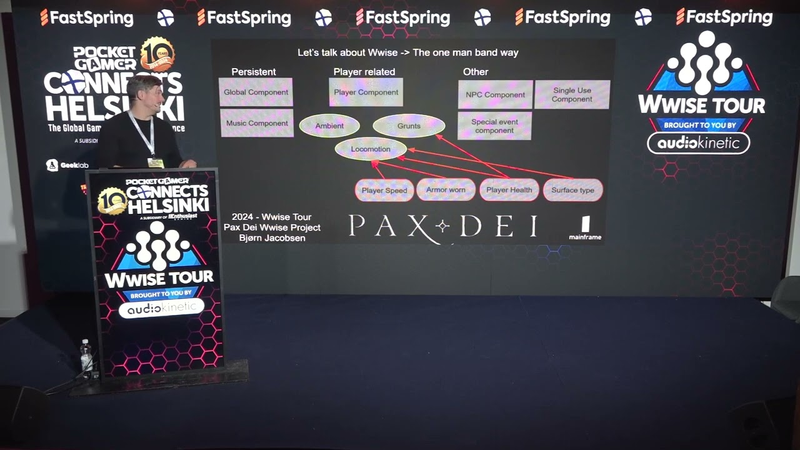
Session: One Man Band AAAudio Department - Bjørn Jacobsen, Mainframe Industries.
Managing the audio landscape for a massive, systemic open-world title like Pax Dei requires a shift from manual asset triggering to a highly automated, data-driven architecture.
- A solo audio lead can achieve AAA-level fidelity in a systemic open-world game by prioritizing a data-driven Wwise architecture over manual asset triggering.
- The system utilizes global RTPCs, states, and switches that update every half-second to dynamically adjust audio based on variables like altitude, weather, time of day, and terrain slope.
- Performance in dense environments is maintained through component pooling, persistent audio components, and strict voice management that limits active virtual voices to the player's immediate biome.

Opening & Welcome to Pocket Gamer Connects, Helsinki 2024 - Chris James, Steel Media Ltd.
The opening address at Pocket Gamer Connects Helsinki 2024 serves as both a celebration of the Finnish mobile games industry’s decade-long evolution and a strategic assessment of the current global gaming market.
- The global games industry is projected to grow by 2% in 2024 to an estimated $188 billion, with mobile gaming specifically expected to rise by 3%.
- Investment activity is showing signs of recovery, with Q2 2024 marking the highest level of early-stage investment in nearly two years and a steady increase in M&A volumes over the last three quarters.
- New distribution channels are challenging traditional app store dominance, including Epic Games' new app store, Apptoid, and direct-to-consumer models supported by companies like Aptoide, Appcharge, and Agera.

Essential Video Game News: October 2024
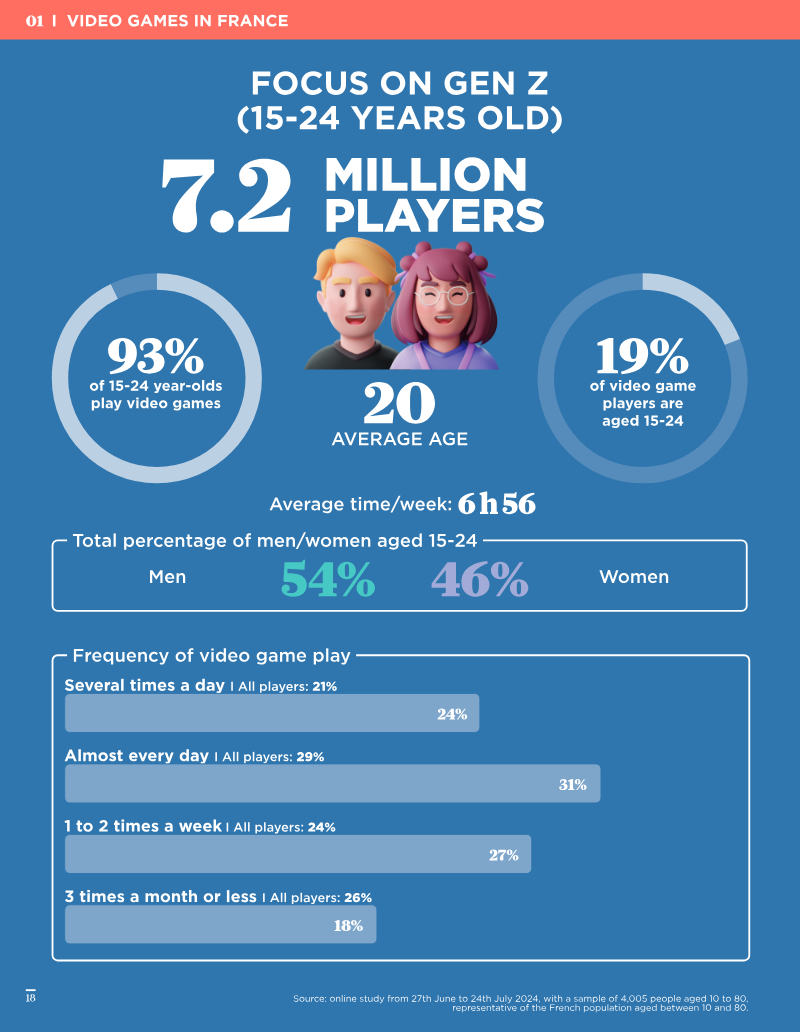
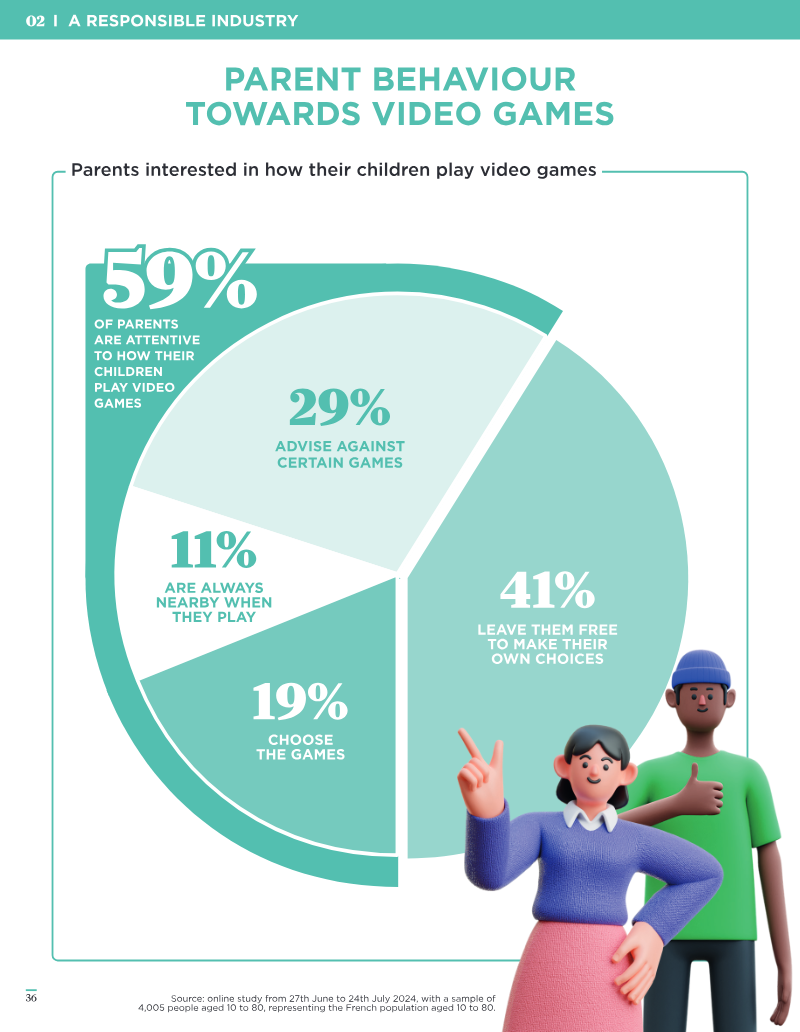
The video game industry in France maintains a robust position as a primary cultural and social pillar, with 38.3 million active players representing 52 percent of the national population.
- The French video game market includes 38.3 million active players, accounting for 52 percent of the national population.
- Mobile devices are the dominant hardware platform, driving the popularity of casual and mobile gaming genres.
- Despite the industry's digital shift, consumers maintain a strong preference for physical media due to collectibility, resale value, and peer sharing.



Game Development Studie 2024: Die wirtschaftliche Bedeutung der österreichischen Spieleentwicklungsbranche, ihre Dynamiken und Einflüsse auf die Gesamtwirtschaft
The study evaluates the state of Austria’s game-development sector in the first half of 2024, tracing its evolution since a comparable survey in 2018 and quantifying its economic contribution.
- Austria’s game development sector has experienced rapid growth since 2017, with turnover increasing 285% to €92.8 million in 2023 and employment rising 128% to 1,080 jobs by 2024.
- The industry generates a total economic impact of €188.7 million in revenue and supports approximately 2,260 jobs across the Austrian economy, reflecting a multiplier effect of 2.0.
- The sector consists of 149 active firms, 81% of which are micro-enterprises with nine or fewer employees, and 54% are concentrated in Vienna.

DMA for Dummies with Archie Stonehill, Head of Product at Stash
The Digital Markets Act and parallel global regulatory frameworks represent a fundamental shift in competition policy, moving away from traditional consumer-price doctrines toward a model that classifies major app distribution platforms as essential infrastructure.
- The Digital Markets Act (DMA) reclassifies major app distribution platforms as essential infrastructure, mandating fair, non-discriminatory practices under threat of fines tied to global turnover.
- Mobile gaming developers are increasingly bypassing traditional app stores for direct-to-consumer web shops to reduce cost of sales from the standard 30% commission to as low as 3–4%.
- Mobile gaming accounts for over 70% of total app store revenue, making the industry particularly vulnerable to platform-imposed fee structures like the Core Technology Fee.
White Paper on Game Education and Game Industry Skill Building
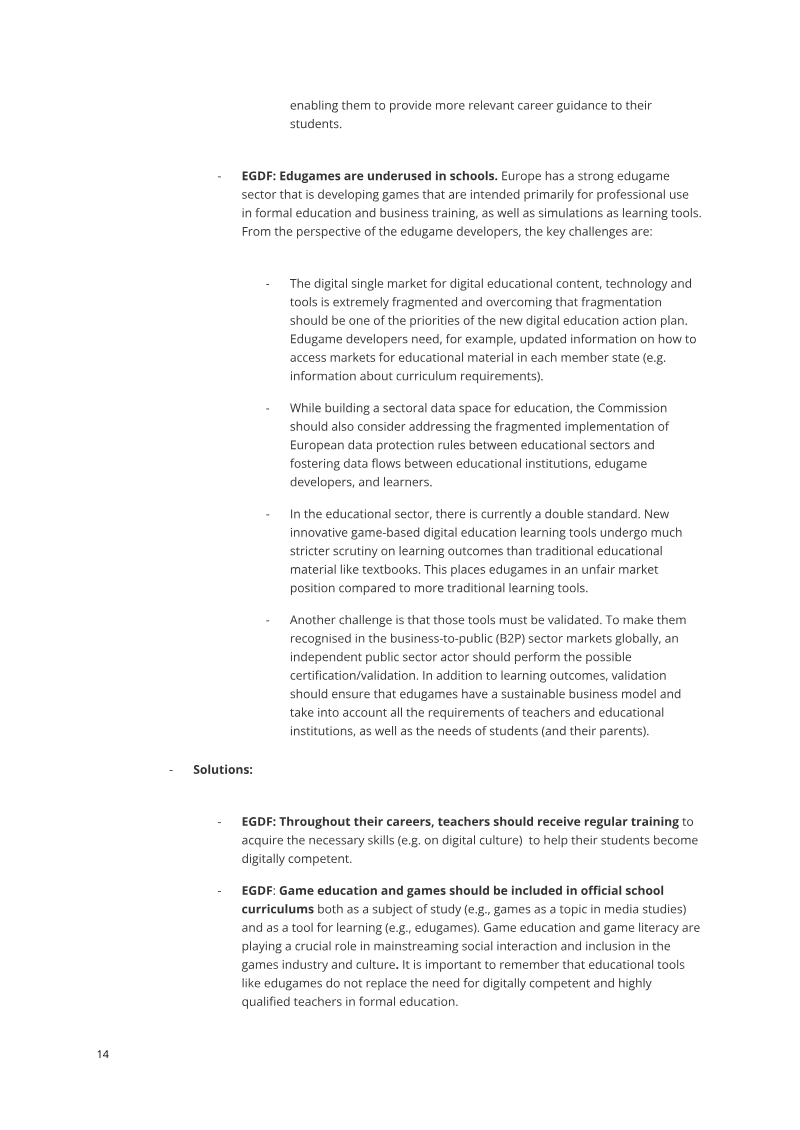
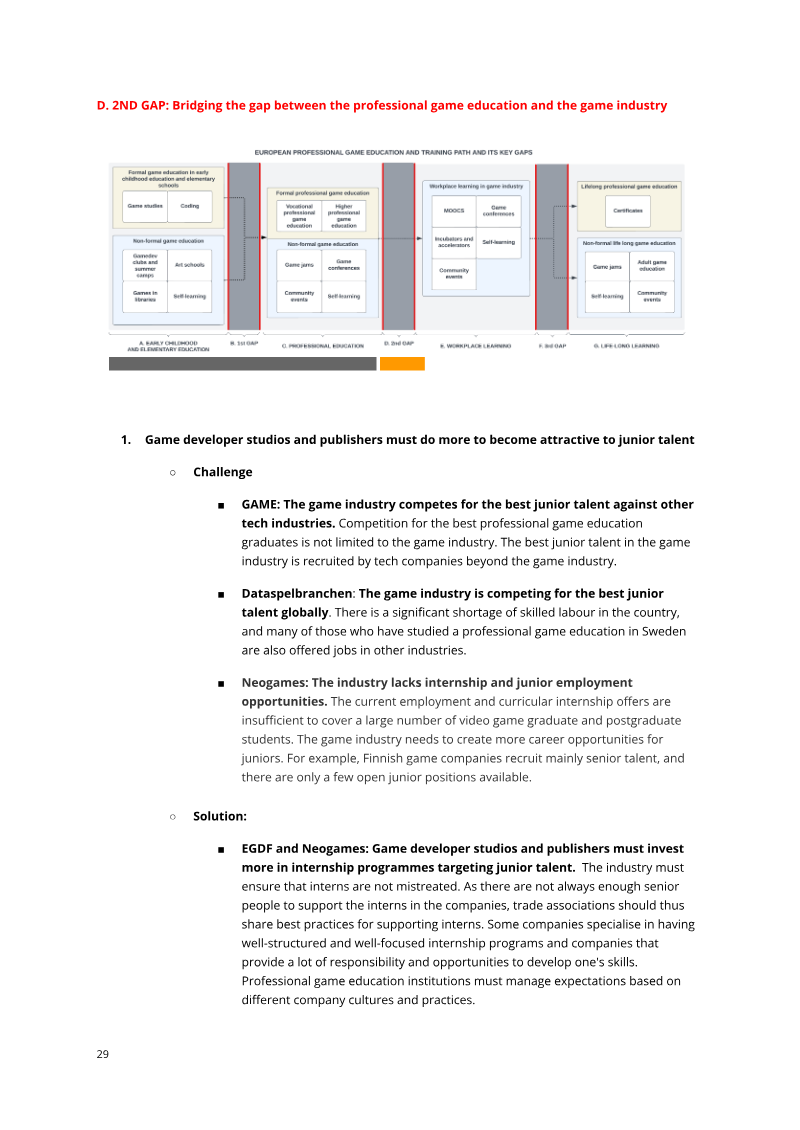
The European games industry serves as a vital economic and cultural engine, yet its continued growth is threatened by a persistent talent shortage and a misalignment between academic curricula and professional requirements.
- The European games industry faces a critical talent shortage caused by a misalignment between academic curricula and professional studio requirements.
- Formalizing game education as an independent academic discipline, supported by dedicated research funding and standardized accreditation, is necessary to ensure a sustainable workforce.
- Industry-specific competency frameworks, such as the Game Badges project and SNJV professional standards, must be adopted to better validate skills for modern studio environments.

TWIG #285 Squad Busters Busted? Destiny 2, Too?
The gaming industry is currently defined by a tension between aggressive transmedia expansion and a fragile economic landscape characterized by studio closures and workforce reductions.
- The gaming industry is facing a business model crisis where cosmetic-only monetization often fails to generate sufficient revenue to sustain live-service operations for titles like Concord and Marvel Rivals.
- Supercell’s Squad Busters is experiencing a rapid decline in daily active users despite high lifetime download figures, driven by an over-reliance on pre-registration incentives and a user base skewed toward lower-revenue markets.
- Sony’s PlayStation 5 install base remains split evenly with the aging PlayStation 4, indicating a stagnant hardware upgrade cycle caused by bloated development costs and a lack of compelling software.
How to Master Europe’s Digital Infrastructure Needs?
Video Games Europe argues that Europe’s digital infrastructure policy should reinforce, rather than reshape, the existing market dynamics that underpin the continent’s thriving video-game ecosystem.
- Video Games Europe opposes new network fees or expanded regulation of cloud services, arguing these measures would threaten net neutrality, increase consumer costs, and damage European digital competitiveness.
- The European video game industry generates €24.5 billion in annual revenue and employs approximately 110,000 people, with 53 percent of the European population participating in gaming.
- Gaming traffic is significantly lower than video streaming, with typical online gameplay consuming 60–80 megabytes per hour and high-intensity titles rarely exceeding 300 megabytes per hour.
Children’s In-Game Spending 2024
Ipsos’ fifth edition of the In-Game Spending by Children and Parent Supervision study tracks how European families manage micro-transactions in video games, focusing on trends from 2018 through 2024.
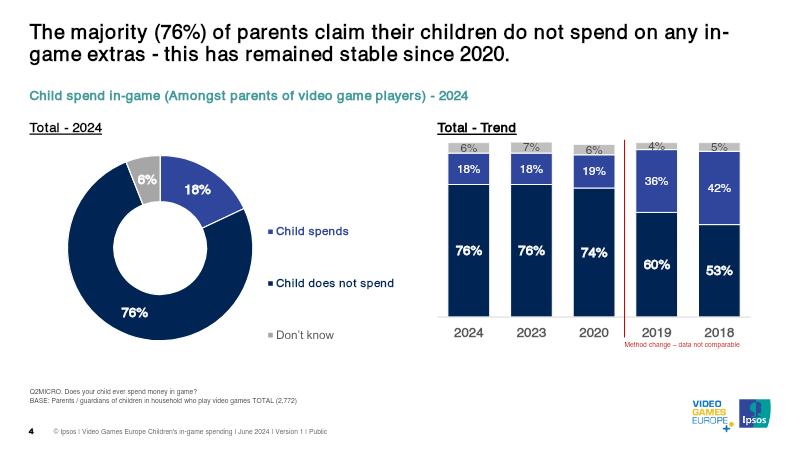
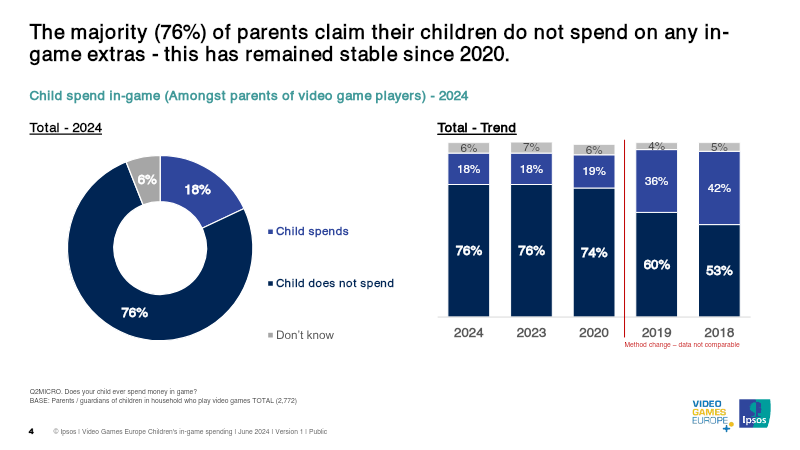
- The majority of children (74%) do not make in-game purchases, a stability trend maintained since 2020.
- Among the 26% of children who do spend money in-game, the average monthly expenditure dropped to €31, with 73% of these spenders limiting their costs to €20 or less per month.
- Gameplay-impacting items like weapons or powers are the primary drivers of spending (38%), followed by decorative cosmetics (30%) and loot-box rewards (21%).
Children’s In-Game Spending: Europe
This research analyzes trends in children’s in-game spending and parental oversight across major European markets, including Great Britain, France, Germany, Spain, and Italy.
- 76% of children do not spend money on in-game extras, a figure that has remained stable since 2020.
- Average monthly in-game spending among children who do make purchases dropped from €39 in 2023 to €31 in 2024.
- 95% of parents whose children spend money in-game have established formal agreements, with 49% requiring children to ask for permission and 27% enforcing strict spending limits.

Xsolla special: Apple's updated EU payments, DMA regime, new fees & requirements, web shops
The implementation of the Digital Markets Act in the European Union has fundamentally altered the financial landscape for mobile game developers, forcing a reevaluation of reliance on Apple’s ecosystem.
- Apple’s updated EU payment regime under the Digital Markets Act imposes a 27% commission on alternative payments and potential annual install fees, complicating profit margins for mobile developers.
- Developers are increasingly adopting proprietary web shops to bypass traditional app store fees, with successful implementations seeing 20% to 30% of player spending migrate to these external channels.
- The effectiveness of a web shop strategy depends heavily on game genre, user education, and the ability to provide a seamless, native-feeling checkout experience for players.

two & a half gamers session #51 - Live Special @ Gamesforum Barcelona
The mobile gaming industry is currently undergoing a structural shift toward aggressive monetization and rapid capital recovery.
- Mobile game developers have shifted from one-year payback targets to aggressive 30-to-90-day windows to combat global economic uncertainty and ensure rapid capital recovery.
- Studios are increasingly prioritizing ad-monetized titles and low-cost user acquisition strategies to maintain financial viability in a competitive market.
- Transitioning to advanced mediation solutions like AppLovin’s MAX can generate a 6 to 7 percent revenue uplift, provided that ad formats and end-card configurations are meticulously managed.