Europe reports and market data
Documents

Videojuegos en el Aula: Guía para un Aprendizaje Adecuado
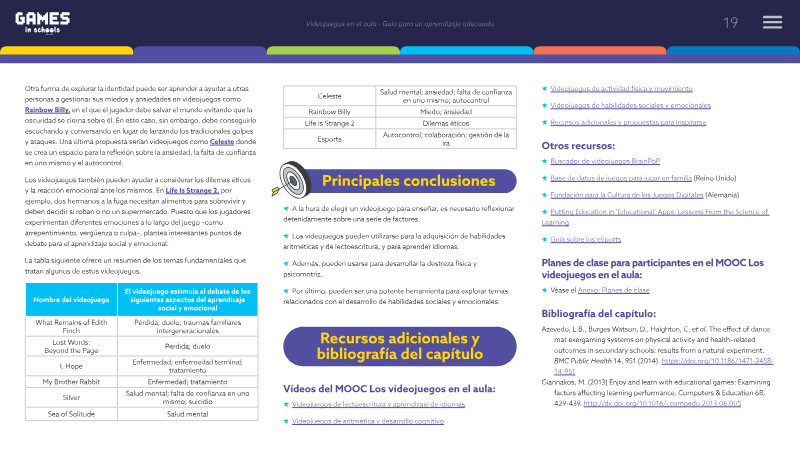
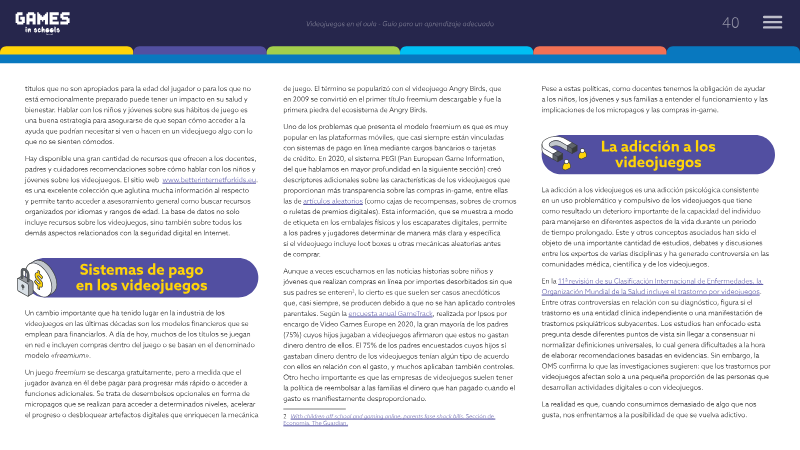
The guide argues that video games, when deliberately selected and scaffolded, can become powerful learning tools across primary, secondary and vocational settings.
- Video games are effective pedagogical tools that improve cognitive functions like memory and problem-solving, with studies such as Parker & Thomsen (2019) linking game mechanics to measurable gains in literacy and clinical ADHD assessment.
- The global games market now encompasses over three billion active players, including 70% of Europeans aged 6–24, providing a massive, accessible platform for cooperative and project-based learning.
- Educational integration is most successful when educators use a continuum from free play to structured activities, utilizing titles like Minecraft and Assassin’s Creed Discovery Tour to support interdisciplinary curricula.
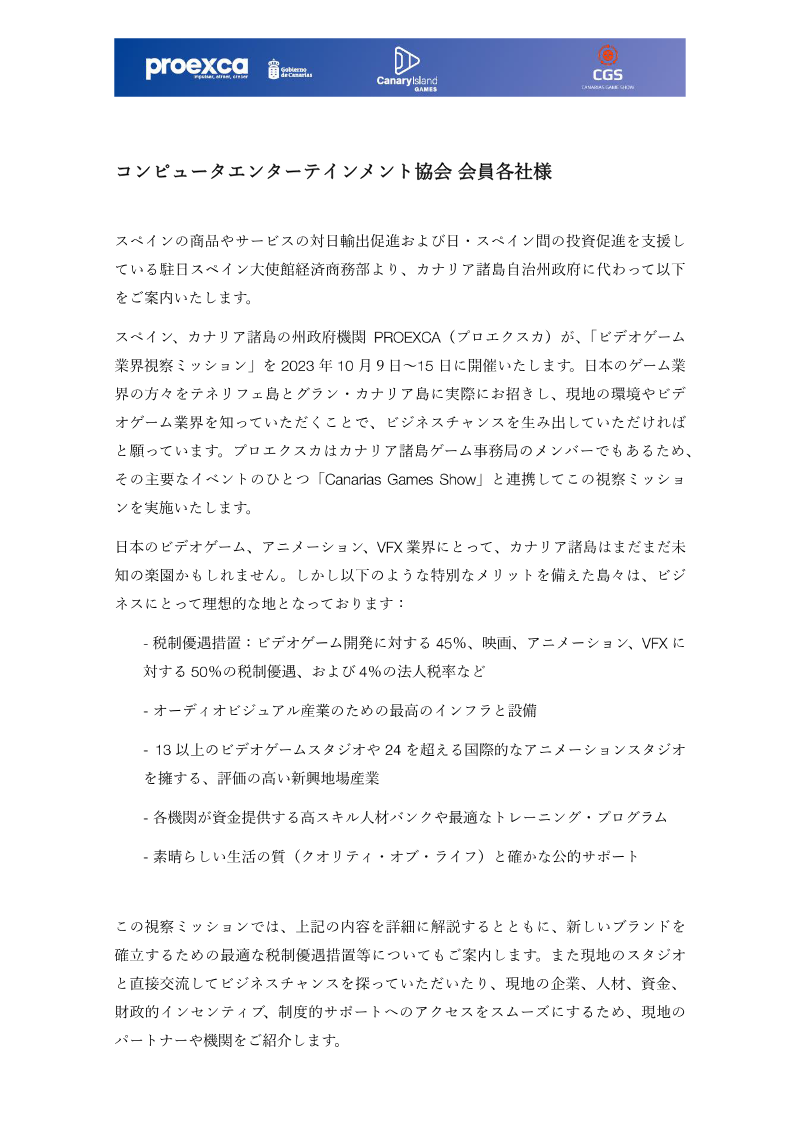
スペイン、カナリア諸島の州政府機関から「ビデオゲーム業界視察ミッション」のご案内
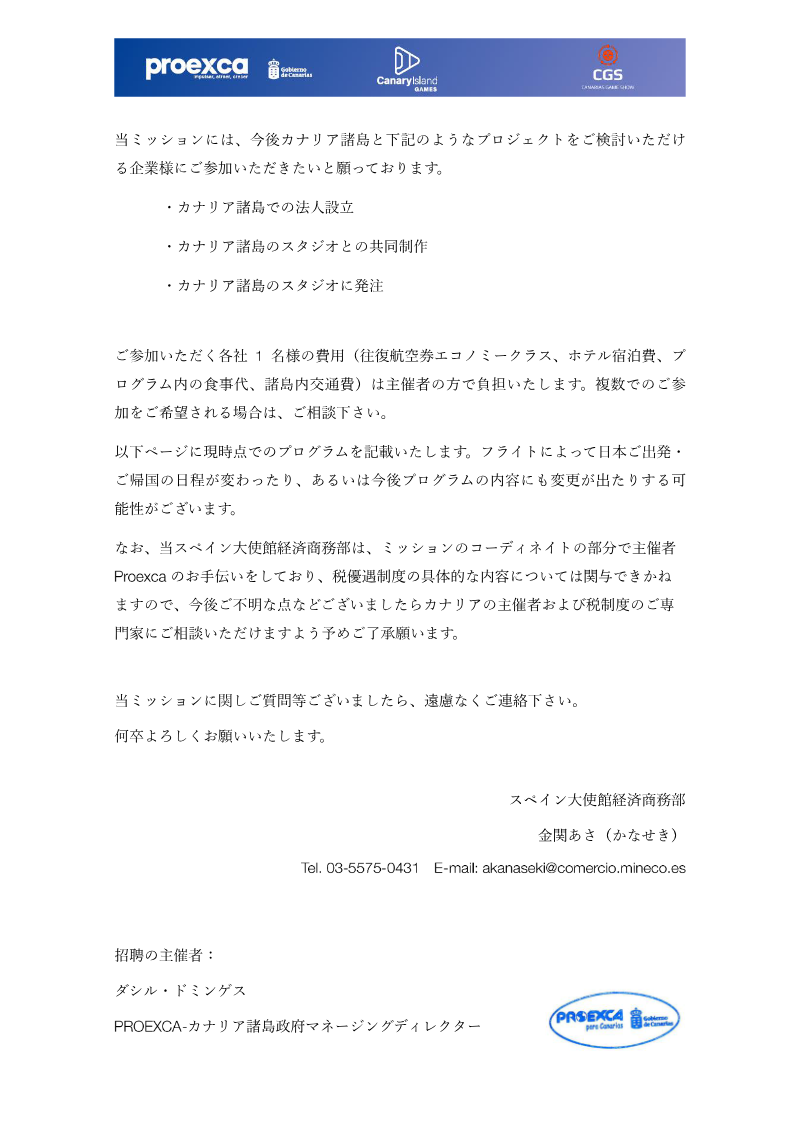
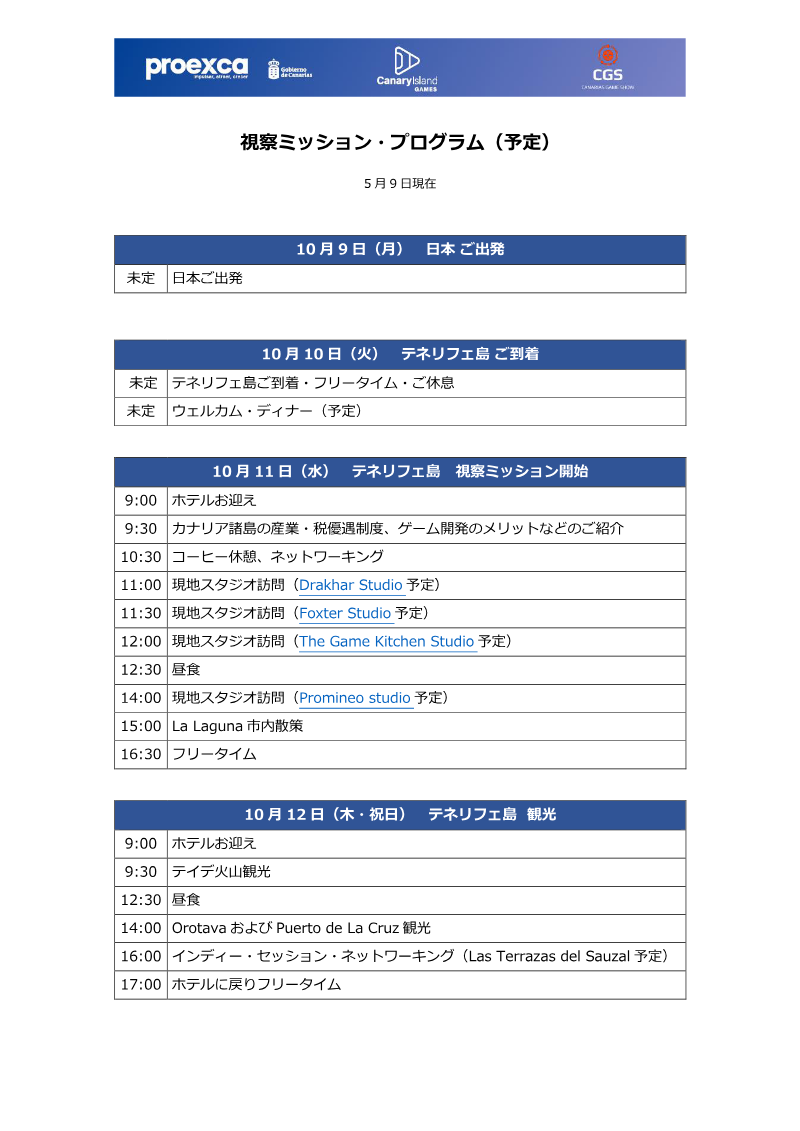
The invitation seeks to generate business opportunities for Japanese video-game, animation and related audiovisual firms by showcasing the Canary Islands as a strategic production hub.
- The Canary Islands government is hosting a business mission for Japanese video game and animation firms from October 9–15 to promote the region as a strategic production hub.
- The mission covers all travel expenses, including economy-class airfare, accommodation, meals, and local transport, for qualified Japanese companies interested in expansion or outsourcing.
- The Canary Islands offer a competitive business environment featuring reduced corporate tax rates and specific financial incentives for game development, animation, and film production.


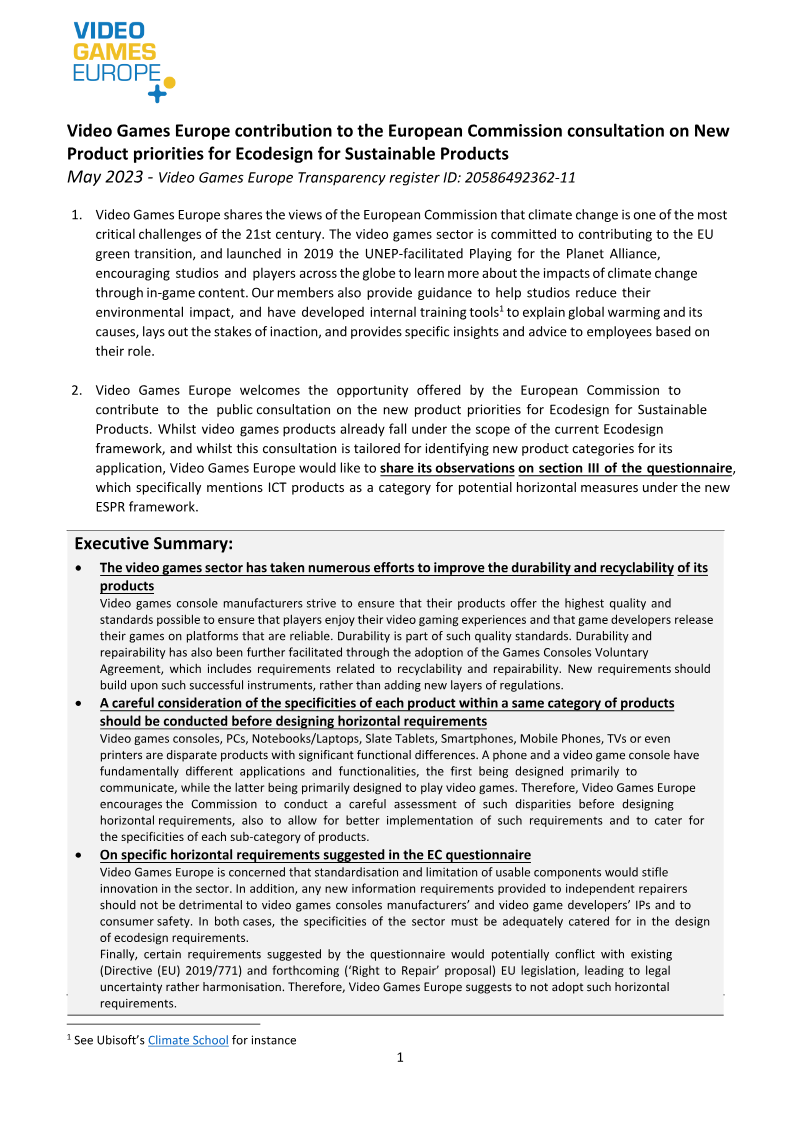
Video Games Europe: Contribution on Ecodesign for Sustainable Products
The submission aims to shape the European Commission’s new ecodesign priorities by presenting the video-games sector’s perspective on durability, repairability and the risks of imposing uniform horizontal requirements across ICT products.
- The European video game industry, comprising 5,000 studios and 98,000 employees, generated a €23.3 billion turnover in 2021 while serving over 135 million players.
- The industry argues against uniform horizontal ecodesign regulations, asserting that the functional and technical diversity of ICT devices like consoles, PCs, and smartphones makes a one-size-fits-all approach impractical.
- Existing frameworks, such as the Games Console Voluntary Agreement and the UNEP-facilitated Playing for the Planet Alliance, already address resource efficiency, recyclability, and out-of-warranty repair provisions.
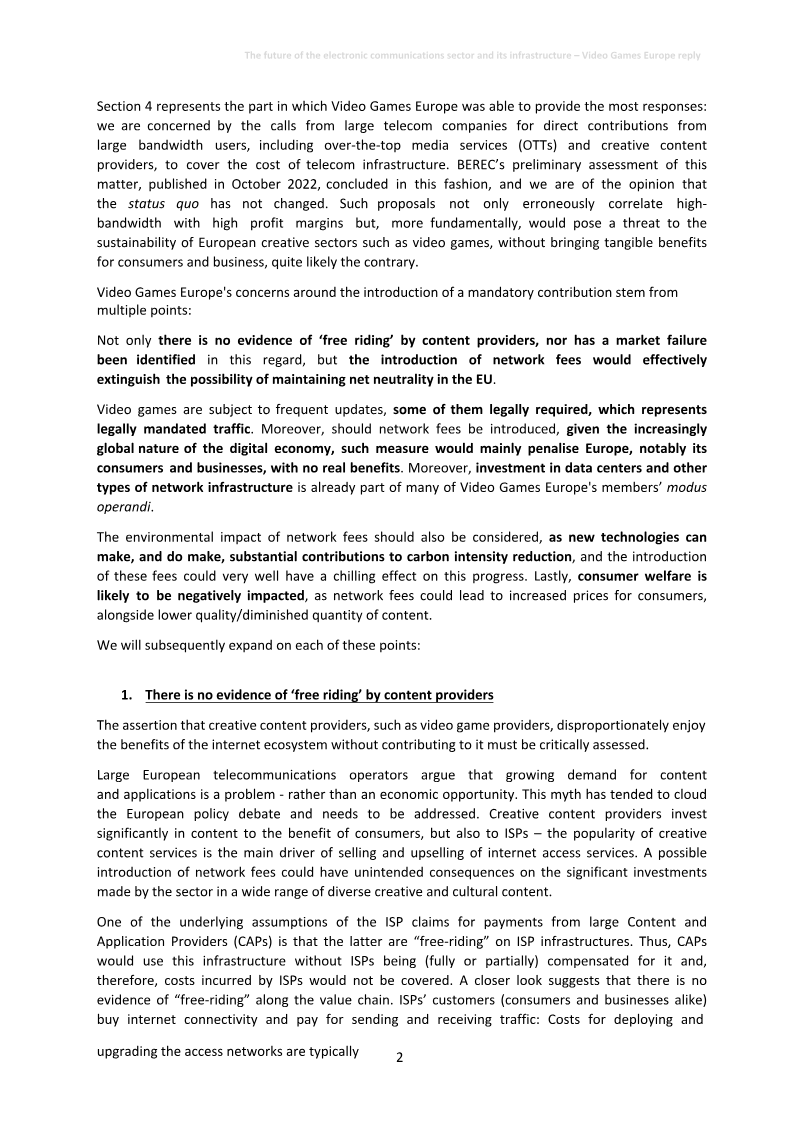
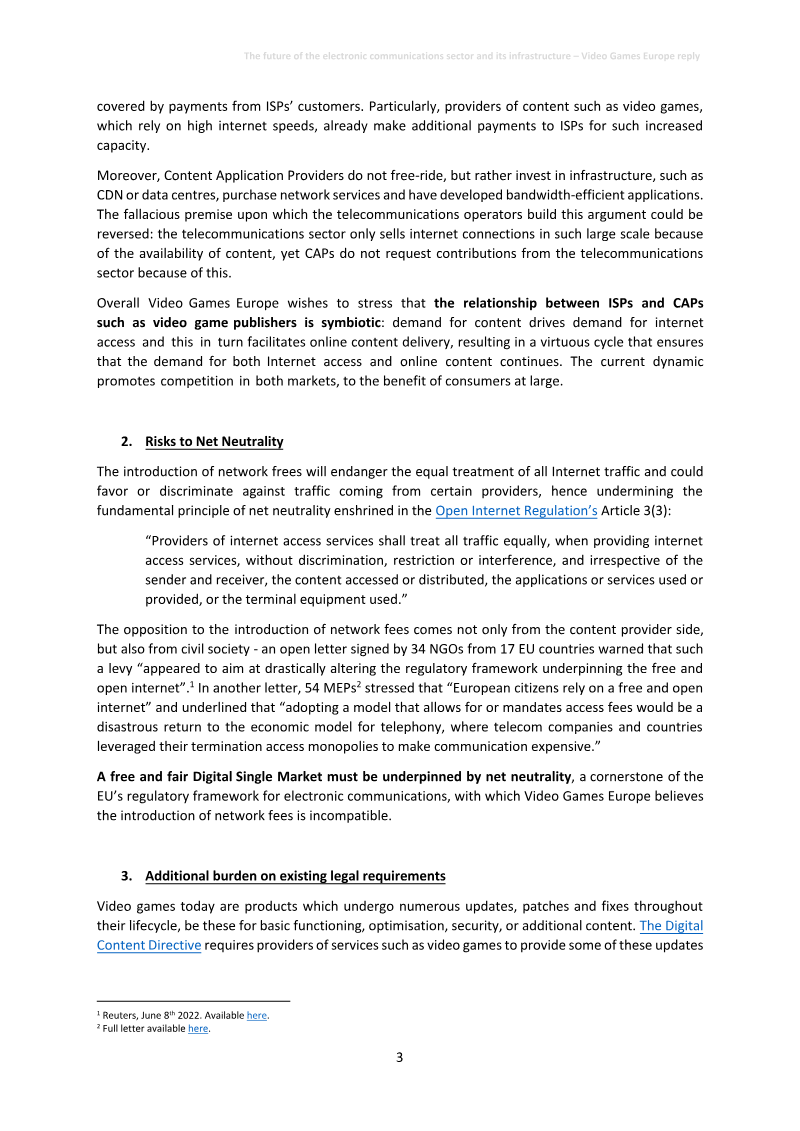
The Future of the Electronic Communications Sector and Its Infrastructure – Video Games Europe Reply
Video Games Europe argues that imposing network fees on high-bandwidth users would harm consumers, the broader Internet ecosystem and the European video-games sector.
- Video Games Europe opposes mandatory network fees for high-bandwidth users, arguing they violate net-neutrality principles and would harm the European video-game sector.
- The European video-games industry comprises approximately 5,100 studios and publishers, generating €12 billion in annual turnover and €23 billion in consumer spending as of 2021.
- Imposing traffic-based fees would create significant financial and technical burdens for publishers, who are already required by the Digital Content Directive to provide frequent security patches and updates.


Initiative on Virtual Worlds: A Head Start Towards the Next Technological Transition
The response aims to shape EU policy on virtual worlds and the emerging metaverse by presenting the video games sector’s perspective, emphasizing that the concept remains fluid and should not be prematurely defined.
- The European video game industry is a significant economic driver, generating over €12 billion in annual turnover, employing approximately 90,000 people, and reaching €23 billion in consumer spending in 2021.
- The sector faces a critical talent shortage, exemplified by a projected shortfall of 25,000 game developers in Sweden alone by 2031, necessitating improved digital-skills education and reduced immigration barriers for global talent.
- Existing EU digital legislation regarding consumer protection, competition, data protection, and cybersecurity is sufficient for virtual environments, and the industry warns that premature legal mandates for interoperability would stifle innovation.


Video Games Europe & EGDF: Position on the Product Liability Directive Review
Video games and their developers argue that the European Commission’s proposal to revise the Product Liability Directive (PLD) would unjustly broaden liability by treating standalone software, including video games, as generic “products.”
- The European video game industry, comprising over 5,100 studios and 90,000 employees, opposes the European Commission’s proposal to classify standalone software as 'products' under the Product Liability Directive (PLD).
- Industry stakeholders argue that the proposed no-fault liability regime for physical goods is ill-suited for complex cultural works like video games, which are already governed by existing frameworks such as the Digital Content Directive and GDPR.
- Public support for extending liability to intangible items like software remains low, with only 48% of respondents in the Commission’s own impact assessment favoring such measures for video games.


People Can Aviators of Gamedev: New Strategy, New Opening
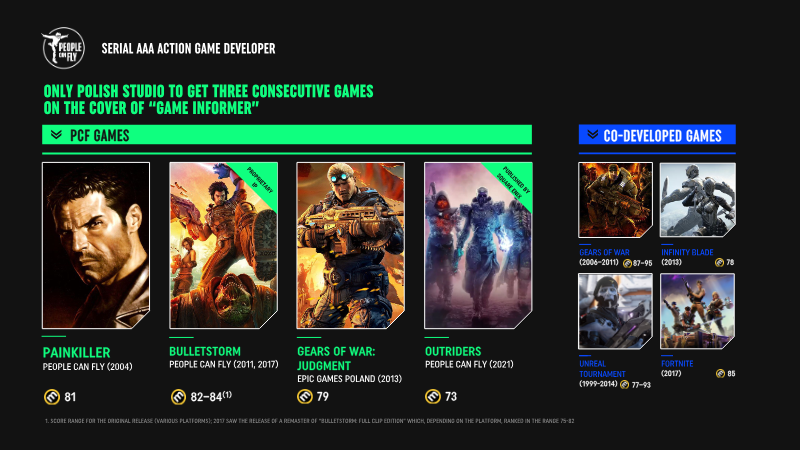
People Can Fly (PCF) Group is a veteran developer specializing in AAA action and shooter video games, currently executing a strategic transition from a work-for-hire model toward self-publishing.
- People Can Fly is shifting its business model from a work-for-hire structure to self-publishing, aiming for the majority of future revenue to come from its own proprietary IP.
- The company targets 3.0 billion PLN in cumulative revenue for the 2023–2027 period, building on 608 million PLN in revenue and 185 million PLN in EBITDA reported between 2018 and 2022.
- The development pipeline includes four core AAA titles—Gemini, Dagger, Bifrost, and Victoria—scheduled for release between 2025 and 2026.

Position Paper: Public Consultation for the Fitness Check of EU Consumer Law on Digital Fairness
The analysis contends that the existing EU consumer-protection framework is already adequate for ensuring digital fairness in the video-game sector and should be fully deployed before any new legislation is considered.
- The existing EU consumer-protection framework is sufficient for ensuring digital fairness in the video-game sector, and no new legislation should be introduced until current powers are fully utilized.
- The industry’s self-regulatory PEGI system is a core component of the current framework, currently maintaining approximately 75% consumer awareness regarding age-appropriate ratings.
- Existing EU regulations already effectively prohibit manipulative commercial practices such as bait-and-switch tactics and false testimonials within the gaming market.
European Commission Proposal for a Regulation Laying Down Rules to Prevent and Combat Child Sexual Abuse
The position presented by Video Games Europe and the European Games Developer Federation seeks to shape the European Commission’s proposed regulation on child sexual abuse online by emphasizing that interactive video-game environments already embody a robust, safety-by-design framework.
- Video Games Europe and the European Games Developer Federation argue that gaming platforms should be exempt from uniform high-risk regulatory models because they already utilize safety-by-design frameworks.
- Data from the 2021 NCMEC Cybertipline indicates that incidents of child sexual abuse material (CSAM) and grooming are significantly lower on video game services compared to platforms focused on photo or video sharing.
- A 2020 Ofcom/ICO survey of 4,000 respondents found that only 2% of adults and 3% of children reported experiencing harms via video game play.

PowerUP Games Industry: A Report on the Swedish Games Industry
The Swedish games industry stands as a globally dominant economic and cultural force, generating €5.8 billion in total revenue as of 2021.
- The Swedish games industry generated €5.8 billion in revenue as of 2021, with one in four people globally having interacted with a Swedish-made title.
- A severe talent deficit exists where the demand for specialized labor significantly outpaces the output of domestic educational institutions.
- The industry lacks a cohesive national strategy, relying instead on regional clusters and private investment, which creates systemic bottlenecks for long-term sustainability.
The Game Industry of Poland: 2023 Report
The Polish game industry has matured into a formidable global force, characterized by a sophisticated, export-oriented business model that prioritizes premium PC and console development.
- Poland’s game industry generated €1.286 billion in annual revenue as of 2022, driven by a business model that exports 75–90% of its production to international markets like the U.S., China, and Western Europe.
- The sector is experiencing a strategic consolidation phase, with 494 active studios shifting toward larger team sizes and high-budget productions despite a plateau in the total number of studios.
- The industry maintains a strong global competitive position, holding the second-highest share of titles on Steam’s global wishlist and achieving consistent year-on-year growth of 11% to 15%.

White Paper on Spanish Videogame Development 2023: Executive Summary
The Spanish video game industry has evolved into a significant economic force, characterized by a decade of rapid expansion and increasing institutional recognition.
- The Spanish video game industry generated 1.383 billion euros in revenue in 2022, marking a 440% increase over the previous decade.
- With targeted fiscal and institutional support, the sector is projected to reach 5.5 billion euros in annual turnover and over 23,000 jobs by 2030.
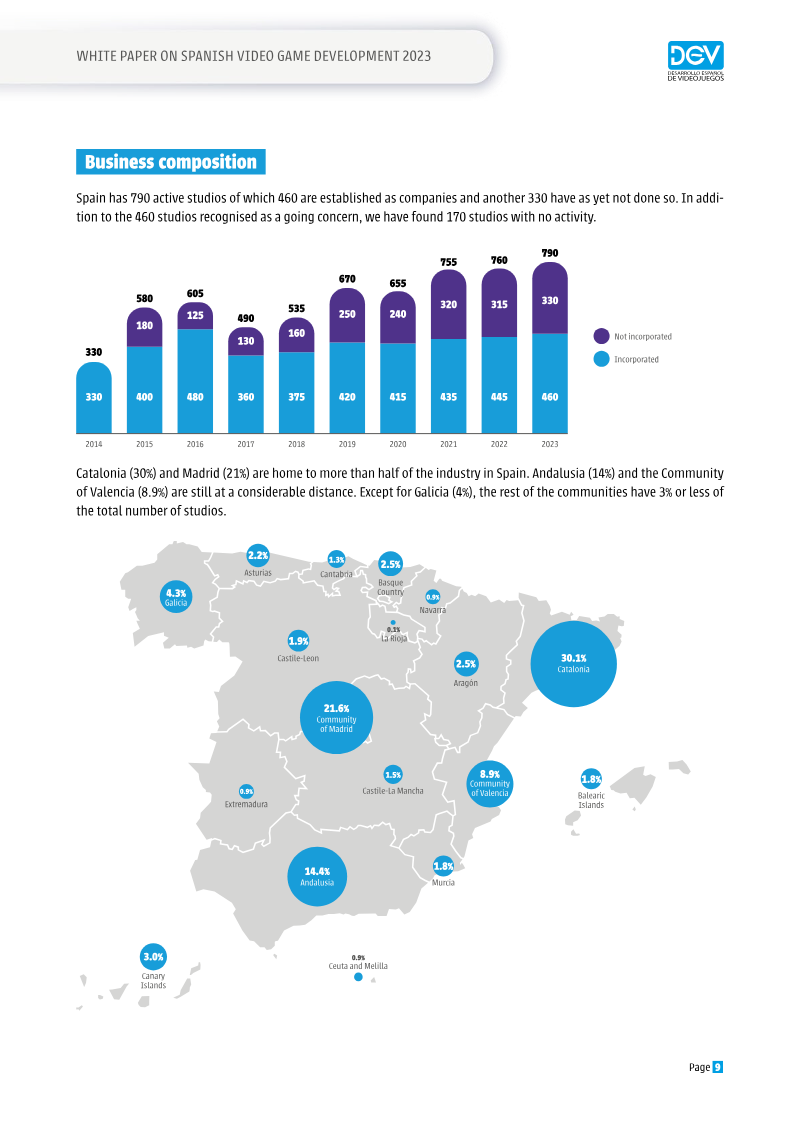
- The industry currently consists of 790 active studios employing 9,261 professionals, with operations concentrated primarily in Catalonia and Madrid.