Showing 30 of 89 results · 0.20s
Jan 2025
Annual Report of the German Games Industry 2025
game
pronounced in game purchases, which fell 17 %, while online gaming and subscription services surged 43 % to €3.26 billion, underscoring a decisive shift toward digital and cloud‑based play
Report39 pages
Jan 2020
The Past, Present and Future of Games: Global and Local Opportunities
Newzoo
dominant segment, accounting for 49% of global consumer revenues. Furthermore, the rise of cloud gaming is expected to generate $4.8 billion in revenue by 2023, supported by major
Report33 pages
Jan 2025
Game Developer Survey 2025
Konvoy
leverages bare‑metal and cloud resources to deliver cost‑effective matchmaking. Xsolla’s recent rollout of loyalty programs, regional tiering, and cloud‑gaming integration underscores a broader move
Report29 pages
Playing for the Planet: Untangling the Carbon Complexities of the Video Gaming Industry
Playing for the Planet Alliance, Carbon Trust, Unity Charitable Fund, Ukie
remain in measurement, reporting consistency, and the integration of emerging technologies such as cloud gaming and AI. Addressing these challenges will be essential for credible net‑zero pathways
Report75 pages
Jan 2025
Gaming: Your Marketing Cheatcode
Dentsu Gaming
developers. Looking ahead, the industry trajectory is shaped by the expansion of cloud gaming and highly anticipated hardware and software launches, such as the Nintendo Switch
Report56 pages
Mar 2026
Video Games Ecosystem Report: Cyprus 2025
InvestGame
Vortex Entertainment demonstrate a growing presence in the market. Cross‑platform development and cloud gaming are emerging trends, offering opportunities for developers skilled across mobile
Report7 pages
Jan 2024
Newzoo PC & Console Gaming Report 2024
Newzoo
projected to outpace established ones with a 4.7 % CAGR versus 0.2 %, and cloud gaming is identified as a key entry point due to high awareness
Report46 pages
Jan 2021
Newzoo’s Global Games Market Report 2021
Newzoo
East. Key findings highlight a significant shift toward platform agnosticism and the "metaverse." Cloud gaming is projected to surpass $1 billion in annual revenue for the first time
Report23 pages
Jan 2020
Baromètre Annuel du Jeu Vidéo en France: 2020
Syndicat National du Jeu Vidéo
shows resilience and optimism, it faces ongoing industrial transitions, including the rise of cloud gaming, immersive technologies, and new distribution models. Overall, the sector maintains a strong export
Report19 pages
Dragon Quest: Reimagined
Square Enix
evolution since 1986 and its adoption of modern technologies such as 3D mapping, cloud gaming, and cross‑platform connectivity. The “Final Fantasy” section cites cumulative sales
Report2 pages
Dec 2025
Video Gaming Report 2026: How Platforms Are Colliding and Why This Will Spark the Next Era of Growth
Boston Consulting Group
cycles and the expansion of user-generated content (UGC) fostering deeper intergenerational engagement. Cloud gaming is projected to become a cornerstone of this evolution, with revenues expected
Report26 pages
Dec 2023
Gaming Industry Report: Global & MENAP Outlook Q4 2023
Shorooq Partners
virtual reality, artificial intelligence, mobile platforms, quantum computing, GPU‑as‑a‑Service, and cloud gaming—which together are accelerating content creation, distribution, and consumption across diverse consumer bases
Report30 pages
Jan 2022
Global Games Market Report 2022
Newzoo
advertisements to create recurring revenue streams. Furthermore, the rise of user-generated content, cloud gaming, and blockchain-based models is redefining how players interact with and derive value
Report61 pages
Jan 2021
The Game Industry of Finland 2020
Finnish Game Developer Studios Association
studios such as Remedy Entertainment and Housemarque, as well as emerging interests in cloud gaming, the metaverse, and AI integration. The ecosystem is supported by a robust infrastructure
Report152 pages
Feb 2026
Southeast Asia Gaming Consumer Economy
Telekom Malaysia, Twimbit
watched events; mobile eSports is expected to lead future growth as 5G and cloud gaming mature. Monetisation remains dominated by free‑to‑play with in‑app purchases
Report19 pages
Jan 2025
The Industry Quest for Growth
Nintendo
being tested to optimise returns. Expanding intellectual property into music, merchandising, and cloud‑gaming subscriptions further unlocks value from dormant franchises
Report37 pages
Dec 2025
2025 Media & Entertainment Industry Predictions Report
AlixPartners
costs, live‑sports migration to direct‑to‑consumer services, and intensified OTT competition. Cloud gaming is set for a 44 % CAGR through 2030, driven by faster broadband
Report46 pages
Jan 2024
The Game Industry of Finland Report 2024
Neogames Finland
with Finnish teams at the forefront of AI‑assisted development, proprietary engines, and cloud‑gaming solutions. Persistent shortages of senior developers and specialists in Unreal Engine, together with
Report64 pages
Jan 2021
Newzoo Trends to Watch 2021
Newzoo
America, Europe, China, and emerging markets. Key data points include the rise of cloud gaming, which is expected to surpass $1 billion in annual revenue for the first
Report23 pages
Jan 2019
Evolution of Mobile Esports for the Mass Market
Niko Partners
signal the professionalization and maturation of the sector. Technological advancements in 5G and cloud gaming are disrupting the historical dominance of PC titles by delivering high-quality competitive
Report45 pages
Oct 2021
Swedish Games Industry 2021
Dataspelsbranschen
long-term sustainability, addressing workplace culture and the environmental implications of energy-intensive cloud gaming. As the sector matures, its primary challenges have shifted from achieving market viability
Report52 pages
Jan 2023
Gaming Spotlight 2023 Review
data.ai
while the Steam Deck appealed to older, male gamers. Emerging technologies like cloud-streamed gaming are gaining significant traction, projected to reach $3.8 billion in revenue with mobile
Report33 pages
Sep 2025
Global Gaming Report Q3 2025
Drake Star Partners
revenue increases, confirming robust demand for both traditional PC hardware and emerging cloud‑based gaming services. Equity performance further illustrates the split between established hardware manufacturers and platform
Report20 pages
Jan 2022
Newzoo Trends to Watch 2022: Games, Esports, Live Streaming, Cloud and the Metaverse
Newzoo
Sandbox, where corporations are establishing branded malls and interactive spaces. Globally, the games industry generated $175.9 billion in 2021, anchored by the Asia‑Pacific region’s $88.2 billion
Report30 pages
Oct 2022
Blockchain Industry Report: October 2022
DappRadar
dramatic surge on NEAR following its partnership with Google Cloud. By contrast, the gaming segment and Ethereum’s core wallet base contracted, falling 2 percent and 4.5 percent
Report24 pages
Nov 2024
Tools & Services Survey: November 2024
Game Developer Collective
Based on a November 2024 survey of the Game Developer Collective, the findings track shifts in engine preference, cloud infrastructure, and overall industry sentiment. The survey includes
Report21 pages
Jan 2020
Investment Activity Report Q1–Q3 2020
InvestGame
report documents investment activity in the global gaming industry from January to September 2020, covering mobile, PC & console, multiplatform, VR/AR, cloud‑native and esports segments. Total deal value
Report11 pages
Jan 2026
The State of Video Gaming: 2025
Epyllion
enhance NPC behavior, the adoption of cloud-native simulations, and a strategic pivot toward programmatic advertising to supplement stagnant game pricing. Furthermore, regulatory pressures on app stores
Report231 pages
Jan 2021
Gaming Deals Activity Report H1'2021
InvestGame
across PC/console, mobile, and cloud platforms. Venture capital activity remained robust; top 15 VC funds invested $1.1 billion in 60+ companies, with Epic Games’ $1 billion round
Report21 pages
Jan 2024
Perforce 2024 State of Game Technology Report
Perforce, JetBrains
Cloud development is also prevalent: 49 % run cloud servers, led by AWS (30 %) and Azure (18 %), while hybrid or on‑premises setups are rare. Hiring priorities across gaming
Report33 pages

Annual Report of the German Games Industry 2025
Jan 202539 pages22k words
Summary
Germany’s video‑game sector generated €5.84 billion in 2024, ranking fifth globally but declining 6 % year‑on‑year. The contraction was most pronounced in game purchases, which fell 17 %, while online gaming and subscription services surged 43 % to €3.26 billion, underscoring a decisive shift toward digital and cloud‑based play. In‑game and in‑app purchases accounted for €4.6 billion, a modest 3 % drop, yet mobile gaming alone grew 63 % since 2019 to €3 billion. Console and PC revenues were €1.9 billion and €1.5 billion, respectively, while hardware sales fell 10 %, with consoles down 26 %. The workforce expanded to 37.5 million players, nearly half women and with an average age of 39.5 years, indicating broader demographic penetration.
Policy analysis reveals that restrictive federal and state funding schemes have limited access for start‑ups, contributing to an 87 % negative perception of Germany’s international competitiveness. The 2025 coalition agreement introduces tax breaks and a €2 750/month “Press Start” grant for new studios, signalling a shift toward a hybrid funding model. A projected €125 million annual increase from 2026, with each tax‑credit euro expected to generate €4.80 in economic spill‑overs, is coupled with calls for university programmes, incubators, and a dedicated “Games University” to supply skilled talent. Without these reforms, Germany risks falling behind global leaders.
The industry’s ecosystem has expanded through high‑profile events such as devcom and gamescom, which attracted record attendance and showcased international diversity. Initiatives like the Press Start: Games Founding Grant, esports talent pipelines, and the Equal Esports Cup demonstrate a coordinated effort to build inclusive professional pathways. The German Games Association, through gamescom and sustainability initiatives such as “Playing for the Planet,” positions Germany as a climate‑friendly, diverse hub. Market data confirm that 60 % of Germans play video games, with mobile gaming dominating at 37.9 %, while over 90 % of households have internet access, underscoring a mature, multi‑platform market poised for continued growth across consoles, PC and mobile channels.
Pages


Insights
- Germany’s video game sector generated €5.84 billion in 2024, representing a 6% year-on-year decline despite the country maintaining its position as the world's fifth-largest market.
- Consumer spending has decisively shifted toward digital models, with online gaming and subscription services surging 43% to €3.26 billion, while traditional game purchases dropped by 17%.
- Mobile gaming has become a primary market driver, growing 63% since 2019 to reach €3 billion in revenue, while hardware sales contracted by 10% overall, led by a 26% decline in console sales.
- To combat an 87% negative perception of international competitiveness, the 2025 coalition agreement introduces a hybrid funding model featuring tax breaks and a €2,750/month 'Press Start' grant for new studios.
- The government projects a €125 million annual funding increase starting in 2026, with each euro of tax credit expected to generate €4.80 in economic spill-overs.
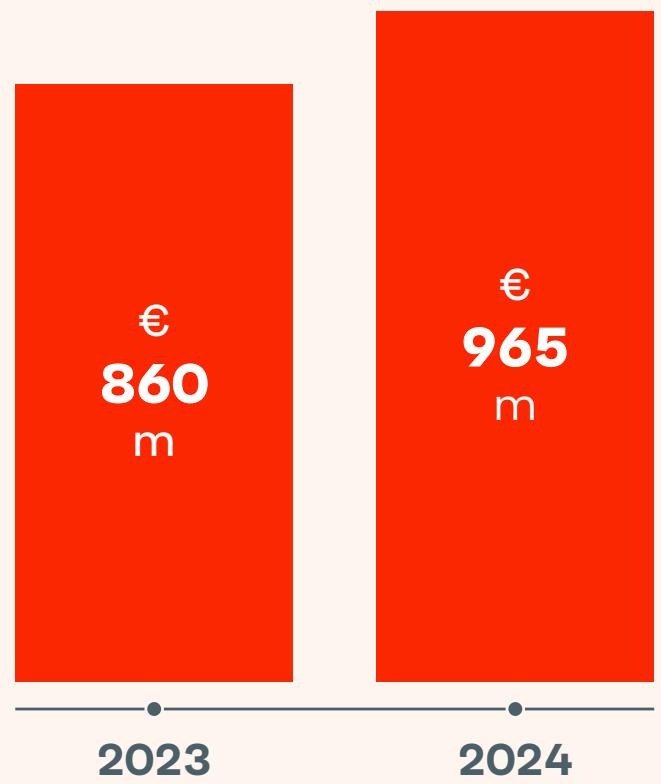
This chart illustrates the year-over-year growth in revenue for the game industry, showing an increase from €860 million in 2023 to €965 million in 2024.