Showing 30 of 654 results · 1.11s
Jan 2025
Dynamics of Gaming Deals
The GGames Fund
Europe, Southeast Asia and China, seeking cost‑efficient teams and pre‑seed opportunities. Mobile games continue to dominate the funding landscape, yet interest in mid‑tier “AA” titles
Report8 pages
Jan 2023
From Hyper to Hybrid in 2023 (2023)
Tenjin
report examines the evolving landscape of mobile gaming in 2023, focusing on the decline of pure hyper‑casual profitability and the rise of hybrid models that blend
Report27 pages
Apr 2022
Store Intelligence Data Digest: Q1 2022
Sensor Tower
Although Google Play growth began to flatten as pandemic-era surges subsided, the mobile gaming sector showed signs of recovery with total downloads reaching 14.34 billion across both
Report75 pages
Jan 2024
Gaming Report 2024: Meet the Moment
Bain & Company
multi-channel experiences. As market saturation intensifies, the high failure rates observed in mobile gaming underscore the need for more rigorous operational discipline. Companies are increasingly required
Report32 pages
Oct 2021
Strategy Genre Snapshot 2021
GameRefinery
strategy genre remains a cornerstone of the mobile gaming market, currently ranking as the third-largest genre in the United States on iOS with a 17% revenue market
Report16 pages
East vs. West: Monetization Trends
Mistplay
study examines how mobile gaming spending patterns differ between Eastern and Western markets, focusing on frequency of purchases, average spend per transaction, and motivational drivers. Findings reveal that
Report5 pages
Jan 2022
Key Insights Into French Gamers
Newzoo
aged 10 to 65 identifying as game enthusiasts. While 38% of this group only plays games, a substantial 34% also views gaming video content, and 15% are classified
Report18 pages
Swipe Before Type: India's Interactive Media Consumer Survey 2024–2025
Lumikai
weekly, skewing male and non‑metro, with participative platforms (astrology, dating) rising. Gaming remains mobile‑first but 30 % use PCs and 22 % consoles; casual and midcore titles command
Report23 pages
Jan 2024
Serbian Gaming Industry Report 2023
SGA
professionals. The market now hosts 38 active studios producing 81 titles, with mobile‑first games still dominant but ceding share to core and original‑IP projects. Talent inflows
Report72 pages
The Rise and Reset of Sweden's $19B Gaming Capital Machine
InvestGame
InvestGame and market‑cap records through December 2025, cover Sweden’s entire gaming industry—mobile, PC & console, VR/AR, esports, and platforms—from 2014 to the present. Methodology includes
Report12 pages
Jan 2025
Interview with Frank Kang, Associate Partner at Antler: Malaysia
Korea Creative Content Agency
Japan. Promising niches include short‑form video, webtoons and IP‑centric ecosystems, mobile‑first games, and live‑commerce platforms, all of which benefit from early community testing
Report13 pages
Jan 2026
2026 Predictions: Trends in Gen AI, Gaming & Digital Ad Spend
Sensor Tower
engine, rivaling traditional paid‑media traffic and reshaping user‑acquisition dynamics across mobile, web and gaming. The analysis draws on Sensor Tower’s app‑store, advertising
Report26 pages
Jan 2022
State of Mobile: Brazil 2022
data.ai
billion. While social, communication, and video streaming apps captured 70% of total mobile minutes, the gaming sector emerged as the primary engine for monetization, accounting for more than
Report62 pages
Jan 2026
How to Build an Effective Offer System in Your Game
Sensor Tower
that shapes perceived value across all offers. Collectively, these principles apply to mobile and casual games operating globally, reflecting current industry practices and data from recent case studies
Report57 pages
Dec 2025
2025 Report on Marketing Trends of Productivity Apps
SocialPeta, Mega Digital
channels across 80+ countries. It shows that the total pool of mobile app (non‑game) advertisers fell 17.8 % YoY to an average of 107 k per month, while
Report30 pages
Mar 2023
Global Gaming Report Q1 2023
Drake Star Partners
capital earmarks from sovereign wealth funds and high-profile acquisitions in the mobile and social gaming space
Report19 pages
Jan 2012
Faits Essentiels 2012: Profil de l'industrie canadienne du jeu vidéo
ESAC – Entertainment Software Association of Canada
employees still focus on traditional consoles, there is rapid diversification into mobile and social gaming. Furthermore, the report emphasizes the importance of the ESRB rating system, noting that
Report18 pages
Financial Highlights: 3rd Quarter of the Fiscal Year Ending March 2015
Koei Tecmo
above their forecasted changes. Operating income by segment mirrored these trends: Game Software and Online & Mobile segments delivered the largest gains, while Media & Rights shifted from a loss
Report2 pages
Aug 2022
Japan Mobile App Trends 2022: Essential App Performance Benchmarks and Insights
Adjust
data from the top 2,000 performing apps, underscores a resilient mobile economy where traditional gaming dominance is being supplemented by rapid digital transformation in financial services
Report34 pages
Jan 2025
From Games to the Big Screen: The Impact of IP Across Platforms
Sensor Tower
major cross-platform releases between 2024 and 2025, focusing on global mobile, PC, and console gaming segments alongside digital advertising and streaming app performance. Key findings highlight
Report6 pages
Jan 2019
Romanian Game Development Industry Report 2019
RGDA – Romanian Game Developers Association
producing niche titles to multinational subsidiaries that co‑develop major franchises. Mobile and hyper‑casual games dominate commercial success, exemplified by Deep Byte’s titles surpassing ten million
Report41 pages
Jan 2011
Faits Essentiels 2011 sur le Secteur Canadien des Jeux Vidéo et Informatiques
ESAC – Entertainment Software Association of Canada
Traditional console development still dominates, employing 68 % of the workforce, while mobile, social and casual games together account for just under 12 % of resources, reflecting a rapid diversification
Report19 pages
Jun 2026
Market Model Reports: Asia & MENA
Niko Partners
survey data, and regional expertise to assess the evolving landscape of mobile, PC, and console gaming. Key findings highlight significant regional disparities in growth and maturity. China remains
Report4 pages
Jan 2023
State of Mobile 2023
data.ai
year‑over‑year growth. The data underscore a continued dominance of mobile advertising, resilience of non‑gaming verticals amid economic headwinds, and the importance of diversified monetization strategies
Report93 pages
Jan 2024
Games Market Trends 2024
Newzoo
premium releases. Other major trends include the slowing growth of multi-game subscriptions, the expansion of mobile developers into the PC space to combat rising user acquisition costs
Report27 pages
Bilan du Marché Français: 2025
SELL – Syndicat des Éditeurs de Logiciels de Loisirs
mobile sector, which reached €1.792 billion. The market maintains a balanced ecosystem, with consoles commanding a 44% share, followed by mobile at 31% and PC gaming
Report39 pages
Jan 2025
Global Gaming Report 2025
Drake Star Partners
buyers. The breadth of activity spans traditional console and PC publishers, mobile‑first developers, and emerging gaming‑tech startups, indicating a convergence of content, distribution, and underlying technology
Report28 pages
Jan 2024
Supercharged: Powering the Future of the UK Video Game and Interactive Entertainment Industry
Ukie
broad collaboration to deliver its ambitious objectives across the UK’s mobile, console, core and casual game segments throughout the 2024‑2030 horizon
Report11 pages
Feb 2026
Aream & Co. Gaming CEO Survey 2025
Aream & Co
remains a concern. The data derive from a global sample of gaming CEOs, reflecting perspectives across mobile, PC, console, and various functional departments. The findings suggest a cautiously
Report13 pages
1Q FY2023 Presentation Material
CyberAgent
FIFA World Cup 2022), and the launch of a new “Game Business” division focused on mobile titles. Overall, CyberAgent projects continued profitability through diversified revenue streams and sustained
Report30 pages

Dynamics of Gaming Deals
Jan 20258 pages1k words
Summary
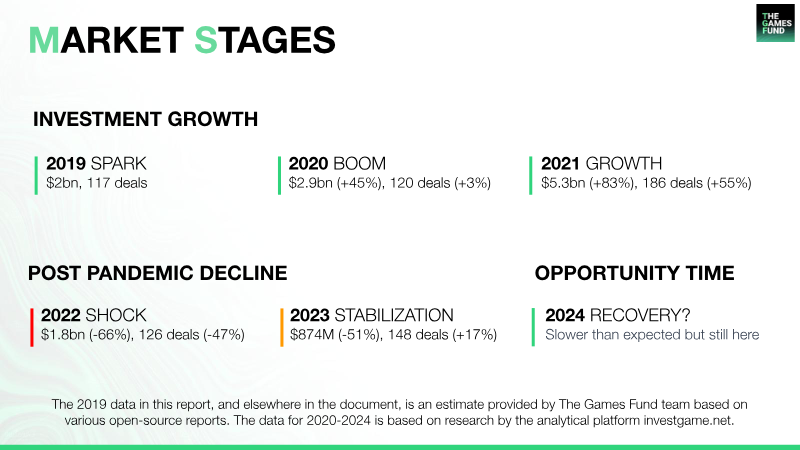
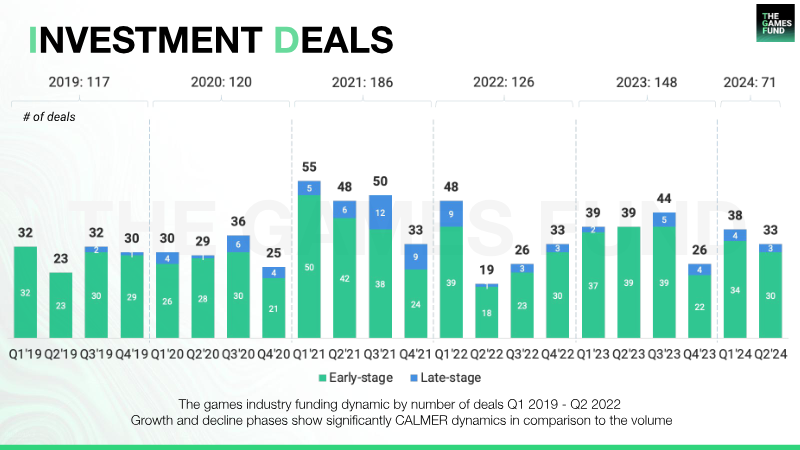
The analysis tracks global venture‑capital activity in the video‑game sector from the first quarter of 2019 through the second quarter of 2024, focusing on deals funded by VCs, strategic investors and publishers. It quantifies total capital deployed and deal counts, revealing a rapid expansion from $2 billion across 117 transactions in 2019 to a peak of $5.3 billion in 2021 (186 deals), followed by a sharp contraction in 2022 to $1.8 billion (126 deals) and a further dip to $874 million in 2023 (148 deals). Early‑stage financing remained relatively stable throughout, while the decline was driven primarily by fewer Series A‑plus rounds, creating a scarcity of growth‑stage capital. The report notes a modest rebound in 2024, with new funds entering the market and higher expected returns despite lingering marketing and user‑acquisition challenges.
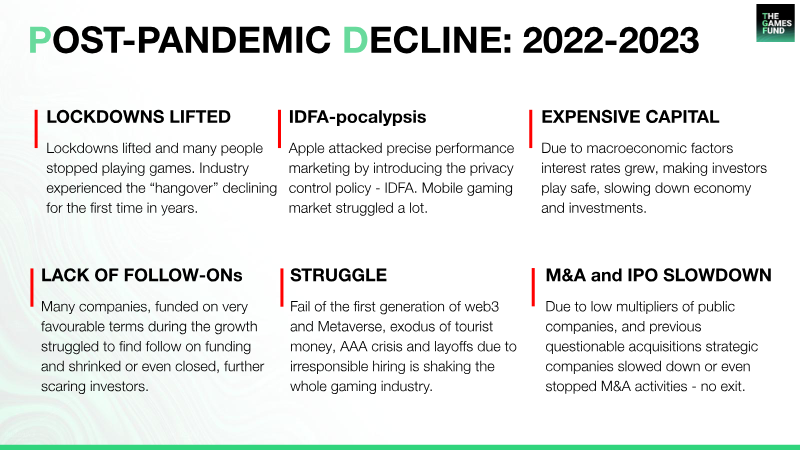
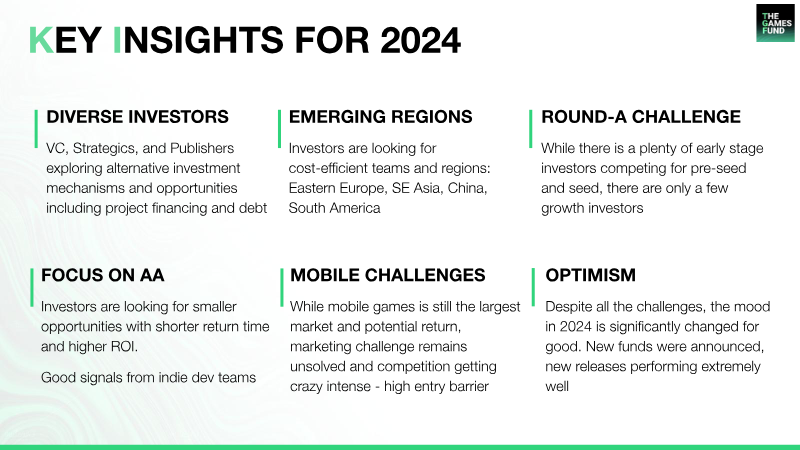
Geographically, investors increasingly target emerging regions such as South America, Eastern Europe, Southeast Asia and China, seeking cost‑efficient teams and pre‑seed opportunities. Mobile games continue to dominate the funding landscape, yet interest in mid‑tier “AA” titles is growing, reflecting a shift toward projects that promise shorter payback periods and stronger ROI. The pandemic‑driven hyper‑casual boom accelerated user‑acquisition technology, while post‑pandemic privacy changes (e.g., Apple’s IDFA restrictions) and macro‑economic headwinds have dampened overall spend and slowed M&A and IPO activity.
Methodologically, the 2019 figures are derived from the Games Fund team’s synthesis of publicly available sources, while data for 2020‑2024 come from the investgame.net analytical platform. The combined dataset provides a comprehensive view of deal volume, value and regional distribution, supporting the conclusion that the gaming VC market exhibits pronounced cyclical dynamics, with early‑stage resilience and emerging‑region optimism offset by a constrained growth‑stage pipeline and broader economic uncertainty.
Pages
Insights
- Global gaming VC investment peaked at $5.3 billion across 186 deals in 2021 before contracting sharply to $874 million in 2023.
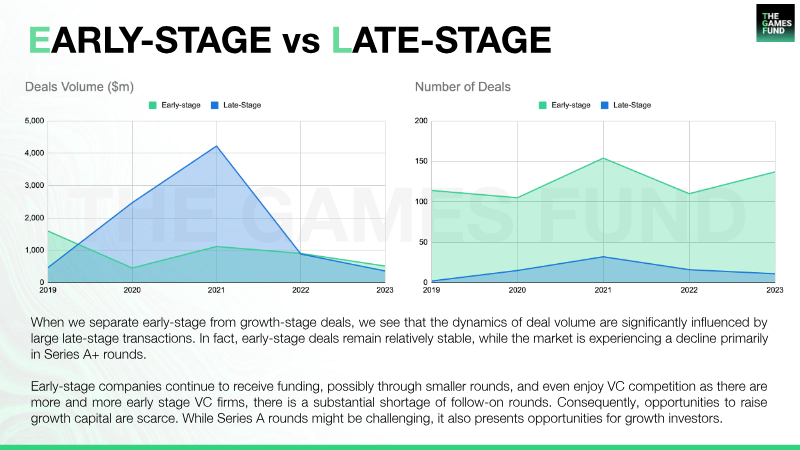
- The decline in total capital was primarily driven by a scarcity of Series A-plus growth-stage funding, even as early-stage financing remained relatively stable.
- A modest market rebound is underway in 2024, supported by the entry of new funds and expectations for higher returns despite ongoing user-acquisition challenges.
- Investors are shifting focus toward emerging regions including South America, Eastern Europe, Southeast Asia, and China to access cost-efficient development teams and pre-seed opportunities.
- While mobile games remain the dominant funding category, there is a growing investor preference for mid-tier 'AA' titles that offer shorter payback periods and stronger ROI.