Showing 30 of 463 results · 0.72s
Jan 2022
Global Esports & Live Streaming Market Report
Newzoo
global esports market is projected to reach $1.38 billion in revenue and an audience of 532 million by the end of 2022, signaling a period of robust expansion
Report51 pages
Jan 2023
Mobile Games: State of the Market
Apptica
mobile gaming market in the first half of 2023 is characterized by a general decline in downloads and revenue across most genres, despite continued dominance in the broader
Report17 pages
Jan 2024
State of Free-to-Play on Steam in 2024
Video Game Insights
free-to-play (F2P) market on Steam represents a dominant but increasingly consolidated segment of the PC gaming industry. In 2023, F2P titles accounted
Report16 pages
Mar 2026
Meridian Play: China Gaming Industry in 2025
GameDev Reports
double-digit growth for international earnings. The United States remains the largest overseas market for Chinese titles, accounting for 32.31% of this revenue, followed by Japan
Article1 pages
Mar 2020
How the Coming Console Generation Will Be Different
SuperJoost
power toward a service-oriented model. The central thesis suggests that the console market is beginning to mirror the mobile industry, characterized by tiered device offerings, digital-only
Article
Mar 2024
Summerhouse & the Rise of the 'Chill Game' on Steam
GameDiscoverCo
title reached 120,000 units sold within its first two weeks on the market. Data reveals that Summerhouse achieved a 97% positive review rating on Steam, driven
Article
Mar 2024
Brutally Honest #143: Useful Stuff About UA in the Post IDFA World
Matej Lancaric
content offers actionable advice for mobile game developers looking to optimize their marketing spend and improve profitability. A significant portion of the analysis focuses on the "snake" creative
Article
Mar 2024
Which Countries Played PC and Console Games Recently?
GameDiscoverCo
time account creation, the findings provide a more accurate reflection of current market engagement. The data is derived from public player profiles and review metadata on Steam
Article
Apr 2025
Trade Wars & the Video Game Biz: The Fragmentation Risk
GameDiscoverCo
significant long-term risks from escalating trade tensions between the United States and China. While initial industry concerns have focused on the immediate impact of tariffs on physical
Article1 pages
Oct 2019
Publishers Playing Politics
SuperJoost
like freedom of speech and maintaining access to the lucrative but protectionist Chinese market. The primary case study involves Blizzard’s decision to ban professional Hearthstone player
Article
Jun 2020
Is Your Streamer Game Discovery Strategy "On Point"?
GameDiscoverCo
specific genre. The scope of the discussion covers the global PC and console market during the 2019–2021 period, with specific emphasis on Steam and the impact
Article
Jul 2020
Financial Results for the First Quarter of the Fiscal Year Ending March 2021
Koei Tecmo
licensing-out title Romance of the Three Kingdoms Senryaku-ban in China and robust back-catalogue sales for Nioh 2, which surpassed one million total units sold during
Financial12 pages
Jul 2019
Playing Like a Girl: How Sports Elevates Gender, Politics, and Equality
SuperJoost
global technology trends highlights a transformative period for international entertainment and digital markets. The 2019 Women’s World Cup serves as a primary case study for how athletic
Article
Jan 2023
Five Key Mobile Game Genres in Asia and MENA
Niko Partners
with AppMagic’s analytics of Apple and Google Play stores. The analysis covers China, India, Indonesia, Japan, Korea, Malaysia, Philippines, Saudi Arabia, Singapore, Thailand, UAE, Vietnam and Egypt
Report15 pages
Sep 2026
The Reverse Acquisition of Xbox
SuperJoost
unit sales. The broader industry landscape reflects a changing center of gravity, with China now serving as the largest source of traffic for Steam as of the first
Article1 pages
Listing on the Growth Enterprise Market: IGG Inc Prospectus
IGG, EBS International, China Everbright Capital Limited, China Everbright Securities (HK) Limited
Singapore with significant research and development operations in the People’s Republic of China, the company maintains a diverse portfolio of browser, client-based, and mobile titles
Financial483 pages
Jan 2025
Souls‑likes: From Niche to Mainstay
Sensor Tower
while AAA output rose to nearly two‑thirds of the market, reflecting a transition from experimental indie projects to large‑scale investments. Geographically, APAC’s influence surged, reaching
Report29 pages
Aug 2020
Turtle Beach Form 10-Q: Q2 2020
Turtle Beach
revenue, with Europe adding $14.6 million, underscoring the company’s reliance on these markets for headset sales. The business anticipates continued growth from next‑generation console launches (Xbox
Financial1 pages
HUYA Inc. Second Quarter 2026 Unaudited Financial Results: China
Huya
HUYA Inc. reported its unaudited financial results for the second quarter of 2026, highlighting a
Financial11 pages
Jan 2024
East Asia Gaming Markets Target $30.8 Billion Mark by 2027
PocketGamer.biz
regional revenue and housing over half of the total gamer population. The Japanese market is expected to see its console gaming revenue exceed $3 billion by 2027. Furthermore
Article1 pages
Jan 2023
Pesquisa Nacional da Indústria de Games 2023
Abragames
developers, 214 freelancers and 80 support organisations, the market expanded despite a 5.1 % contraction in the global games market, delivering a 3 % domestic growth that lifted the industry
Report166 pages
Nov 2020
All Aboard the Axie Infinity Hype Train
SuperJoost
shifts, noting that while titles like World of Warcraft and Fortnite expanded the market by popularizing new genres, other "disruptors" like Rovio eventually struggled to maintain valuations comparable
Article
Jun 2026
Censorship of Queer Video Game Content: Global Trends
Video Games Industry Memo
state regulation, platform moderation and industry self‑censorship. Opaque legal frameworks in China, Russia and Saudi Arabia permit broad bans on queer themes, while storefronts such as Steam
Article1 pages
Mar 2026
Mobilegamer.biz Weekly News Roundup
Mobilegamer.biz
strategic insights into high-growth markets and product development. Industry experts provided guidance on navigating the $50 billion Chinese mobile gaming market, while the director
Article1 pages
Aug 2018
10 Years, 10 Highlights of Google Play
data.ai
spend. The findings exclude pre-installed applications and focus on worldwide performance, excluding China. Geographic data reveals a significant divide between volume and monetization. India leads the world
Report34 pages
Jan 2026
What Were Steam's Most Unexpected Successes of the Last 2 Years?
GameDiscoverCo
rely on gameplay mechanics and viral potential rather than traditional, high-budget marketing campaigns. Genre analysis reveals that roguelikes, idlers, and clickers are particularly well-represented among these
Article1 pages
Dec 2021
Holiday Special: Did Steam Really Just Get Banned in China?
GameDiscoverCo
browsers. Despite these hurdles, the Steam client remains functional for existing users in China, who continue to purchase games, download content, and upload builds. This technical interference mirrors
Article
Oct 2019
Summary of Main Supplementary Explanations Questions and Answers at the FY2020 First Quarter GREE Results Briefing
GREE
expansion of the title lineup. This includes a robust commitment to international markets, supported by a newly developed system capable of simultaneous global releases. However, the timing
Financial2 pages
Mar 2019
Nexon Sale: A Rare Opportunity to Buy a Business That Has Several Fat Years Ahead of It
SuperJoost
high valuation is supported by Nexon’s robust financial performance, particularly in China, where its flagship title, Dungeon Fighter Online, generates approximately $150 million in monthly revenue
Article
Apr 2025
Global Top Mobile Games: February 2025
SocialPeta
ascension, reaching the top‑10 free game lists in South Korea and Greater China within a week of launch. The title produced about 4,400 deduplicated ad creatives
Article1 pages
Global Esports & Live Streaming Market Report
Jan 202251 pages6k words
Summary
The global esports market is projected to reach $1.38 billion in revenue and an audience of 532 million by the end of 2022, signaling a period of robust expansion and structural evolution. China remains the dominant regional player, contributing nearly one-third of total global revenue. While sponsorships continue to serve as the industry’s financial backbone, accounting for approximately 60% of income, organizations are increasingly diversifying into direct-to-fan models. These new revenue streams include lifestyle apparel, blockchain-integrated loyalty programs, and educational platforms, reflecting a strategic shift toward positioning esports as a broader lifestyle brand.
The live-streaming ecosystem is experiencing even more rapid growth, with the audience expected to reach 1.41 billion by 2025 at a compound annual growth rate of 16.3%. This surge is fueled by the rise of non-gaming content and the explosive popularity of mobile esports in emerging markets such as Southeast Asia, Latin America, and the Middle East. Demographically, the esports audience represents a high-value target for advertisers, as nearly three-quarters of enthusiasts are employed full-time and 44% belong to high-income brackets.
Platform dynamics reveal a clear geographic and technological divide. Twitch maintains its dominance in Western markets for PC and console gaming, while YouTube Gaming and Facebook Gaming have successfully captured the mobile-centric audiences of emerging regions. To challenge established leaders, platforms are leveraging massive video-on-demand audiences and exclusivity deals to convert passive viewers into live participants. Despite this growth, the industry faces potential volatility from the fluctuating cryptocurrency sector and the possible migration of audiences toward emerging metaverse events.
Pages


Insights
- The global esports market is projected to reach $1.38 billion in revenue with 532 million viewers by the end of 2022, with China accounting for nearly one-third of total global revenue.
- The live-streaming audience is forecast to grow at a 16.3% compound annual growth rate, reaching 1.41 billion users by 2025.
- Sponsorships remain the primary financial driver at 60% of total income, though organizations are diversifying into lifestyle apparel, blockchain loyalty programs, and educational platforms.
- The esports demographic is highly attractive to advertisers, with 75% of enthusiasts employed full-time and 44% falling into high-income brackets.
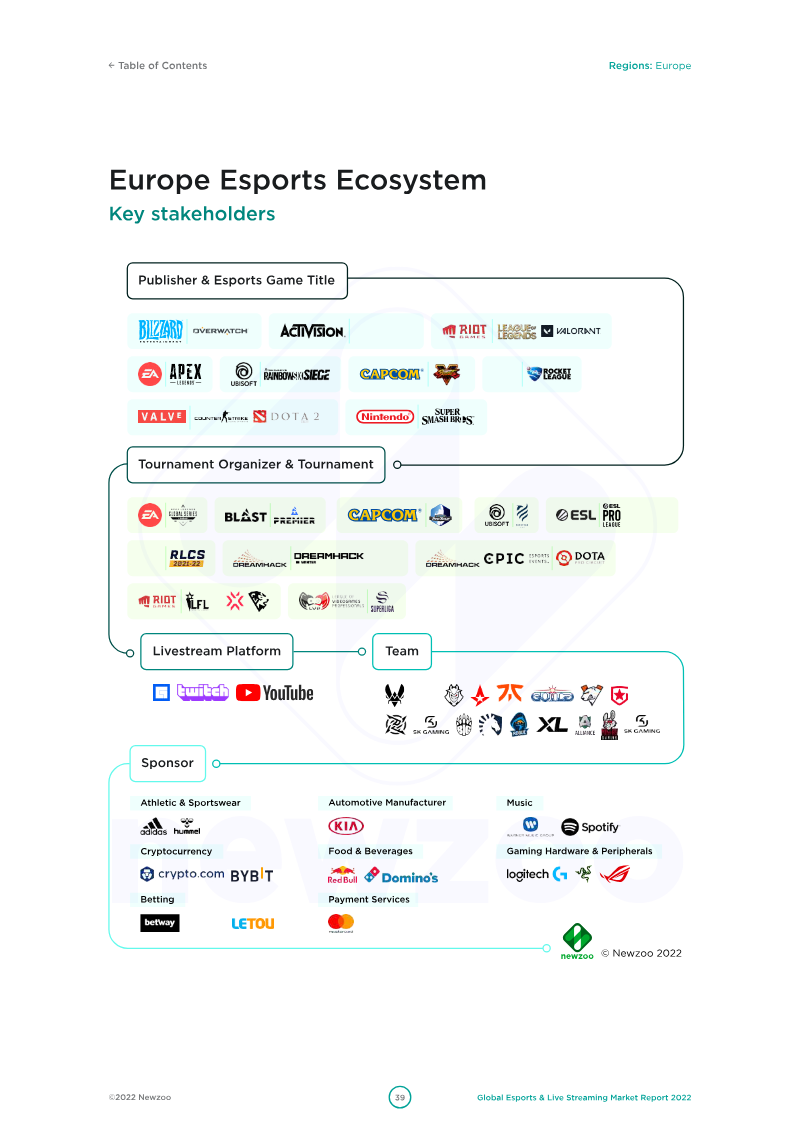
- Platform dominance is split geographically, with Twitch leading Western PC and console markets while YouTube Gaming and Facebook Gaming capture mobile-centric audiences in Southeast Asia, Latin America, and the Middle East.
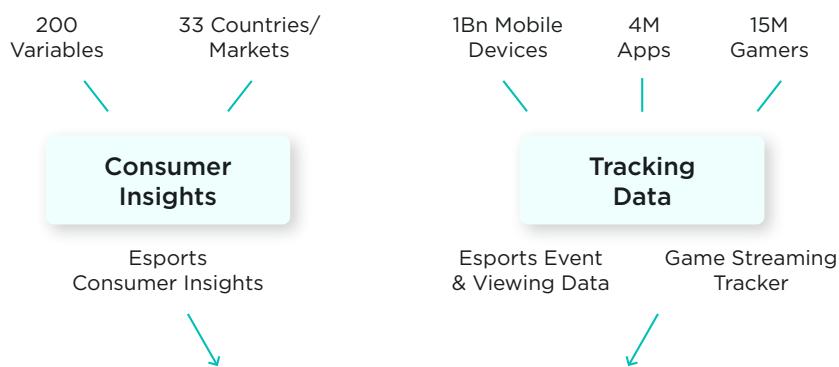
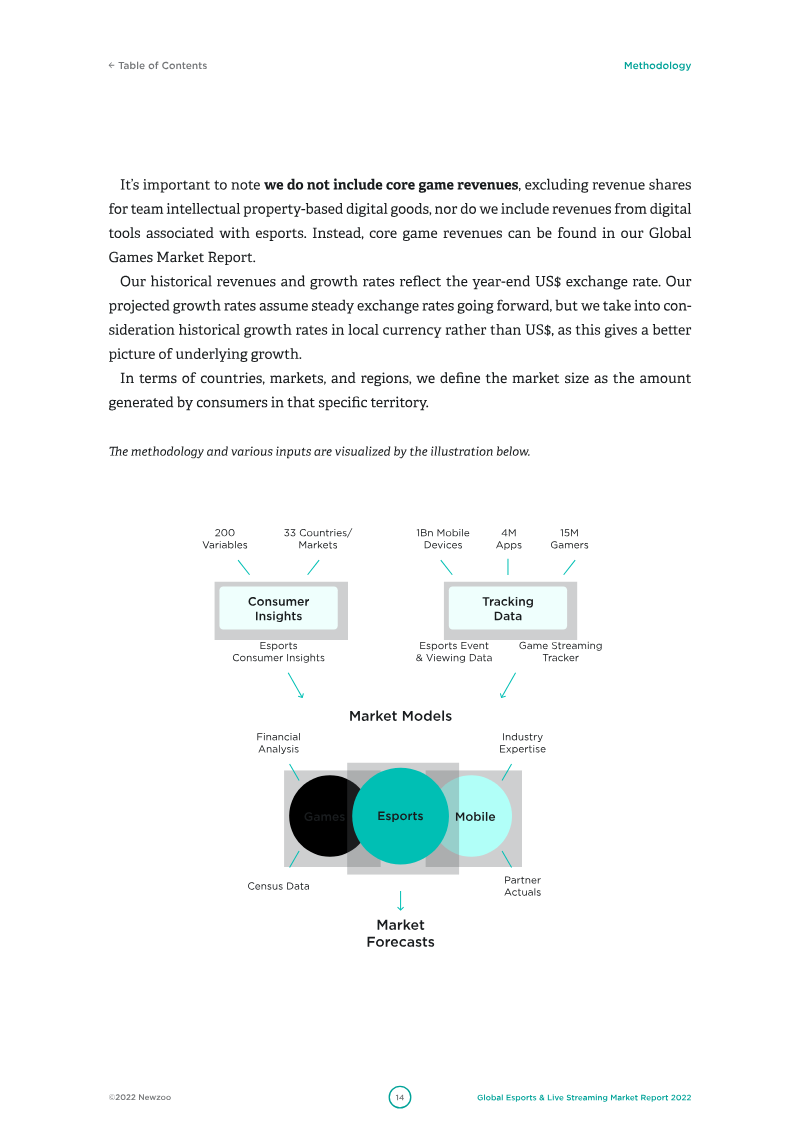
This image from a game industry report illustrates two main categories of data: "Consumer Insights" and "Tracking Data." Consumer Insights are derived from 200 variables across 33 countries/markets, leading to "Esports Consumer Insights." Tracking Data is gathered from 1 billion mobile devices, 4 million apps, and 15 million gamers, contributing to "Esports Event & Viewing Data" and "Game Streaming Tracker."