Showing 30 of 463 results · 0.59s
Jan 2022
Analyzing the Consumer and Market Impacts of Chinese Games Market Policies: China
Newzoo
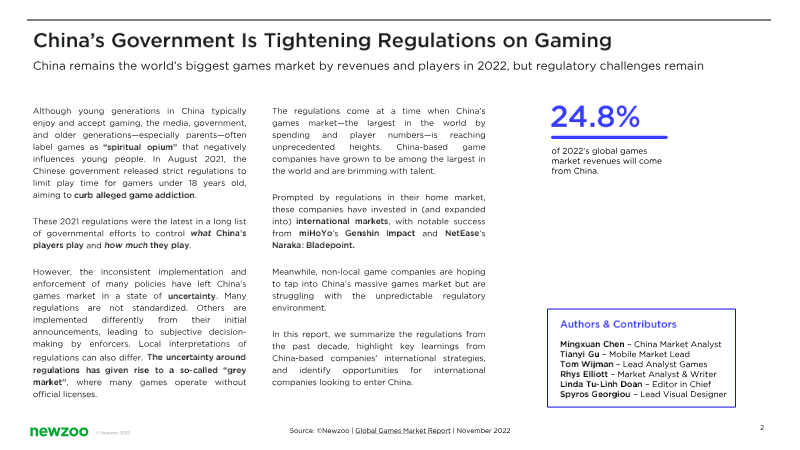
China continues to dominate the global gaming market, yet a series of regulatory tightening measures—particularly anti‑addiction rules for minors and an expanded licensing framework—have introduced
Report29 pages
Apr 2021
Market Snapshot: Q1 2021 US, China & Japan
GameRefinery
titles, driven by the breakout success of Cygames’ Uma Musume Pretty Derby. China’s market moved away from traditional RPG and strategy dominance, favoring a surge in shooter
Report21 pages
Jun 2026
Asia Game Buzz & GameDev Reports: China’s Steam & PC Gaming Market in 2025
GameDev Reports, PWN Games
China’s gaming market is projected to reach a valuation of $51.8 billion in 2025, supported by an estimated 683 million players nationwide and a Steam user base
Article1 pages
Jun 2023
In‑Depth: Inside China’s 'Hidden' Game Console Market
GameDiscoverCo
game console market contains a massive "hidden" segment of unofficial players that significantly outpaces the regulated, domestic market. While official hardware exists in mainland China, it is often
Article
Jan 2025
2025 Half-Year Market Model Update: Asia & MENA
Niko Partners
regulatory developments, the analysis offers updated revenue forecasts through 2029 for key markets, including China, East Asia, India, Southeast Asia, and the MENA-3 region. The primary objective
Report3 pages
Jul 2026
China’s WeChat Mini Games Market: 2026
Meridian Play, Jinke, PWN Games
WeChat Mini Games market in China is experiencing rapid expansion, serving as a critical segment of the broader gaming industry. As of 2026, the market is characterized
Article1 pages
Jan 2020
Asia Spotlight Report: The Impact of COVID-19 on China’s Video Game Market in Q1 2020
Niko Partners
video game market in China experienced a significant surge in engagement and revenue during the first quarter of 2020, driven by widespread stay-at-home mandates during
Report21 pages
Jun 2026
Where Asia’s $103 Billion Game Market Is Actually Growing
Deconstructor of Fun, Niko Partners
China, Japan, and Korea—which together account for 88.6% of the regional share in 2030 but exhibit modest growth rates (China 2.9%, East Asia 2.5%). Emerging markets such
Article1 pages
Jul 2020
Rise of the Player-Fan: The Growing Opportunity of Mobile Esports in Asia
Niko Partners
China doubling during lockdowns. The scope of this analysis covers major Asian markets including China, South Korea, Japan, India, and Southeast Asia, focusing on the period between
Report12 pages
China Steam & PC Gaming Market Report: 2025
Asia GameDev
often obscured by grey-market and cross-region transactions. Consequently, pricing strategies must account for local market realities, as Steam titles in China are consistently priced
Report26 pages
Jun 2026
Weekly Gaming Reports Recap: June 8 - June 12, 2026
GameDiscoverCo
market. Turkish mobile and console segments also feature prominently, illustrating regional disparities in platform penetration and pricing strategies. Distribution and marketing dynamics in China emphasize a multi‑platform
Article1 pages
Mar 2020
AdCost Intelligence: Advertising Cost Analysis Module
SocialPeta
Facebook network, including Instagram, Audience Network, and Messenger, with a focus on China’s market through the SocialPeta China station. Methodologically, data is sourced from a broad array
Article1 pages
Jan 2025
Newzoo Puzzle Games Report: Mobile Game Genre Insights
Newzoo
puzzle game market with a specific focus on the divergent trends between Western and Eastern territories. The study covers major markets including the United States, China, Japan
Report26 pages
Jan 2023
Global Gaming Report 2023: Investment & M&A Overview
Drake Star Partners
points covering North America, Europe, and Asian markets, particularly Japan, Korea, and China. Public market performance showed a gradual recovery, with the Drake Star Gaming Index rising
Financial24 pages
May 2026
Business Review: January–March 2026
Remedy Entertainment
liquidity cushion. Geographically, Remedy operates globally with a focus on core markets and expanding presence in China and Latin America through targeted marketing campaigns for CONTROL Resonant
Financial20 pages
Jan 2020
For the Win: Breaking Down the Preferences of Asia's Mobile Gamers
Niko Partners
transition from casual play toward complex, competitive, and socially-driven experiences. China remains the largest market, characterized by the successful migration of PC intellectual properties to mobile
Report22 pages
Mar 2024
2024 Global Gamer Study
Video Games Industry Memo
more prevalent in emerging markets like India, Saudi Arabia, and China compared to established markets like Japan or Finland. Financial data reveals robust spending across platforms, with over
Article
Jan 2025
Asian & MENA Markets: 2025 Half-Year Report
Niko Partners
Niko Partners’ 2025 half-year market model updates, covers PC, mobile, and console platforms across 13 distinct markets. The methodology integrates proprietary market models, macroeconomic indicators, and qualitative
Report3 pages
Jan 2021
Store Intelligence Data Digest: Q4 2021
Sensor Tower
other categories such as Finance and Utilities demonstrated faster growth rates. The market landscape saw China reclaim its position as the leading market for App Store installs, while
Report80 pages
Jan 2021
Mobile Game Genre Report: Comparing & Contrasting Eastern and Western Markets 2021
Newzoo
player count, market dynamics vary significantly between regions. The United States remains the largest market for puzzle games, followed by Japan and China, though Western markets generally favor
Report25 pages
Jun 2010
NetEase.com, Inc. Form 20‑F (FY2009)
NetEase
significant R&D investment (RMB 230 m) and a dedicated marketing force. Geographically, all operations are China‑based, with revenue generated through portal traffic, game subscriptions, and advertising
Financial1 pages
Jul 2024
Global Gamer Study 2024: How Consumers Engage with Games Today
Newzoo
average player. Geographically, this appetite for new experiences is strongest in emerging markets like China, India, and Saudi Arabia, while more mature markets like Japan and Western Europe
Report30 pages
Nov 2021
In-Game Events Snapshot: November 2021
GameRefinery
examines the strategic implementation of these live operations across major global markets, including the US, China, and Japan, focusing on data from late 2020 through late
Report24 pages
Jan 2025
Financial Results for the First Quarter of the Fiscal Year Ending March 2026
Koei Tecmo
American and European markets while focusing on mobile dominance in Japan and China. Emerging markets in India and Southeast Asia are also being targeted for research and development
Financial18 pages
Jul 2021
State of Card Battler Mobile Games Report 2021
Sensor Tower
half of 2021 indicates a significant shift in market composition; while historically dominated by Asian markets like Japan and China, the United States has emerged as a critical
Report26 pages
Oct 2022
Female Gamers in Asia: Version for Women in Games Asia Panel
Niko Partners
total market increase of 5.0%. The scope of this analysis covers China and the Asia-10 markets, which include Chinese Taipei, India, Indonesia, Japan, Korea, Malaysia, Philippines, Singapore
Report14 pages
Jun 2024
Supercell Struggle: Navigating Market Saturation in Mobile Gaming
SuperJoost
data from 214 countries to demonstrate that playtime patterns in major markets like the US and China are now nearly identical. This universality indicates a mature market where
Article
Aug 2026
The Chinese Gaming Market: H1 2026
China Audio-video and Digital Publishing Association
The Chinese gaming market experienced significant growth during the first half of 2026, with domestic
Article1 pages
Annual Report 2024: Tencent Holdings Limited
Tencent
market competition, regulatory compliance, and technological volatility. Geographically, the Mainland of China remains the primary market, accounting for roughly 90% of total revenue. To operate within this regulatory
Financial274 pages
Apr 2026
What Is Meta's China Exposure?
Mobile Dev Memo
article examines Meta’s current exposure to the Chinese market following a regulatory directive from China’s National Development and Reform Commission (NDRC). The NDRC has ordered Meta
Article1 pages

Analyzing the Consumer and Market Impacts of Chinese Games Market Policies: China
Jan 202229 pages7k words
Summary
China continues to dominate the global gaming market, yet a series of regulatory tightening measures—particularly anti‑addiction rules for minors and an expanded licensing framework—have introduced significant uncertainty and higher operational costs for both domestic and foreign developers. The new minor‑protection law caps playtime, limits in‑game spending, and restricts live‑streaming access for users under 18, while the licensing system now demands detailed content reviews and real‑name verification. These requirements are projected to dampen player engagement and increase investment risk over the long term.
Regulators enforce licensing through a complex approval process, yet many unlicensed titles persist on platforms such as Steam, VR services, cloud gaming, and mobile ad‑only games. Enforcement remains uneven; fines are issued but monitoring is inconsistent. Console and live‑streaming services often circumvent restrictions via overseas purchases, backdoors, or content renaming, creating a regulatory environment that is difficult to monitor and enforce uniformly.
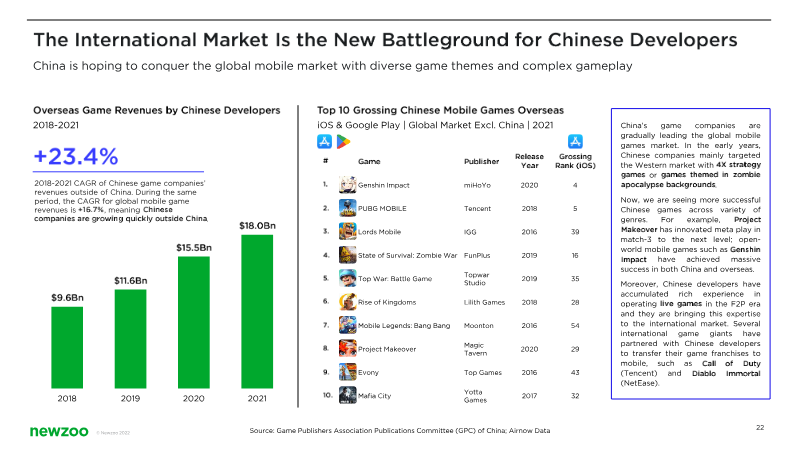
The revised licensing regime now permits a single license for multiplatform releases, encouraging developers to produce cross‑platform titles and streamlining the approval process. The market remains dominated by free‑to‑play mobile games, with LiveOps and regular content updates sustaining high retention. In 2021, half of the top 50 grossing mobile games were launched before 2019. Chinese studios are increasingly exporting their expertise, establishing international studios and publishing arms to tap global markets while leveraging IP‑based mobile games to penetrate China’s competitive scene.
Pages



Insights
- China’s regulatory environment has tightened through strict anti-addiction laws for minors, which now cap playtime, limit in-game spending, and restrict live-streaming access for users under 18.
- The licensing framework now requires detailed content reviews and real-name verification, increasing operational costs and long-term investment risks for both domestic and foreign developers.
- While the licensing process is complex, a new policy allowing a single license for multiplatform releases is incentivizing developers to prioritize cross-platform title development.
- Regulatory enforcement remains inconsistent, with many unlicensed titles continuing to operate on platforms like Steam, VR services, and cloud gaming despite the official approval requirements.
- The Chinese mobile market is characterized by high maturity and retention, evidenced by the fact that 50% of the top 50 grossing mobile games in 2021 were released prior to 2019.
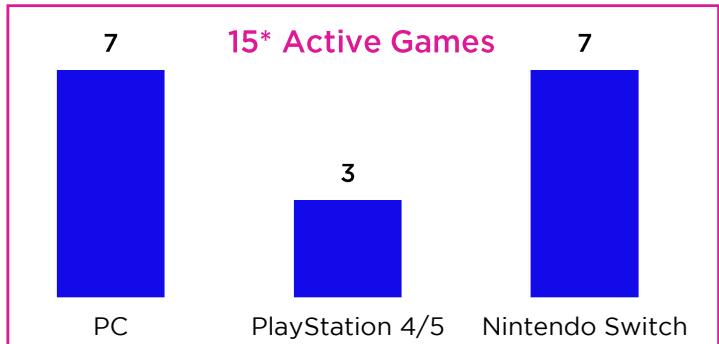
This bar chart illustrates the distribution of 15 active games across three gaming platforms, showing that PC and Nintendo Switch each host 7 games, while PlayStation 4/5 hosts 3. The asterisk likely indicates that some games are cross-platform, as the individual totals (7+3+7) exceed the stated total of 15.
Showing 1 – 30 of 463