Showing 30 of 319 results · 0.93s
Tencent 2026 First Quarter Results Presentation
Tencent
year-over-year increase in domestic game revenue and a 13% rise in international game revenue, driven by titles such as Peacekeeper Elite and VALORANT Mobile. Marketing services
Financial25 pages
Jun 2025
Console’s Brand New Death
SuperJoost
console gaming industry is currently undergoing a fundamental strategic shift as it enters its tenth generation. While historical trends often misinterpret declining hardware sales
Article1 pages
Sep 2021
Publishers and Their Hidden Steam Advantage
GameDiscoverCo
Assassin’s Creed and Total War also command massive independent followings. While individual game wishlists remain the primary metric for success, building a follower base on a publisher
Article
Nov 2022
Unity 10-Q: Q3 FY2022
Unity
dollar—have dampened advertising revenue and slowed overall growth. Expansion into non‑gaming verticals faces significant R&D, sales‑marketing, and compliance costs before revenue materializes. Dependence
Article1 pages
Feb 2026
Platform Momentum and Monetization Shifts Shape Early 2026
Sparkers
Switch 2 game sales in the Oct–Dec 2025 window delivered on disc, while digital titles continue to dominate overall volumes. Microsoft’s gaming division reports
Article1 pages
Feb 2024
Annual Report: 2023 FY
Unity
Strategically, Unity maintains a dual‑solution model: Create Solutions (real‑time engine and cloud services) and Grow Solutions (monetization, mediation, publishing). The company emphasizes its extensive creator community
Financial1 pages
Tencent Second Quarter 2026 Results Presentation: China
Tencent
increase year-over-year, supported by strong performance in domestic gaming, marketing services, and fintech. Net profit attributable to equity holders reached 68.4 billion
Financial28 pages
Jul 2026
Form 10-K: Microsoft Corporation
Microsoft
continues to leverage its three primary business segments—Productivity and Business Processes, Intelligent Cloud, and More Personal Computing—to drive growth. Total revenue for fiscal year 2026 climbed
Article1 pages
Jan 2010
¿Cómo Se Proyecta el Videojuego del Futuro?: España
AEVI
barriers to online play, and the aspirations of different user segments for future gaming experiences. Research combined three perspectives—regular gamers, industry experts and parents—through focus groups
Report17 pages
A Shortcut to Your Own Game Insights Platform
InvestGame
titles using Raw Export—illustrating tangible ROI gains. The scope covers global game studios, with examples from iOS, Android, Steam, and VR platforms. Timeframes referenced include daily updates
Report20 pages
Feb 2026
Mobile Market Landscape 2026
AppMagic
approximately 80% as developers move toward puzzle and simulation subgenres. Meanwhile, midcore gaming revenue has plateaued at $33–34 billion, prompting a reliance on intensified LiveOps and direct
Report94 pages
Game & Network Services Segment Presentation
Sony Interactive Entertainment
diversified content mix of over 12 000 titles and high‑engagement live‑service games underpins this momentum, with revenue increasingly driven by services such as PlayStation Plus
Presentation41 pages
Jun 2024
GMTK Digest: June 2024
Game Maker's Toolkit
June 2024 gaming landscape was defined by major platform showcases that traditionally align with the mid-year industry cycle. Nintendo’s presentation highlighted a significant shift
Article
Aug 2021
Three Decades of Games Industry Consolidation
SuperJoost
global video games industry is currently undergoing a significant wave of consolidation, highlighted by three major acquisitions in early 2022: Microsoft’s $69 billion purchase of Activision Blizzard
Article
Dec 2025
Leveling Up for the New Reality: The Gaming Report
InvestGame
report examines the global gaming market’s evolution from 2017 to 2028, highlighting a post‑pandemic correction that has shifted growth expectations from double‑digit rates to modest
Report18 pages
Feb 2026
Where's Xbox Heading, Post-Impossible Game Pass Dream?
GameDiscoverCo
services like Netflix. The core thesis of this transition is that the "Game Pass dream"—a vision of scaling to over 100 million subscribers through aggressive first-party
Article1 pages
Stories: Lightspeed Venture Partners
Lightspeed Venture Partners
field. Beyond AI infrastructure, Lightspeed’s portfolio showcases a breadth of innovation across gaming and education. Giant Skull delivers AAA, story‑driven action adventures while championing sustainability
Article
Annual Report 2017: Tencent
Tencent
billion monthly active accounts, and robust gains in digital content, payment services, and cloud infrastructure. The company’s operational success was supported by a disciplined approach to capital
Financial246 pages
Jul 2026
A Primer on AI in the 2026 Games Industry
AI and Games
video game industry has transitioned from rule-based, theatrical systems designed to simulate character behavior to sophisticated machine learning frameworks that underpin modern development pipelines. Historically, game
Article1 pages
Jan 2024
Xsolla Report: State of Play – Winter 2024 Edition
Xsolla
global gaming industry is currently navigating a period of stabilization following a massive 26% growth surge between 2019 and 2021. While the rapid pandemic-era expansion has moderated
Report55 pages
May 2023
NVIDIA Quarterly Report: Form 10-Q (Q1 FY2023)
NVIDIA
worked to normalize channel inventory following a period of weakened demand in the gaming sector. Despite this top-line pressure, net income rose to $2.04 billion, bolstered significantly
Financial1 pages
Interview with Game Expert at Line Studio: Japan Market Insights
Korea Creative Content Agency
shift 1. Time‑scarcity: Japanese commuters and office workers increasingly favor games that can be enjoyed in 5‑10‑minute bursts. 2. Platform diversification: With smartphones
Report21 pages
Feb 2023
Roblox 10-K: FY 2022
Roblox Corporation
filing outlines a high‑growth, user‑generated content platform that monetizes through in‑game purchases (Robux), advertising, and premium subscriptions. In 2022, bookings rose to $2.87 billion
Financial1 pages
1Q FY2023 Presentation Material
CyberAgent
FY2023, emphasizing a dual‑stream business model that blends advertising revenue with game development while expanding into media and digital content. Core financial highlights show a modest increase
Report30 pages
Nov 2018
Winter Is Coming: New Sony Handheld? Spotify's Ambition
SuperJoost
period of consistent growth is nearing a plateau. The primary thesis suggests that gaming has lost its "anti-cyclical" status; having fully integrated into the mainstream
Article
Jan 2025
Interview with Yi Yuan, at Hiverlab: Southeast Asia
Korea Creative Content Agency
time and interaction density to assess engagement. Effective experiences consistently incorporate gamified micro‑games and selfie‑style interactions that encourage user participation and social sharing. These design elements
Report15 pages
Beyond the Game: How Gamification is Becoming Mainstream
InvestGame, GDev
analysis examines how gamification—applying game‑like mechanics such as streaks, leaderboards, and reward loops—to non‑gaming consumer apps has shifted the mobile app economy over
Report9 pages
FY2023 Third Quarter Financial Results: GREE
GREE
rising to ¥3.08 billion QoQ, largely due to upfront promotional investments for app games, while commission fees increased to ¥4.11 billion as sales expanded. Total costs climbed
Financial28 pages
Jan 2024
Game & Network Services Segment
Sony Group
Game & Network Services segment demonstrates a robust market position characterized by a PlayStation 5 monthly active user base of 118 million and a significant increase in per-console
Financial39 pages
Feb 2023
Form 10-K: Fiscal Year 2023
NVIDIA
platform provider, NVIDIA leverages a fabless manufacturing model to serve the data center, gaming, professional visualization, and automotive markets. The company’s strategy centers on integrating hardware, software
Financial1 pages
Tencent 2026 First Quarter Results Presentation
25 pages4k words
Summary
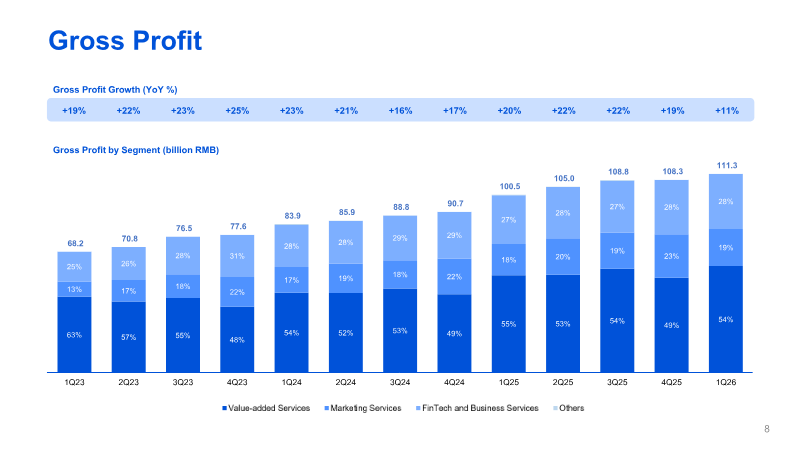
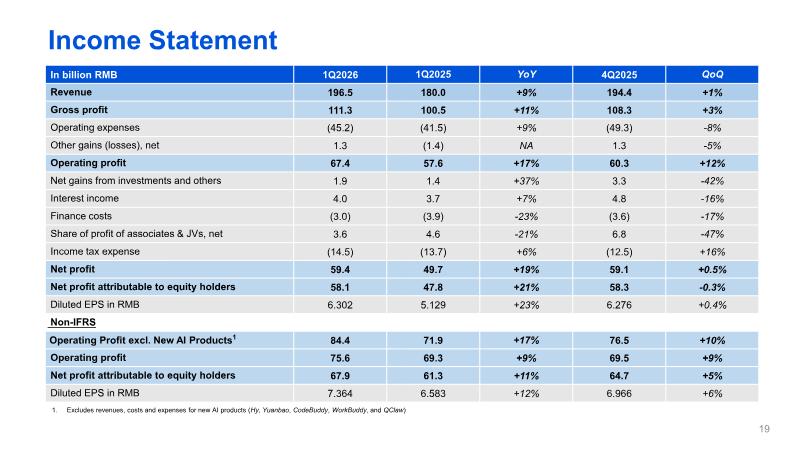
The first quarter 2026 results for Tencent Holdings Limited demonstrate sustained financial growth and a strategic pivot toward agentic artificial intelligence. Total revenue reached 196.5 billion RMB, representing a 9% year-over-year increase. The company reported a net profit attributable to equity holders of 67.9 billion RMB on a non-IFRS basis, an 11% increase compared to the same period in 2025. These results reflect a stable non-IFRS operating margin of 38.5%, supported by growth across core segments including domestic games, marketing services, and fintech.
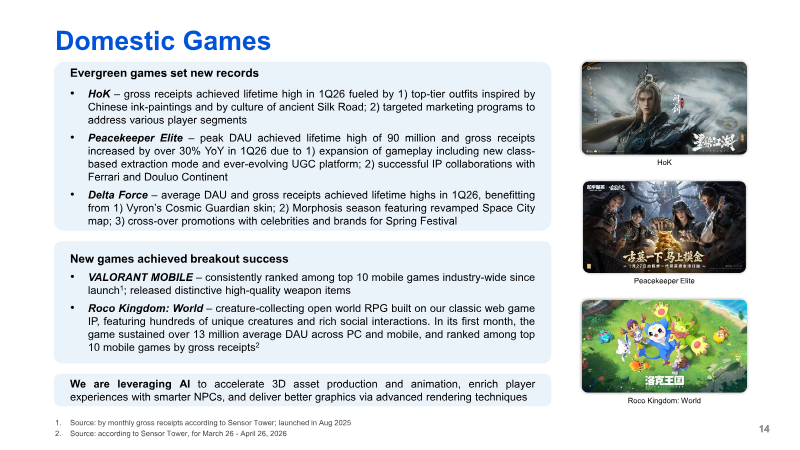
The company’s performance was bolstered by a 6% year-over-year increase in domestic game revenue and a 13% rise in international game revenue, driven by titles such as Peacekeeper Elite and VALORANT Mobile. Marketing services saw significant momentum with a 20% year-over-year revenue increase, aided by enhanced ad recommendation models and increased inventory in Video Accounts. Additionally, the fintech and business services segment grew by 9%, with cloud services benefiting from rising demand for AI-related infrastructure and international expansion.
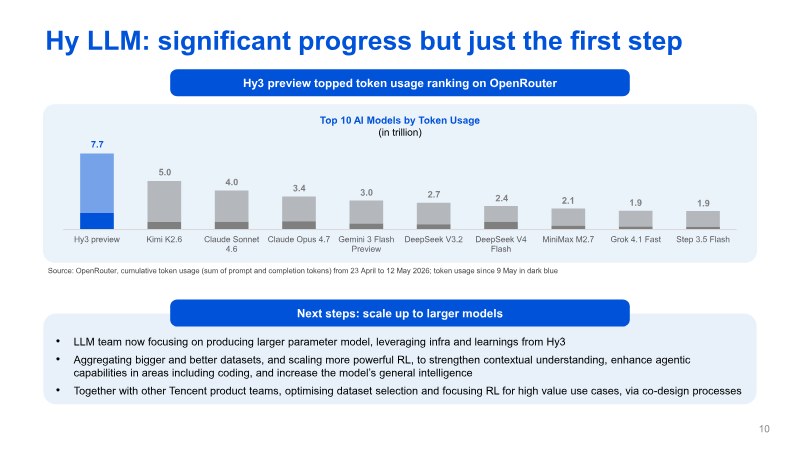
A central focus of the period was the development and deployment of the Hy large language model and associated agentic AI tools, including CodeBuddy and WorkBuddy. These products are being integrated across the company’s ecosystem to drive productivity and user engagement. The company has re-architected its infrastructure to support these AI initiatives, reporting high retention rates among early adopters and a virtuous feedback loop where increased AI usage drives higher token consumption on Tencent Cloud.
The reporting period covers the first quarter of 2026, with financial figures presented in Renminbi and converted to US dollars at an exchange rate of 6.9194. The company maintains a strong liquidity position, reporting 533.7 billion RMB in total cash and a net cash position of 146.9 billion RMB. These results underscore a transition toward AI-centric operations while maintaining leadership in China’s mobile community and digital content markets.
Pages
Insights
- Tencent reported Q1 2026 total revenue of 196.5 billion RMB, a 9% year-over-year increase, with non-IFRS net profit rising 11% to 67.9 billion RMB.
- The company is strategically pivoting toward agentic AI, deploying the Hy large language model and productivity tools like CodeBuddy and WorkBuddy to drive cloud consumption and ecosystem engagement.
- Gaming performance remained strong with domestic revenue up 6% and international revenue up 13%, bolstered by titles such as Peacekeeper Elite and VALORANT Mobile.
- Marketing services revenue grew 20% year-over-year, driven by improved ad recommendation models and increased inventory within Video Accounts.
- Fintech and business services revenue increased by 9%, supported by rising demand for AI-related infrastructure and international cloud expansion.
Top 10 AI Models by Token Usage