Web3 & Blockchain·Updated Apr 8, 2026 by DappRadar
Report · January 1, 2022
Published by DappRadar
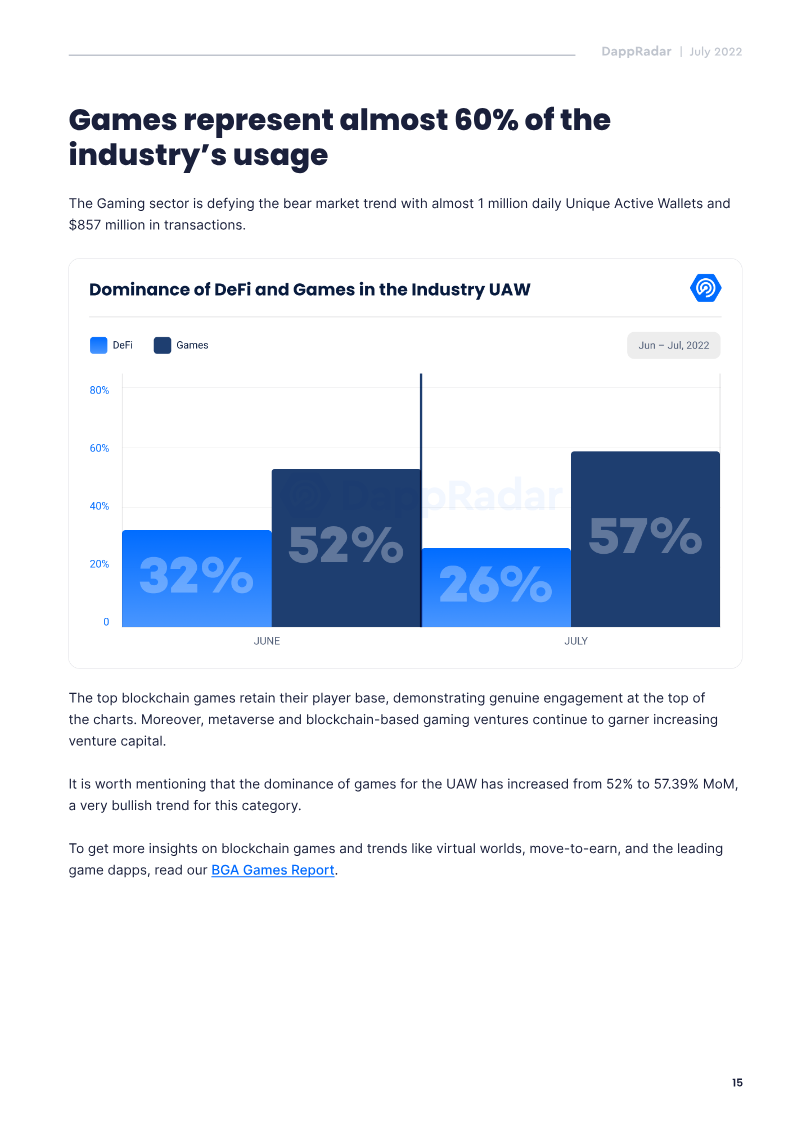
The report examines the blockchain ecosystem during a prolonged bear market, highlighting how macroeconomic pressures—high U.S. inflation, rising interest rates, and a recessionary environment—have driven investors to withdraw capital from both equity and cryptocurrency markets. This withdrawal has intensified selling pressure, reducing medium‑term trading volume and pushing dapp activity to its lowest point of 2022, with 1.68 million daily unique active wallets (UAW) in July, a 4 % month‑over‑month decline yet still 20 % above July 2021 levels. DeFi remains the most affected segment, with UAW falling below 500 k for the first time since April 2021—a 22 % MoM drop and a 31 % YoY decline. Total value locked (TVL) has begun to recover, rising 22 % from July 1 to July 31 to $82.3 bn, driven by gains across Ethereum, BNB Chain, and Polygon. Polygon’s network upgrades and migration of Terra projects have contributed to a 17 % TVL increase, while the launch of a web3 smartphone partnership signals continued innovation. NFT trading volume contracted 25 % MoM, falling below $1 bn for the first time since June 2021. Market concentration intensified, with Yuga Labs’ collections accounting for over 20 % of July’s volume. OpenSea’s dominance has eroded from 84 % to 58.6 %, as new marketplaces such as GameStop and Nickelodeon capture niche segments. Gaming defied the downturn, achieving 1 million daily UAW and $857 m in transactions, with its share of overall usage rising from 52 % to 57.4 %. The report concludes that while the crypto winter has triggered significant market recalibration, resilient projects—particularly in DeFi and gaming—are positioned to drive a future bull run.
@ Jul Jul J DappRadar Blockchain DappRadar Blockchain Industry Report Industry Report Check out the dapp industry Check out the dapp industry Check highlights of July 2022 highlights of July 2022 highlights ofJuly 2022
BLOCKCHAIN INDUSTRY REPORT The crypto industry is still trapped in a bear market, feeling the effects of Terra’s collapse, which had repercussions on the entire world of Web 3.0, including DeFi, NFTs, and the metaverse. From the macro perspective, recent U.S. inflation figures reached their highest level in decades, with a rising interest rate of 75 basis points and a contraction of 0.9% in the second quarter of 2022. This was also the second quarter in a row for the United States making the official entrance into recession. As obligations such as mortgage payments increase, disposable income decreases. Investors withdraw funds from the equity and cryptocurrency markets to repay loans and minimize liabilities. This increases the selling pressure and decreases the medium-term trading volume since it becomes more difficult to identify profitable chances. The decline in cryptocurrency is visible, in fact, dapp activity has hit its lowest point this year with 1.68 million daily Unique Active Wallets (UAW) connected to blockchain dapps in July. This number represents a 4% decrease month-over-month (MoM), although it is still 20% higher than in July 2021. Industry Unique Active Wallets, M ? UAW —DeFi Games Jun, 2021 - Jul, 2022 2 Wu Muhrm Ma m M m
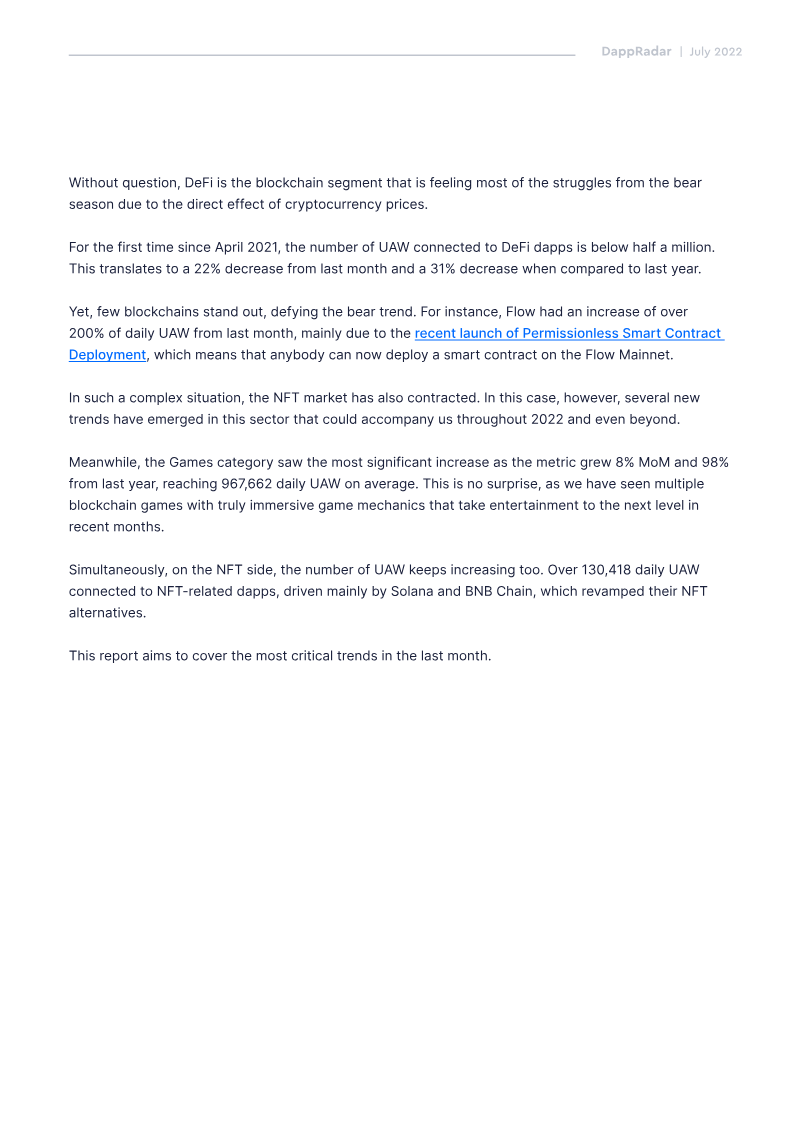
Without question, DeFi is the blockchain segment that is feeling most of the struggles from the bear season due to the direct effect of cryptocurrency prices. For the first time since April 2021, the number of UAW connected to DeFi dapps is below half a million. This translates to a 22% decrease from last month and a 31% decrease when compared to last year. Yet, few blockchains stand out, defying the bear trend. For instance, Flow had an increase of over 200% of daily UAW from last month, mainly due to the recent launch of Permissionless Smart Contract Deployment, which means that anybody can now deploy a smart contract on the Flow Mainnet. In such a complex situation, the NFT market has also contracted. In this case, however, several new trends have emerged in this sector that could accompany us throughout 2022 and even beyond. Meanwhile, the Games category saw the most significant increase as the metric grew 8% MoM and 98% from last year, reaching 967,662 daily UAW on average. This is no surprise, as we have seen multiple blockchain games with truly immersive game mechanics that take entertainment to the next level in recent months. Simultaneously, on the NFT side, the number of UAW keeps increasing too. Over 130,418 daily UAW connected to NFT-related dapps, driven mainly by Solana and BNB Chain, which revamped their NFT alternatives. This report aims to cover the most critical trends in the last month.
Key Takeaways DeFi TVL starts to recover, a 22% increase from the previous month, with Tron and Polygon • DeFi TVL starts to recover, a 22% increase from the previous month, with Tron and Polygon gaining ground • The centralized lending platform, Celsius, filed for Chapter 11 bankruptcy, placing additional uncertainty on the possibility of depositors’ funds being recovered • NFT volume fails to hit $1 billion in trades for the first time since June 2021 • New entries as competitors in the NFTs marketplace, and the dominance of OpenSea falls to 58.6% from the 84% measured in May • The dominance of the blockchain gaming sector keeps growing and is now almost 60%, defying the bear market trend. defying the bear market trend.
Contents DeFi starts recovering from Terra collapse - 22% TVL increase 6 Polygon keeps building amid the bear season 7 Crypto contagion continues as Celsius files for bankruptcy 8 More calls for regulation in crypto 9 Has the NFT bubble finally burst? 10 OpenSea might soon engage in an NFT Marketplace “War” 11 Games represent almost 60% of the industry’s usage 15 Closing - what to expect in the future? 16
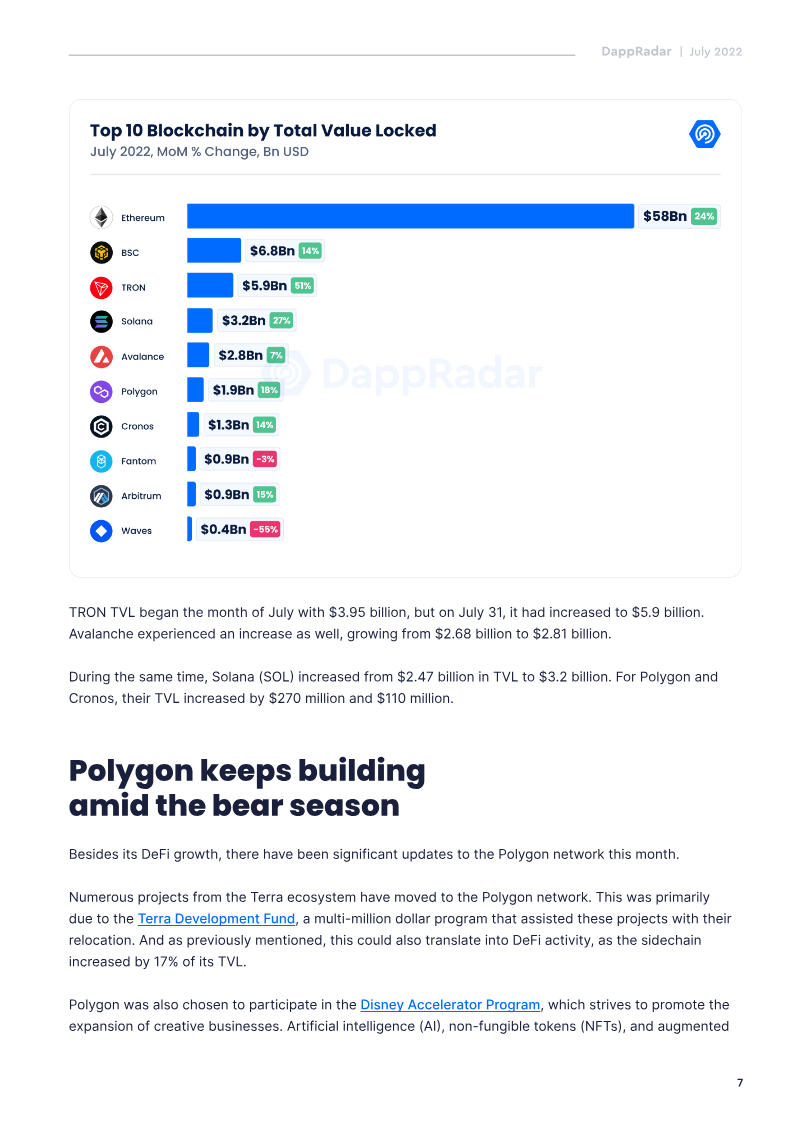
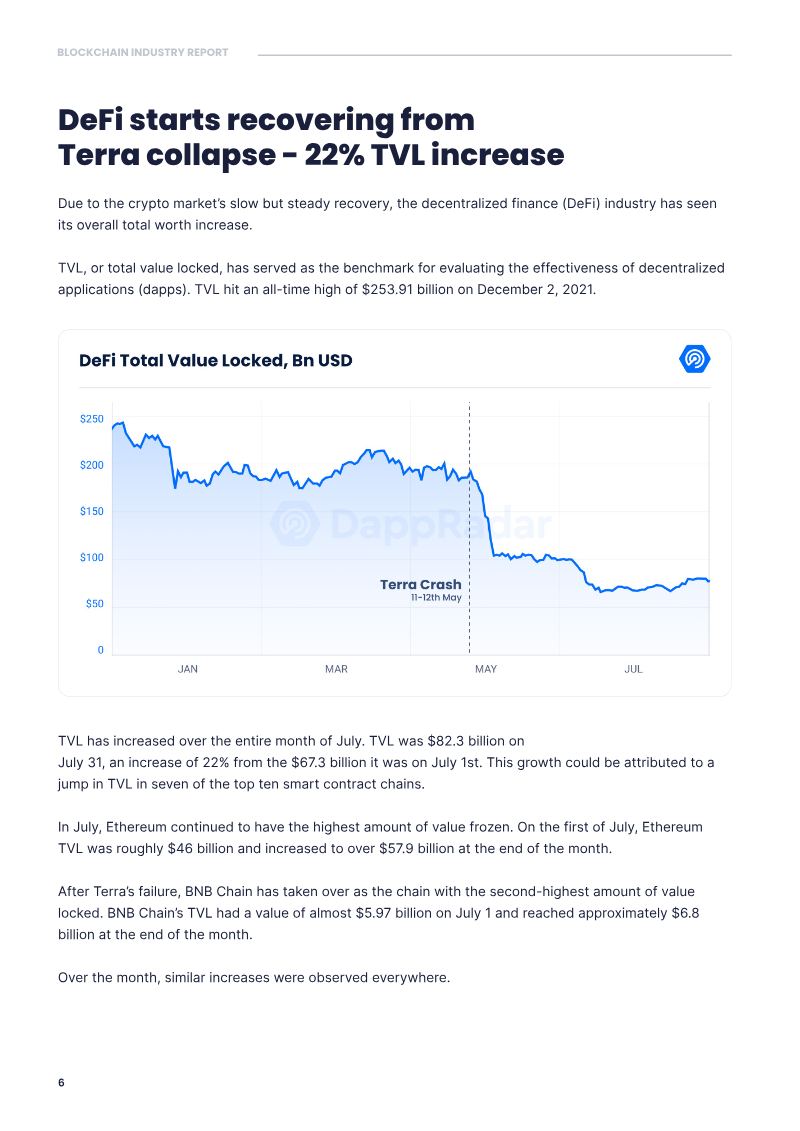
BLOCKCHAIN INDUSTRY REPORT DeFi starts recovering from Terra collapse - 22% TVL increase Due to the crypto market’s slow but steady recovery, the decentralized finance (DeFi) industry has seen its overall total worth increase. TVL, or total value locked, has served as the benchmark for evaluating the effectiveness of decentralized applications (dapps). TVL hit an all-time high of $253.91 billion on December 2, 2021. DeFi Total Value Locked, Bn USD ? $250 $200 $150 DappR dar $100 Terra Crash $50 11-12th May JAN MAR MAY JUL TVL has increased over the entire month of July. TVL was $82.3 billion on July 31, an increase of 22% from the $67.3 billion it was on July 1st. This growth could be attributed to a jump in TVL in seven of the top ten smart contract chains. In July, Ethereum continued to have the highest amount of value frozen. On the first of July, Ethereum TVL was roughly 46 billion and increased to over 57.9 billion at the end of the month. After Terra’s failure, BNB Chain has taken over as the chain with the second-highest amount of value locked. BNB Chain’s TVL had a value of almost 5.97 billion on July 1 and reached approximately 6.8 billion at the end of the month. Over the month, similar increases were observed everywhere.
This analysis examines the intersection of cryptocurrency and live streaming, tracking the rapid growth of digital asset content across Twitch, YouTube, and Kick. The primary thesis identifies a significant surge in crypto-related broadcasting driven by market speculation, memecoin popularity, and political events. The scope covers global data from July 2023 through June 2025, utilizing a methodology that tracks unique channels with at least 30 hours of monthly airtime while excluding bots and suspicious accounts to ensure data integrity. Findings reveal that the number of unique channels streaming crypto content doubled in the six months leading into late 2024. YouTube experienced the most dramatic growth, rising from 31 channels in July 2024 to over 200 by June 2025. Viewership peaked across platforms in early 2025, with Twitch reaching its height in February and YouTube seeing major spikes in January and June. While Bitcoin remains the most discussed asset with over 500,000 chat mentions in the first half of 2025, Solana has emerged as a dominant secondary interest, recording 171,000 mentions—triple that of Cardano. The geographic reach of this content is notably diverse, with India emerging as a major hub; four of the top ten crypto creators are based there and stream primarily on YouTube. K1m6a is identified as the leading creator with 6.7 million hours watched. Beyond dedicated finance streams, crypto discourse has permeated gaming communities. Just Chatting is the top category for crypto mentions, but Escape from Tarkov and Fortnite lead among gaming titles. Furthermore, crypto integration is deepening in professional gaming, evidenced by high-viewership esports events like the 2025 Mid-Season Invitational, which secured major crypto-related sponsorships.
The Web3 gaming market entered a phase of maturation in 2024, marked by a strategic pivot from rapid expansion to ecosystem stability. While new game announcements decreased by 36%, project discontinuations plummeted by 84%, signaling a more resilient landscape. Indie developers currently drive over 90% of new launches, though technical integration remains a significant hurdle, with only 34% of titles successfully incorporating blockchain infrastructure. To combat the inflationary failures of earlier economic models, the industry is shifting toward "Play-to-Airdrop" mechanics to foster more sustainable player engagement. Geographically, the APAC region and the United States remain the primary hubs for development, collectively hosting the majority of active teams. Genre dominance continues to favor RPG, Casual, and Action titles, which also attract the bulk of stabilized venture capital funding. A notable shift in distribution is underway as Telegram emerged as a powerhouse platform, capturing 21% of new game launches, while the Epic Games Store expanded its Web3 portfolio to nearly 100 titles. This evolution in accessibility is mirrored by a technical migration toward Layer 2 and Layer 3 solutions, which now account for 57% of new game launches. Infrastructure is becoming increasingly specialized, with 64% of new blockchains designed specifically for gaming. Although the Ethereum Virtual Machine ecosystem maintains its dominance, high-growth frameworks like Arbitrum Orbit and Immutable are driving a record number of migrations as developers seek more efficient environments. Despite a 200% surge in token launches, investors maintain a conservative outlook, prioritizing high-quality game content over foundational infrastructure. This growth occurs against a fragmented regulatory backdrop, where developers must navigate the rigorous enforcement of the U.S. SEC alongside more structured frameworks in Asia and the European Union.
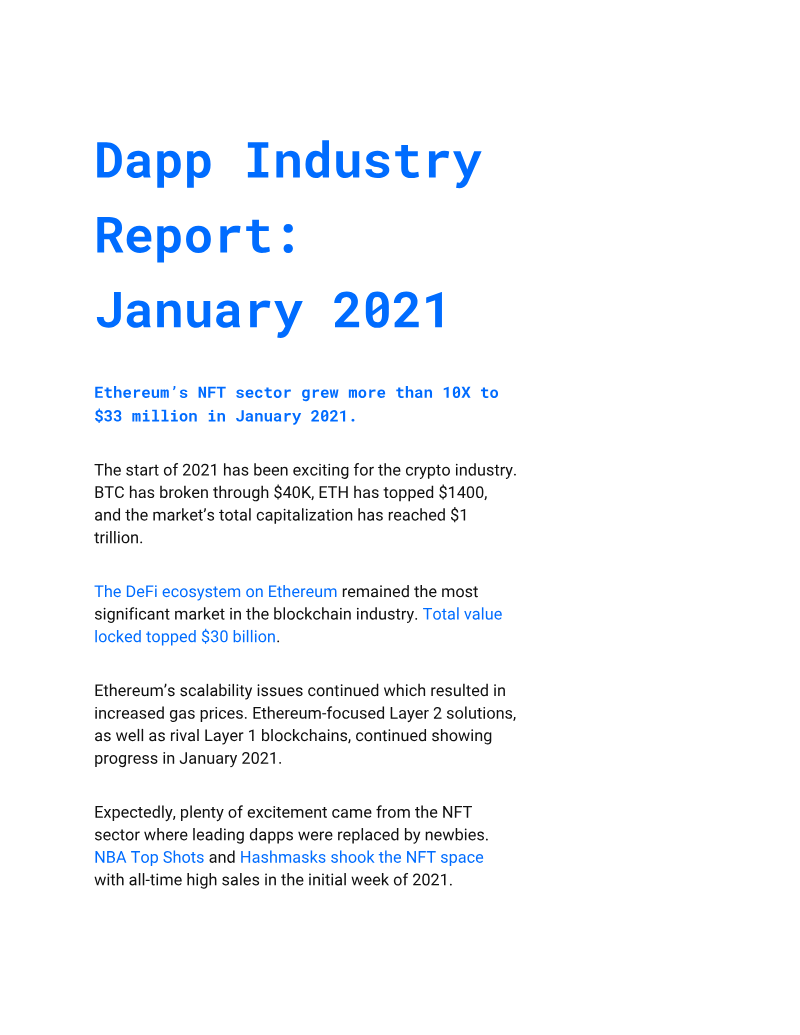
This analysis examines the state of the decentralized application (dapp) and blockchain industry during August 2022. The report highlights a period of significant volatility characterized by a 14.73% year-over-year decline in daily Unique Active Wallets (UAW), which reached a yearly low of 1.67 million. Despite the prevailing bear market and a series of high-profile security breaches—including the $190 million Nomad bridge exploit and the Solana wallet hack—the industry showed pockets of resilience, particularly within Ethereum scaling solutions and the gaming sector. The Decentralized Finance (DeFi) sector experienced a 10.47% contraction in Total Value Locked (TVL), falling to $74.21 billion. This decline was exacerbated by U.S. sanctions against Tornado Cash, which sparked industry-wide debates regarding the true nature of Web3 decentralization. Conversely, Ethereum Layer-2 protocols like Optimism and Arbitrum saw growth in anticipation of "The Merge," with Optimism entering the top ten blockchains by TVL. While the gaming sector’s dominance of industry usage dipped slightly to 51%, it remained the primary driver of blockchain activity with over 847,000 daily UAW. The NFT market faced downward pressure, with UAW dropping 16.7% to its lowest level since mid-2021. Trading volumes decreased by 5% month-over-month, influenced by the falling price of Ethereum and liquidation fears surrounding major collections like Bored Ape Yacht Club. However, the report notes structural evolution in the marketplace, specifically the rise of the Automated Market Maker (AMM) model via SudoSWAP and continued interest from traditional brands like Mars and Tiffany & Co. The findings suggest that while macroeconomic uncertainty and security vulnerabilities persist, the underlying infrastructure continues to mature through technical milestones and diversifying use cases.
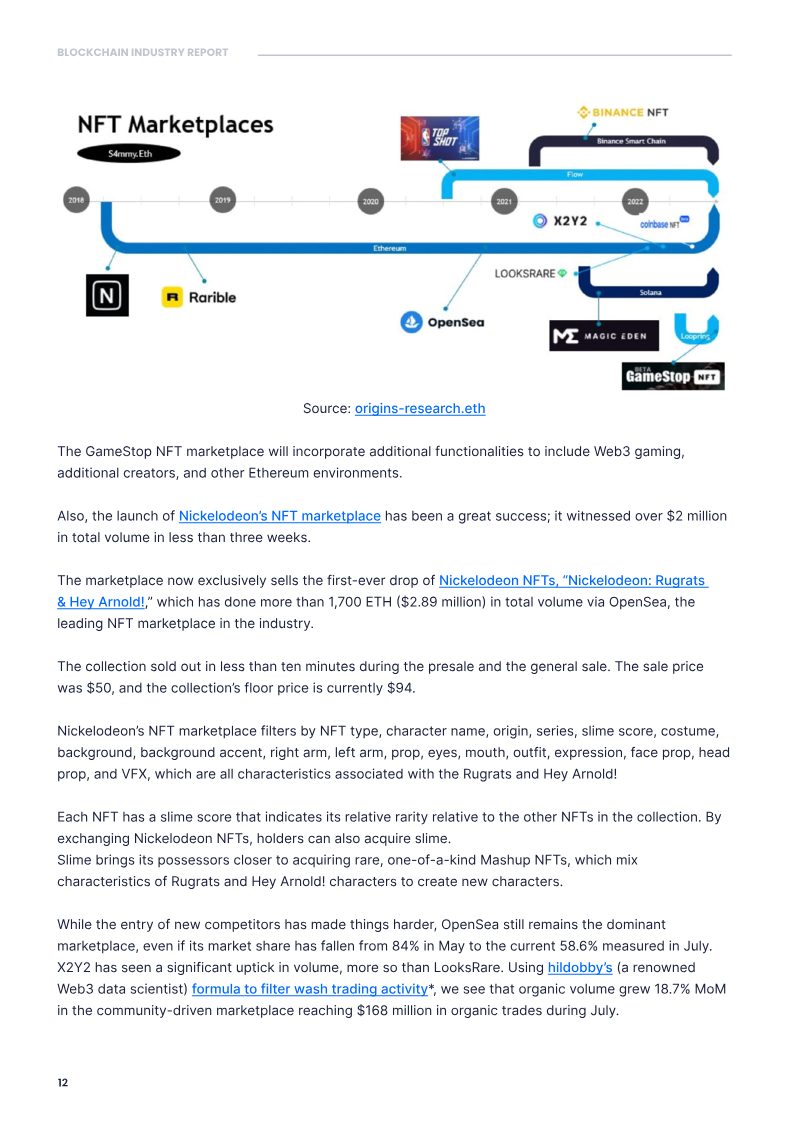
The July 2022 DappRadar Blockchain Industry Report analyzes the state of the decentralized application ecosystem during a significant market downturn. The findings indicate that while the broader crypto industry remains trapped in a bear market influenced by the collapse of Terra and macroeconomic pressures like U.S. inflation, specific sectors—most notably blockchain gaming—demonstrate remarkable resilience. The report covers global trends across decentralized finance (DeFi), non-fungible tokens (NFTs), and gaming, utilizing data on Unique Active Wallets (UAW) and Total Value Locked (TVL) to measure health and engagement. Data shows that dapp activity reached a yearly low in July with 1.68 million daily UAW, a 4% decrease from June. DeFi was the hardest-hit segment, with UAW dropping below 500,000 for the first time since early 2021. Despite this, DeFi TVL saw a 22% recovery during the month, rising to $82.3 billion, led by growth on Ethereum, BNB Chain, and Tron. The report also highlights the continued "crypto contagion" following the Celsius Network bankruptcy filing, which has increased calls for international regulatory frameworks like the EU’s MiCA. The NFT market experienced a contraction, with monthly trading volume failing to reach $1 billion for the first time in over a year. Market dynamics are shifting as OpenSea’s dominance fell from 84% in May to 58.6% in July, facing increased competition from new entrants like the GameStop and Nickelodeon marketplaces. Conversely, the gaming sector emerged as a primary industry driver, accounting for nearly 60% of all dapp usage. With nearly 1 million daily UAW, blockchain games grew 8% month-over-month, suggesting that immersive mechanics and venture capital interest are insulating the segment from the prevailing "crypto winter."