Report1 pages
Raport Bieżący Nr 44/2025: Zawarcie Warunkowego Porozumienia ze Spółką Square Enix Limited
PCF Group S.A. has entered into a conditional agreement with Square Enix Limited to finalize the financial settlement of the Gemini project and formally terminate existing development and publishing partnerships. This agreement marks the conclusion of two long-standing collaborations, specifically the 2020 production-publishing contract for the Gemini project and the 2016 agreement concerning the Madness project. As part of this settlement, both parties have agreed to waive all potential claims arising from their previous professional relationship.
The effectiveness of this agreement is subject to a specific condition precedent involving the transfer of technical assets. PCF Group is required to deliver a comprehensive closing kit containing all development materials related to the Gemini project within 30 days of the agreement date. Square Enix Limited then has a subsequent 30-day window to verify and accept these materials. Should the publisher fail to respond or formally reject the contents of the closing kit, the agreement will expire, and the stipulated legal consequences, including the termination of the contracts and the waiver of claims, will not take effect.
This development represents a strategic shift in the operational relationship between the Warsaw-based developer and the London-based publisher. By resolving these outstanding project obligations, the parties aim to clear the path for future independence or alternative partnerships. The company intends to provide further updates as the verification process for the closing kit progresses and the final status of the agreement is confirmed.
- PCF Group S.A. and Square Enix Limited have signed a conditional agreement to formally terminate their 2020 Gemini project contract and 2016 Madness project agreement.
- The settlement includes a mutual waiver of all potential claims arising from the previous professional relationship between the two companies.
- The agreement is contingent upon PCF Group delivering a comprehensive closing kit of all Gemini project development materials within 30 days of the agreement date.
- Square Enix Limited has a 30-day window following the delivery of the closing kit to verify and accept the materials.
- If Square Enix fails to accept the closing kit or does not respond within the 30-day verification period, the agreement will expire and the contract terminations and claim waivers will not take effect.
+2
PCF Group
Report100 pages
Integrated Report 2018
I N T E G R AT E D R E P O R T 2 0 1 8 develops entertainment-related toys, network content, home video games, amusement machines, amusement facilities, and visual and music content. Under the Mid-term Plan, which was launched in April 2018, the Group aims to achieve “CHANGE” to progress to the next stage, with a Mid-term Vision of CHANGE for the NEXT: Empower, Gain Momentum, and Accelerate Evolution. “Dreams, Fun and Inspiration”are the Engine of Happiness.
- BANDAI NAMCO Group aims for ¥750 billion in net sales and ¥75 billion in operating profit by March 31, 2021, with an operating profit margin and ROE of 10% or more.
- The Group's business is segmented into Toys and Hobby, Network Entertainment, and Visual and Music Production, with Network Entertainment encompassing network content, home video games, arcade machines, and amusement facilities.
- In FY2018.3, amusement facilities generated ¥64.2 billion in sales from 1,870 facilities (293 directly managed, 1,563 revenue-sharing), while amusement machines generated ¥28.2 billion.
- BANDAI NAMCO Group was ranked among the top global app market publishers in 2017 based on revenue for iOS and Google Play, with Tencent being the top publisher.
- The Group emphasizes work-life balance through systems like extended childcare leave, flextime, shorter working hours, and support for family caregiving, exceeding legal requirements.
+3
Bandai Namco

Report136 pages
Annual Report and Accounts 2012
14.59 Moscow Stockholm CEO’s Review 1 CFO’s Review 4 Five Year Summary 6 Modern Responsibility 10 Directors’ Report 16 The MTG Share 46 Corporate Governance Report 50 Board of Directors 60 Executive Management 63 Consolidated Financial Statements 67 Parent Company Financial Statements ...
- In 2012, the Group acquired 80% of Zitius Service Delivery AB (Sweden's leading independent Open Access Communications Operator with ~150,000 connected fibre households), a 53% stake in Paprika Latino (a Central and Eastern European TV production group), and 100% of AS Latvijas Neatkarīgā Televīzija (Latvia's second largest free-TV channel operator).
- The Group sold its Bet24 operations to Unibet Group plc for approximately EUR 13.5 million on May 3, 2012.
- MTG received USD 7.8 million in dividends from CTC Media in December 2012, bringing total dividend payments from CTC Media in 2012 to USD 31.2 million.
- The Group's total operations generated revenues of 2,124 SEK million in 2012, compared to 2,492 SEK million in 2011 and 1,855 SEK million in 2010.
- Asset impairment charges and non-recurring costs were 3,352 SEK million in 2011, primarily due to charges in Bulgaria and Slovenia.
+1
Modern Times Group
Report103 pages
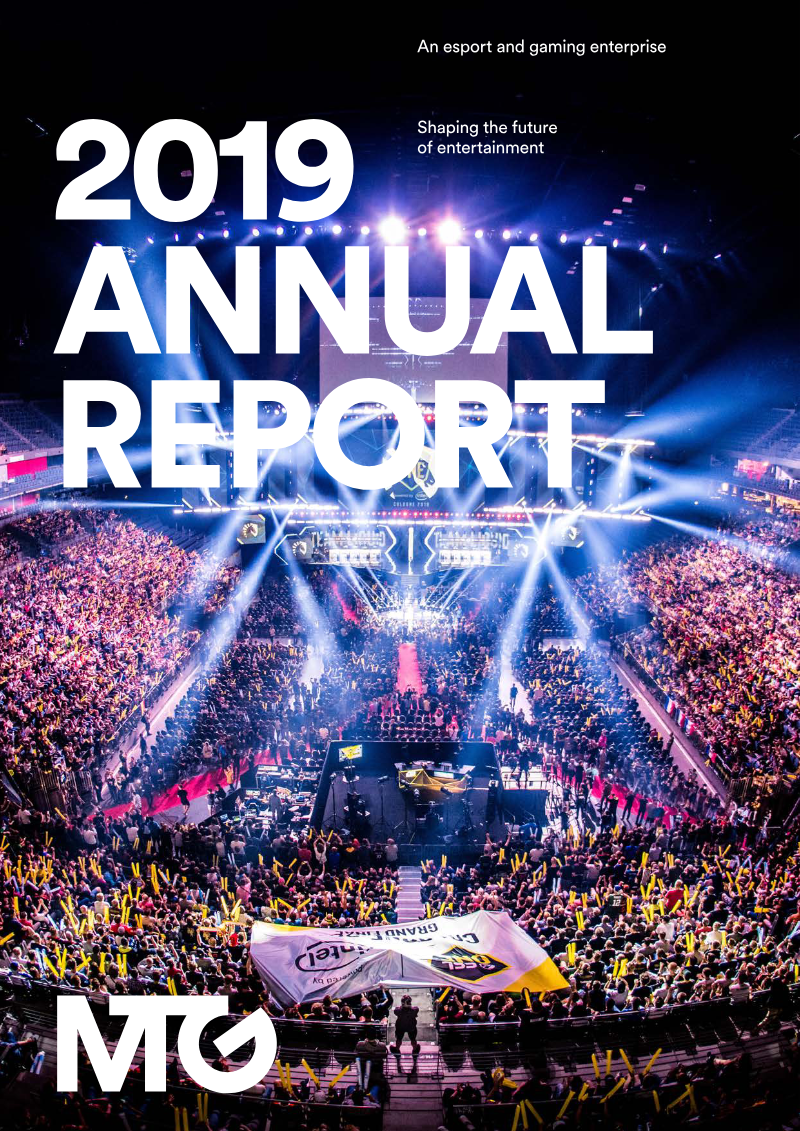
Annual Report 2019: Shaping the Future of Entertainment
Corporate responsibility and sustainability priorities are covered in MTG’s Annual Corporate Responsibility Report, published 19 S EGMENTAL PERFORMANCE 31 Other Group Information 34 Financial Policies and Risk Management 36 Governance and Responsibilities 41 Internal Control Report 101 ALTERNATIVE PERFORMANCE It’s impossible to reflect on 2019 without first commenting on the split of MTG into two companies in March – Nordic Enter- tainment and new MTG.
- MTG's 2019 strategy focused on profitable growth in esports and gaming, driven by the ESL Pro Tour launch, Kongregate's revised strategy, and Innogames' mobile revenue optimization.
- MTG divested Nova Broadcasting Group in Bulgaria for EUR 185 million (SEK 1,917 million) in January 2019 and Zoomin in October 2019, to focus on its core esports and gaming verticals.
- MTG announced annual savings, redundancy costs, and impairment charges in 2019 as part of a strategic review and evaluation of its gaming portfolio.
- MTG's esports vertical, comprising ESL and DreamHack, saw external sales of SEK 1,712 million in 2019, up from SEK 1,515 million in 2018, but reported an EBIT loss of SEK -430 million.
- The gaming vertical generated SEK 2,531 million in external sales in 2019, an increase from SEK 2,296 million in 2018, with an EBIT of SEK 269 million.
+1
Modern Times Group
Report110 pages
2021 Interim Report
Incorporated in the Cayman Islands with limited liability 3 Financial Performance Highlights 3 Financial Performance Highlights 9 Management Discussion and Analysis 9 Management Discussion and Analysis 23 Report on Review of Interim Financial Information Report on Review of Interim Financial Information 24 Consolidated Income Statement 25 Consolidated Statement of Comprehensive Income 26 Consolidated Statement of Financial Position 29 Consolidated Statement o...
- Tencent's FinTech and Business Services revenue significantly increased, reaching RMB 80,920 million for the six months ended June 30, 2021, up from RMB 56,337 million in the same period of 2020.
- The company experienced a shift from net cash of RMB 5.6 billion as of March 31, 2021, to net debt of RMB 21.0 billion as of June 30, 2021, primarily due to M&A activities and dividend payments, partially offset by RMB 17.3 billion in free cash flow.
- Tencent's Value Added Services (VAS) revenue grew to RMB 144,456 million for the six months ended June 30, 2021, compared to RMB 127,431 million in the prior year, with games contributing RMB 86,620 million and social networks RMB 57,836 million.
- Online Advertising revenue increased to RMB 44,653 million for the six months ended June 30, 2021, up from RMB 36,265 million in the same period of 2020, driven by social and other advertising.
- Selling and marketing expenses rose by 17% quarter-on-quarter to RMB 10.0 billion in Q2 2021, mainly due to seasonality and increased spending on digital content, games, and Business Services.
+2
Tencent

Report11 pages
FOCUS: ACC South Florida 2026
2 ....Opportunity Zones and the 5 ....Event Photos Sports & Entertainment Industries: 9 ....New Board Member Spotlight 3 ....New Incentives Under the OBBBA 10 ..ACC South Florida Evolving Risks of AI and Actionable Upcoming Events 4 ....Strategies to Manage Them 11 ..Executive Director Note Practical Tips for Avoiding 11 ..Chapter Leadership Post‑Transaction M&A Disputes FOCUS Greetings ACC South Florida community! ...
- The OBBBA, enacted in 2025, makes the Opportunity Zone program permanent, introduces a new 10-year cycle for zone redesignation, and expands federal tax benefits, significantly impacting sports and entertainment developments.
- AI poses substantial data leakage risks, both external (sensitive data made public) and internal (private data exposed within an organization), as evidenced by Amazon's 2023 warning to employees about unapproved AI tool usage.
- Post-closing M&A disputes are increasingly likely in 2026 due to continued market volatility, regulatory scrutiny, AI uncertainty, and increased use of completion accounts and earnouts.
- To mitigate M&A dispute risk, parties should tighten Sale and Purchase Agreement drafting, ensure financial integrity early, and manage deal dynamics thoughtfully, especially concerning complex deal economics.
- ACC South Florida has hosted several well-attended events in 2026, including holiday parties, a member appreciation event, and service opportunities like a Big Brothers Big Sisters impact event.
ACC South Florida
Presentation8 pages
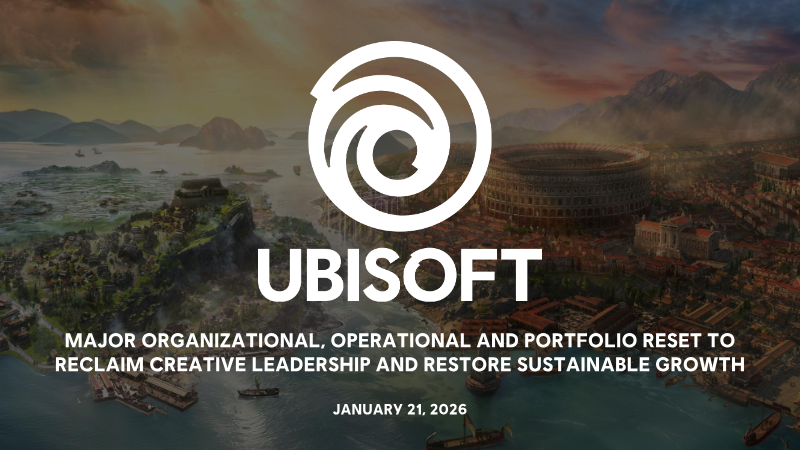
Major Organizational, Operational and Portfolio Reset to Reclaim Creative Leadership and Restore Sustainable Growth
Ubisoft has initiated a major organizational and operational reset designed to reclaim creative leadership and restore sustainable growth in an increasingly selective AAA market. This strategic pivot addresses rising development costs and the competitive challenges of establishing new intellectual properties. The transformation is built upon three primary pillars: the implementation of a new operating model, a refocused game portfolio with a revised three-year roadmap, and a significant rightsizing of the global organization to improve agility and reduce fixed costs.
The new operating model decentralizes production into five distinct Creative Houses supported by a centralized Creative Network and Core Services. These houses are specialized by genre and business model, focusing on billionaire brands like Assassin’s Creed and Far Cry, competitive shooters such as Rainbow Six and Ghost Recon, live-service experiences, immersive narrative universes, and casual family-friendly titles. To support this focus, Ubisoft has discontinued six games—including the Prince of Persia: The Sands of Time remake and four unannounced titles—while allocating additional development time to seven other projects to ensure higher quality standards.
Financial restructuring is a critical component of this reset, with the company targeting a total reduction in fixed costs of approximately €500 million by March 2028 compared to FY23 levels. This includes the closure of studios in Halifax and Stockholm, alongside restructurings in Abu Dhabi, RedLynx, and Massive. For FY26, the group anticipates net bookings of approximately €1.5 billion and a non-IFRS EBIT loss of around €1 billion, largely due to a €650 million one-off accelerated depreciation from canceled and delayed titles. Moving forward, the group aims to reach a run-rate fixed cost base of €1.25 billion by 2028, prioritizing robust cash generation and a more disciplined approach to capital allocation.
- Ubisoft is targeting a €500 million reduction in fixed costs by March 2028 compared to FY23 levels to restore sustainable growth.
- The company is restructuring into five specialized Creative Houses to focus on core franchises like Assassin’s Creed, Far Cry, and Rainbow Six while improving operational agility.
- Ubisoft has canceled six projects, including the Prince of Persia: The Sands of Time remake and four unannounced titles, while extending development timelines for seven others to prioritize quality.
- The company projects an FY26 non-IFRS EBIT loss of approximately €1 billion, driven by €650 million in one-off depreciation charges from canceled and delayed games.
- To achieve a target run-rate fixed cost base of €1.25 billion by 2028, Ubisoft is closing studios in Halifax and Stockholm and restructuring operations in Abu Dhabi, RedLynx, and Massive.
+1
UbisoftJan 2026
Report20 pages
Global Gaming Report Q3 2025
The third quarter of 2025 underscores the continued premium placed on hardware and platform players within the global gaming ecosystem, as investors assign a wide spectrum of valuation multiples that reflect divergent growth narratives and market positioning. Enterprise‑valued firms such as Dell and HP trade near a 1‑times EV/EBITDA ratio, indicating modest expectations for earnings expansion, while high‑growth entities like Nvidia and AppLovin command multiples exceeding 25‑times, with the latter reaching 42.8‑times, highlighting the market’s appetite for cutting‑edge processing power and mobile advertising integration. Across the board, most companies in the segment posted double‑digit year‑over‑year revenue increases, confirming robust demand for both traditional PC hardware and emerging cloud‑based gaming services.
Equity performance further illustrates the split between established hardware manufacturers and platform‑centric developers. Roblox delivered the strongest year‑to‑date appreciation at 136.9%, driven by expanding user engagement and monetization initiatives, while Unity recorded a 77‑percent gain, reflecting its pivotal role in cross‑platform development tools and the growing adoption of real‑time 3D content. These returns contrast sharply with the more muted trajectories of hardware‑only firms, suggesting that investors are rewarding firms that blend hardware capabilities with scalable software ecosystems.
Overall, the data portray a gaming market in which valuation is increasingly tied to the ability to integrate hardware performance with platform services, and where growth‑oriented companies enjoy markedly higher multiples and stock appreciation. The findings span a global landscape, covering major North American, European, and Asian players, and focus on the quarter ending September 2025, offering a snapshot of valuation dynamics and performance trends that are likely to shape strategic investment decisions throughout the remainder of the year.
- Investors are heavily favoring platform-centric companies over traditional hardware manufacturers, with high-growth firms like AppLovin and Nvidia commanding EV/EBITDA multiples exceeding 25x, compared to roughly 1x for legacy hardware firms like Dell and HP.
- Roblox led equity performance with a 136.9% year-to-date appreciation, driven by successful user engagement and monetization strategies.
- Unity recorded a 77% year-to-date gain, underscoring the market's high valuation of cross-platform development tools and real-time 3D content adoption.
- AppLovin reached a 42.8x EV/EBITDA multiple, reflecting strong market confidence in the integration of mobile advertising with gaming ecosystems.
- Most gaming companies reported double-digit year-over-year revenue growth in Q3 2025, confirming sustained demand across both PC hardware and cloud-based gaming services.
+1
Drake Star PartnersSept 2025
Presentation37 pages
Consolidated Financial Results Briefing Materials: FY3/26 Q1
Akatsuki Inc. experienced a challenging start to the fiscal year ending March 2026, reporting a 44% year-over-year decline in consolidated sales to ¥2,313 million and an operating loss of ¥1,698 million for the first quarter. This downturn was primarily driven by a 52% revenue contraction in the core Games business, resulting from a reactionary fall following a strong prior quarter, strategic title withdrawals, and heightened development costs associated with the upcoming global launch of Kaiju No. 8 The Game. While total operating expenses decreased by 18% due to a 42% reduction in research and development spending and a streamlined portfolio, these savings were insufficient to offset the revenue decline and typical seasonal fluctuations.
Despite the volatility in gaming, the IP Solutions and Comics segments demonstrated robust growth. IP Solutions sales surged 168% to ¥298 million, bolstered by the consolidation of CRAYON, Inc. and the rapid expansion of the Slash Gift online lottery service. Simultaneously, the Comics segment broadened its international footprint through the MANGA MIRAI service in the United States, integrating high-profile titles such as One Piece and Naruto. The company also accelerated its expansion into new business domains through the full acquisition of the creator agency Natee Co., Ltd. and realized ¥1.2 billion in investment proceeds following the IPO of LIFE CREATE Co., Ltd.
The financial position remains liquid with ¥33.2 billion in cash and deposits, providing a stable foundation for ongoing strategic investments despite a slight decrease in total assets to ¥50.9 billion. The current fiscal trajectory reflects a transition period as the company rebalances its portfolio, shifting focus toward high-potential global IP launches and diversified digital entertainment services to mitigate the inherent cyclicality of the mobile gaming market.
- Akatsuki Inc. reported a 44% year-over-year decline in consolidated sales to ¥2,313 million and an operating loss of ¥1,698 million for Q1 FY3/26.
- The core Games business revenue contracted by 52% due to title withdrawals, a reactionary decline from the previous quarter, and high development costs for the upcoming 'Kaiju No. 8 The Game'.
- IP Solutions revenue grew 168% to ¥298 million, driven by the consolidation of CRAYON, Inc. and the expansion of the Slash Gift online lottery service.
- The company maintains a liquid financial position with ¥33.2 billion in cash and deposits, despite total assets decreasing to ¥50.9 billion.
- Operating expenses fell by 18% overall, supported by a 42% reduction in research and development spending and a streamlined game portfolio.
+1
AkatsukiAug 2025
Report1 pages
Video Game Industry Inspection Mission: Canary Islands
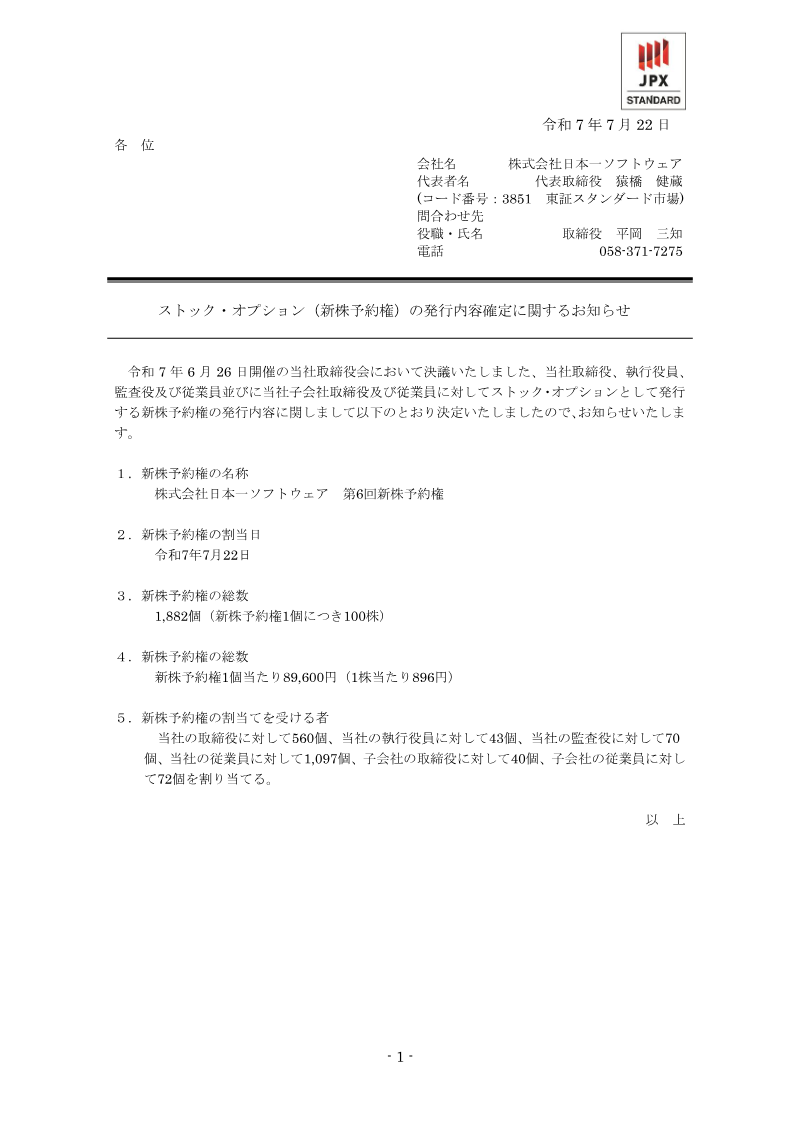
The announcement serves to formalize the issuance of a new series of stock options by Nippon Ichi Software Co., Ltd., a listed entity on the Tokyo Stock Exchange Standard Market. Following a board resolution on 26 June 2025, the company will allocate 1,882 stock options, each representing 100 shares, with an exercise price of ¥89,600 per option (equivalent to ¥896 per share). The allocation date is set for 22 July 2025, and the distribution targets internal stakeholders across the corporate hierarchy and its subsidiaries.
The breakdown of the allocation assigns 560 options to company directors, 43 to executive officers, 70 to auditors, and 1,097 to employees. Within the subsidiary structure, 40 options are designated for subsidiary directors and 72 for subsidiary employees. This distribution reflects a strategic effort to align the interests of management and staff with shareholder value, reinforcing incentive structures within the organization.
Contact details for inquiries are provided, listing Director Hiraka Mitsuchi as the point of reference, with a telephone number for direct communication. The notice underscores compliance with corporate governance standards and aims to ensure transparency regarding equity compensation for all eligible participants.
- Nippon Ichi Software will issue 1,882 stock options on 22 July 2025, with each option representing 100 shares.
- The exercise price for the new stock options is set at ¥89,600 per option, or ¥896 per share.
- The allocation targets a broad range of internal stakeholders, including 560 options for company directors and 1,097 for employees.
- Subsidiary staff and directors will receive a combined total of 112 options as part of the incentive program.
- Executive officers and auditors are allocated 43 and 70 options, respectively, to align internal interests with shareholder value.
PROEXCAJul 2025
Report1 pages
Video Game Business Snapshot: Q2 2025
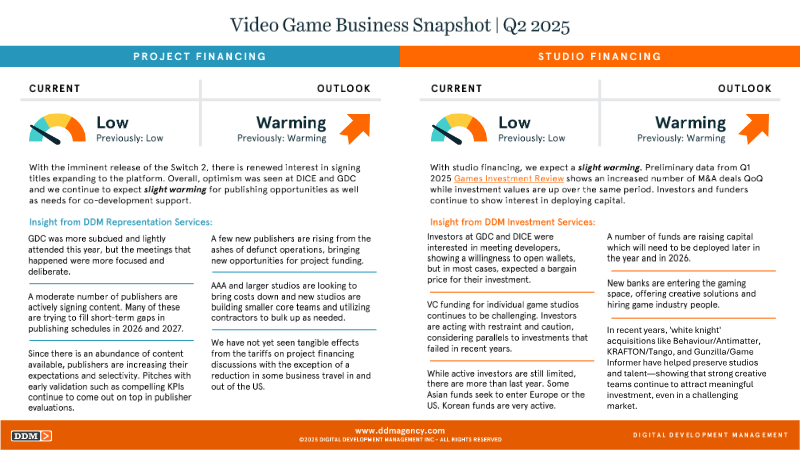
The second quarter of 2025 highlights a strategic shift in the video game industry’s mergers and acquisitions landscape, characterized by a rise in rescue-style investments often referred to as white knight acquisitions. These transactions involve established global entities stepping in to acquire studios or media outlets that might otherwise face closure or significant downsizing. Notable examples include KRAFTON’s acquisition of Tango Gameworks, Behaviour Interactive’s absorption of Antimatter, and Gunzilla Games’ involvement with Game Informer. These moves suggest that despite broader economic volatility and a contraction in traditional venture capital, high-quality creative talent and established intellectual properties remain highly valuable assets for diversified gaming conglomerates.
The current market environment reflects a transition where strategic preservation is prioritized over speculative growth. Large-scale publishers are increasingly focused on securing proven development teams to bolster their long-term pipelines, viewing these acquisitions as opportunities to integrate specialized expertise at a time when independent sustainability is difficult. This trend underscores a broader industry sentiment that while the capital market remains challenging, the underlying value of experienced human capital continues to drive significant deal flow. These developments indicate that the industry is moving toward a more consolidated but stable structure, where the survival of key creative hubs is facilitated by the strategic interests of larger market players.
- Q2 2025 is defined by a surge in 'white knight' acquisitions, where major conglomerates are purchasing studios facing closure or downsizing to preserve creative talent and intellectual property.
- Notable rescue acquisitions this quarter include KRAFTON’s purchase of Tango Gameworks, Behaviour Interactive’s absorption of Antimatter, and Gunzilla Games’ involvement with Game Informer.
- The industry is shifting away from speculative growth toward strategic preservation, as large publishers prioritize securing proven development teams to stabilize long-term production pipelines.
- Despite a contraction in traditional venture capital and broader economic volatility, experienced human capital remains a high-value asset driving deal flow.
- The current market environment is trending toward a more consolidated industry structure, where the survival of independent creative hubs is increasingly dependent on the strategic interests of larger market players.
+1
DDMJun 2025
Report19 pages
Global Gaming Report: Q1 2025
The global gaming industry experienced a significant resurgence in financial activity during the first quarter of 2025, marked by a substantial rebound in mergers, acquisitions, and private placements. Total deal value for the quarter reached $4.4 billion across 48 announced transactions, representing the highest quarterly valuation in nearly two years. This momentum was primarily driven by large-scale strategic consolidations, such as the $3.5 billion acquisition of Niantic’s games division by Scopely and AppLovin’s $900 million studio spin-off. Simultaneously, private investment surged to $3.5 billion across 149 deals, anchored by a landmark $3 billion investment into Infinite Reality at a $12.25 billion valuation.
Investment trends during this period shifted toward AI-driven entertainment and mobile user acquisition technologies. Strategic players like Savvy Games Group and Tencent maintained leadership roles in capital deployment, while venture capital firms such as BITKRAFT and Andreessen Horowitz remained the most prolific investors by volume. Geographically, the Asian developer market demonstrated steady stability with a median revenue growth of 9%, while the hardware and tools sector outperformed broader segments with a 20% average revenue increase. This growth was heavily influenced by the dominance of NVIDIA, which saw a 114% year-over-year revenue surge, positioning it as a cornerstone of the industry’s infrastructure with a $2.6 trillion market capitalization.
Despite the overall recovery reflected in the 16.37% return of the Drake Star Gaming Index, the market exhibited extreme volatility among individual public companies. While Sea Limited experienced a dramatic 223% increase, established entities like Unity and Ubisoft faced significant downturns, with valuations falling by over 50%. This divergence highlights a period of intense transition where hardware providers and AI-integrated platforms are capturing the majority of market gains, while traditional software developers and engine providers navigate a more challenging and fragmented economic landscape.
- The gaming industry saw a major financial rebound in Q1 2025, with $4.4 billion in M&A deal value across 48 transactions and $3.5 billion in private investment.
- NVIDIA has become a critical industry infrastructure pillar, achieving a 114% year-over-year revenue surge and a $2.6 trillion market capitalization.
- Private investment was anchored by a $3 billion funding round for Infinite Reality, which reached a $12.25 billion valuation.
- Market performance is highly polarized: while the Drake Star Gaming Index rose 16.37%, companies like Sea Limited grew 223% while Unity and Ubisoft saw valuations drop by over 50%.
- Strategic consolidation was led by major deals including Scopely’s $3.5 billion acquisition of Niantic’s games division and AppLovin’s $900 million studio spin-off.
+1
Drake Star PartnersApr 2025
Report17 pages
Games Investment Review: Q1 2025 Executive Summary Report
The Q1 2025 Games Investment Review provides a comprehensive analysis of global financial activity within the video game industry, covering investments, mergers and acquisitions (M&A), and initial public offerings (IPOs). The report identifies a significant recovery in market activity, noting that the combined value of investments and M&As reached $7.8 billion across 245 transactions. This represents the largest quarterly total since late 2023 and the second consecutive quarter of growth, signaling a stabilizing investment landscape.
Key findings highlight a massive surge in investment value, which rose 370% quarter-over-quarter to $4.4 billion. This growth was primarily driven by a $3.0 billion mid-to-late-stage investment in Infinite Reality. While M&A volume hit a two-year high with 55 transactions, the total reported value fell to $3.3 billion, largely because 80% of these deals did not disclose financial terms. The exit market showed strength through Asmodee’s $2.2 billion IPO and several billion-dollar acquisitions, such as Miniclip’s purchase of Easybrain. Additionally, new fund announcements reached a three-year peak of $21.8 billion, with 65% of that capital concentrated in five major funds.
The scope of the research encompasses diverse industry segments, including Console/PC, Mobile, Tech/Other, eSports, and Web3/Blockchain. Geographically, activity was led by Asia and Europe, while North America contributed high transaction volume with lower disclosed values. Methodology relies on a proprietary database tracking officially closed deals rather than mere announcements, ensuring data reflects actual capital deployed. The analysis emphasizes that artificial intelligence and blockchain remain primary areas of investor enthusiasm, with AI-related game investments totaling $3.1 billion during the quarter.
- Global gaming investment and M&A activity reached $7.8 billion across 245 transactions in Q1 2025, marking the highest quarterly total since late 2023.
- Investment value surged 370% quarter-over-quarter to $4.4 billion, largely driven by a single $3.0 billion mid-to-late-stage investment in Infinite Reality.
- New fund announcements hit a three-year peak of $21.8 billion, with 65% of that capital concentrated within just five major funds.
- Artificial intelligence remains a primary investment driver, accounting for $3.1 billion in game-related funding during the quarter.
- M&A volume reached a two-year high of 55 transactions, though total disclosed value was limited to $3.3 billion because 80% of deals did not report financial terms.
+1
Digital Development ManagementMar 2025
Report13 pages
Gaming CEO Survey: 2024 in Review
Industry leadership maintains a cautiously optimistic outlook for 2025, with 98% of executives expecting consumer spending to either increase or remain stable. Growth expectations are strongest in the mobile sector, where 41% of leaders anticipate expansion in in-app purchases and 31% expect growth in advertising revenue. While the PC segment remains relatively healthy with a 33% growth projection, the console market appears more stagnant, as 70% of respondents forecast stable performance and only 15% predict growth. This outlook is tempered by concerns regarding content saturation and a challenging user acquisition environment, which are cited as the primary hurdles facing the industry.
Operational strategies for the coming year signal a shift toward expansion and increased investment. A majority of companies plan to initiate more game development projects in 2025 compared to the previous year, supported by higher or stable budgets and increased marketing spend. Talent acquisition remains a priority, particularly in game development and engineering roles. Furthermore, the mergers and acquisitions landscape is expected to intensify, with 71% of executives anticipating more opportunities in 2025 and none predicting a decrease in activity.
Artificial intelligence has reached a significant level of penetration within the sector, with 84% of companies reporting either limited implementation or advanced integration across multiple functions. Executives identify art, game design, and engineering as the areas where AI will provide the most significant value. These findings, compiled by a leading global investment bank specializing in gaming, reflect a sector transitioning from a period of consolidation toward a renewed focus on production, technological integration, and strategic deal-making.
- Industry leadership is optimistic for 2025, with 98% of executives expecting consumer spending to increase or remain stable.
- AI adoption is widespread, with 84% of companies already implementing the technology across functions like art, game design, and engineering.
- The M&A landscape is expected to intensify, as 71% of executives anticipate more deal-making opportunities in 2025 compared to the previous year.
- Mobile gaming is the primary growth driver, with 41% of leaders expecting increased in-app purchases and 31% projecting growth in advertising revenue.
- The console market is largely stagnant, with 70% of respondents forecasting stable performance and only 15% predicting growth.
+1
Aream & CoJan 2025
Report19 pages
Global Gaming M&A and Growth Financing Advisory: Q1 2025
The global gaming industry experienced a notable resurgence in early 2025, characterized by a rebound in merger and acquisition activity and sustained interest in private financing. During the first quarter, 48 announced acquisitions reached a total value of $4.4 billion, anchored by the significant $3.5 billion acquisition of Niantic’s games division by Scopely. Simultaneously, the private placement market remained active, recording 149 deals worth $3.5 billion. These investments were primarily concentrated in mobile-focused developers and companies integrating artificial intelligence into their entertainment platforms, with major strategic entities like Savvy Games Group and Tencent continuing to drive market momentum.
Despite this activity, the financial landscape remains bifurcated. While the broader sector shows signs of recovery, with the Drake Star Gaming Index posting a 16.37% gain, performance remains highly volatile across the top 35 public gaming companies. Valuation disparities are particularly pronounced; industry leaders such as NVIDIA and AppLovin command premium revenue multiples, while many other firms face a more challenging environment. Furthermore, while early-stage funding remains accessible, later-stage financing continues to present significant hurdles for companies seeking capital.
Looking forward, the industry is positioned for a gradual increase in consolidation as public markets stabilize. Strategic focus is shifting toward the integration of AI and advanced technological platforms, which are expected to serve as primary catalysts for future growth. As market conditions improve, the sector is likely to see a renewed pipeline of initial public offerings, signaling a transition toward a more mature and diversified investment climate for global gaming stakeholders.
- Q1 2025 saw 48 M&A deals totaling $4.4 billion, headlined by Scopely’s $3.5 billion acquisition of Niantic’s games division.
- The private placement market recorded 149 deals worth $3.5 billion, with capital primarily flowing into mobile developers and AI-integrated entertainment platforms.
- The Drake Star Gaming Index rose 16.37% in Q1 2025, though performance remains volatile across the top 35 public gaming companies.
- Valuation gaps are widening, with industry leaders like NVIDIA and AppLovin commanding premium revenue multiples while other firms face significant capital constraints.
- While early-stage funding remains accessible, companies seeking later-stage financing continue to face substantial hurdles.
+2
Drake StarJan 2025

Report20 pages
Global Gaming Report Q2 2025
Public gaming equities surged in the first half of 2025, with the Drake Star Gaming Index climbing 28 % compared to a modest 5 % gain in the S&P 500. Leading performers included Square Enix, Roblox and Konami, underscoring a robust rebound in the sector. M&A activity remained steady at 46 deals, highlighted by Krafton’s $516 million purchase of ADK and Epic Games’ acquisition of AI studio Loci. Private‑market financing reached $3 billion across 110 placements, driven by high‑profile exits such as Dream Games’ $2.5 billion minority stake sale to CVC and Apple’s acquisition of RAC7 for its arcade portfolio. Projections indicate a continued rise in M&A and IPO activity through 2026, with artificial intelligence and technology platforms identified as primary growth catalysts.
Private‑placement capital in Q2 2025 totaled $2.6 billion across 24 deals, with the largest transaction—a $5 billion minority stake sale—valuing its target at nearly $5 billion. Deal distribution spanned mobile ($1.5 billion), PC/console ($0.8 billion), platform/tools ($0.4 billion), esports ($0.3 billion) and blockchain/VR‑AR ($0.2 billion). Key investors included CVC, Blackstone, Tencent and Bessemer Venture Partners. Notable exits such as Dream Games’ $2.5 billion minority sale and Arrowhead’s $80 million investment provided significant liquidity for early‑stage venture capitalists.
Valuation analysis reveals a pronounced divergence between high‑growth Asian titles and mature Western peers. Tencent (EV/EBITDA ≈ 5.7x, revenue growth 10%) and Sea Limited (EV/EBITDA ≈ 4.1x, revenue growth 30%) command premium multiples and robust double‑digit growth, reflecting investor appetite for fast‑growing Asian firms. In contrast, U.S. hardware and platform players such as NVIDIA (EV/EBITDA ≈ 17.9x, revenue growth 43%) and Unity (EV/EBITDA ≈ 6.2x, revenue growth –17%) exhibit lower multiples and mixed performance, indicating more modest valuations amid fluctuating earnings. This geographic and segmental disparity underscores the continued premium placed on rapid growth in emerging markets while mature Western companies face a more cautious valuation environment.
- Public gaming equities significantly outperformed the broader market in H1 2025, with the Drake Star Gaming Index rising 28% compared to a 5% gain in the S&P 500.
- Private-market financing reached $3 billion across 110 placements in H1 2025, bolstered by major exits such as Dream Games’ $2.5 billion minority stake sale to CVC.
- M&A activity remains steady with 46 deals recorded in H1 2025, including Krafton’s $516 million purchase of ADK and Epic Games’ acquisition of AI studio Loci.
- Investor sentiment shows a clear geographic divide, with high-growth Asian firms like Sea Limited (30% revenue growth) commanding premium multiples compared to the mixed performance of mature Western platform players like Unity.
- Q2 2025 private-placement capital totaled $2.6 billion, with mobile gaming leading the sector at $1.5 billion, followed by PC/console at $0.8 billion.
+1
Drake StarJan 2025

Report5 pages
Mobile Gaming M&A Playbook: How to Identify and Target High‑Growth Gaming Companies
The playbook outlines a systematic approach for mobile gaming publishers and investors to identify, evaluate, and acquire high‑growth developers. It argues that the mobile gaming market—projected to reach $138 billion in 2025—has become a prime arena for mergers and acquisitions, citing recent deals such as Zynga’s $2 billion purchase of Peak Games, EA’s $2.1 billion acquisition of Glu Mobile, and Embracer Group’s multi‑year funding round for future buys. The document stresses that M&A serves dual purposes: portfolio diversification and the acquisition of talent, expertise, and new IPs that can accelerate growth beyond a publisher’s core genres.
Key findings highlight the importance of data‑driven target selection. Sensor Tower’s Game Intelligence platform is promoted as a tool for tracking genre trends, revenue trajectories, and market share across regions. The playbook recommends establishing clear acquisition criteria—budget limits, company size, geographic focus—and using custom alerts and taxonomy filters to surface promising titles. It also advises building structured lead‑tracking workflows, labeling qualified versus unqualified prospects, and continuously monitoring portfolio performance to spot strategic shifts or revenue declines that may signal acquisition opportunities.
The scope covers the global mobile gaming industry, with particular emphasis on North America and Southeast Asia, over a recent five‑year period marked by accelerated M&A activity. Methodologically, the playbook relies on Sensor Tower’s proprietary analytics, supplemented by industry news feeds from outlets such as Pocket Gamer, VentureBeat, and Crunchbase. The conclusion urges publishers to leverage analytics, maintain rigorous criteria, and stay alert to market movements in order to secure advantageous acquisitions that align with long‑term growth objectives.
- The mobile gaming market is projected to reach $138 billion by 2025, driving significant M&A activity as publishers seek to diversify portfolios and acquire new talent and intellectual property.
- High-profile acquisitions demonstrate the scale of industry consolidation, including Zynga’s $2 billion purchase of Peak Games and EA’s $2.1 billion acquisition of Glu Mobile.
- Effective target identification requires a data-driven approach using platforms like Sensor Tower to track specific genre trends, revenue trajectories, and regional market share.
- Publishers should establish rigorous acquisition criteria—including defined budget limits, company size, and geographic focus—to systematically filter potential targets.
- Strategic lead-tracking workflows are essential for distinguishing qualified prospects from unqualified ones and monitoring existing targets for revenue declines or shifts that signal an acquisition opportunity.
+1
Sensor TowerJan 2025
Report29 pages
InvestGame Q4'24 Report (Unknown Time)
The gaming industry experienced a strategic shift in 2024, moving away from short-term financial arbitrage toward long-term, objective-driven transactions. While the broader market faced a stricter environment characterized by layoffs and the offloading of non-core assets, total deal-making activity remained above pre-pandemic levels. A significant trend emerged in the work-for-hire sector, highlighted by the $2.8 billion Keywords buyout. Additionally, venture capital interest notably pivoted from game development studios toward platform and technology startups, leaving corporate venture arms to fill the gap in studio financing.
The analysis identifies a stabilization phase following the post-pandemic "hangover." Private investments saw a 22% year-over-year increase in funding during Q4 2024, while the M&A market recorded one of its strongest quarters in two years. Although the public market remained volatile, a three-quarter recovery trend in public offerings suggests a gradual reopening of the IPO window. Geographically, North America and Europe led early-stage studio fundraising, accounting for the vast majority of capital raised, while Asian developers dominated new top-tier mobile releases.
The outlook for 2025 anticipates sustained M&A momentum driven by lower interest rates, significant cash reserves among public strategics, and increased private equity involvement. Investment in AI-driven solutions and web3 is expected to rise, fueled by renewed crypto enthusiasm. While high-profile gaming teams will continue to command strong valuations, such deals may become less frequent as investors prioritize "picks and shovels" technology over pure content.
This report covers global gaming industry segments including PC, console, mobile, and hardware, with a specific focus on M&A, private equity, and public offerings. Data is derived from public media, business partners, and market insights, tracking closed transactions while excluding pure gambling and non-gaming blockchain ventures.
- The gaming industry is shifting toward long-term, objective-driven transactions, evidenced by a strong Q4 2024 M&A market and a 22% year-over-year increase in private investment funding.
- Venture capital is pivoting away from game development studios in favor of platform and technology startups, forcing corporate venture arms to become the primary source of studio financing.
- The work-for-hire sector is seeing major consolidation, underscored by the $2.8 billion buyout of Keywords.
- Public markets are showing signs of a gradual recovery, with a three-quarter trend suggesting the IPO window is beginning to reopen despite ongoing volatility.
- Investment strategies for 2025 are expected to prioritize 'picks and shovels' technology—specifically AI and web3 solutions—over pure content development.
+1
InvestGameJan 2025
Report13 pages
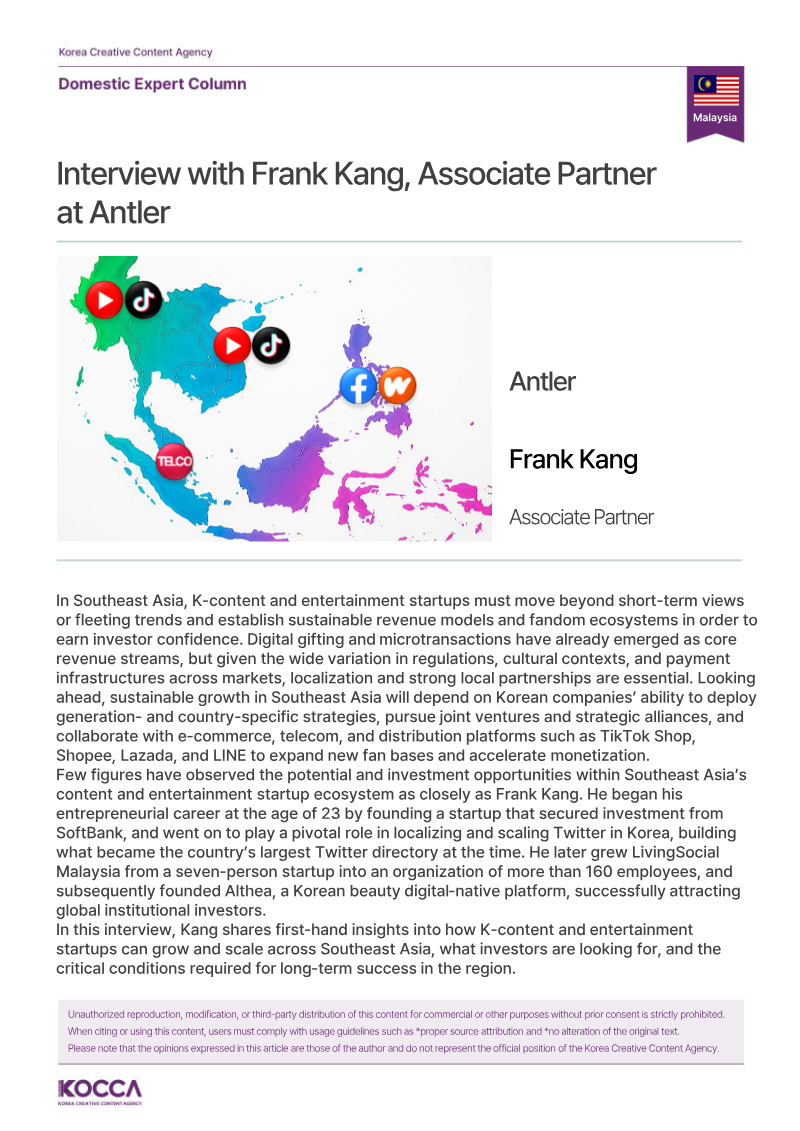
Interview with Frank Kang, Associate Partner at Antler: Malaysia
Korean content and entertainment startups are being urged to treat Southeast Asia as a primary growth engine rather than a peripheral market. Success hinges on deep localisation that goes beyond subtitles, requiring partnerships with local “co‑pilots” that can navigate fragmented linguistic, regulatory and payment landscapes in cities such as Jakarta, Manila and Bangkok. By embedding region‑specific monetisation schemes—micro‑transactions, live‑commerce, and hybrid free‑plus‑premium models—companies can align with the mobile‑wallet‑driven habits of Southeast Asian fans and convert grassroots enthusiasm into sustainable revenue streams.
The region’s fandom operates as a decentralized, grassroots network where fans act as unpaid marketers, driving earnings through digital stickers, low‑priced concert tickets and other micro‑purchases that often outpace traditional subscription revenues seen in Korea or Japan. Promising niches include short‑form video, webtoons and IP‑centric ecosystems, mobile‑first games, and live‑commerce platforms, all of which benefit from early community testing and strong local alliances. Trust capital built by global Korean acts such as BTS and BLACKPINK demonstrates the willingness of Southeast Asian audiences to pay for authentic, culturally resonant experiences.
Investors now demand proven revenue traction and genuine localisation before committing capital, and scalable startups are expected to adopt modular, locally adapted business models. Exits are likely to occur through mergers and acquisitions rather than public listings, underscoring the strategic importance of establishing a resilient foothold in Southeast Asia as a launchpad for broader global expansion.
- Korean entertainment and content startups must treat Southeast Asia as a primary growth engine rather than a peripheral market to achieve sustainable expansion.
- Success requires deep localisation through local 'co-pilots' to navigate fragmented linguistic, regulatory, and payment landscapes in key hubs like Jakarta, Manila, and Bangkok.
- Revenue models should shift toward mobile-wallet-driven micro-transactions, live-commerce, and hybrid free-plus-premium structures to align with local consumption habits.
- Startups should leverage decentralized, grassroots fan networks that drive revenue through digital stickers and low-priced micro-purchases, which often outperform traditional subscription models.
- High-growth niches include short-form video, webtoons, IP-centric ecosystems, and mobile-first games that utilize early community testing and local alliances.
+1
KOCCA – Korea Creative Content AgencyJan 2025

Report26 pages
Global Sports Tech Market Report H1 2025
In the first half of 2025 the global sports‑technology sector recorded approximately $52 billion in announced or closed transactions, underscoring a rapid acceleration of both merger‑and‑acquisition activity and capital raising. Roughly $32 billion stemmed from 233 M&A deals, while a record‑high $6.6 billion was secured through 239 private‑placement rounds, more than 80 % of which involved early‑stage companies. The capital influx was driven by a mix of strategic consolidations—most notably TSG Consumer’s $1.5 billion acquisition of EOS Fitness and RTL’s $613 million purchase of Sky Deutschland—alongside a wave of targeted investments such as Valeas’s $110 million majority stake in Ticketmanager, Genstar’s acquisition of Playmetrics for integration with Stack Sports, and IMG’s takeover of SportsRecruits. Deal multiples varied across subsectors, reflecting divergent growth trajectories within wearables, fan‑engagement platforms, and performance‑analytics solutions.
Geographically, the activity spanned North America, Europe and emerging markets, with transaction processing centralized through Drake Star Securities LLC in the United States and its UK affiliate, Drake Star UK Limited, both operating under FINRA regulation and SIPC membership. This infrastructure ensures compliance and investor protection for institutional participants. The concentration of early‑stage financing and the prevalence of large‑scale consolidations together signal a market transitioning from fragmented innovation toward integrated platforms capable of delivering end‑to‑end sports experiences. The data suggest that investors and strategic acquirers view the sector as a high‑growth arena, positioning it for continued expansion and deeper consolidation throughout the remainder of 2025.
- The global sports tech market reached a total deal value of $51.9 billion in H1 2025 across 503 announced or closed transactions.
- M&A activity dominated the sector with $32.2 billion in disclosed deal value across 233 deals, led by TSG Consumer’s $1.5 billion acquisition of EōS Fitness.
- Private placements hit a record $6.6 billion across 239 deals, highlighted by Infinite Reality raising $3 billion and DAZN securing $1.8 billion.
- Investor appetite for new sports-focused capital remains high with over $3.5 billion in new funds announced, including the $1.2 billion Checketts Sports fund.
- Disney acquired a 70% stake in FuboTV for $220 million in cash and a $145 million loan, creating a provider with 6.2 million subscribers.
+1
Drake Star PartnersJan 2025