Updated Mar 23, 2026 by PCF Group
Report
Published by PCF Group
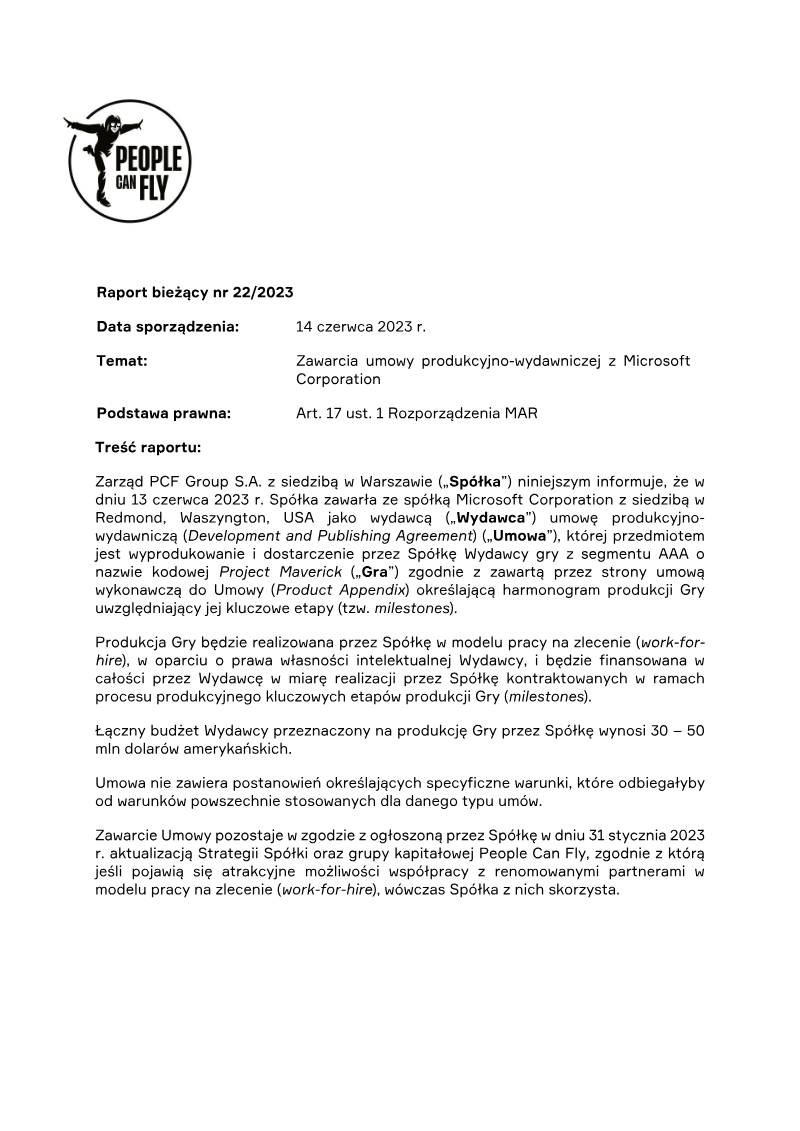
The report announces that on 13 June 2023 PCF Group S.A. entered into a Development and Publishing Agreement with Microsoft Corporation to produce and deliver an AAA‑grade title, code‑named Project Maveric k. The agreement designates Microsoft as the publisher and outlines a production schedule in a Product Appendix that details key milestones. PCF Group will develop the game under a work‑for‑hire model, with intellectual property rights retained by Microsoft. Funding is fully provided by the publisher and will be released as each milestone is achieved, with a total budget ranging from $30 million to $50 million. The contract follows standard industry terms for this type of partnership and does not contain any atypical provisions. The agreement aligns with PCF Group’s strategic update issued on 31 January 2023, which stated the company would pursue attractive work‑for‑hire collaborations with reputable partners. The project is geographically focused on the United States, given Microsoft’s headquarters in Redmond, Washington, and targets the global AAA gaming market. No survey or external data sources are cited; the report is a straightforward disclosure of contractual arrangements and financial commitments.
PEOPLE CAN FLY Raport bieżący nr 22/2023 Data sporządzenia: 14 czerwca 2023 r. Temat: Zawarcia umowy produkcyjno -wydawniczej z Microsoft Corporation Podstawa prawna: Art. 17 ust. 1 Rozporządzenia MAR Treść raportu: Zarząd PCF Group S.A. z siedzibą w Warszawie („ Spółka”) niniejszym informuje, że w dniu 13 czerwca 2023 r. Spółka zawarła ze spółką Microsoft Corporation z siedzibą w Redmond, Waszyngton, USA jako wydawcą („Wydawca”) umowę produkcyjno - wydawniczą (Development and Publishing Agreement ) („ Umowa”), której przedmiotem jest wyprodukowanie i dostarczenie przez Spółkę Wydawcy gry z segmentu AAA o nazwie kodowej Project Maveric k („Gra”) zgodnie z zawartą przez strony umow ą wykonawczą do Umowy ( Product Appendix) określającą harmonogram produkcji Gry uwzględniający jej kluczowe etapy (tzw. milestones). Produkcja Gry będzie realizowana przez Spółkę w modelu pracy na zlecenie ( work-forhire), w oparciu o prawa własności intelektualnej Wydawcy, i będzie finansowana w całości przez Wydawcę w miarę realizacji przez Spółkę kontraktowanych w ramach procesu produkcyjnego kluczowych etapów produkcji Gry (milestones). Łączny budżet Wydawcy przeznaczony na produkcję Gry przez Spółkę wynosi 30 – 50 mln dolarów amerykańskich. Umowa nie zawiera postanowień określających specyficzne warunki, które odbiegałyby od warunków powszechnie stosowanych dla danego typu umów.
go kluczowych etapów produkcji Gry (milestones). Łączny budżet Wydawcy przeznaczony na produkcję Gry przez Spółkę wynosi 30 – 50 mln dolarów amerykańskich. Umowa nie zawiera postanowień określających specyficzne warunki, które odbiegałyby od warunków powszechnie stosowanych dla danego typu umów. Zawarcie Umowy pozostaje w zgodzie z ogłoszoną przez Spółkę w dniu 31 stycznia 2023 r. aktualizacją Strategii Spółki oraz grupy kapitałowej People Can Fly, zgodnie z którą jeśli pojawią się atrakcyjne możliwości współpracy z renomowanymi partnerami w modelu pracy na zlecenie (work-for-hire), wówczas Spółka z nich skorzysta.
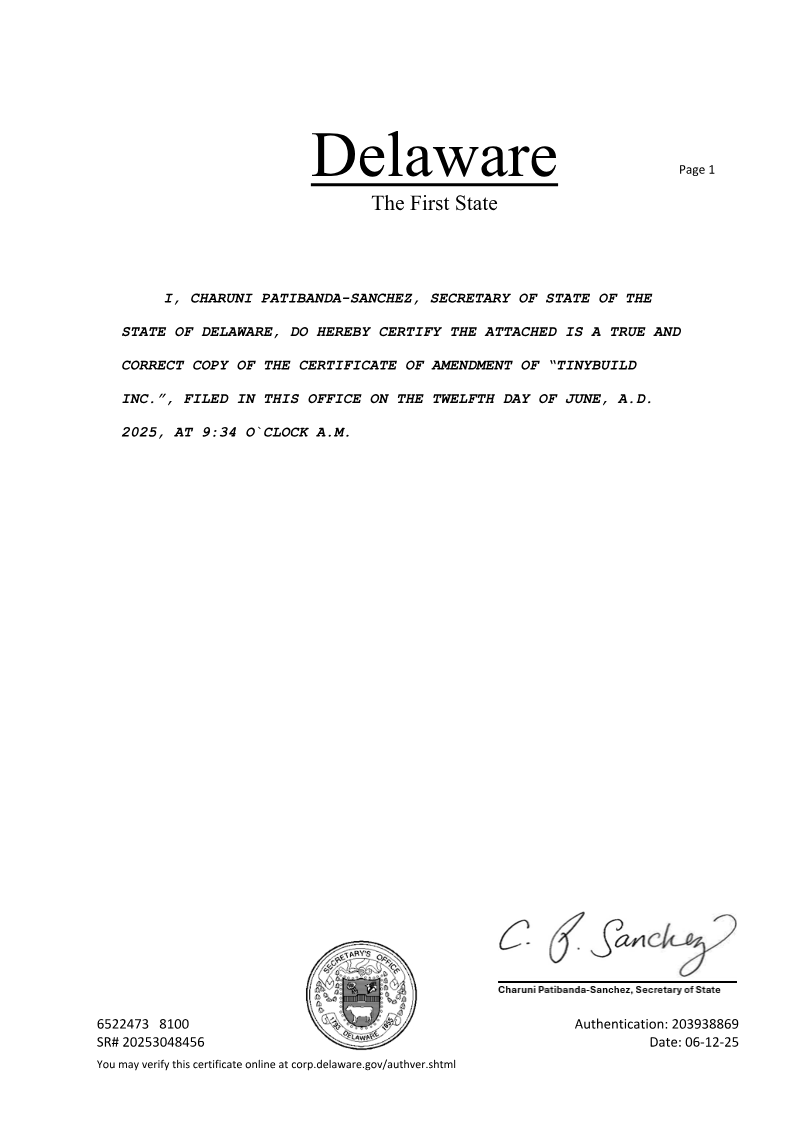
TinyBuild Inc., a Delaware-incorporated video game publisher, enacted significant structural changes to its corporate governance through a Certificate of Amendment filed on June 12, 2025. This legal filing formalizes a shift in the company’s internal leadership framework, specifically transitioning the Board of Directors toward a declassified structure. Under these new provisions, all directors will serve one-year terms expiring at the subsequent annual meeting of stockholders, effectively ending any previous multi-year staggered terms by the 2026 annual meeting. The amendments further centralize control over board composition within the board itself. The number of directors is now fixed exclusively by board resolution, and any vacancies or newly created positions must be filled by a majority of the remaining directors rather than by stockholders. While stockholders retain the power to remove directors with or without cause via a majority vote, the board maintains the sole authority to appoint replacements. Additionally, the company expanded its liability protections, stipulating that directors and officers are not personally liable for monetary damages resulting from breaches of fiduciary duty to the fullest extent permitted by the Delaware General Corporation Law. Geographically and legally, the scope of these changes establishes Delaware as the primary jurisdiction for corporate disputes. The amendment mandates that federal district courts serve as the exclusive forum for Securities Act of 1933 claims, while the Delaware Court of Chancery or the federal district court for the District of Delaware are designated as the sole venues for derivative claims under the Securities and Exchange Act of 1934. These updates, signed by CFO Gjasone Salati, align the company’s governing documents with modern Delaware corporate standards regarding executive indemnification and jurisdictional exclusivity.
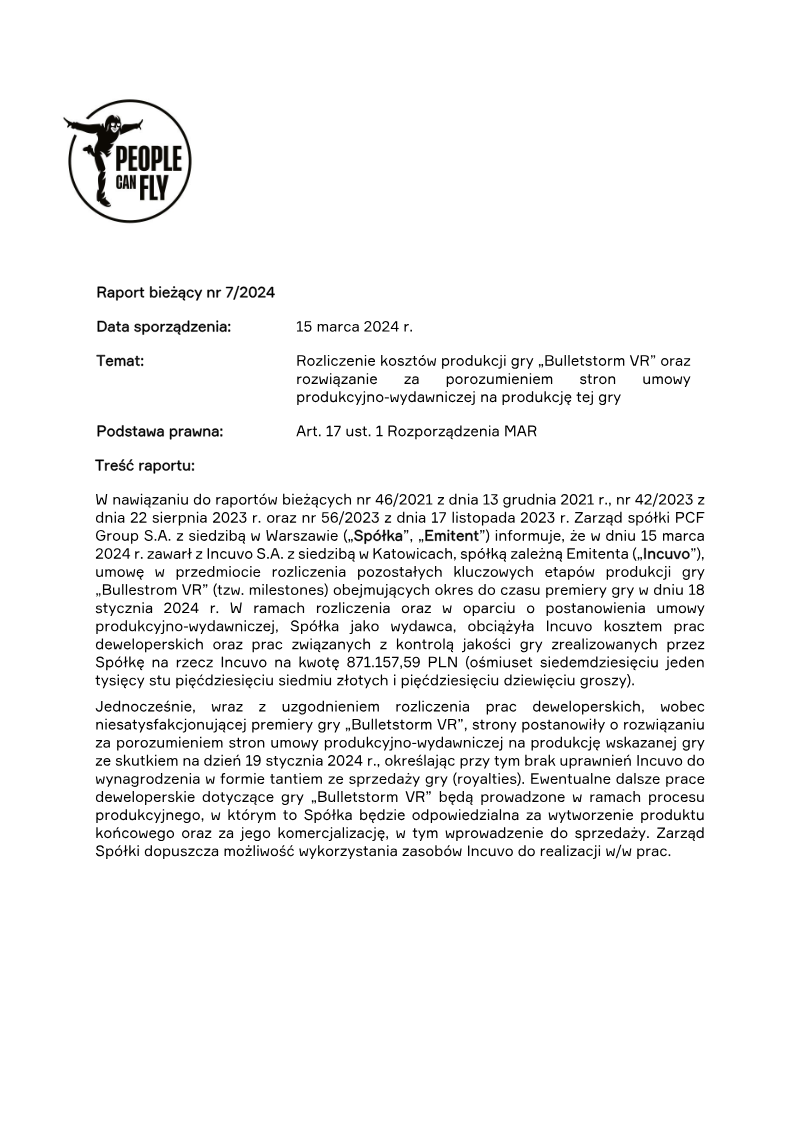
The settlement report records the final accounting and contractual resolution between PCF Group S.A., headquartered in Warsaw, and its subsidiary Incuvo S.A. of Katowice concerning the development of the virtual‑reality title “Bulletstorm VR.” It confirms that, as of 15 March 2024, the parties concluded the remaining production milestones that spanned the period leading up to the game’s launch on 18 January 2024, and that PCF, acting as publisher, invoiced Incuvo for development and quality‑assurance services in the amount of 871 157,59 złoty. The agreement also stipulates a mutual termination of the production‑publishing contract effective 19 January 2024, driven by an unsatisfactory market reception of the title. Under the termination terms, Incuvo forfeits any entitlement to royalties from subsequent sales, while PCF assumes full responsibility for completing the final product and overseeing its commercial distribution. The report notes that PCF may still draw on Incuvo’s resources for any remaining development work, though no further financial compensation is prescribed. Reference is made to three earlier interim reports—numbers 46/2021, 42/2023 and 56/2023—that documented the project’s progress and financial status. The current settlement therefore closes the fiscal cycle for the “Bulletstorm VR” project, consolidating all outstanding developer costs into a single charge and establishing PCF’s exclusive control over the game’s post‑release lifecycle. The scope is limited to the Polish corporate entities involved, covering activities from the initial milestones through the January 2024 launch and subsequent termination.
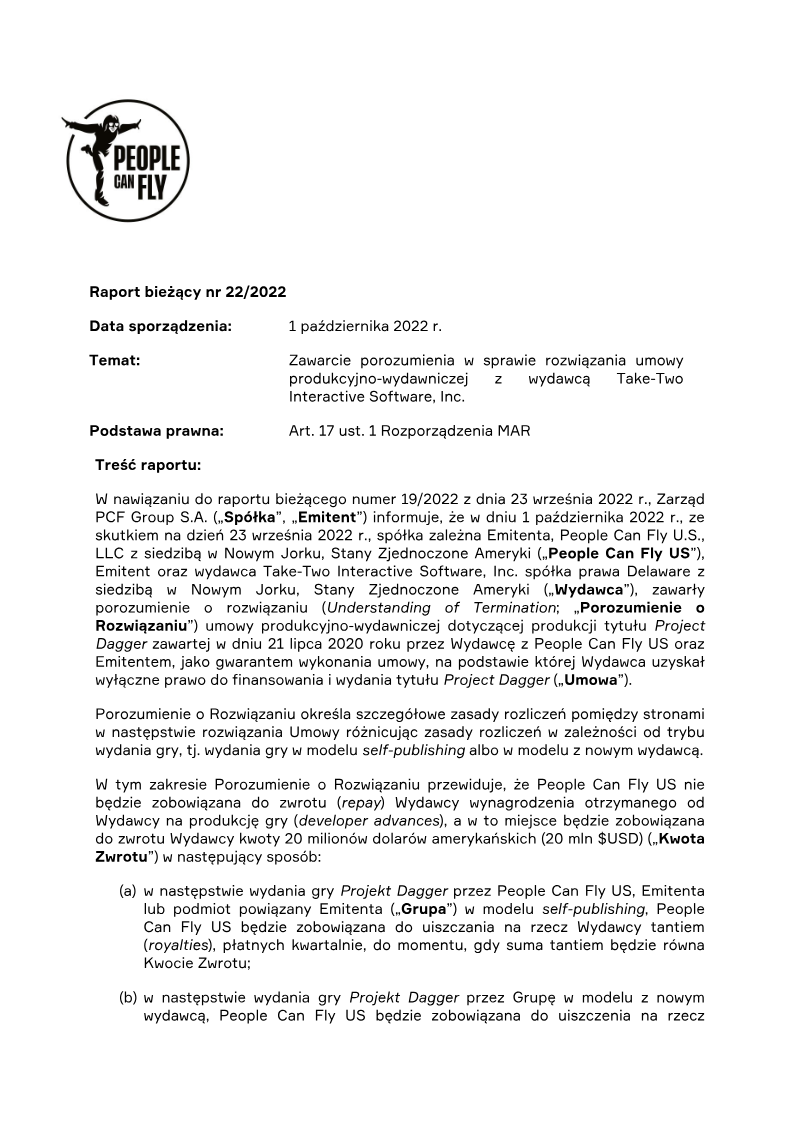
The termination of the production and distribution agreement between PCF Group S.A., its subsidiary People Can Fly U.S., and Take-Two Interactive Software marks a significant shift in the development trajectory of the action RPG codenamed Project Dagger. Effective September 23, 2022, the parties formalized an Understanding of Termination regarding the original July 2020 contract, which had previously granted Take-Two exclusive rights to fund and publish the title. This move transitions the project from a third-party funded model to one where People Can Fly retains full intellectual property rights and control over future commercialization. The financial settlement dictates that People Can Fly is not required to immediately repay the development advances received during the production period. Instead, the developer is obligated to pay Take-Two a fixed sum of $20 million, contingent upon the game’s commercial release. The repayment structure varies based on the chosen distribution path: if the game is self-published, the amount will be paid through quarterly royalties until the $20 million threshold is met; if a new third-party publisher is secured, the sum must be paid in two equal installments within 12 months of the game's launch. Notably, if the project is never commercially released, no repayment is required. By declining to exercise its buyout option for the intellectual property, Take-Two has allowed all rights to revert to People Can Fly. This outcome enables the developer to pursue independent publishing or seek alternative partnerships for the North American-developed title. The agreement reflects a strategic pivot for the Polish-headquartered PCF Group, emphasizing their intent to maintain ownership of their creative assets while managing the financial liabilities associated with high-budget game development.
TinyBuild Inc. established a comprehensive corporate governance framework through its 2021 recapitalization and incorporation in Delaware, coinciding with its listing on the London Stock Exchange’s AIM market. The company authorized 800 million shares of common stock following a significant 1:129.826 stock split and the conversion of all preferred shares. This structural foundation prioritizes long-term stability and protection against hostile takeovers by implementing a classified Board of Directors with staggered three-year terms. Directors are shielded by robust indemnification clauses and can only be removed for cause by a supermajority 75% stockholder vote, which is the same high threshold required for any amendments to the corporate bylaws or voluntary delisting from the exchange. The governance model incorporates rigorous transparency and regulatory compliance measures tailored for public listing. Stockholders are legally obligated to disclose beneficial ownership interests starting at a 3% threshold, with subsequent reporting required for every 1% change. Failure to meet these disclosure requirements within 14 days empowers the Board of Directors to impose severe sanctions, including the suspension of voting rights, the withholding of dividends, and the restriction of share transfers. These provisions ensure the company maintains a clear understanding of its ownership structure and can respond effectively to rapid accumulations of voting power. Furthermore, the framework includes strict "Article XII" provisions regarding mandatory offers and control. Any entity acquiring 30% or more of the voting rights triggers specific disclosure rules, while reaching a 50% threshold necessitates a mandatory cash offer to all remaining stockholders at the highest price paid by the acquirer in the previous year. To protect minority interests, the Board maintains broad enforcement powers to penalize non-compliance, including the forced sale of securities. By designating Delaware as the exclusive legal forum while adhering to FCA and AIM standards, the company creates a dual-layered regulatory environment designed to balance director autonomy with stringent shareholder accountability.