
Report8 pages
Strategies for Creating Global Hit Formats: Exporting and Localizing K-Broadcast Formats
The interview with Jin‑Woo Hwang, CEO and executive producer of Something Special, outlines a strategic framework for turning Korean broadcast formats into globally successful products. Central to the thesis is that formats must be conceived with a “global‑oriented concept” and then deliberately exported and localized, rather than relying on passive inbound interest. Hwang identifies six core attributes—simplicity, flexibility, scalability, authenticity, compelling storytelling, and play‑along participation—that distinguish formats capable of crossing cultural boundaries, and he emphasizes the “Korean Twist,” a hybrid, genre‑blending approach that reflects Korea’s dynamic audience preferences.
The discussion situates these ideas within a practical scope that spans Asia, Europe, and North America. Something Special’s recent LEAP project with Taiwan’s Creative Content Agency, alongside new co‑development deals with major French and Spanish media firms, illustrates active outbound collaboration. Past successes such as “Grandpas Over Flowers” and “I Can See Your Voice” are cited as case studies where market insight, differentiation articulation, and extensive pitching were essential. Hwang stresses that legal risk management—registering formats with FRAPA’s Format Registration System, maintaining detailed e‑trail documentation, and constructing a “format bible” for localization—are critical to protecting intellectual property and enhancing commercial value.
Technology is addressed as both an opportunity and a challenge; AI and VR can enrich format expression, yet integrating these tools abroad requires careful cost‑benefit analysis and protection of core technologies. Hwang warns that entering the U.S. market without experience in intermediate territories often demands significant sacrifice, underscoring the need for a stepwise, experience‑based expansion strategy. Ultimately, the interview calls for Korean producers to choose active global expansion, invest in long‑term partnerships, and view format export as a dual process of contract negotiation and sustained localization, positioning Something Special as a hub for Korea’s future format IP ecosystem.
- Successful global format export requires a proactive strategy of deliberate localization rather than relying on passive inbound interest.
- Core attributes for cross-cultural success include simplicity, flexibility, scalability, authenticity, compelling storytelling, and play-along participation, often enhanced by a 'Korean Twist' of genre-blending.
- Protecting intellectual property is essential and should be managed through the FRAPA Format Registration System, detailed e-trail documentation, and the creation of a comprehensive 'format bible'.
- A stepwise expansion strategy is recommended, as entering the U.S. market without prior experience in intermediate territories often requires significant commercial sacrifice.
- Active international collaboration is demonstrated by Something Special’s LEAP project with Taiwan’s Creative Content Agency and new co-development partnerships with French and Spanish media firms.
+1
KOCCA – Korea Creative Content AgencyJan 2025

Report31 pages
Influencer Marketing for Brands
The gaming creator landscape has evolved into a primary cultural driver, with Gen Z and Alpha audiences now prioritizing streamers and digital personalities over traditional celebrities or professional athletes. This shift necessitates a move away from disruptive advertising toward seamless integration within creator ecosystems. Current consumer sentiment indicates that 75% of audiences demand innovative marketing approaches, while 57% actively seek brand experiences that can be converted into social media content. High-engagement activations across major titles like Minecraft and League of Legends, which boast interaction rates between 13.4% and 31.8%, demonstrate that brand relevance is best achieved through long-term ambassador programs and interactive live events rather than one-off placements.
Strategic focus has transitioned from manual outreach to automated creator programs and data-driven management tools. Brands such as HyperX and HP OMEN utilize dedicated landing pages to vet high-intent applicants, streamlining the scaling of influencer networks. Growth is increasingly concentrated in immersive environments, including Roblox—which recently doubled its monthly viewership to reach 400 million users—as well as augmented reality activations and niche communities within Discord and Grand Theft Auto V role-play servers. These platforms allow brands to leverage user-generated content and earned media to foster authentic connections with digital-native demographics.
Global expansion and technological shifts further define the current marketing environment. While Twitch and YouTube Gaming remain dominant, emerging platforms like Kick and Korean services such as SOOP and Chzzk offer new avenues for engagement. Marketers must also navigate technical challenges, including the rise of AI-driven influencer discovery, the mitigation of viewbotting, and the optimization of the "Q5" holiday period to maximize return on investment. Ultimately, success in the 2025 landscape depends on a brand's ability to integrate into the creator’s narrative while utilizing sophisticated tracking metrics to measure performance across diverse digital territories.
- Gen Z and Alpha audiences prioritize digital creators over traditional celebrities, requiring brands to shift from disruptive advertising to seamless integration within creator ecosystems.
- Long-term ambassador programs and interactive live events in titles like Minecraft and League of Legends yield high interaction rates ranging from 13.4% to 31.8%.
- Roblox has doubled its monthly viewership to 400 million users, highlighting the growing importance of immersive environments for fostering authentic connections with digital-native demographics.
- Consumer data shows that 75% of audiences demand innovative marketing approaches, while 57% specifically seek brand experiences that can be converted into social media content.
- Brands like HyperX and HP OMEN are scaling influencer networks by replacing manual outreach with automated, data-driven management tools and dedicated vetting landing pages.
Stream HatchetJan 2025

Report26 pages
The Power of Marketing Mix Modeling
This analysis explores the transition from traditional last-touch attribution (LTA) to next-generation marketing mix modeling (MMM) within the mobile gaming industry. It posits that while LTA has long been the standard for measuring return on ad spend (ROAS), it is increasingly inadequate due to systemic signal loss from privacy regulations (such as Apple’s AppTrackingTransparency), the rise of multi-platform gaming, and a heavy bias toward bottom-of-funnel channels that ignores the incremental value of top-of-funnel platforms like TikTok.
The findings highlight a significant shift in the global gaming landscape, noting that the industry is projected to reach three billion players by 2029. Despite this growth, marketers face rising user acquisition costs, which are forecast to exceed $130 billion by 2025. Data from Kochava and TikTok indicates that LTA frequently under-attributes early-stage revenue events. For example, a case study shows that at a $5,000 daily spend, an MMM model attributed 43% more Day 7 revenue events to TikTok than a traditional LTA model, revealing that LTA often fails to capture the full impact of video-forward media.
The scope of this research is global, with specific emphasis on the North American and Asia-Pacific markets, which accounted for $50 billion and $84 billion in 2023 revenue, respectively. The methodology involves comparing aggregated market-level data against granular user-level data to demonstrate how MMM identifies channel saturation and incrementality without relying on depreciating user identifiers.
The conclusion advocates for a dual-wielding strategy where studios utilize both LTA for tactical, real-time creative optimization and next-gen MMM for strategic budget allocation and forecasting. Organizations spending over $160,000 monthly per region with a diverse mix of at least five media partners are identified as the primary beneficiaries of this advanced attribution framework.
- Marketing Mix Modeling (MMM) provides a more accurate view of incrementality than last-touch attribution (LTA), as evidenced by a case study where MMM attributed 43% more Day 7 revenue events to TikTok at a $5,000 daily spend.
- Traditional LTA is increasingly inadequate for mobile gaming due to privacy regulations like Apple’s AppTrackingTransparency and a systemic bias that undervalues top-of-funnel media.
- User acquisition costs in the gaming industry are projected to exceed $130 billion by 2025, necessitating more sophisticated measurement tools to manage rising expenditures.
- The global gaming industry is expected to reach three billion players by 2029, with North American and Asia-Pacific markets generating $50 billion and $84 billion in revenue respectively as of 2023.
- Studios spending over $160,000 monthly per region across at least five media partners are the primary candidates to benefit from adopting an MMM-based attribution framework.
+1
Kochava & TikTok for BusinessJan 2025

Report28 pages
2025 Global Mobile Game Marketing Insights & Creative Breakdown
The 2025 Global Mobile Game Marketing Insights & Creative Breakdown provides a comprehensive analysis of the mobile advertising landscape, focusing on the evolution of ad creatives across more than 80 countries and 80 ad channels. Utilizing data from SocialPeta and Reforged Labs, the findings cover over 1.6 billion creatives and 10,000 tracked mobile games between January 2024 and October 2025. The primary thesis suggests that the mobile market is experiencing a significant surge in creative volume and a rapid shift toward AI-driven production to combat creative fatigue and rising competition.
Key data points indicate that the average monthly creatives per advertiser rose to 123 in 2025, a nearly 20% year-over-year increase. New creatives now account for 58% of total monthly ads, peaking at over 60% in October. Geographically, North America and the Hong Kong, Macao, and Taiwan regions lead in total creative volume, while Europe maintains the highest refresh rate for new content. From a genre perspective, Strategy Games (SLGs) dominate advertising intensity with 325 monthly creatives per advertiser, while Casino games lead in creative turnover, with new assets making up 65.6% of their monthly output.
The analysis highlights a clear platform divide, with Android hosting 77.6% of total creatives compared to 22.4% on iOS. Hard-core games represent the largest share of iOS creatives at 34.7%, whereas light games are more prevalent on Android. Video remains the dominant format, particularly for Puzzle games, where it accounts for 83.5% of ads. Furthermore, the industry has reached a tipping point in automation, with over 90% of advertisers now utilizing AI to generate scenes, characters, or scripts. Case studies of top performers like Royal Match and Monopoly GO! emphasize that successful marketing currently relies on "hook" innovation—such as diegetic sound, tactile satisfaction, and subverting brand expectations—to maintain high return on ad spend in an oversaturated market.
- Over 90% of mobile game advertisers now utilize AI to generate assets, marking a critical industry shift toward automation to combat rising competition.
- The average monthly creative volume per advertiser reached 123 in 2025, representing a 20% year-over-year increase, with new creatives accounting for 58% of total monthly output.
- Strategy games lead the industry in advertising intensity with 325 monthly creatives per advertiser, while Casino games prioritize the highest turnover with 65.6% of assets being new each month.
- Android dominates the mobile advertising landscape, hosting 77.6% of total creatives compared to 22.4% on iOS.
- Video remains the primary ad format, particularly in the Puzzle genre where it comprises 83.5% of all advertisements.
+2
SocialPeta & Reforged LabsJan 2025
Report38 pages
The 2025 Guide to US Gaming Audiences: From Data to Personas
The 2025 United States gaming landscape reflects a profound demographic shift, moving away from the outdated stereotype of the isolated young male toward a mainstream, diverse population nearly evenly split by gender. Modern gamers are characterized by high levels of education and financial stability, with a significant portion of the audience falling into middle-to-high income brackets ranging from $51,000 to over $250,000 in net worth. This population views gaming as a social and familial cornerstone rather than a solitary pursuit, possessing substantial purchasing power that prioritizes immediate lifestyle quality, premium groceries, and discretionary spending over long-term asset accumulation.
Physical activity and convenience define the daily habits of this audience, as they over-index in gym attendance and outdoor recreation. Consumer behavior remains nuanced across different genres; for instance, Action and Simulation players tend to be more tech-focused and affluent, whereas Casual and Arcade gamers often reside in multi-generational, value-conscious households. Despite these differences, a universal reliance on delivery services, mainstream fast-food brands, and budget-friendly fitness options persists across the entire segment. This suggests a consumer base that values efficiency and digital integration in their physical lives.
The market is further segmented into distinct personas ranging from tech-savvy "Young Lifestyle Explorers" to financially secure "Golden Fans" over the age of 70. High-value opportunities for precision targeting exist within specific niches, such as sports gamers who dominate the highest income tiers or board and trivia enthusiasts who exhibit practical, family-oriented spending patterns. Geographically concentrated in hubs like Iowa and Hawaii, these diverse audiences offer brands a sophisticated landscape of consumers who defy traditional tropes, presenting a high-value target for advertisers across nearly every life stage and socioeconomic category.
- The US gaming audience is now gender-balanced and financially stable, with significant segments earning between $51,000 and over $250,000 in net worth.
- Modern gamers prioritize immediate lifestyle quality and discretionary spending over long-term asset accumulation, frequently investing in premium groceries and convenience services.
- Gaming is primarily a social and familial activity rather than a solitary pursuit, with consumer habits heavily influenced by multi-generational household dynamics.
- Consumer behavior is genre-specific: Action and Simulation players are typically more tech-focused and affluent, while Casual and Arcade gamers are more value-conscious.
- The audience over-indexes in physical activity, including gym attendance and outdoor recreation, while maintaining a universal reliance on delivery services and mainstream fast-food brands.
+1
Anzu & SemcastingJan 2025

Report36 pages
Retention Radar
The global mobile ecosystem is entering a period of maturation characterized by a 2.3% decline in installs, necessitating a strategic pivot from aggressive user acquisition toward sophisticated retention models. Because a 10% improvement in retention can yield profit increases of up to 90%, the industry is increasingly prioritizing the lifetime value of existing users. This shift is supported by the identification of distinct behavioral patterns between functional apps, which command high initial stickiness, and emotional categories like gaming, which foster long-term loyalty. By analyzing these "app-hopping" behaviors, marketers can identify high-value users who move fluidly between different app categories.
Data across various gaming genres indicates that while retention naturally declines over time, Return on Ad Spend often grows significantly as players deepen their investment in narrative and premium features. For instance, simulation games frequently see a threefold increase in ROAS by the thirtieth day of engagement. Furthermore, significant cross-genre affinities exist, such as RPG players demonstrating a 40.2% engagement rate with non-gaming applications. These insights suggest that targeting "synthesized cohorts"—clusters of interconnected apps based on shared user habits—is more effective than traditional siloed marketing.
To maximize engagement through 2025, the industry must adopt advanced technological frameworks, including deep neural networks and supervised AI, to facilitate surgical ad precision. Utilizing a "Stickiness Index" allows for the quantification of engagement patterns, enabling the deployment of dynamic product ads and automated event-based retargeting. By leveraging real-time post-install data and deep linking, advertisers can create frictionless, hyper-personalized journeys that capture users during high-intent moments. This methodology transforms brief digital interactions into sustained loyalty, ensuring that advertising spend is optimized across both gaming and non-gaming verticals globally.
- A 10% improvement in user retention can drive profit increases of up to 90%, making retention a more critical financial lever than aggressive user acquisition in a market seeing a 2.3% decline in installs.
- Simulation games demonstrate the value of long-term engagement by achieving a threefold increase in Return on Ad Spend (ROAS) by the thirtieth day of player activity.
- Targeting 'synthesized cohorts'—clusters of interconnected apps based on shared user habits—is more effective than siloed marketing, especially given that RPG players show a 40.2% engagement rate with non-gaming applications.
- The industry is shifting toward advanced technological frameworks, including deep neural networks and supervised AI, to facilitate surgical ad precision and real-time, event-based retargeting.
- Quantifying engagement through a 'Stickiness Index' allows advertisers to deploy dynamic product ads and deep linking to create frictionless, hyper-personalized user journeys through 2025.
+2
AarkiJan 2025
Report46 pages
The Global State of Game Publishing & Marketing 2025 Industry Report
The global game publishing market is entering a period of significant expansion, with revenues projected to rise from $117.4 billion in 2025 to $150.5 billion by 2030. This growth is underpinned by a fundamental shift toward digital distribution, which already accounted for 95% of industry revenue in 2023. While traditional publishers maintain a competitive edge through high-budget user acquisition and advanced analytics, the democratization of the industry via platforms like Steam and the Epic Games Store has enabled self-published titles to achieve massive commercial success. Consequently, the industry is moving toward a hybrid landscape where multiplatform launches have increased by 40% to maximize player engagement and revenue potential.
Strategic success in the current market relies heavily on closed-loop marketing and data-driven publishing. Developers are increasingly utilizing real-time telemetry and AI analytics to optimize player retention and monetization strategies. This is particularly evident in the rise of Live Service Games, with 95% of studios now developing titles designed for recurring revenue. However, community management and influencer marketing have emerged as equally vital pillars; approximately 40% of gamers now make purchases based on creator recommendations, and social touchpoints drive over 54% of player motivation to continue gameplay. Furthermore, transmedia collaborations, such as television adaptations of gaming franchises, have doubled their share of box office revenues, illustrating the power of cross-media synergy.
The monetization landscape is further diversifying through the growth of subscription services and the esports sector. Subscriptions are expected to reach 318 million active users and a $21.6 billion valuation by 2030, while the esports market is projected to hit $87.7 billion in the same timeframe. To navigate this complexity, many developers are adopting publishing-as-a-service models and leveraging AI to manage diverse revenue streams across platforms. Ultimately, the integration of cross-platform development, which can boost revenue by up to 40%, combined with sophisticated digital marketing and community-focused strategies, defines the modern trajectory of the global gaming industry.
- The global game publishing market is projected to grow from $117.4 billion in 2025 to $150.5 billion by 2030, driven by a market where 95% of revenue is already generated through digital distribution.
- Multiplatform launches have increased by 40% as developers prioritize cross-platform strategies, which can boost total revenue by up to 40%.
- Live Service Games have become the industry standard, with 95% of studios now developing titles specifically designed for recurring revenue models.
- Community-driven marketing is critical, as 40% of gamers make purchases based on creator recommendations and social touchpoints drive 54% of player retention.
- Subscription services are forecast to reach 318 million active users and a $21.6 billion valuation by 2030, while the esports market is expected to hit $87.7 billion in the same period.
+1
Game Publishing & Marketing SummitJan 2025

Report6 pages
From Games to the Big Screen: The Impact of IP Across Platforms
The entertainment industry is increasingly leveraging a transmedia strategy where video game intellectual property serves as the foundation for high-budget scripted content. This approach creates a symbiotic relationship between platforms, where the release of films and television series triggers a boomerang effect that revitalizes interest in the original games. Data indicates that these adaptations drive significant growth across multiple metrics, including active users, digital downloads, and in-app purchases, while simultaneously boosting the performance of the streaming services hosting the content.
The scope of this analysis covers major cross-platform releases between 2024 and 2025, focusing on global mobile, PC, and console gaming segments alongside digital advertising and streaming app performance. Key findings highlight the success of the Minecraft movie, which grossed over $900 million and led to a 44% spike in mobile in-app revenue and a 36% increase in console sales. Similarly, the Fallout television series drove a 23% increase in Amazon Prime Video downloads and a massive 410% surge in daily sales for Fallout 4 on PC. The longevity of this impact is notable, with daily active users for legacy Fallout titles remaining 225% higher for up to 20 weeks following the show's premiere.
Methodology relies on proprietary data from Sensor Tower, tracking digital market insights, app usage, and advertising spend. The data reveals that strategic marketing is essential to this success; for instance, Amazon increased its desktop video ad spend twentyfold to promote Fallout, specifically targeting gaming-focused platforms like Twitch and IGN. While results vary based on the faithfulness of the adaptation and the monetization model of the game, the overarching trend suggests that transmedia releases are a powerful tool for re-engaging historical players and attracting new audiences to established gaming franchises.
- The Fallout television series triggered a 410% surge in daily PC sales for Fallout 4 and sustained a 225% increase in daily active users for legacy titles for up to 20 weeks post-premiere.
- The Minecraft film grossed over $900 million while driving a 44% spike in mobile in-app revenue and a 36% increase in console sales.
- Transmedia adaptations create a symbiotic growth loop that simultaneously boosts gaming metrics and streaming platform performance, such as the 23% increase in Amazon Prime Video downloads following the Fallout series launch.
- Strategic marketing is a critical success factor, evidenced by Amazon increasing its desktop video ad spend twentyfold on gaming-centric platforms like Twitch and IGN to support the Fallout release.
- Video game IP is increasingly serving as a foundation for high-budget scripted content to re-engage historical players and attract new audiences across mobile, PC, and console segments.
+2
Sensor TowerJan 2025
Report22 pages
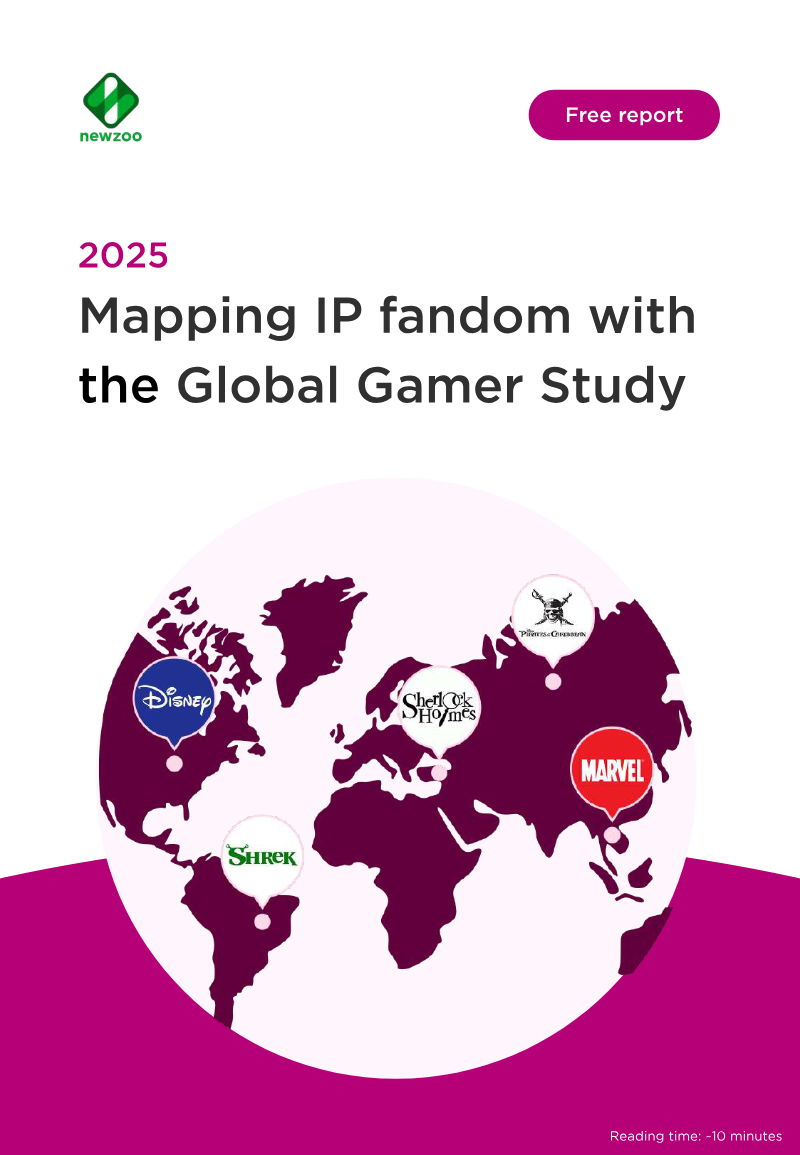
Mapping IP fandom with the Global Gamer Study
This analysis explores the intersection of intellectual property (IP) fandom and player engagement within the global gaming industry. The primary thesis is that while transmedia collaborations are essential for driving player acquisition and retention in a live-service landscape, the effectiveness of an IP is heavily dictated by regional awareness and cultural sentiment. Success in global gaming requires a move away from one-size-fits-all licensing toward market-specific strategies that align with local fanbases.
The findings are based on the 2025 Global Gamer Study, which surveyed over 73,000 consumers across 36 markets, tracking awareness and attitudes toward 42 popular entertainment IPs. Data indicates that a majority of gamers in 24 of the 36 countries are more likely to play a game featuring their favorite IP. This influence is strongest in South Asia (74%) and Latin America (64%), while Western Europe and Oceania show more reserved engagement levels (45%).
The research categorizes IPs into four quadrants based on the relationship between awareness and favorability. Global Favorites, such as Harry Potter and Disney, maintain near-universal recognition (90%) and high sentiment. Familiar Faces like Star Wars and Barbie possess high awareness but suffer from polarizing or lower favorability in specific regions. Hidden Gems, including Studio Ghibli and various anime titles, maintain niche global awareness but command intense loyalty in specific markets like Japan or Vietnam. Finally, IPs with Limited Appeal, such as Doctor Who or Percy Jackson, struggle with both low recognition and lukewarm sentiment outside their core territories.
Geographic variations are stark; for instance, anime franchises like Dragon Ball achieve 85–90% awareness in Latin America and Southeast Asia, nearly double their recognition in the West. Conversely, Western staples like DC Comics see high awareness in the U.S. (70%) but significantly lower traction in Japan (21%). The study concludes that cultural resonance, linguistic accessibility, and historical distribution patterns are the primary drivers of IP success in the gaming sector.
- In 24 of 36 surveyed markets, gamers are more likely to play a title featuring an IP they favor, confirming that transmedia collaborations are a primary driver for acquisition and retention.
- IP influence on player engagement varies significantly by region, peaking in South Asia (74%) and Latin America (64%) compared to more reserved engagement in Western Europe and Oceania (45%).
- Global Favorites like Harry Potter and Disney maintain 90% recognition with high sentiment, whereas IPs like DC Comics show extreme regional variance, with 70% awareness in the U.S. versus only 21% in Japan.
- Anime franchises like Dragon Ball demonstrate the importance of market-specific strategies, achieving 85–90% awareness in Latin America and Southeast Asia—nearly double their recognition in Western markets.
- The 2025 Global Gamer Study, which tracked 42 entertainment IPs across 73,000 consumers, identifies cultural resonance, linguistic accessibility, and historical distribution as the primary determinants of IP success.
+1
NewzooJan 2025

Report56 pages
Gaming: Your Marketing Cheatcode
Gaming has evolved into a horizontal cultural layer encompassing 3.4 billion global players who utilize interactive platforms to build identity and community. Despite this massive reach, the sector currently receives less than 5% of global media investment, representing a significant disconnect between consumer attention and advertising spend. The industry is increasingly defined by transmedia expansion and social connectivity, particularly among Gen Z audiences who prioritize platforms like Roblox and Discord for brand discovery and social interaction. Success in this landscape requires a strategic shift from isolated sponsorships toward full-funnel integrations that align with specific player motivations, including relaxation, achievement, and immersion.
The shift toward non-intrusive brand integration utilizes high-impact formats such as rewarded video and custom in-game partnerships to secure superior video completion rates and brand recall. Immersive strategies drive substantial consumer consideration, with 55% of players expressing interest in branded virtual items. Furthermore, custom experiences within gaming environments can yield up to 100x higher attention levels than traditional social media. Case studies involving major titles like Genshin Impact demonstrate that blending digital fandom with real-world value can result in triple-digit sales growth and heightened community engagement.
As a full-funnel engine, gaming integrations now produce measurable lifts in awareness and consideration through interactive campaigns. Data indicates that gamified loyalty programs can increase purchase rates by 12% and guest spend by 64%, while in-game commerce on platforms like Roblox generates significant revenue for developers. Looking ahead, the industry trajectory is shaped by the expansion of cloud gaming and highly anticipated hardware and software launches, such as the Nintendo Switch 2 and Grand Theft Auto VI. These developments reinforce gaming's role as a primary driver of modern media consumption and commercial conversion.
- Gaming commands 3.4 billion players globally, yet receives less than 5% of total media investment, indicating a significant misalignment between consumer attention and advertising spend.
- Custom in-game experiences can generate up to 100x higher attention levels compared to traditional social media platforms.
- Immersive brand strategies are highly effective, with 55% of players expressing interest in acquiring branded virtual items.
- Gamified loyalty programs are proven to drive commercial performance, increasing purchase rates by 12% and guest spend by 64%.
- Strategic integration in titles like Genshin Impact demonstrates that blending digital fandom with real-world value can trigger triple-digit sales growth.
+1
dentsu gamingJan 2025
Report112 pages
Championing the 25 Retailers and Digital Services Who Connect Music, Video and Games Creators with UK Fans Yearbook
The United Kingdom’s entertainment market reached a historic milestone in 2024, achieving a record valuation of £12.0 billion. This performance marks twelve consecutive years of growth and a 50% increase in market value since 2019. The industry has undergone a near-total digital transformation, with streaming and digital services now accounting for 93% of total revenues. Subscription-based models have become the primary engine of this economy, representing over three-quarters of total consumer spend across the music, video, and gaming sectors.
Video remains the largest individual segment, valued at £5.0 billion. This growth is fueled almost exclusively by Subscription Video on Demand (SVoD), which rose 8.3% to reach £4.46 billion, offsetting a sixteen-year decline in physical media. Conversely, the gaming sector experienced a 4.4% contraction to £4.61 billion. This decline was driven by a sharp 34.5% collapse in physical software sales and a cyclical downturn in hardware as major consoles reach maturity. Despite this, gaming remains overwhelmingly digital, with 98.6% of consumer spend occurring through online channels, particularly via mobile gaming and digital subscriptions.
Music emerged as the fastest-growing sector, reaching a record £2.4 billion. While digital streaming accounts for 85% of this value, the music industry is unique for its resilient physical market. Vinyl LPs saw their 17th consecutive year of growth, with unit sales rising to 7.1 million. This resurgence has revitalized the high street; independent music shops now account for 24% of total outlets, up from just 2% in 2015. While supermarkets and traditional retailers are exiting the physical games and video space, specialist and independent retailers are capturing a five-year high in physical market share, supported by major promotional events and a consumer shift toward high-definition and collectible formats.
- The UK entertainment market reached a record £12.0 billion valuation in 2024, marking twelve consecutive years of growth and a 50% increase since 2019.
- Digital services and streaming now dominate the industry, accounting for 93% of total revenue, with subscription models driving over 75% of consumer spending.
- Video is the largest sector at £5.0 billion, fueled by an 8.3% rise in Subscription Video on Demand (SVoD) to £4.46 billion, which successfully offset the decline in physical media.
- The gaming sector contracted 4.4% to £4.61 billion, impacted by a 34.5% collapse in physical software sales and a cyclical downturn in console hardware.
- Music is the fastest-growing sector at £2.4 billion, supported by a resilient physical market where vinyl LP sales grew for the 17th consecutive year to 7.1 million units.
ERAJan 2025

Report1 pages
CEDEC 2025 Schedule Announcement
The announcement establishes the official timetable for CEDEC 2025, Japan’s premier three‑day conference for computer‑entertainment developers organized by the Computer Entertainment Developers Association (CESA). By moving the event to July 22‑24, 2025—approximately one month earlier than the traditional late‑August slot—the schedule compresses several preparatory phases, prompting participants to adjust their planning accordingly.
Key milestones are detailed: the public call for proposals opens on January 6, 2025, followed by the launch of sponsor and partnership programs in early‑to‑mid February. The final deadline for submissions is set for February 17 at 10 a.m. JST, with selection results communicated in late March. An early‑application deadline for sponsorships occurs on March 31, while ticket‑sale dates remain pending and will be announced later. The conference itself occupies three consecutive days, Tuesday through Thursday, in late July.
The scope is national, targeting Japanese developers, studios, and related stakeholders within the computer‑entertainment sector, and it outlines a timeline that spans from early January through late July 2025. Although the schedule is provisional and subject to minor adjustments, contact information for the CEDEC operations office and the official website are provided for inquiries and future updates.
- CEDEC 2025 will take place from July 22–24, 2025, shifting the conference approximately one month earlier than its traditional late-August schedule.
- The call for session proposals opens on January 6, 2025, with a strict submission deadline of February 17, 2025, at 10 a.m. JST.
- Selection results for proposed sessions will be communicated to applicants in late March 2025.
- Sponsorship and partnership programs launch in early-to-mid February 2025, with an early-application deadline for sponsors set for March 31, 2025.
- The conference is organized by the Computer Entertainment Developers Association (CESA) and targets Japanese developers, studios, and computer-entertainment stakeholders.
+1
Computer Entertainment Developers AssociationSept 2024

Report71 pages
Insights into Global Mobile Game Marketing & Ad Spend Trends for H1 2024
The global mobile gaming landscape in the first half of 2024 is defined by a strategic pivot toward hybrid-casual and subscription-based models as developers seek stable revenue and higher user lifetime value. This transition is supported by the rapid expansion of mini-games on super-apps, currently engaging approximately 650 million players, and the integration of 5G and AI-driven personalization. Marketing success now hinges on the synergy between App Store Optimization and paid search, alongside the use of predictive modeling to mitigate rising acquisition costs. Rewarded playtime has emerged as a critical monetization tool, yielding eCPMs 2.7 times higher than standard formats.
Market activity surged during this period, with monthly active advertisers increasing 33.7% year-over-year to exceed 55,000. Despite this influx, the intensity of individual campaigns moderated, with the average monthly creatives per advertiser falling to 105. Video remains the primary medium, accounting for 77% of ad formats, though AI-generated imagery is gaining significant traction. While Western Europe maintains the highest advertiser density, the Hong Kong, Macau, and Taiwan regions represent the most competitive environments. Genre-wise, casual and puzzle games dominate advertiser participation on Android, but RPGs have surpassed strategy titles in total creative volume through the aggressive use of AI-generated content.
Regional performance highlights distinct growth corridors, such as Brazil’s emergence as a hub for casino games and the Middle East’s demand for localized simulation and strategy titles. Successful campaigns frequently utilize "mini-game" video ads and deliberate-failure narratives to drive conversions. High-performing titles like Legend of Mushroom and Solo Leveling: Arise demonstrate the efficacy of high-volume creative output and IP-driven TikTok marketing. Ultimately, the industry is moving toward a bifurcated strategy where Asia-Pacific markets focus on intensive pre-registration windows while Western markets prioritize long-term promotional stability.
- Monthly active advertisers in mobile gaming grew 33.7% year-over-year in H1 2024, surpassing 55,000 total advertisers.
- Rewarded playtime has become a primary monetization driver, generating eCPMs 2.7 times higher than standard ad formats.
- Video remains the dominant ad medium at 77% of total formats, though average monthly creatives per advertiser dropped to 105 as AI-generated imagery gains traction.
- Mini-games on super-apps have reached 650 million players, serving as a core component of the industry's shift toward hybrid-casual and subscription-based models.
- RPG titles have overtaken strategy games in total creative volume, largely driven by the aggressive integration of AI-generated content.
+2
SocialPetaJun 2024
Report9 pages
How Gamers Discover What to Play
Video game marketing remains a vital component of the industry, though consumer preferences have shifted toward authentic, multi-channel discovery rather than traditional overt sales tactics. Research conducted in May 2024 among 1,009 PC and console gamers in the United States reveals that the average player utilizes four to five different information sources before committing to a new title. This behavior underscores a move away from single-channel reliance toward a diverse marketing mix where authenticity and peer-led insights are prioritized over corporate messaging.
YouTube stands as the dominant platform for game discovery, used by 52% of respondents and cited as the most trusted source of information. However, discovery habits vary significantly by demographic. Younger gamers aged 18–24 are twice as likely to use TikTok and Instagram for news compared to those aged 34–44. Gender also influences platform choice, with men favoring YouTube and Twitch, while women are 13% more likely than men to utilize TikTok for discovery. Despite the prevalence of these platforms, trust remains fragmented; while YouTube is the most trusted, social media platforms like TikTok and X are frequently viewed with skepticism, suggesting that trust resides more in specific creators than the platforms themselves.
Purchasing decisions are primarily driven by familiarity and risk mitigation. Forty percent of gamers prioritize established franchises they already enjoy, and 25% favor games from respected developers. While reviews and influencer endorsements remain influential, cost-related factors such as subscription services and price promotions also play a significant role in the decision-making process. Ultimately, the data suggests that successful game discovery relies on building a presence across multiple social and video platforms while leveraging established brand equity and influencer relationships to overcome consumer distrust.
- Gamers utilize an average of four to five distinct information sources before purchasing a new title, reflecting a shift away from single-channel marketing reliance.
- YouTube is the primary discovery platform for 52% of gamers and is ranked as the most trusted source of information.
- Purchasing decisions are driven by risk mitigation, with 40% of players prioritizing established franchises and 25% favoring games from respected developers.
- Demographic discovery habits vary significantly, as gamers aged 18–24 are twice as likely to use TikTok and Instagram for news compared to those aged 34–44.
- Gender influences platform preference, with women being 13% more likely than men to use TikTok for game discovery.
+1
Big Games MachineMay 2024

Report26 pages
Level Up – Harnessing the Power of Gaming Audiences
The 2024 Level Up report, a collaborative analysis by Comscore and Anzu, examines the evolving landscape of the U.S. gaming market and the expanding opportunities for brand integration. The study defines gamers as adults aged 18 to 65 who play multiple times a week, revealing that 62% of the U.S. adult population fits this criteria. A significant finding is the high level of cross-platform engagement; 77% of gamers utilize more than one device, while 40% play across all platforms, including PC, console, and mobile.
The data highlights distinct consumer behaviors based on platform preference. Console gamers demonstrate the highest willingness to pay for content, with 37% prepared to spend over $60 on a single title. In contrast, 32% of mobile-only gamers prefer free-to-play models. Genre preferences also vary by hardware, with PC players favoring first-person shooters and RPGs, while console players show a strong affinity for action-adventure and sports titles.
From an advertising perspective, the report concludes that gaming is no longer a niche silo but a mainstream medium with high receptivity to marketing. Approximately two-thirds of gamers view in-game advertisements as having a positive or neutral impact on their experience. Specifically, 34% of respondents believe product placement enhances realism, and 45% express a preference for rewarded ad formats. Case studies, such as Tommy Hilfiger’s campaign, demonstrate the efficacy of these strategies, showing a 20-point lift in brand favorability and a 23-point increase in purchase intent. The report emphasizes that the partnership between Comscore and Anzu now allows for more precise measurement of the incremental reach provided by intrinsic in-game advertising.
- Gaming is a mainstream U.S. medium, with 62% of adults aged 18–65 playing games multiple times per week.
- Cross-platform engagement is high, as 77% of gamers use more than one device and 40% play across PC, console, and mobile platforms.
- Two-thirds of gamers view in-game advertisements as having a neutral or positive impact on their experience, with 34% noting that product placement enhances realism.
- Rewarded ad formats are preferred by 45% of gamers, and campaigns like Tommy Hilfiger’s have demonstrated significant performance gains, including a 20-point lift in brand favorability and a 23-point increase in purchase intent.
- Monetization preferences are platform-dependent: 37% of console gamers are willing to spend over $60 on a single title, whereas 32% of mobile-only gamers prefer free-to-play models.
+1
ComscoreMar 2024

Report33 pages
Marketing Insights into Global Casual & Puzzle Games for Q1 2024
The global mobile gaming landscape in the first quarter of 2024 is characterized by a significant expansion in the advertiser base, which grew nearly 29% year-over-year to approximately 51,300 monthly active participants. Despite this increase in competition, the volume of unique creatives per advertiser decreased by 18%, signaling a strategic shift toward quality over quantity. Casual and puzzle games remain the primary drivers of this ecosystem, collectively representing half of all active advertisers. Casual games alone account for nearly 40% of total ad creatives, with the most intense market activity concentrated in Europe and the United States. In these regions, success is increasingly dependent on high-quality, short-form video content and rapid creative iteration to combat player fatigue.
Performance data indicates that iterative content updates and rigorous A/B testing are essential for scaling titles in a saturated market. Successful case studies demonstrate that optimizing level depth and refining monetization strategies can yield substantial financial gains, as seen in the 32% increase in average revenue per user for Camo Snipper and the continued dominance of Royal Match as a top-five global grossing title. Furthermore, the rapid international expansion of instant games from Chinese developers highlights a growing trend toward cross-border competition. To penetrate diverse markets such as Japan, South Korea, and Southeast Asia, developers are increasingly relying on localized ad creatives and influencer marketing to bridge cultural gaps.
The scope of these findings encompasses a broad geographic range, including Southeast Asia, the Middle East, South America, and East Asian territories. By analyzing these regional clusters, it becomes clear that while the casual and puzzle segments are globally ubiquitous, effective execution requires a nuanced understanding of local preferences. The current market environment demands a sophisticated balance between broad-reach advertising and localized engagement strategies to maintain growth and profitability in the face of rising advertiser density.
- The global mobile gaming advertiser base grew 29% year-over-year in Q1 2024 to 51,300 participants, while the volume of unique creatives per advertiser dropped by 18% as firms shifted toward quality over quantity.
- Casual and puzzle games dominate the market, accounting for 50% of all active advertisers, with casual games alone responsible for nearly 40% of total ad creatives.
- Success in saturated markets like the US and Europe requires high-quality short-form video content and rapid creative iteration to mitigate player fatigue.
- Rigorous A/B testing and content optimization drive financial performance, evidenced by a 32% increase in average revenue per user for Camo Snipper and the continued top-five grossing status of Royal Match.
- Chinese developers are driving cross-border competition through instant games, utilizing localized ad creatives and influencer marketing to penetrate markets in Japan, South Korea, and Southeast Asia.
+2
SocialPetaMar 2024

Report29 pages
Turning Organic Success into Long-Term Revenue: A Framework for F2P Mobile Games
This industry guide provides a strategic framework for mobile game developers to transition from initial organic traction to sustainable, long-term revenue growth. The central thesis argues that while organic "sparks" are invaluable, lasting success requires a rigorous, two-step approach: first, optimizing the game’s internal economy for maximum Lifetime Value (LTV), and second, deploying data-driven paid User Acquisition (UA) campaigns.
The first phase focuses on monetization through ad mediation and in-app purchases (IAP). Key findings suggest that implementing a hybrid ad mediation setup—combining real-time bidding with manual waterfalls—can yield a 10% to 20% uplift in Average Revenue Per Daily Active User (ARPDAU) immediately. The analysis emphasizes the importance of rewarded ads over intrusive interstitials and highlights that personalized, segmented IAP offers can increase player spending by up to 23%. It also advocates for regional pricing, noting that price cuts in lower-purchasing-power markets can boost ARPDAU by as much as 30%.
The second phase details a methodology for scaling through paid UA, emphasizing the necessity of accurate data post-IDFA. The guide recommends a three-step framework of assessment, preparation, and optimization. It advises that while platforms like Meta and TikTok are accessible for smaller budgets, larger networks typically require a minimum monthly spend of $20,000 to exit the "learning phase" effectively. Furthermore, it stresses the role of App Store Optimization (ASO), citing a case where a simple icon change resulted in a 90% install uplift.
The scope of the analysis covers the global free-to-play (F2P) mobile gaming market, applicable to various genres and studio sizes. The methodology relies on industry benchmarks, case studies, and data from SuperScale’s proprietary analytics engine, SuperInsights. The overarching conclusion is that developers must treat monetization and UA as iterative, scientific processes, using predictive modeling to forecast Return on Ad Spend (ROAS) up to a year in advance to ensure business-level profitability.
- Developers should treat monetization and user acquisition as iterative, scientific processes, using predictive modeling to forecast ROAS up to one year in advance to ensure profitability.
- Implementing a hybrid ad mediation setup that combines real-time bidding with manual waterfalls can yield an immediate 10% to 20% uplift in ARPDAU.
- Personalized, segmented in-app purchase offers can increase player spending by up to 23%, while regional pricing adjustments in lower-purchasing-power markets can boost ARPDAU by as much as 30%.
- Paid user acquisition campaigns on larger networks typically require a minimum monthly spend of $20,000 to effectively exit the platform's initial learning phase.
- App Store Optimization is a high-impact lever for growth, as evidenced by a case study where a simple icon change resulted in a 90% uplift in installs.
+2
SuperScaleMar 2024

Report30 pages
The Golden Age of Video Game Remakes and Remasters
The video game industry has entered a definitive era of remakes and remasters, fueled by a risk-averse development climate and the significant purchasing power of nostalgic Millennial consumers. These projects serve as a strategic hedge against the rising costs of original intellectual property, allowing developers to re-engage dormant fanbases while attracting new audiences through modernized graphics and gameplay. Success in this sector depends heavily on timing and the specific nature of the renewal. Remasters perform most effectively when released within five years of an original title to capitalize on hardware transitions. Conversely, full remakes require a longer gestation period, typically between nine and twenty-five years, to ensure that technological advancements are substantial enough to justify a full-price purchase.
Effective remakes must strike a delicate balance between preservation and modernization. Developers are encouraged to maintain the core essence and iconic moments of a title—such as specific art styles or dialogue—while aggressively updating outdated mechanics like quick-time events. Leveraging contemporary hardware capabilities, such as 3D audio and advanced rendering, is essential for meeting modern player expectations. By aligning these updates with a clear vision for modernization, studios can successfully bridge the gap between historical authenticity and current industry standards.
This 2024 analysis provides a comprehensive overview of the global gaming landscape, focusing on the strategic advantages of revitalizing established franchises. While the findings highlight clear pathways to commercial success through market-tested IPs, the data is intended for informational purposes and reflects the broader trends shaping the current development cycle. Ultimately, the strategic deployment of remakes and remasters reduces financial volatility for studios while ensuring that classic gaming experiences remain accessible and relevant in a rapidly evolving technological environment.
- Remakes and remasters serve as a strategic financial hedge against the rising costs of developing original intellectual property in a risk-averse industry.
- Full remakes require a gestation period of nine to twenty-five years to ensure technological advancements are significant enough to justify a full-price purchase.
- Remasters are most commercially effective when released within five years of the original title to capitalize on hardware transitions.
- Successful revitalization requires balancing the preservation of iconic elements, such as art style and dialogue, with the aggressive modernization of outdated mechanics like quick-time events.
- Studios must leverage contemporary hardware capabilities, including 3D audio and advanced rendering, to meet modern player expectations for updated titles.
+1
VirtuosMar 2024
Report78 pages
2023 Global Mobile Games Marketing Trends White Paper
The global mobile gaming landscape underwent a significant transformation in 2023, characterized by a strategic shift toward the hybrid-casual model. This evolution combines the accessibility of hyper-casual mechanics with the monetization depth of mid-core titles, utilizing a mix of in-app advertising and in-app purchases to stabilize revenue. Marketing efforts were defined by a nearly 50% year-over-year surge in monthly active advertisers, exceeding 40,000 globally. While North America maintained its leadership in total advertiser volume, Southeast Asia emerged as the most competitive region for creative output. Concurrently, Android became the primary focus for volume-driven campaigns due to ongoing iOS privacy restrictions, though iOS remained the preferred platform for high-value mid-core and hard-core marketing.
Creative strategies pivoted toward high-impact visual storytelling and the integration of generative AI to manage rising user acquisition costs. Although video remains the dominant format, accounting for over 76% of impressions, AI-generated image creatives gained significant traction, particularly in square formats. Developers increasingly utilized "mini-game" ad patterns—such as ASMR, dramatic narratives, and deliberate failure scenarios—to lower entry barriers for complex genres like Simulation and Strategy games. Meanwhile, RPG and Casino titles leaned heavily on influencer collaborations and live-action content to drive engagement in emerging markets across Southeast Asia and the Middle East.
Sustainable growth in 2024 depends on a holistic integration of AI-driven production and programmatic transparency. The successful global expansion of Chinese-developed mini-games and the revitalization of legacy titles through trending ad mechanics illustrate a broader trend of creative agility. By analyzing over 1.4 billion ad creatives across 70 countries, it is evident that the industry is moving toward a data-driven future where high-engagement formats like rewarded ads and user-generated content are essential for navigating a fragmented and privacy-conscious global market.
- The mobile gaming industry shifted toward a hybrid-casual model in 2023, blending hyper-casual accessibility with mid-core monetization to stabilize revenue through combined in-app advertising and purchases.
- Monthly active advertisers surged by nearly 50% year-over-year, surpassing 40,000 globally as competition for user acquisition intensified.
- Video ads remain the dominant format, accounting for over 76% of total impressions, while AI-generated image creatives are increasingly used to mitigate rising acquisition costs.
- Android has become the primary platform for volume-driven campaigns due to iOS privacy restrictions, though iOS retains its status as the preferred channel for high-value mid-core and hard-core titles.
- Developers are utilizing 'mini-game' ad patterns—including ASMR, dramatic narratives, and failure scenarios—to lower entry barriers for complex genres like Strategy and Simulation.
+2
SocialPetaJan 2024

Report21 pages
Marketing Insights into Global Mobile Games & Minigames 2024
The global mobile gaming landscape in 2024 is characterized by a high volume of advertising activity, with monthly active advertisers averaging over 63,000. While the total number of advertisers remains robust, the proportion of new market entrants has steadily declined, falling below 7% by late 2024. Conversely, the industry has seen a consistent rise in the deployment of new ad creatives, with over 72% of advertisers releasing fresh content by September, signaling an intensification of competition and a focus on creative iteration to maintain audience engagement.
Analysis of genre-specific performance reveals a shift in marketing priorities. Casual game advertising has experienced a slight decline, whereas the casino genre has seen a notable growth of over 10% in advertiser volume. Across the board, RPG, puzzle, and simulation games remain significant contributors to the advertising ecosystem. The data suggests that successful market penetration increasingly relies on high-frequency creative updates and localized marketing strategies, particularly as developers look to expand beyond domestic borders.
The minigame sector, encompassing H5 and mini-program games, has emerged as a critical growth area. These titles are increasingly adopting a "going global" strategy, moving from initial releases in Asian markets to broader international expansion in North America, Western Europe, and Latin America. Successful minigames often utilize hybrid monetization models and leverage specific sub-genres such as "backpack-like" or "knights-like" games. Marketing for these titles is highly data-driven, with distinct strategies for the Asia-Pacific region—which favors pre-registration and launch-phase intensity—versus Western markets, which prioritize sustained, long-term advertising during a game’s stable period. The industry continues to favor creative formats that emphasize playable, low-friction experiences and culturally localized themes to maximize user retention and acquisition.
- Competition is intensifying through creative iteration, with over 72% of the 63,000+ monthly active advertisers releasing fresh ad content by September 2024.
- The proportion of new market entrants has dropped below 7%, indicating a shift toward established players focusing on retention rather than market expansion.
- Casino games have emerged as a growth leader with a 10% increase in advertiser volume, while casual game advertising has experienced a slight decline.
- Minigames are increasingly adopting a global strategy, moving from Asian markets into North America, Western Europe, and Latin America.
- Successful minigame monetization relies on hybrid models and specific sub-genres like 'backpack-like' or 'knights-like' games.
+2
SocialPetaJan 2024