Report19 pages
Top 500 Titles on Twitch 2023
The gaming industry experienced record-breaking engagement in 2023, with the top 500 titles on Twitch generating nearly 15 billion hours of watch time. This viewership was characterized by extreme concentration at the top of the rankings, as a mere 11 titles accounted for half of the total watch time. Grand Theft Auto V led the industry with 1.3 billion hours watched, while Fortnite demonstrated the highest level of creator engagement, boasting 2.8 million unique channels—more than double its nearest competitor.
The streaming landscape across 2023 showcased a diverse mix of modern AAA releases, indie sensations, and enduring legacy titles. While competitive staples like VALORANT and League of Legends dominated the upper echelons, the rankings revealed significant staying power for older franchises. Titles such as Super Mario 64, Age of Empires II, and various entries from The Legend of Zelda series maintained millions of hours of watch time, often outperforming newer releases. This trend highlights a bifurcated market where viewers gravitate toward both high-stakes competitive play and nostalgic speedrunning or retro content.
The data, which excludes non-gaming categories like "Just Chatting" and tabletop games to focus strictly on video game performance, indicates that even titles at the bottom of the top 500 maintain substantial audiences. Games ranked between 400 and 500, such as Tekken 8 and PICO PARK, still commanded approximately 1.8 million to 2.2 million hours watched each. This comprehensive analysis across PC, console, and mobile platforms underscores a resilient ecosystem where niche indie horror, classic RPGs, and modern shooters coexist, maintaining high viewer retention despite broader economic volatility within the development sector.
- The top 500 Twitch titles generated nearly 15 billion hours of watch time in 2023, with 50% of that total concentrated in just 11 games.
- Grand Theft Auto V was the most-watched title of 2023, accumulating 1.3 billion hours of viewership.
- Fortnite led the industry in creator engagement with 2.8 million unique channels, more than double the count of its nearest competitor.
- The streaming market is bifurcated between high-stakes competitive staples like League of Legends and VALORANT and legacy titles like Super Mario 64 and Age of Empires II that maintain millions of hours of watch time.
- Even titles ranked between 400 and 500, such as Tekken 8 and PICO PARK, sustained significant engagement, each generating between 1.8 million and 2.2 million hours watched.
LurkitJan 2024
Report18 pages
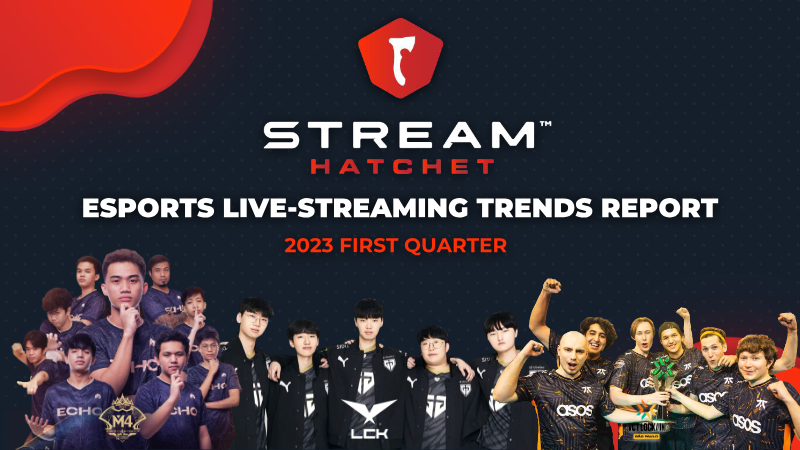
Esports Live-Streaming Trends Report: Q1 2023
The esports live-streaming market demonstrated significant resilience in the first quarter of 2023, with viewership growing 15% year-over-year to reach 651 million hours watched. This growth occurred despite a general decline in broader live-streaming viewership during the same period. The data, aggregated from major platforms including Twitch, YouTube, Facebook Gaming, and AfreecaTV, indicates that the top 30 tournaments alone account for 68% of total esports viewership, highlighting a heavy concentration of audience interest in premier events.
Twitch maintains its market leadership with a 62% share of esports hours watched, followed by YouTube at 30%. While Twitch dominates smaller events with an 81% market share, YouTube has successfully increased its presence in the large-scale event segment, capturing 34% of viewership for tournaments with an average minute audience exceeding 80,000. Multiplayer Online Battle Arena (MOBA) and First-Person Shooter (FPS) remain the most popular genres, though Action-Adventure saw the highest growth due to specialized events like Minecraft Extremo.
A critical trend identified is the rise of co-streaming, where independent creators broadcast official tournament footage to their own audiences. In the case of the Call of Duty League, co-streaming helped triple the league's hours watched compared to the previous year, with nearly 60% of the peak audience watching via creator channels rather than official streams. Top creators like Tarik and Ibai have become central to this ecosystem, often generating higher chat engagement rates than official broadcasts. Mobile esports also showed strength, particularly Mobile Legends: Bang Bang, which saw a 273% increase in esports viewership despite a general downturn in the mobile gaming sector.
- Esports live-streaming viewership grew 15% year-over-year in Q1 2023 to 651 million hours, bucking the broader industry trend of declining live-streaming viewership.
- Audience interest is highly concentrated, with the top 30 tournaments accounting for 68% of total esports hours watched.
- Twitch holds 62% of the total esports market share, while YouTube maintains 30% and has successfully captured 34% of viewership for large-scale events with an average minute audience over 80,000.
- Co-streaming has become a primary growth driver, exemplified by the Call of Duty League tripling its hours watched as 60% of its peak audience tuned in via creator channels rather than official streams.
- Mobile esports demonstrated significant momentum, with Mobile Legends: Bang Bang recording a 273% increase in viewership despite a general downturn in the mobile gaming sector.
+1
Stream HatchetMar 2023
Report21 pages
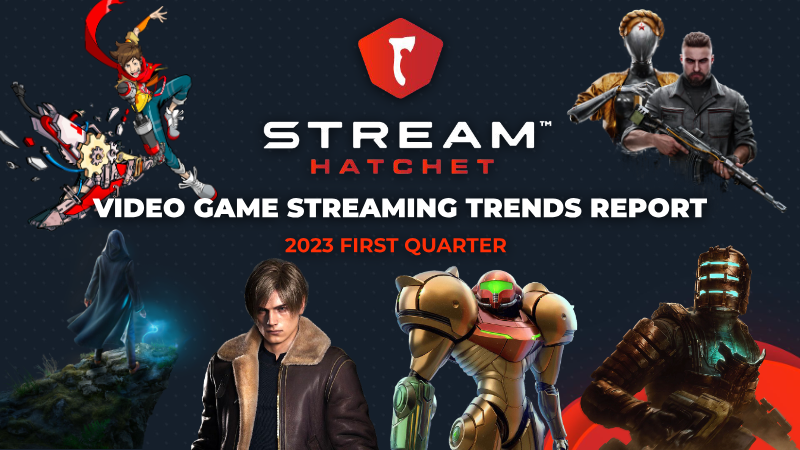
Video Game Streaming Trends Report: Q1 2023
The live-streaming market experienced a cooling period in the first quarter of 2023, with combined viewership across major platforms decreasing by 16% compared to the previous year. Despite this decline, the industry remains significantly larger than pre-pandemic levels, with total hours watched still 46% higher than in Q1 2020 and double the volume of Q1 2019. This analysis, based on data from Twitch, YouTube Live Gaming, Facebook Live, and emerging platforms like AfreecaTV, highlights a shifting competitive landscape where Twitch and YouTube have increased their market share to 74% and 15% respectively, while Facebook Live’s influence plummeted by nearly 69%.
A primary trend identified is the growing synergy between streaming and other media formats. The release of The Last of Us television series on HBO triggered a 107% increase in viewership for the franchise's games and generated over one million related chat messages on Twitch within two weeks. Similarly, non-gaming content continues to expand, with sports—specifically football—accounting for four of the top five non-gaming broadcasts. In the gaming sector, League of Legends reclaimed the top spot by hours watched, while Hogwarts Legacy set a record for single-player games with 1.28 million peak viewers during its early access period.
The creator landscape saw significant shifts as KaiCenat became the top streamer, surpassing xQc following a record-breaking 30-day "subathon" that generated 53.4 million hours watched. The report also notes the rising dominance of VTubers, particularly in the female creator category, where they occupy half of the top ten spots. Geographically, the influence of Spanish and Portuguese-speaking creators remains strong, representing the majority of the top ten global streamers. While the market is stabilizing after years of rapid growth, these findings suggest that high-production crossovers and diverse content categories are becoming the primary drivers of audience engagement.
- Total live-streaming viewership declined 16% year-over-year in Q1 2023, though total hours watched remain 46% higher than Q1 2020 levels.
- Twitch and YouTube Live Gaming consolidated their market dominance to a combined 89% share, while Facebook Live viewership plummeted by 69%.
- Cross-media synergy is a primary growth driver, evidenced by the HBO 'The Last of Us' series triggering a 107% increase in viewership for the franchise's games.
- Hogwarts Legacy set a record for single-player games with 1.28 million peak concurrent viewers during its early access period.
- Creator KaiCenat became the top streamer in Q1 2023, generating 53.4 million hours watched during a 30-day 'subathon'.
+1
Stream HatchetMar 2023
Report25 pages
The MENA Games Market: From Sand to Stardom
The Middle East and North Africa (MENA) gaming market is experiencing a period of rapid expansion, characterized by significant government investment, a growing base of digital natives, and an increasing emphasis on cultural localization. As of 2022, the MENA-3 region—comprising Saudi Arabia, the United Arab Emirates, and Egypt—generated $1.8 billion in revenue and supported 67.4 million gamers. This growth is underpinned by a strong mobile-first ecosystem and a burgeoning esports sector that benefits from high engagement rates and substantial public sector backing, most notably through Saudi Arabia’s National Gaming and Esports Strategy.
The industry’s trajectory is heavily influenced by the necessity of localized content. Data indicates that 86.6% of regional gamers prioritize language localization, and successful titles like PUBG Mobile have demonstrated that integrating regional celebrities, cultural themes, and Arabic-language support is essential for market penetration. Beyond content, the region is actively fostering a domestic development pipeline through workforce training, educational initiatives, and high-profile mergers and acquisitions, such as those led by the Savvy Games Group. These efforts aim to transition the region from a consumer market into a global hub for game development and esports.
Esports serves as a primary driver of engagement, with 73% of regional gamers participating in competitive gaming. The rise of local influencers and streamers, coupled with massive prize pools and the development of dedicated infrastructure like esports cities, has created a self-sustaining cycle of fan engagement and corporate sponsorship. Furthermore, the market is increasingly viewed as a strategic partner for international firms, particularly those from China, which have successfully utilized the region as a growth market. By leveraging social gaming trends—where voice chat and online socialization are central to the player experience—and prioritizing gender-inclusive gaming spaces, the MENA region is positioning itself as a significant, high-growth player in the global gaming landscape.
- The MENA-3 region (Saudi Arabia, UAE, and Egypt) generated $1.8 billion in revenue from 67.4 million gamers as of 2022, driven by a mobile-first ecosystem.
- Cultural localization is a critical success factor, with 86.6% of regional gamers prioritizing language support and successful titles integrating Arabic themes and local celebrities.
- Esports is a primary engagement driver, with 73% of regional gamers participating in competitive gaming supported by massive prize pools and dedicated infrastructure.
- The region is transitioning from a consumer market to a development hub through strategic initiatives like Saudi Arabia’s National Gaming and Esports Strategy and the Savvy Games Group’s M&A activity.
- International firms, particularly from China, are increasingly using the MENA region as a strategic growth market by capitalizing on high social gaming engagement and voice chat trends.
+3
Niko PartnersJan 2023
Report35 pages
Video Game Streaming Trends 2022 Yearly Report
Western live streaming viewership experienced a 13.5% year-over-year decline in 2022, totaling 29.5 billion hours watched. This contraction was primarily driven by a 14% reduction in unique active channels, suggesting that streamer burnout impacted content supply more significantly than a lack of audience demand. While Facebook Gaming suffered a substantial 56% drop in viewership, Twitch maintained its market dominance, and YouTube Gaming solidified its status as the second-largest platform. Notably, non-gaming content reached new heights, with the "Just Chatting" category leading Twitch and female creator representation expanding across YouTube and Facebook.
The industry landscape shifted toward creator-driven events and original programming, which frequently outperformed traditional AAA game launches. High-profile spectacles like Ludwig’s Chessboxing and Ibai’s boxing matches demonstrated the immense power of individual personalities to command massive audiences. This trend extended to esports organizations, which generated 1.6 billion hours watched; however, more than half of that engagement was attributed to their rosters of content creators rather than professional competitive matches. Marketing strategies evolved accordingly, as brands prioritized long-term sponsorships with mid-sized influencers and publishers utilized "drops" campaigns to boost game viewership by as much as 412%.
Engagement metrics from 2022 highlight the continued dominance of established titles such as Counter-Strike: Global Offensive and Escape From Tarkov, alongside the rise of international creators like the Portuguese streamer Gaules. As the ecosystem matures, the integration of business intelligence, social analytics, and programmatic advertising has become essential for stakeholders. These tools allow brand marketers and media publishers to navigate a complex market where influencer management and creator-led events serve as the primary engines for revenue growth and audience retention.
- Western live streaming viewership fell 13.5% year-over-year in 2022 to 29.5 billion hours, driven largely by a 14% reduction in unique active channels.
- Twitch maintained market dominance while YouTube Gaming solidified its position as the second-largest platform, despite Facebook Gaming suffering a 56% viewership decline.
- Creator-driven events and original programming frequently outperformed traditional AAA game launches, with individual personalities proving more effective at driving engagement than professional esports matches.
- Marketing strategies shifted toward long-term sponsorships with mid-sized influencers and the use of 'drops' campaigns, which can boost game viewership by up to 412%.
- Non-gaming content, led by the 'Just Chatting' category on Twitch, reached new heights while female creator representation expanded across YouTube and Facebook.
+1
Stream HatchetJan 2023
Report25 pages
Video Game Live Streaming Trends Report: Q3 2023
The Q3 2023 Video Game Live Streaming Trends Report provides a comprehensive analysis of the global live-streaming market, covering major platforms including Twitch, YouTube Gaming, Facebook Live, Kick, and AfreecaTV. Utilizing data from a consortium of industry analysts, the findings indicate that the market has entered a period of stabilization. Total viewership reached 7.6 billion hours watched, representing a minor 4% year-over-year decline but remaining 90% higher than pre-pandemic levels in 2019.
A significant shift in the platform landscape is highlighted by the rapid ascent of Kick, which surpassed Facebook Live and AfreecaTV to become the third most-watched platform. Kick’s growth is largely driven by non-gaming content, which accounts for 66% of its viewership, compared to 27% on Twitch. While Twitch maintains a dominant 71% market share, its esports viewership saw an 18% year-over-year decrease. Despite this, mobile titles remain strong, with MPL Indonesia Season 12 ranking as the quarter's top esports event.
The report identifies creator-driven events as a primary engine for high engagement. Events like ibai’s La Velada del Año III and Squeezie’s GP Explorer 2 generated tens of millions of hours watched and record-breaking peak viewership. In the software sector, Grand Theft Auto V reclaimed the top spot for most-watched game, while new role-playing releases Baldur’s Gate 3 and Starfield emerged as the most successful launches of the quarter, collectively generating nearly 100 million hours watched in their first months. The analysis concludes that while overall growth has slowed, the industry is sustained by high-profile creator events and the continued popularity of role-playing and variety content.
- The live-streaming market has stabilized with 7.6 billion hours watched in Q3 2023, a 4% year-over-year decline but still 90% higher than 2019 levels.
- Kick has emerged as the third most-watched platform, surpassing Facebook Live and AfreecaTV, with 66% of its viewership driven by non-gaming content.
- Twitch maintains a dominant 71% market share, though its esports viewership experienced an 18% year-over-year decrease.
- Creator-led events are primary engagement drivers, exemplified by La Velada del Año III and GP Explorer 2, which generated tens of millions of hours watched.
- Grand Theft Auto V reclaimed the top spot for most-watched game, while new releases Baldur’s Gate 3 and Starfield generated nearly 100 million hours watched in their debut months.
+1
Stream HatchetJan 2023
Report24 pages
Video Game Streaming Trends Report: Q2 2023
This analysis of the video game live-streaming market for Q2 2023 highlights a period of stabilization and strategic shifts following the post-pandemic boom. While overall viewership declined by 9% compared to the previous quarter, the industry remains significantly larger than its pre-pandemic state, with total hours watched up 97% over Q2 2019. The data covers major global platforms including Twitch, YouTube Gaming, Facebook Live, and the emerging competitor Kick, utilizing data aggregated through third-party APIs and manual classification.
A primary finding is the rapid ascent of Kick, which secured a 2% market share to become the fifth most-watched platform. Kick’s growth was driven by a creator-friendly 95-5 revenue split and high-profile signings like xQc and Amouranth, leading to a 204% increase in unique channels. Notably, Kick’s content mix differs from Twitch; while Twitch remains 74% gaming-focused, over two-thirds of Kick’s viewership comes from non-gaming categories, specifically "Just Chatting" and "Slots & Casino."
In the gaming sector, League of Legends reclaimed the top spot for hours watched, followed by Grand Theft Auto V and VALORANT. The report emphasizes the impact of new releases, specifically Diablo IV, which generated 164 million hours watched in its first month. Blizzard’s use of a "Hardcore Mode" challenge demonstrated the efficacy of creator-led marketing, as 29% of the game's first-week viewership was tied to this specific challenge.
The esports segment showed resilience, growing 4.1% year-over-year despite the broader market cooling. The analysis also notes the continued dominance of female VTubers on YouTube and the trend of esports organizations relying heavily on content creators for viewership, with eight of the top ten teams drawing over 50% of their audience from creators rather than competitive matches.
- Despite a 9% quarterly viewership decline in Q2 2023, the live-streaming market remains 97% larger than pre-pandemic levels from Q2 2019.
- New platform Kick captured a 2% market share in Q2 2023, driven by a 204% increase in unique channels and a creator-friendly 95-5 revenue split.
- Kick’s content strategy diverges from Twitch, with over two-thirds of its viewership originating from non-gaming categories like 'Just Chatting' and 'Slots & Casino' rather than gaming.
- Diablo IV generated 164 million hours watched in its first month, with 29% of its first-week viewership directly attributed to the 'Hardcore Mode' creator-led marketing challenge.
- Esports viewership grew 4.1% year-over-year, with top organizations increasingly reliant on content creators, who account for over 50% of the audience for eight of the top ten teams.
Stream HatchetJan 2023
Report23 pages
Peak Play: Trends in East Asian Videogame Streaming H1 2023
The East Asian videogame livestreaming market is a mature and culturally distinct ecosystem where competitive esports serve as the primary engine for audience engagement. During the first half of 2023, MOBA and Battle Royale titles accounted for over half of the region's most-watched content. While established franchises like League of Legends maintain a dominant presence, the market is increasingly shaped by the influence of Key Opinion Leaders and VTubers. These creators contribute up to 15% of total viewership for major titles and have demonstrated the power to revitalize older games such as Minecraft and Escape from Tarkov.
Regional preferences reveal a bifurcated landscape where specific titles command massive scale. In China, Honor of Kings remains the undisputed leader with 5.67 billion views, while VALORANT and Apex Legends dominate the Japanese and Korean markets, each surpassing 100 million hours watched. The barrier to entry for new releases is high, as only high-profile 2023 titles like Diablo IV, Honkai: Star Rail, and Street Fighter 6 managed to break into regional top-ten rankings. The rapid ascent of Honkai: Star Rail in China notably came at the expense of Genshin Impact, which saw a 31% decline in viewership as audiences shifted toward the newer release.
The integration of granular streaming analytics and market intelligence is essential for navigating this complex environment. By tracking metrics across platforms such as Twitch, YouTube, and AfreecaTV, stakeholders can monitor audience retention and demographic shifts. This data-driven approach highlights the volatility of the market, evidenced by the 68.5% decline in Splatoon 3 viewership following its launch period. Understanding these dynamics—ranging from the professional esports circuit to the rising prominence of virtual avatars—is critical for identifying growth opportunities and executing successful market entry strategies across Asia.
- Competitive esports, specifically MOBA and Battle Royale titles, drive over 50% of total viewership in the East Asian streaming market.
- Honor of Kings remains the dominant force in China with 5.67 billion views, while VALORANT and Apex Legends lead in Japan and Korea with over 100 million hours watched each.
- Key Opinion Leaders and VTubers are significant market drivers, contributing up to 15% of total viewership for major titles and successfully revitalizing older games.
- New title launches face high barriers to entry, with only Diablo IV, Honkai: Star Rail, and Street Fighter 6 breaking into regional top-ten rankings during H1 2023.
- Audience cannibalization is a measurable risk, as evidenced by Honkai: Star Rail’s growth contributing to a 31% decline in Genshin Impact viewership.
+1
Niko PartnersJan 2023
Report19 pages
The Games We Watched: Lurkit’s Top 500 Global Stream Report
The global gaming industry experienced a period of significant contrast in 2023, characterized by record-breaking streaming engagement despite internal industry volatility such as widespread layoffs. Analysis of 170,000 games and 12 million channels reveals that the top 500 titles alone generated nearly 15 billion hours of viewership on Twitch. This engagement is heavily concentrated at the top of the market, with only 11 titles accounting for half of the total viewership among the top 500. Grand Theft Auto V maintained its position as the most-watched title with 1.3 billion hours, while Fortnite demonstrated the broadest creator appeal, engaging 2.8 million unique streaming channels.
The performance of mid-tier and newly released titles illustrates a diverse landscape where evergreen sandbox games compete with high-impact narrative launches. While established hits like Stardew Valley maintained steady viewership, 2023 releases such as Alan Wake II and Armored Core VI achieved high average viewership densities, signaling strong concentrated interest during their launch windows. Even at the lower end of the top 500 rankings, titles like PICO PARK maintained substantial footprints, recording nearly 1.8 million hours watched. This indicates a deep tail of engagement where hundreds of games sustain millions of hours of annual viewership.
Methodologically, these findings focus exclusively on digital video game software, omitting non-gaming categories such as "Just Chatting" and tabletop games to provide a precise view of the interactive entertainment market. The data accounts for active engagement by excluding streams with zero concurrent viewers, a factor that impacts total hours watched by less than 1%. Ultimately, the 2023 streaming data confirms that while a small number of blockbuster titles dominate the majority of audience attention, the ecosystem remains robust enough to support hundreds of titles with significant, multi-million-hour viewership totals.
- The top 500 games generated nearly 15 billion hours of viewership on Twitch in 2023, despite broader industry volatility.
- Market engagement is highly concentrated, with just 11 titles accounting for 50% of the total viewership among the top 500 games.
- Grand Theft Auto V was the most-watched title of 2023, accumulating 1.3 billion hours of viewership.
- Fortnite achieved the highest creator appeal, with 2.8 million unique streaming channels broadcasting the game throughout the year.
- New 2023 releases like Alan Wake II and Armored Core VI demonstrated high average viewership density during their launch windows, proving the viability of high-impact narrative launches.
LurkitJan 2023

Report108 pages
Creative Industries in the UK Report
The United Kingdom’s entertainment market reached a historic peak of £11.1 billion in 2022, representing a 6.9% year-on-year increase and nearly doubling its total value since 2015. This growth is fundamentally underpinned by a comprehensive transition to digital consumption, with digital services now commanding a 91% market share across the video, music, and gaming sectors. While physical formats generally continue a long-term decline, specific niches such as vinyl and 4K UHD Blu-ray demonstrate notable resilience, with vinyl revenue surpassing CD sales for the first time this century.
The video games sector remains the largest individual segment, valued at £4.66 billion. Digital software sales account for 90% of this spend, led by mobile gaming and console downloadable content. Although hardware sales faced challenges due to global supply chain constraints, the market remains robust, with digital sales for major titles like Elden Ring and FIFA 23 significantly outperforming physical retail. Similarly, the video market reached a record £4.43 billion, fueled by a 17.6% surge in subscription video-on-demand services. Approximately 68% of UK households now maintain an average of 2.5 streaming subscriptions, cementing the dominance of online distribution.
The music industry mirrors these trends, with subscription streaming accounting for 84% of its £1.99 billion valuation. Interestingly, 2022 saw a nuanced recovery for physical retail as high-street specialists and independent shops experienced a 12.6% growth in sales following the normalization of post-pandemic trading. Despite this resurgence of local brick-and-mortar outlets, online channels still facilitate nearly 95% of total music spending. Strategic initiatives like Record Store Day and the implementation of advanced data tracking continue to support the industry's evolution, ensuring that both digital innovation and traditional retail advocacy remain central to the UK’s creative economy.
- The UK entertainment market reached a record £11.1 billion in 2022, a 6.9% year-on-year increase that nearly doubles its 2015 valuation.
- Digital services now dominate the landscape with a 91% market share across video, music, and gaming sectors.
- The video games sector is the largest segment at £4.66 billion, with digital software sales—driven by mobile and console DLC—accounting for 90% of that total.
- The video market grew to £4.43 billion, supported by a 17.6% surge in subscription video-on-demand services, with 68% of UK households now averaging 2.5 subscriptions each.
- Music industry revenue reached £1.99 billion in 2022, with subscription streaming accounting for 84% of total valuation.
+1
ERAJan 2023
Report14 pages
Video Game Streaming Trends: 2022 Third Quarter Report
The third quarter of 2022 reflects a period of stabilization for the live streaming industry as it transitions away from pandemic-era highs. While total hours watched and unique channels both decreased by 13% compared to the previous year, the market remains significantly larger than in 2019, with viewership levels nearly double those of the pre-pandemic era. Data indicates that while fewer creators are active, those remaining are broadcasting for longer durations, resulting in a 7.5% increase in total hours broadcast year-over-year.
Twitch maintains a dominant market share, accounting for 72% of total gaming hours watched, followed by YouTube at 15% and Facebook Gaming at 12%. Notably, YouTube was the only major platform to see growth in hours watched, rising 4% as high-profile creators migrated to the service. Conversely, Facebook Gaming experienced a sharp 70% decline in viewership, likely influenced by the discontinuation of its standalone app. In contrast to the broader market slowdown, the esports segment grew by 40% year-over-year, with Twitch capturing 66% of this specific market.
Content trends highlight the rising influence of VTubers and the strategic shift of esports organizations toward variety content. VTubers now represent 50% of the top ten female creators, with the top ten VTubers seeing an average viewership growth of 30% over the previous quarter. Additionally, eight of the top ten esports organizations now generate more than half of their total watch time through content creators rather than competitive matches. While established titles like Grand Theft Auto V and League of Legends continue to lead the charts, the quarter also saw a peak in gambling viewership on Twitch just prior to the implementation of new platform restrictions on unlicensed sites.
- Twitch maintains a dominant 72% market share of gaming hours watched, while YouTube grew its viewership by 4% and Facebook Gaming suffered a 70% decline following the discontinuation of its standalone app.
- The live streaming industry is stabilizing post-pandemic with total hours watched down 13% year-over-year, though current viewership remains nearly double 2019 levels.
- Esports viewership grew 40% year-over-year, with Twitch capturing 66% of this segment and eight of the top ten esports organizations now generating the majority of their watch time through non-competitive variety content.
- While the total number of active channels decreased by 13%, the remaining creators increased their output, leading to a 7.5% year-over-year rise in total hours broadcast.
- VTubers are a significant growth driver, now representing 50% of the top ten female creators and achieving an average viewership increase of 30% over the previous quarter.
+1
Stream HatchetSept 2022
Report23 pages
Video Game Streaming Trends Report: 2022 First Quarter
The primary aim of the analysis is to map the state of global video‑game streaming in the first quarter of 2022, linking audience behavior to platform performance, game releases, and advertising potential. While overall viewership growth has begun to temper—total hours watched fell 6 % from the previous quarter—it remains 66 % higher than the same period in 2020 and 140 % above Q1 2019, underscoring the sector’s continued expansion despite pandemic stabilization.
Twitch retains overwhelming dominance, delivering roughly three‑quarters of all streamed hours and accounting for 80 % of esports viewership, which itself showed only a 0.3 % dip year‑over‑year but rose 63 % since 2019. Emerging competitors such as AfreecaTV, Trovo and NaverTV posted double‑digit growth, yet YouTube and Facebook together contributed less than 10 % of total hours. Core viewers—just 7.8 % of the audience—generated two‑thirds of watch time, averaging 276 minutes per day and proving 24 times more receptive to repeated advertising than casual viewers, who average 12 minutes daily.
Game‑level insights reveal that legacy titles like Grand Theft Auto V and League of Legends remain top‑draws, while new releases such as Elden Ring and Lost Ark captured strong core‑viewer engagement, each accounting for over half of their streaming hours. Mobile game streaming is heavily core‑oriented, with 78 % of hours coming from core fans despite casual dominance in downloads. Content creators mirror these patterns: xQcOW led live streams with 62.8 million hours, while VOD‑first creators like Rubius generated twice as many video‑on‑demand views per concurrent viewer, highlighting divergent monetization pathways.
- Twitch maintains a dominant market position, accounting for approximately 75% of all streamed hours and 80% of esports viewership.
- Total hours watched in Q1 2022 declined 6% from the previous quarter, yet remains 66% higher than Q1 2020 and 140% above Q1 2019 levels.
- A small segment of core viewers, representing only 7.8% of the total audience, generates two-thirds of all watch time and is 24 times more receptive to repeated advertising than casual viewers.
- While YouTube and Facebook combined contribute less than 10% of total streaming hours, emerging platforms like AfreecaTV, Trovo, and NaverTV are experiencing double-digit growth.
- New releases such as Elden Ring and Lost Ark successfully captured core-viewer engagement, with both titles deriving over 50% of their streaming hours from this demographic.
+1
Stream HatchetMar 2022
Report51 pages
Global Esports & Live Streaming Market Report 2022
The global esports and live streaming industry is undergoing a period of robust expansion, with total esports revenue projected to reach $1.38 billion in 2022 and an audience base of 532 million people. This growth trajectory is expected to continue, with market valuations potentially hitting $1.86 billion by 2025. While sponsorship remains the dominant revenue stream, accounting for nearly 60 percent of total earnings, the industry is actively diversifying its financial models. Organizations are increasingly pivoting toward direct-to-fan strategies, including digital merchandise, loyalty programs, and educational initiatives, to mitigate risk and transition toward sustainable, lifestyle-oriented business models.
The live streaming sector serves as a critical pillar of this ecosystem, with its audience projected to grow to 1.41 billion by 2025. Market dominance is currently split between major platforms like Twitch, YouTube Gaming, and Facebook Gaming, each leveraging distinct regional strengths. Twitch maintains a stronghold in Western PC and console markets, whereas YouTube and Facebook are capitalizing on the rapid proliferation of mobile gaming in emerging economies. These platforms are further evolving by integrating non-gaming content and interactive features to enhance user retention and broaden monetization opportunities.
Despite the positive outlook, the industry must navigate potential volatility stemming from shifting media consumption habits, evolving publisher investment strategies, and the lingering economic effects of the pandemic. Nevertheless, the sector remains highly attractive to stakeholders due to its core demographic of young, high-income professionals. As the market matures, the integration of co-streaming and the expansion into emerging regions—supported by localized platforms—will be essential for maintaining long-term growth and fostering deeper engagement with a global, digitally native audience.
- Global esports revenue is projected to reach $1.38 billion in 2022, with a total audience of 532 million, and is expected to grow to $1.86 billion by 2025.
- Sponsorship currently accounts for nearly 60% of total esports revenue, though organizations are shifting toward direct-to-fan models like digital merchandise and loyalty programs to improve financial sustainability.
- The live streaming audience is forecast to reach 1.41 billion by 2025, driven by the integration of non-gaming content and interactive features to boost user retention.
- Market dominance in live streaming is split between Twitch, which leads in Western PC and console markets, and YouTube Gaming and Facebook Gaming, which are capturing growth in mobile-first emerging economies.
- The industry remains highly attractive to stakeholders due to its core demographic of young, high-income professionals.
+3
NewzooJan 2022
Report30 pages
Games, Esports, Live Streaming, Cloud and the Metaverse: 2022 Trends to Watch
The global gaming industry is currently undergoing a structural transformation characterized by the integration of emerging technologies and a pivot toward cross-platform accessibility. Central to this evolution is the expansion of cloud gaming, which serves as a critical bridge to overcome hardware constraints, allowing publishers to reach broader audiences on mobile devices and legacy consoles. Simultaneously, the metaverse is maturing into a robust commercial ecosystem, fueled by significant venture capital investment, the proliferation of virtual real estate, and the integration of digital fashion. These developments signal a broader industry shift toward enhanced creator-viewer interactivity and the adoption of Web3.0 business models.
Monetization strategies are diversifying as companies experiment with blockchain-based player trading and fan engagement tools, despite notable consumer resistance toward non-fungible tokens. This period is also defined by a surge in high-quality cross-media intellectual property adaptations and a crowded release calendar, which intensifies competition for consumer attention. Furthermore, regulatory and consumer pressures are forcing a transition toward more open app store ecosystems, challenging traditional distribution gatekeepers.
Within the esports sector, organizations are actively diversifying revenue streams by prioritizing mobile-first titles and leveraging co-streaming to maximize viewership reach. These trends, observed throughout 2022, reflect a strategic effort to sustain growth across global markets. By synthesizing market intelligence and tracking key performance metrics, the industry continues to navigate the complexities of digital transformation, balancing the pursuit of innovative monetization with the necessity of maintaining user trust in an increasingly interconnected virtual landscape.
- Cloud gaming is driving industry growth by bypassing hardware limitations, enabling publishers to deliver high-end experiences to mobile devices and legacy consoles.
- The metaverse is evolving into a commercial ecosystem supported by significant venture capital, virtual real estate markets, and digital fashion integration.
- Monetization models are shifting toward Web3.0 and blockchain-based player trading, despite ongoing consumer resistance to non-fungible tokens.
- Regulatory and consumer pressure is forcing a transition away from traditional app store gatekeepers toward more open distribution ecosystems.
- Esports organizations are prioritizing mobile-first titles and utilizing co-streaming strategies to diversify revenue and expand global viewership.
+5
NewzooJan 2022
Report30 pages
Games, Esports, Live Streaming, Cloud and the Metaverse: 2022
The global gaming industry is undergoing a fundamental transformation characterized by the convergence of traditional media, high-fidelity content, and emerging Web3 technologies. The primary thesis posits that the sector is shifting toward an interconnected, cross-platform ecosystem where revenue diversification and creator-driven engagement models are essential for growth. While consumer skepticism persists regarding blockchain-based assets and NFTs, publishers are successfully navigating this transition by prioritizing mobile esports, co-streaming strategies, and efforts to circumvent restrictive app store ecosystems to foster deeper fan loyalty.
Technological infrastructure is evolving to support this expansion, with cloud-based solutions and Platform-as-a-Service models playing a critical role in mitigating hardware limitations. By integrating gaming experiences into smart TVs and leveraging cloud technology, companies are effectively broadening their reach to new demographics. Simultaneously, the metaverse has emerged as a significant focal point for venture capital and brand investment, as corporations increasingly utilize digital fashion and virtual real estate to capture the attention of younger, digitally native audiences.
Geographically, the market remains dominated by the Asia-Pacific region, which generates $88.2 billion in annual revenue, representing over half of the global total. North America follows with $42.6 billion, maintaining a strong position in the industry landscape. However, the long-term trajectory of the market is increasingly influenced by emerging territories in Latin America, the Middle East, and Africa. These regions are currently expanding at rates exceeding the global average, signaling a gradual decentralization of revenue and a more diverse, globalized future for the interactive entertainment sector.
- The Asia-Pacific region dominates the global gaming market with $88.2 billion in annual revenue, accounting for more than 50% of the total global share.
- North America remains a primary industry pillar, generating $42.6 billion in annual revenue.
- Emerging markets in Latin America, the Middle East, and Africa are currently experiencing growth rates that exceed the global average, signaling a shift toward market decentralization.
- Publishers are prioritizing mobile esports, co-streaming, and direct-to-consumer strategies to bypass restrictive app store ecosystems and increase fan loyalty.
- Cloud-based infrastructure and Platform-as-a-Service models are being used to overcome hardware limitations and expand reach through smart TV integration.
+5
NewzooJan 2022

Report23 pages
Stream Hatchet Video Game Streaming Trends Report 2022 First Quarter Report
The report examines live video‑game streaming activity in Q1 2022, focusing on audience growth, platform market share, and creator performance across Twitch, YouTube Gaming, Facebook Gaming, and emerging competitors such as Trovo, AfreecaTV, and Naver TV. Total hours watched across all platforms rose 140 % from Q1 2019, yet the growth rate slowed to a 6 % decline versus Q1 2021, reflecting creator fatigue and pandemic‑induced saturation. Twitch maintained dominance with 75 % of total hours, adding 286 million hours (5 % growth), while Trovo and AfreecaTV experienced double‑digit gains of 188 % and 15 %, respectively. Esports viewership remained resilient, increasing by 61 % from pre‑pandemic levels and contributing 80 % of esports hours on Twitch.
Creator analytics reveal that xQcOW led all platforms with 62.8 million hours, while Spanish‑speaking channels dominated the top 30 % of viewership. Female creators such as Ironmouse and Valkyrae achieved significant growth, largely driven by VTuber content. Core viewers—those watching 5 hours daily—constitute only 7.8 % of the audience but generate two‑thirds of total hours and are 24 times more likely to engage with repeated advertising. Mobile game streaming remains largely casual, yet core audiences drive 78 % of mobile stream hours.
Methodologically, the study aggregates live and VOD metrics from third‑party APIs across 14 platforms, applying manual labeling and automated filtering to produce hourly, concurrent, and retention statistics. The findings underscore a maturing streaming ecosystem where platform diversification, creator niche specialization, and core audience targeting are pivotal for marketers and publishers.
- Twitch remains the dominant streaming platform with 75% of total market share, growing by 5% (286 million hours) in Q1 2022 despite a broader industry decline.
- Total hours watched across all streaming platforms fell by 6% compared to Q1 2021, signaling a market correction following pandemic-era saturation and creator fatigue.
- Core viewers who watch at least 5 hours daily represent only 7.8% of the total audience but account for two-thirds of all hours watched and are 24 times more likely to engage with ads.
- Esports viewership remains a high-performing sector, showing a 61% increase over pre-pandemic levels with 80% of all esports hours occurring on Twitch.
- Emerging platforms are gaining traction, with Trovo and AfreecaTV recording significant viewership growth of 188% and 15% respectively in Q1 2022.
+1
Stream HatchetJan 2022

Report2 pages
Global Esports and Live Streaming Market Report
The report outlines the global esports and live‑streaming landscape for 2022, emphasizing key tournaments, viewership metrics, and emerging strategic shifts by major publishers. Counter‑Strike: Global Offensive dominated with the PGL Major Antwerp drawing 10.5 million hours watched and an average concurrent unique viewer (ACU) of 96.7 k, followed by Dota 2 and League of Legends events that collectively attracted over 20 million hours. Valorant’s regional tours and the upcoming Champions Tour in Japan added nearly 3 million hours, while Wild Rift’s global championship moved to Singapore with a $2 million prize pool and 24 teams. PUBG Mobile’s Nations Cup returned to Bangkok with a $500 k prize pool, and the IEM Rio Major was re‑announced after pandemic cancellations, selling out tickets in Brazil’s Jeunesse Arena.
The analysis highlights a shift toward franchising models that reduce entry barriers, notably Riot’s new Valorant structure that foregoes franchise fees in favor of long‑term partnerships and financial stipends, contrasting with the high costs seen in League of Legends. Third‑party organizers are encouraged to host off‑season events, expanding grassroots participation and diversifying content. The report also notes the growing importance of women’s tournaments, such as Riot’s Game Changers initiative, to broaden audience engagement.
Data were sourced from Newzoo’s platform aggregating Twitch, YouTube, and Facebook Gaming streams, covering global viewership across 2022. The scope spans North America, Europe, Asia-Pacific, and Latin America, focusing on major esports titles and live‑streaming platforms. The methodology involved compiling broadcast hours, ACU figures, and prize pool totals to assess market size, growth drivers, and investment trends within the esports ecosystem.
- Counter-Strike: Global Offensive led 2022 viewership with the PGL Major Antwerp recording 10.5 million hours watched and an average concurrent viewership of 96.7k.
- Riot Games is shifting its Valorant esports strategy from high-cost franchising to a partnership model that eliminates franchise fees in favor of financial stipends.
- Major esports titles including Dota 2 and League of Legends events generated over 20 million hours of combined viewership in 2022.
- Wild Rift’s global championship in Singapore featured a $2 million prize pool across 24 teams, while the PUBG Mobile Nations Cup in Bangkok offered a $500k prize pool.
- Valorant’s regional tours and the upcoming Champions Tour in Japan contributed nearly 3 million hours of viewership to the global landscape.
+1
NewzooJan 2022
Report30 pages
Newzoo’s Games, Esports, Live Streaming, Cloud and the Metaverse
The analysis examines how emerging technologies and shifting consumer behaviors are reshaping the global gaming ecosystem. Blockchain‑based monetisation, particularly non‑fungible tokens (NFTs), has met with mixed reception. While the promise of secure, legitimised trading is evident in titles such as Axie Infinity, major publishers have reacted cautiously. Valve’s ban of crypto games on Steam and Ubisoft’s withdrawal from NFT initiatives after player backlash illustrate a broader industry reluctance, compounded by regulatory constraints in jurisdictions like South Korea and platform‑level anti‑steering rules from Apple and Google. Consequently, publishers are exploring “NFT‑like” features under less controversial branding to satisfy investor appetite while mitigating gamer discontent.
Live‑streaming and cloud gaming are emerging as pivotal drivers of player engagement. Interactive shows such as Facebook’s Rival Peak and PAC‑MAN Community have amassed over 100 million minutes of viewership in three months, opening new monetisation avenues. The semiconductor shortage is accelerating the migration of high‑end titles—Elden Ring, Starfield—to cloud platforms. Services like NVIDIA GeForce NOW and Google Stadia have already recorded user growth, while publishers leverage cloud to deliver AAA content on legacy hardware (e.g., Nintendo Switch) and broaden access through subscription bundles such as Game Pass Ultimate. This trend signals a shift toward broader platform reach and subscription retention.
Geographically, the Asia‑Pacific region dominates global game revenues at $42.6 billion, driven by China’s mobile‑first market and an 8.7% compound annual growth rate (CAGR). North America matches this revenue figure at $42.6 billion, with a 7.9% CAGR. Latin America, the Middle East, and Africa are projected to grow faster than the global average, increasing their share of worldwide revenues. COVID‑19’s impact on Asia‑Pacific was muted, partly due to a strong console gaming emphasis that helped sustain growth. The findings collectively underscore the importance of balancing innovative monetisation models, expanding platform accessibility, and regional market dynamics in shaping the future of gaming.
- The Asia-Pacific and North American markets are currently tied for the global lead in game revenue at $42.6 billion each, with Asia-Pacific maintaining an 8.7% compound annual growth rate.
- Cloud gaming is expanding rapidly as publishers use services like NVIDIA GeForce NOW to deliver AAA titles to legacy hardware, driven by semiconductor shortages and the need for broader platform reach.
- Major publishers are pivoting away from explicit NFT branding due to significant player backlash and platform-level restrictions from companies like Valve, Apple, and Google, opting instead for less controversial 'NFT-like' monetization features.
- Interactive live-streaming content is proving to be a high-engagement driver, with titles like Rival Peak and PAC-MAN Community generating over 100 million minutes of viewership in a three-month period.
- Emerging markets in Latin America, the Middle East, and Africa are projected to outpace the global average in revenue growth, signaling a shift in the geographic distribution of the gaming industry.
+4
NewzooJan 2022
Report15 pages
Video Game Streaming Trends: 2022 Second Quarter Report
The second quarter of 2022 marked a period of stabilization for the live streaming industry as the rapid growth spurred by pandemic lockdowns began to cool. Total hours watched across major platforms fell 15% year-over-year to 8.1 billion hours. This decline is attributed in part to creator fatigue, evidenced by a 20% drop in unique channels and a 16% decrease in total hours broadcast. Despite this contraction, the industry remains significantly larger than its pre-pandemic state in 2019.
Twitch continues to dominate the market with a 68% share of total hours watched, followed by YouTube at 14%. Facebook Gaming saw a significant 50% decline in watch time compared to the previous year. Conversely, disruptor platforms like Trovo experienced a 127% increase in viewership, largely driven by Russian streamers migrating from Twitch. While the broader market slowed, the esports segment grew by 8%, with major events like the League of Legends Mid-Season Invitational and the PGL Major Antwerp driving significant engagement.
The data highlights a strategic shift among esports organizations, which are increasingly relying on content creators to reach broader audiences. For example, 98% of the hours watched for Luminosity were generated by its affiliated creators rather than competitive matches. Top-tier games like Grand Theft Auto V and League of Legends maintained their dominance, while new releases like The Quarry demonstrated the potential for narrative-driven titles to capture short-term viewership peaks. Non-gaming content also made an impact, as the Johnny Depp vs. Amber Heard trial boosted the Just Chatting category by over 7% during the quarter.
This analysis covers global streaming trends across nearly 20 platforms, including Twitch, YouTube, and Facebook Gaming, for the period of April through June 2022. The findings are based on proprietary data aggregation and business intelligence from Stream Hatchet.
- Total hours watched across live streaming platforms fell 15% year-over-year to 8.1 billion in Q2 2022, signaling a post-pandemic market stabilization.
- Twitch maintains a dominant 68% market share of total hours watched, while YouTube holds 14% and Facebook Gaming experienced a 50% decline in viewership.
- The esports segment grew by 8% during the quarter, bolstered by major events like the League of Legends Mid-Season Invitational and the PGL Major Antwerp.
- Creator activity contracted significantly, with a 20% drop in unique channels and a 16% decrease in total hours broadcast compared to the previous year.
- Esports organizations are increasingly reliant on content creators for reach, as evidenced by 98% of Luminosity’s total watch time being generated by affiliated creators rather than competitive matches.
+1
Stream HatchetJan 2022
Report30 pages
Newzoo Trends to Watch 2022: Games, Esports, Live Streaming, Cloud and the Metaverse
The analysis projects that 2022 will be defined by a cautious expansion of emerging monetisation models and a deepening investment in immersive technologies. While non‑fungible tokens and crypto‑based revenue streams continue to provoke player backlash, platform bans and regulatory scrutiny, publishers are expected to experiment with “NFT‑like” features under less contentious branding. Concurrently, legal pressure on Apple and Google is likely to ease app‑store steering rules, creating alternative payment pathways that could reshape distribution economics.
Metaverse and virtual‑reality narratives are driving substantial capital inflows, with major hardware releases from Meta, Sony and Apple building on the strong sales of the Quest 2 in 2021. High‑profile titles such as Horizon Forbidden West illustrate the market’s appetite for immersive experiences. A parallel “brand gold rush” in virtual real‑estate is accelerating, exemplified by multi‑million‑dollar acquisitions in Decentraland’s Fashion District and The Sandbox, where corporations are establishing branded malls and interactive spaces.
Globally, the games industry generated $175.9 billion in 2021, anchored by the Asia‑Pacific region’s $88.2 billion contribution and an 8.7 percent compound annual growth rate. North America remains a significant market, while esports and cloud‑based services continue to expand the ecosystem’s reach and monetisation potential. The convergence of these trends suggests a year of strategic experimentation, heightened investment in immersive platforms, and evolving regulatory landscapes shaping the future of interactive entertainment.
- The global games industry generated $175.9 billion in 2021, with the Asia-Pacific region contributing $88.2 billion and maintaining an 8.7 percent compound annual growth rate.
- Publishers are shifting away from explicit NFT branding due to player backlash and regulatory scrutiny, opting instead to experiment with 'NFT-like' features under alternative labels.
- Legal pressure on Apple and Google is expected to force a relaxation of app-store steering rules, potentially creating new payment pathways that will alter distribution economics.
- Major hardware releases from Meta, Sony, and Apple are building on the momentum of the Quest 2 to drive capital into immersive technologies and virtual reality.
- A 'brand gold rush' is occurring in virtual real estate, with corporations spending millions to acquire space in platforms like Decentraland and The Sandbox for branded malls and interactive experiences.
+3
NewzooJan 2022