Report106 pages
Annual Financial Report and CSR Report: 2023-2024
ANNUAL FINANCIAL REPORT AS OF 31 MARCH 2024 1. INTRODUCTION pages 3 to 6 2. DECLARATION BY THE CHIEF EXECUTIVE OFFICER page 7 3. MANAGEMENT REPORT pages 8 to 26 4. REPORT ON CORPORATE GOVERNANCE pages 27 to 38 ON THE CONSOLIDATED FINANCIAL STATEMENTS AS OF 31 MARCH 2024 pages 39 to 40 6.
- PULLUP Entertainment (formerly FOCUS ENTERTAINMENT) reported a consolidated net loss of €19,244K for the financial year ended March 31, 2024, a significant decrease from the €10,261K net profit in the previous year, representing a 288% decline.
- Revenue decreased by 3% to €187,334K as of March 31, 2024, from €194,104K in the prior year, while game development costs nearly doubled, increasing by 99% to €64,726K from €32,509K.
- The company acquired UK studio Dovetail Games, known for simulation franchises like Train Simulator Classic and Train Sim World, with the acquisition consolidated into PULLUP Entertainment's accounts from April 20, 2023, and expected to have a slightly accretive impact on profit margin.
- PULLUP Entertainment drew an additional €20M on its credit line for the Dovetail Games acquisition and pledged 50.1% of Dotemu shares and 98% of Dovetail Games Holding shares to creditors.
- The company's net debt increased significantly from €27,260K to €132,646K as of March 31, 2024, primarily due to new bank loans totaling €70,500K.
+1
Pullup Entertainment

Report36 pages
Half-Year Financial Report: S1 2025/2026
RAPPORT FINANCIER SEMESTRIEL S1 2025/2026 1. ATTESTATION DE LA PERSONNE RESPONSABLE page 3 2. RAPPORT DE GESTION pages 4 à 10 3. RAPPORT D’EXAMEN LIMITÉ DES COMMISSAIRES AUX COMPTES SUR LES COMPTES CONSOLIDÉS SEMESTRIELS page 11 4.
- PULLUP Entertainment refinanced its senior debt on July 30, 2025, securing €168 million in new bank financing, replacing an existing syndicated credit of €117.5 million that was due in 2028.
- The company's equity (Capitaux propres) decreased from €166,475k on March 31, 2025, to €156,808k on September 30, 2025.
- PULLUP Entertainment expanded its executive committee with the appointment of Geoffroy Sardin as Deputy CEO for operational management (effective April 1, 2025) and Marion Dufour as HR Director.
- The Group's workforce increased from 606 employees on March 31, 2025, to 623 employees on September 30, 2025, with notable growth in Focus Entertainment Publishing (166 to 174), Deck13 (83 to 87), and Dovetail (182 to 186).
- Commitments to studios and rights holders decreased from €111,806k on March 31, 2025, to €86,490k on September 30, 2025, with the majority (€81,077k) owed to studios.
Pullup Entertainment
Report44 pages
Half-Year Report 2021: DONTNOD
Public limited company (Société Anonyme) with share capital of €168,018.74 Registered office: Parc du Pont de Flandre “Le Beauvaisis” 11 rue de Cambrai, 75019 Paris Paris Trade and Companies Register no. 504 161 902 MANAGEMENT REPORT ON THE CONSOLIDATED FINANCIAL STATEMENTS FOR THE SIX MONTHS ENDED JUNE 30, 2021 1.<sub>FIRST </sub>HALF 2021 HIGHLIGHTS In view of the exceptional circumstances surrounding the coronavirus (Covid-19) health crisis and the ensuing government recommendations, DONTNOD ...
- DONTNOD's total operating revenues increased by 19% to €12.8 million in H1 2021, up from €10.8 million in H1 2020, driven by a ramp-up in co-production and self-publishing.
- The company successfully completed a €50 million capital increase on January 28, 2021, with Tencent Holdings Limited contributing €30 million, strengthening DONTNOD's shareholding structure.
- Revenues fell 62% to €2.3 million in H1 2021 from €6.1 million in H1 2020, as the company shifts towards a self-publishing strategy, with only one co-production project currently contributing to publisher revenues.
- Capitalized production doubled from €3.8 million in H1 2020 to €7.8 million in H1 2021, due to increased development under Project 8 with Focus Home Interactive, and other projects including those in Montreal and with PortaPlay.
- DONTNOD allocated 415,554 new ordinary shares, representing 5% of current share capital, through various bonus share and founders' warrant plans, subject to vesting periods and share price targets (e.g., €40 target for some plans).
+1
Don't Nod

Presentation8 pages
Major Organizational, Operational and Portfolio Reset to Reclaim Creative Leadership and Restore Sustainable Growth
Ubisoft has initiated a major organizational and operational reset designed to reclaim creative leadership and restore sustainable growth in an increasingly selective AAA market. This strategic pivot addresses rising development costs and the competitive challenges of establishing new intellectual properties. The transformation is built upon three primary pillars: the implementation of a new operating model, a refocused game portfolio with a revised three-year roadmap, and a significant rightsizing of the global organization to improve agility and reduce fixed costs.
The new operating model decentralizes production into five distinct Creative Houses supported by a centralized Creative Network and Core Services. These houses are specialized by genre and business model, focusing on billionaire brands like Assassin’s Creed and Far Cry, competitive shooters such as Rainbow Six and Ghost Recon, live-service experiences, immersive narrative universes, and casual family-friendly titles. To support this focus, Ubisoft has discontinued six games—including the Prince of Persia: The Sands of Time remake and four unannounced titles—while allocating additional development time to seven other projects to ensure higher quality standards.
Financial restructuring is a critical component of this reset, with the company targeting a total reduction in fixed costs of approximately €500 million by March 2028 compared to FY23 levels. This includes the closure of studios in Halifax and Stockholm, alongside restructurings in Abu Dhabi, RedLynx, and Massive. For FY26, the group anticipates net bookings of approximately €1.5 billion and a non-IFRS EBIT loss of around €1 billion, largely due to a €650 million one-off accelerated depreciation from canceled and delayed titles. Moving forward, the group aims to reach a run-rate fixed cost base of €1.25 billion by 2028, prioritizing robust cash generation and a more disciplined approach to capital allocation.
- Ubisoft is targeting a €500 million reduction in fixed costs by March 2028 compared to FY23 levels to restore sustainable growth.
- The company is restructuring into five specialized Creative Houses to focus on core franchises like Assassin’s Creed, Far Cry, and Rainbow Six while improving operational agility.
- Ubisoft has canceled six projects, including the Prince of Persia: The Sands of Time remake and four unannounced titles, while extending development timelines for seven others to prioritize quality.
- The company projects an FY26 non-IFRS EBIT loss of approximately €1 billion, driven by €650 million in one-off depreciation charges from canceled and delayed games.
- To achieve a target run-rate fixed cost base of €1.25 billion by 2028, Ubisoft is closing studios in Halifax and Stockholm and restructuring operations in Abu Dhabi, RedLynx, and Massive.
+1
UbisoftJan 2026

Report31 pages
Les Français et le jeu vidéo: 2025
The French video game market has reached a historic peak in engagement, with 40.2 million individuals—representing 66% of the national population—identifying as players. The demographic profile of the average gamer has stabilized at 40 years old, characterized by near gender parity. Notably, women now constitute a 55% majority within the 16-30 age bracket, while the senior segment has expanded to 5.4 million participants. This broad adoption is accompanied by an increase in weekly playtime to nearly eight hours, driven largely by a preference for social and multiplayer experiences. Approximately 86% of players utilize multiplayer modes, and 60% report forming direct friendships through gaming, illustrating the medium's role as a primary driver of social cohesion across generations.
Professional interest in the sector is also rising, particularly among young adults, over a third of whom have considered industry careers. This cultural integration is supported by a robust regulatory and educational framework. Parental involvement is high, with 67% of parents actively monitoring their children’s gaming habits and 95% expressing awareness of parental control systems. The PEGI classification system remains the cornerstone of consumer protection, utilizing independent verification bodies to ensure content appropriateness across more than 35,000 titles. This system facilitates informed purchasing decisions and maintains safety standards for the nation's "digital native" demographics.
The industry’s operational landscape is anchored by the Syndicat des Éditeurs de Logiciels de Loisirs (SELL), which represents major publishers and manages significant cultural milestones such as Paris Games Week. Beyond market intelligence and event organization, the sector emphasizes social responsibility through initiatives like PédagoJeux and various inclusion-focused partnerships. These efforts ensure that the French gaming ecosystem remains both economically vibrant and socially responsible, balancing rapid growth with a commitment to player safety and diversity.
- The French video game market has reached 40.2 million players, representing 66% of the national population with an average player age of 40.
- Social and multiplayer gaming are primary engagement drivers, with 86% of players using multiplayer modes and 60% reporting the formation of direct friendships through gaming.
- Gender parity is a defining characteristic of the market, with women now comprising a 55% majority of players in the 16–30 age demographic.
- Parental engagement is high, as 67% of parents actively monitor gaming habits and 95% are aware of parental control systems.
- The PEGI classification system serves as the primary consumer protection framework, covering more than 35,000 titles to ensure content appropriateness.
+1
SELL – Syndicat des Éditeurs de Logiciels de LoisirsJul 2025
Report36 pages
Mobile Games: State of the Market & Playtime Q3 2023
Mobile games: state of the market & playtime Joint report of Apptica & Gamelight The purpose of this study is to analyse the state of gaming category in Q3 2023. All data presented in this report has been collected from Apptica and Gamelight platforms. "Games" category is defined by a store's tag. The basis of this analysis is made up of data from the Apptica's Store, Ad and Market Intelligence sections and Gamelight's playtime and app usage data.
- iOS remains the dominant platform for mobile gaming revenue, accounting for 56.01% of the total global share compared to 43.99% for Android.
- The United States and Japan are the leading revenue generators among major markets, contributing $2.92 billion and $2.03 billion respectively, with the six analyzed countries accounting for 59% of global gaming revenue.
- South Korea experienced the highest growth in game installs at 32% compared to Q3 2022, while the United States and France saw declines of 5% and 0.7%, respectively.
- Card games are the most engaging genre globally with an average playtime of 41.68 minutes, consistently ranking as the top genre for user engagement across analyzed regions.
- Average daily playtime is higher on iOS (38.69 minutes) than on Android (32.17 minutes) across the studied markets.
+6
AppticaJan 2023

Report20 pages
Pour une Pratique Responsable du Jeu Vidéo: France
The guide presents a comprehensive overview of the French video‑game ecosystem in 2023, emphasizing the need for responsible consumption and the protection of minors. It argues that widespread digital engagement—now a daily habit for two‑thirds of adults and more than half of teenagers—requires coordinated action from industry, parents, and public authorities to ensure safe and balanced play.
Survey data collected from the SELL‑GSD/GameTrack panels at the end of 2021 reveal that 70 % of French residents play video games at least occasionally, with 53 % doing so regularly. Daily play is reported by 68 % of adults and 52 % of children aged 10‑17, while 95 % of parents are aware of parental‑control tools; only 44 % actually use them, and 51 % know of them without applying them. Parental involvement varies: 13 % supervise every session, 22 % select titles, 25 % advise against certain games, and 40 % allow autonomous play without consent. Moreover, 64 % of parents admit to playing with their children at least occasionally, highlighting the family‑oriented dimension of gaming.
The market analysis shows a split between physical and digital sales, with physical units representing 34 % of volume and 40 % of value, while digital formats account for the remainder. PEGI age‑rating labels dominate purchase decisions, being consulted by 67 % of adult buyers and 64 % of parents, and the system’s classification process involves independent bodies (NICAM and VSC) to certify titles across the Pan‑European market.
The publication also details the functionality of console‑based parental‑control systems, online interaction moderation tools, and the educational outreach conducted by the SELL and its partner network PédaGoJeux. Campaigns such as Safer Internet Day and a series of PEGI‑focused awareness drives illustrate the sector’s proactive stance on fostering a safer, more informed gaming environment for all French users.
- Gaming is a mainstream activity in France, with 70% of residents playing occasionally and 53% playing regularly as of late 2021.
- While 95% of parents are aware of parental-control tools, only 44% actively use them, leaving a significant gap between awareness and implementation.
- Parental involvement in gaming is inconsistent: 40% of parents allow children to play autonomously without consent, while only 13% supervise every session.
- The French market remains hybrid, with physical media accounting for 34% of unit volume and 40% of total market value.
- PEGI age-rating labels are a primary consumer tool, consulted by 67% of adult buyers and 64% of parents to inform purchase decisions.
SELL – Syndicat des Éditeurs de Logiciels de LoisirsJan 2023
Report18 pages
Annual Survey of Video Games in France 2022
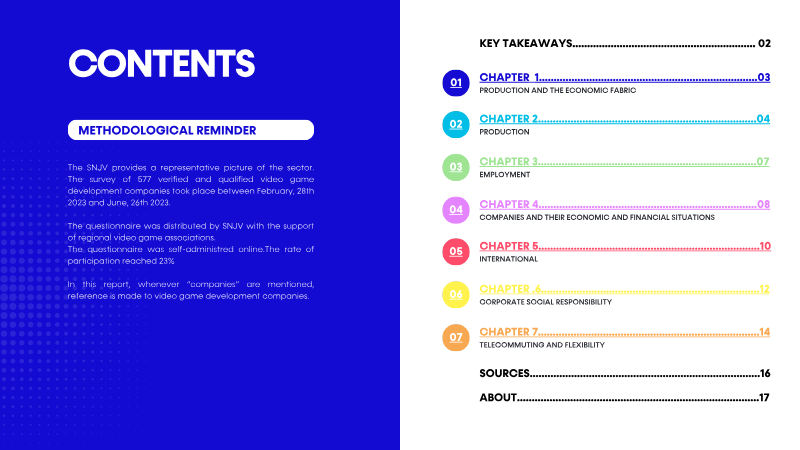
The 2023 annual survey of the French video game industry provides a comprehensive analysis of the sector’s economic health, production trends, and workforce dynamics during 2022. Conducted by the Syndicat National du Jeu Vidéo (SNJV) between February and June 2023, the study relies on a self-administered online questionnaire sent to 577 qualified development companies, achieving a 23% participation rate. The scope covers approximately 1,000 companies across France, including 580 development studios, with a significant concentration of 44.6% located in the Île-de-France region.
Findings indicate a robust but maturing production landscape, with nearly 1,260 games in development and over 850 new intellectual properties created. While the number of games in production fell by 7% compared to 2020, the industry saw a rise in professionalization, with 62% of studios working with publishers. Financial growth is evident, as 27% of studios now generate over 1 million euros in revenue, a 9-point increase from 2020. However, the sector remains dominated by smaller entities, with 55% of companies earning less than 300,000 euros annually. Despite this growth, optimism has tempered; only 28.6% of respondents expect revenue growth in the coming year, compared to 66% in 2020.
Employment remains stable with 76% of staff on permanent contracts, though gender diversity shows slow progress, with women making up 24% of the workforce. The industry is also navigating structural shifts in work culture, as 33% of companies have adopted full-time remote work. Corporate Social Responsibility is emerging as a priority, with 65.5% of companies implementing gender equality actions and nearly half planning carbon footprint assessments. France remains highly attractive to 85% of studios, primarily due to tax incentives and the quality of specialized training.
- The French video game industry is maturing financially, with 27% of studios generating over 1 million euros in revenue, a 9-point increase since 2020.
- Despite revenue gains, industry optimism has declined significantly, with only 28.6% of studios expecting growth compared to 66% in 2020.
- The production landscape remains highly concentrated in the Île-de-France region, which hosts 44.6% of the nation's development studios.
- While the industry is professionalizing—evidenced by 62% of studios working with publishers—the total volume of games in development fell by 7% compared to 2020.
- The sector is dominated by small-scale operations, as 55% of companies continue to generate less than 300,000 euros in annual revenue.
Syndicat National du Jeu VidéoJan 2022
Report18 pages
Key Insights Into French Gamers
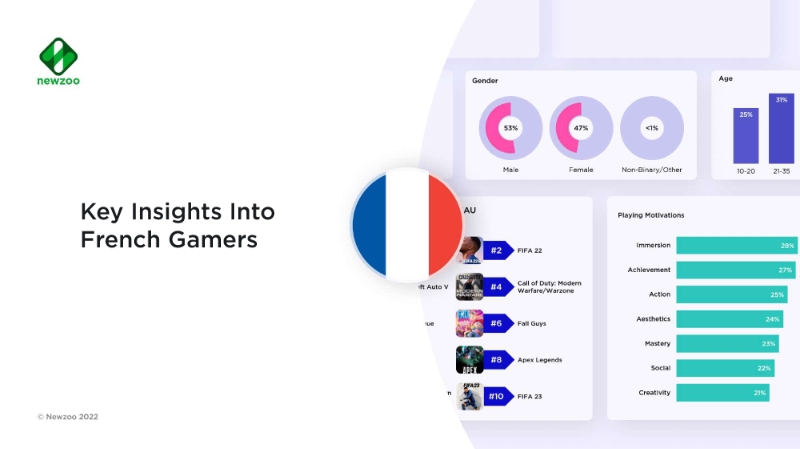
France represents a significant gaming market, ranking seventh globally in terms of revenue and fifteenth in total player count as of 2022. The French gaming population is highly engaged, with 71% of the online population aged 10 to 65 identifying as game enthusiasts. While 38% of this group only plays games, a substantial 34% also views gaming video content, and 15% are classified as esports enthusiasts who watch professional competitive gaming at least once a month.
The demographic profile of French players is nearly balanced by gender, consisting of 52% men and 48% women. The largest age cohort is the 21-35 bracket, representing 31% of the player base. In terms of behavior, Time Fillers and Mainstream Gamers are the most common personas. Time Fillers use games primarily to pass the time and show less interest in viewing content, whereas Mainstream Gamers are deeply invested in both playing and watching gaming media. Mobile is the most popular platform, utilized by 44% of the online population, followed by console at 41% and PC at 30%. Despite mobile's reach, PC players record the highest average weekly playtime at four hours and forty minutes.
Monetization data indicates that 56% of French players are payers, driven primarily by value-based incentives such as sales or special offers. Other significant spending motivators include unlocking exclusive content and the desire to play with friends or family, underscoring the social nature of the market. This analysis is based on a 2022 survey of 2,080 online consumers in France, part of a broader global study covering 36 markets and over 75,000 respondents.
- France is a top-tier global gaming market, ranking seventh in revenue and fifteenth in player count as of 2022.
- The French gaming population is highly engaged, with 71% of online users aged 10–65 identifying as enthusiasts, including 15% who follow esports monthly.
- Mobile is the leading platform with 44% reach, followed by console at 41% and PC at 30%, though PC users record the highest average weekly playtime at four hours and forty minutes.
- The player base is gender-balanced at 52% men and 48% women, with the 21–35 age bracket serving as the largest demographic segment at 31%.
- 56% of French players are payers, with spending primarily motivated by value-based incentives, exclusive content, and social play with friends or family.
NewzooJan 2022
Report17 pages
Annual Barometer of the Video Game Industry in France 2021
The 2021 Annual Barometer of the Video Game Industry in France provides a comprehensive analysis of the sector’s economic health, employment trends, and production landscape. Conducted between May and June 2021 through an online survey of 1,200 qualified entities, the research captures a representative snapshot of the French video game ecosystem, which is primarily composed of development studios, publishers, and service providers. The study highlights the industry's resilience and growth despite the challenges posed by the global health crisis.
Key findings indicate that the French video game sector remains highly productive, with approximately 1,350 games in development during 2021, 92% of which are original creations. The industry is characterized by a strong focus on independent production, with 77% of studios identifying as indie developers. Financially, while the sector shows promise—with 20% of studios reporting annual revenues exceeding €1 million—the landscape remains fragile, as 36.5% of studios reported a deficit in 2020, the highest level since 2014. Despite this, the industry maintains a positive outlook, with 89% of respondents expressing confidence in their company’s future and 94% remaining optimistic about the broader French video game market.
Employment remains a cornerstone of the industry, which continues to prioritize permanent contracts, with 80% of salaried positions held as CDI. The workforce is increasingly diverse, with female representation reaching 22%. Furthermore, the sector benefits from robust institutional support, as 41% of companies utilize regional funding and many rely on the national video game tax credit. France is currently ranked as the second most attractive country for video game development globally, trailing only the United States, reflecting the sector's strong international standing and continued potential for expansion.
- France is the second most attractive country globally for video game development, supported by a strong reliance on national tax credits and regional funding utilized by 41% of companies.
- The industry is highly productive with approximately 1,350 games in development during 2021, 92% of which are original intellectual properties.
- Despite high levels of optimism regarding the market, 36.5% of studios reported a financial deficit in 2020, marking the highest rate of insolvency since 2014.
- The French ecosystem is dominated by independent production, with 77% of studios identifying as indie developers.
- Employment stability is a priority for the sector, as 80% of salaried positions are held under permanent (CDI) contracts.
+1
Syndicat National du Jeu VidéoJan 2021
Report19 pages
Baromètre Annuel du Jeu Vidéo en France: 2020
The 2020 Annual Barometer of the Video Game Industry in France provides a comprehensive analysis of the sector’s economic health, production landscape, and educational ecosystem. Based on a survey of 1,131 industry structures conducted between June and September 2019, the report highlights a robust industry characterized by steady growth, strong entrepreneurial spirit, and significant international reach. The findings underscore France's position as a highly attractive hub for video game development, ranking second globally behind the United States.
Key findings reveal that the industry is heavily focused on production, with half of all sector entities operating as development studios. These studios demonstrate a strong commitment to independence, with 93% identifying as independent and 74% actively creating original intellectual properties. Production remains largely centered on PC platforms, though mobile and console markets remain vital. Financially, the sector relies heavily on self-financing, supplemented by public support mechanisms such as the Video Game Tax Credit (CIJV) and regional aids. Despite this, access to traditional bank credit remains a challenge for many studios.
The report also details a positive outlook for employment, noting a trend toward stable, qualified, and permanent positions, with significant hiring intentions for the coming year. The educational sector is identified as a critical pillar of this growth, with 40 surveyed institutions training a growing pipeline of talent across design, technology, and management roles. While the industry shows resilience and optimism, it faces ongoing industrial transitions, including the rise of cloud gaming, immersive technologies, and new distribution models. Overall, the sector maintains a strong export orientation, with 44% of studio revenue generated internationally, reinforcing the strategic importance of the French video game industry within the global market.
- France ranks as the second-largest global hub for video game development, trailing only the United States.
- The industry is primarily composed of independent development studios, with 93% identifying as independent and 74% focused on creating original intellectual properties.
- International markets are a primary revenue driver, accounting for 44% of total studio income.
- The sector relies heavily on self-financing and public support mechanisms like the Video Game Tax Credit (CIJV), as traditional bank credit remains difficult to access.
- The workforce is characterized by stability and growth, with a trend toward permanent, qualified positions and high hiring intentions.
Syndicat National du Jeu VidéoJan 2020
Report3 pages
The Video Game Industry in France: 2020 Edition Economic Context and Production
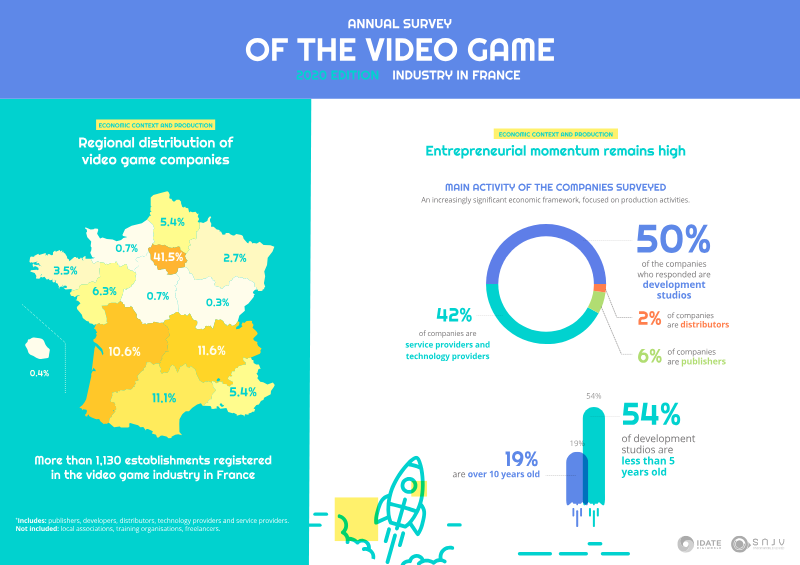
The French video game industry demonstrates robust entrepreneurial momentum and a strong focus on production, characterized by a diverse ecosystem of over 1,130 establishments. The sector is primarily composed of development studios, which account for 50% of industry entities, followed by service and technology providers at 42%, publishers at 6%, and distributors at 2%. This landscape is marked by a youthful demographic, with 19% of development studios having been established within the last five years, while another 19% have operated for over a decade.
Production output remains stable, with 530 titles marketed in 2019 and a significant pipeline of projects in development. Notably, 63% of these titles are based on new intellectual properties, reflecting a strong commitment to original content. Employment trends are equally positive, with 75% of employees working under permanent contracts. The industry is actively expanding, with projections indicating the creation of 800 to 1,200 new jobs by the end of 2019. Despite this growth, gender diversity remains a challenge, as women and non-binary individuals comprise only 16% of the workforce, with women holding just 11% of management roles.
The findings are based on a comprehensive survey conducted between June and September 2019, targeting 1,131 industry entities, including both members and non-members of the French Video Game Trade Association. The data highlights a strong educational pipeline, with a 26% growth in student enrollment and a high placement rate, as one in two graduates secures employment within the video game sector within a year. These metrics underscore the industry's role as a vital economic engine, supported by a specialized talent pool and a clear focus on sustainable, long-term production.
- The French video game industry comprises over 1,130 establishments, with development studios representing 50% of the sector and service/technology providers accounting for 42%.
- The industry demonstrates a strong commitment to original content, with 63% of the 530 titles marketed in 2019 based on new intellectual properties.
- Employment is characterized by stability and growth, with 75% of the workforce on permanent contracts and projections for 800 to 1,200 new jobs created by the end of 2019.
- Gender diversity remains a significant industry challenge, as women and non-binary individuals make up only 16% of the total workforce and women hold just 11% of management positions.
- The sector benefits from a robust talent pipeline, evidenced by a 26% growth in student enrollment and a 50% placement rate for graduates within the industry one year after completion.
+1
Syndicat National du Jeu VidéoJan 2020

Report48 pages
Baromètre Annuel du Jeu Vidéo en France 2017
SYNDICAT NATIONAL DU JEUVIDEO DIGIWORLD X Une vidéo Pictanovo! a production, types d'aide : dedieau jeu ide paprojet, dgdi poes ades ! a egion Hauts-de 20.00€ rprojet. A4 frane lanait te f onds regional COUV Comit de lecture 16/02/18 2E DE May fone.con 1 503/18 Comnite de lecture21/09/18 B A R O M È T R E A N N U E L D U J E U V I D É O E N F R A N C E 08<sup>LE </...
- The global video game market is projected to grow from €60 billion in 2017 to nearly €80 billion by the end of 2021, with mobile gaming being the largest segment at €22.5 billion in 2017.
- The 'premium' economic model (paid-at-purchase with no additional content) has become dominant in 2017, adopted by 63.9% of studios, surpassing the free-to-play model which saw a significant 26.8-point decline.
- French video game companies are predominantly small, with an average of 29.5 full-time equivalent (FTE) employees in 2017, an increase of 3.2 FTE since 2016, though half of companies have 6 FTE or fewer.
- CDI (permanent contracts) remain the majority (60%) in the sector in 2017, increasing by 3.8 points from 2016, while the use of fixed-term contracts (CDD) also rose by 1.2 points.
- Developer studios are increasingly self-publishing, with 63% engaged in direct commercialization, though reliance on traditional publishers for expertise and resources remains necessary.
+1
Syndicat National du Jeu VidéoFeb 2018

Whitepaper59 pages
Guide RGPD pour les Développeurs de Jeux Vidéo
Le Règlement général pour la protection des données (RGPD) constitue le texte de référence en matière de protection des données personnelles au sein de l’Union Européenne. Les principaux objectifs du RGPD sont d'accroître à la fois la protection des personnes concernées par un traitement de leurs données à caractère personnel et la responsabilisation des acteurs de ce traitement.
- The GDPR significantly increases potential penalties for non-compliance, with fines up to 20 Million Euros or 4% of annual global turnover, a substantial increase from the previous 3 Million Euros maximum under the 1978 French law.
- Data Protection Officers (DPOs) are not held responsible for GDPR non-compliance; the data controller or processor bears this responsibility. DPOs cannot be penalized for performing their duties due to their independence, though they can be dismissed for reasons unrelated to their DPO role.
- Consent under GDPR must be a free, specific, informed, and unambiguous indication of the data subject's wishes, given by a statement or clear affirmative action, and the data controller must be able to prove valid consent.
- Processing 'sensitive data' (special categories of personal data) is generally prohibited unless specific exceptions apply, such as explicit consent from the data subject for defined purposes.
- Data controllers must facilitate the exercise of data subjects' rights (access, rectification, erasure, etc.), responding within one month (or two for complex cases) and providing reasons if a request is denied, with these services generally being free unless requests are unfounded or repetitive.
reTeenmeepeJan 2018

Report17 pages
Baromètre Annuel du Jeu Vidéo en France Edition 2018
The 2018 Annual Barometer of the Video Game Industry in France provides a comprehensive analysis of the French gaming sector’s economic health, employment trends, and production landscape. Produced through a collaboration between the Syndicat National du Jeu Vidéo (SNJV) and IDATE DigiWorld, the study aims to capture the industry's current activity levels and future outlook. The methodology involved an online survey conducted between June and August 2018, targeting both SNJV members and non-member companies, including development studios, publishers, and service providers.
Key findings reveal a dynamic and predominantly independent industry, with 93% of studios identifying as independent. The sector is characterized by a strong entrepreneurial spirit, as 56% of development studios are less than five years old. Production remains robust, with 1,200 games in development during 2018, two-thirds of which represent new intellectual properties. Studios show a clear preference for PC development, followed by mobile and console platforms. Financially, the industry relies heavily on self-financing, though there is a growing reliance on public support mechanisms, with 62% of studios utilizing regional, national, or European aid.
Employment in the sector is marked by high qualification levels and steady growth. In 2018, the industry supported an average of 9.5 full-time equivalent employees per studio, with 86% of these roles held under permanent contracts. Projections indicate the creation of 650 to 850 new jobs annually, reflecting a positive outlook. Industry leaders express significant confidence in both their individual companies and the broader French gaming ecosystem, with 76% of respondents viewing France as an attractive territory for video game production. The report concludes that the industry is increasingly export-oriented, with 40% of studio revenue generated internationally.
- The French video game industry is overwhelmingly independent, with 93% of studios operating independently and 56% of development studios being less than five years old.
- In 2018, the sector had 1,200 games in active development, with two-thirds of these projects representing new intellectual properties.
- Public funding is a critical pillar of the industry, with 62% of studios utilizing regional, national, or European financial support mechanisms.
- The sector demonstrates strong export performance, with 40% of total studio revenue generated from international markets.
- Employment is stable and growing, with 86% of the average 9.5 full-time equivalent employees per studio held under permanent contracts.
Syndicat National du Jeu VidéoJan 2018

Whitepaper34 pages
Le Marché Illicite de la Distribution Digitale de Jeux Vidéo sur PC: France
SYNDICAT NATIONAL DU JEU VIDÉO jeux pc et parasitisme 6 1.1 canaux d’exploitation officiels provoqué par le marché des jeux vidéo pc illicite par téléchargement 11 1.2 émergence et consolidation 23 1.3 agissements illégaux à la base développement du marché illicite efficacement contre le 30 2.1 tarir les sources marché illicite d’approvisionnement 33 2.2 permettre une meilleure distribution officiels et de leur Ce document est destiné à des plate...
- The digital PC game market in France is significantly impacted by an illicit market, where game keys are resold at prices up to 60% lower than official retail prices, often before a game's release, leading consumers to perceive official prices as too high.
- This illicit market is fueled by geographical price differences (e.g., keys sold for €19 in Poland vs. €49 in France) and physical wholesalers reselling keys from boxed games to unofficial sites, with German wholesaler Gross Electronic GmbH identified as a major supplier to MMOGA.com from 2013-2015.
- Major illicit platforms like MMOGA (sold for €306M in 2015 with over €100M revenue) and G2A operate from offshore locations (e.g., Hong Kong, Eastern Europe) to avoid European VAT and consumer protection laws, despite often having significant European customer bases (e.g., over 60% French audience for some sites).
- These illicit sites exploit loopholes in VAT collection by registering offshore, though EU rules since 2015 require VAT to be paid based on the buyer's location; they also benefit from search engines like Google and specialized price comparison sites (e.g., Allkeyshop, DLcompare) promoting their discounted offers.
- The illicit market is characterized by widespread VAT fraud and non-compliance with consumer protection laws, with authorities largely inactive in pursuing these offshore entities despite clear evidence of local ties (e.g., French-speaking support, local payment systems like Hipay, significant local social media presence).
+1
Syndicat National du Jeu VidéoJan 2015