
Report53 pages
Ad Monetization Without Killing Retention
Hybrid monetization can increase revenue without eroding player retention by treating advertisements as an integral part of the game’s design system. Three core ad formats—interstitials, rewarded video (RV), and banners—are positioned strategically through careful gating on level progression, playtime, or cooldown periods. Optimal triggers and placement reduce player frustration while maximizing eCPM, ensuring that monetization flows naturally with gameplay.
Rewarded video is most effective when offered during high‑stakes moments such as revives, boosters, or time‑limited rewards. Leveraging scarcity and urgency in these contexts drives conversions while preserving the core experience. Consistent visual cues, a clear distinction between coin rewards and RV value, and optional “No Ads” bundles further balance monetization with player comfort.
Selling “No Ads” bundles requires thoughtful presentation. Bundles should appear side‑by‑side with regular items, use distinct visual cues and anchoring to convey high value, and be gated behind a minimum purchase tier to protect payer retention. Segmenting ad exposure—capping impressions, applying cooldowns, and filtering out disruptive creatives—maintains a positive user experience while sustaining revenue.
Overall, the strategy blends ad formats with gameplay mechanics, employs scarcity and urgency for rewarded video, and offers high‑value “No Ads” options. This approach delivers robust monetization across diverse segments while safeguarding long‑term player engagement and retention.
- Integrate advertisements as core gameplay design elements rather than external overlays to increase revenue without negatively impacting player retention.
- Deploy rewarded video ads during high-stakes moments—such as revives, boosters, or time-limited rewards—to leverage scarcity and urgency for higher conversion rates.
- Implement strategic gating for ad triggers based on level progression, total playtime, or specific cooldown periods to minimize player frustration.
- Market 'No Ads' bundles by presenting them alongside regular items using clear visual anchoring to establish high value, while gating them behind minimum purchase tiers to protect payer retention.
- Maintain a positive user experience by segmenting ad exposure through impression caps, cooldown timers, and the filtering of disruptive creative content.
+2
Sensor TowerApr 2026

Report33 pages
2026 Global Non‑Gaming App Trends Report
The report argues that non‑gaming mobile applications are experiencing accelerated growth driven by AI integration, short‑form content, and intensified user acquisition competition. Key findings show that Android dominates download volume—particularly in Utilities (79 % of installs) and Life Services (58 %)—while iOS generates a higher share of revenue, especially in Finance & Business (56 % of iOS revenue) and Life Services (57 %). In 2025, AI‑focused apps such as ChatGPT (+1,340 %) and Perplexity (+3,613 %) achieved the highest year‑over‑year download growth, and Short Drama titles like Kuku TV (+45 % k) and RapidTV (+498 %) recorded explosive revenue increases, with AI Social apps (e.g., Character AI +918 %) also driving significant monetization.
User acquisition activity expanded across all major categories, with Life Services (+42 %) and Finance & Business (+43.5 %) leading the rise in app counts. Smart bidding adoption surged, with Target ROAS spend increasing by 50 % and Target CPE spending up 57 %, particularly in Utilities and Entertainment. Cost‑per‑install (CPI) analysis revealed that E‑Commerce on Android commands a 3× premium, while Finance & Business on iOS reaches 4.6×, underscoring high competition for transactional users.
Monetization patterns shift toward in‑app advertising (IAA), dominating across Education, Utilities, and Entertainment. Video formats—rewarded and interstitial—outperform banner ads by 128–165× eCPM, with North America delivering the highest rewarded video eCPMs (up to 11.8× in Short Drama). The report covers global markets excluding Mainland China from January to December 2025, drawing on anonymized data from Mintegral and Insightrackr across 100+ key app categories.
- AI-focused applications experienced massive 2025 growth, led by Perplexity (+3,613%), ChatGPT (+1,340%), and Character AI (+918%).
- Short Drama apps like RapidTV (+498%) and Kuku TV (+45k%) are driving explosive revenue, with North American rewarded video eCPMs for this category reaching up to 11.8x.
- Android leads in global download volume, particularly in Utilities (79%) and Life Services (58%), while iOS captures the majority of revenue in Finance & Business (56%) and Life Services (57%).
- User acquisition competition is intensifying, evidenced by a 50% increase in Target ROAS spending and a 57% rise in Target CPE spending, particularly within Utilities and Entertainment.
- Cost-per-install (CPI) premiums remain high for transactional users, reaching 3x for E-Commerce on Android and 4.6x for Finance & Business on iOS.
MintegralApr 2026

Report97 pages
State of Mobile 2026
The 2026 State of Mobile report demonstrates that the global mobile ecosystem remains mature yet increasingly monetized, with 2025 in‑app purchase (IAP) revenue reaching $85.6 billion—a 21 % year‑over‑year rise that now places non‑game apps ahead of games for the first time. Generative AI and short‑form drama have become the fastest‑growing subgenres, driving double‑digit IAP growth; AI assistants such as ChatGPT alone generated $3.4 billion in 2025, while short‑drama apps captured more than ten percent of global video‑entertainment time. These categories also show a shift from acquisition to retention, with session volumes outpacing downloads and time spent tripling in AI apps.
Hybrid‑casual and hyper‑casual games continue to lead revenue growth, especially in Tier 2 markets where downloads are falling but engagement is surging. Publishers targeting these segments can capture higher revenue per user, though they face tighter ad‑spend competition and a move toward high‑attention formats. In the gaming web arena, Roblox dominates with 74 % of game‑publisher site visits in 2025, underscoring the importance of product‑centric web design.
Beyond entertainment, general‑shopping apps such as Temu and Amazon maintain massive download volumes, with grocery and buy‑and‑sell subgenres growing 5 % and 4 % YoY, respectively. Food & drink apps hit a record 2.4 billion downloads in 2025, driven largely by emerging markets like India and the Middle East. Mobility and sports apps also show notable shifts: Waymo’s standalone app captured 15 % of rideshare MAUs in key U.S. metros, while DFS‑style sports betting apps now command 80 % of the betting‑app MAU share, reflecting regulatory impacts and new market entrants.
Overall, the report covers a global geographic scope with particular emphasis on the U.S., India, Western Europe, and emerging Tier 2 markets. It spans 2025 data with forward‑looking insights for 2026, highlighting AI’s transformative role across monetization, user engagement, and competitive dynamics in the mobile industry.
- Non-game apps surpassed games in in-app purchase (IAP) revenue for the first time in 2025, contributing to a total global IAP market of $85.6 billion, a 21% year-over-year increase.
- Generative AI and short-form drama are the fastest-growing subgenres, with AI assistants like ChatGPT generating $3.4 billion in 2025 and short-drama apps capturing over 10% of global video-entertainment time.
- Roblox solidified its dominance in the gaming web arena, accounting for 74% of all game-publisher site visits in 2025.
- Hybrid-casual and hyper-casual games are seeing surging engagement and higher revenue per user in Tier 2 markets, despite a broader trend of declining download volumes.
- Daily Fantasy Sports (DFS)-style apps now command 80% of the betting-app monthly active user (MAU) share, driven by new market entrants and regulatory shifts.
Sensor TowerApr 2026

Report80 pages
PC & Console Gaming Report 2026
1. Market trajectory What direction is the PC and console market heading in 2026? 8 What direction is the PC and console market heading in 2026? 2. Attention & value allocation Where do players spend time and money on PC and console? 17 3. Market concentration What happens if you are not a top-20 game? 45 4.
- PC player base is projected to exceed one billion by 2028, with a CAGR of 2.9% from 2025-2028, while console player growth moderates with a 2.2% CAGR in the same period.
- Almost two-thirds of console revenues (PlayStation and Xbox) go to the top 20 games, whereas on PC, over half of revenue comes from games ranked 21+.
- PC is the only platform effectively monetizing Free-to-Play (F2P) games, with revenue holding stable despite falling playtime in the west; on console, F2P revenue is dropping faster than engagement.
- Games ranked 21+ are capturing a growing share of playtime across platforms, with PC showing the strongest shift since 2022, indicating market disaggregation and growth from outside the top 20 titles.
- Premium game revenue is growing on PC and PlayStation, but Xbox's more modest growth cannot offset declines in F2P and Call of Duty.
+3
NewzooApr 2026
Report19 pages
Ubisoft First-Half 2025-26 Earnings Figures
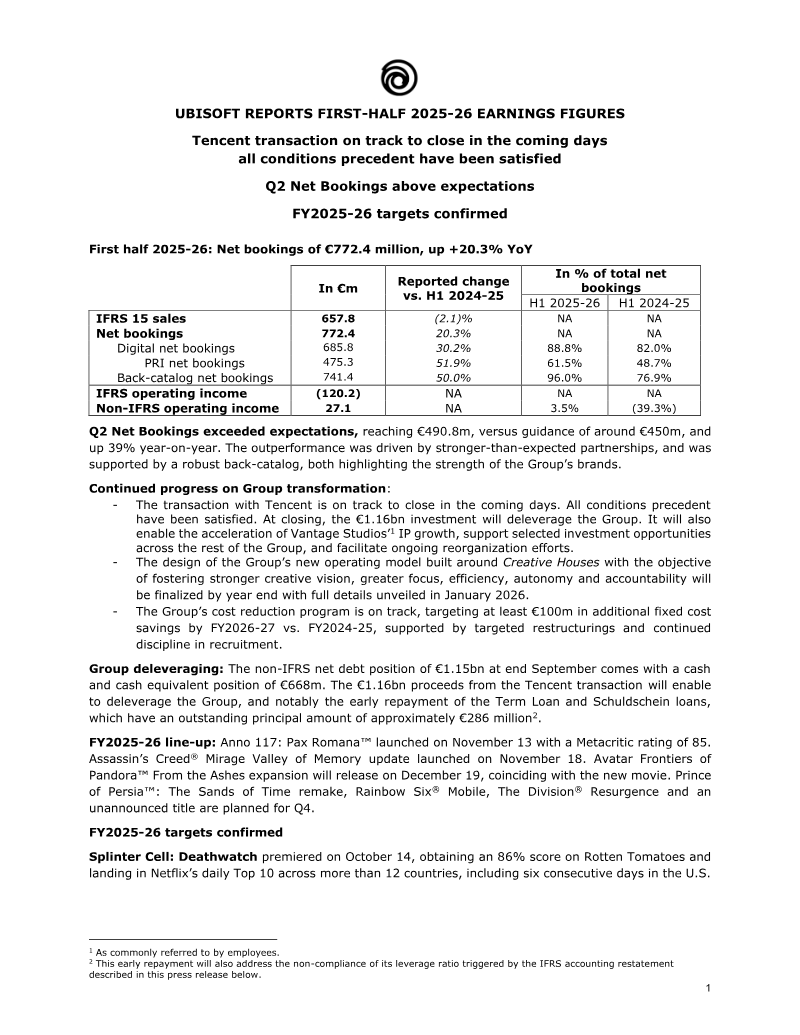
UBISOFT REPORTS FIRST-HALF 2025-26 EARNINGS FIGURES Tencent transaction on track to close in the coming days all conditions precedent have been satisfied Q2 Net Bookings above expectations First half 2025-26: Net bookings of €772.4 million, up +20.3% YoY Reported change In % of total net In €m vs.
- Ubisoft's H1 2025-26 net bookings reached €772.4 million, a 20.3% year-over-year increase, with Q2 net bookings exceeding expectations at €490.8 million (versus guidance of €450 million) due to strong partnerships and back-catalog performance.
- The transaction with Tencent, involving a €1.16 billion investment, is on track to close soon, with all conditions precedent satisfied, which will deleverage Ubisoft by enabling early repayment of approximately €286 million in loans.
- Ubisoft confirmed its FY2025-26 targets, expecting stable net bookings year-on-year, approximately break-even non-IFRS operating income, and negative free cash flow, but anticipates returning to positive non-IFRS operating income and free cash flow in FY27.
- Digital net bookings grew by 30.2% year-over-year to €685.8 million, representing 88.8% of total net bookings, while back-catalog net bookings increased by 50.0% to €741.4 million.
- Ubisoft's headcount decreased by approximately 1,500 employees over the past 12 months to 17,097, with a targeted Voluntary Leave Program and restructuring introduced at Nordic studios in October.
+2
Ubisoft
Report9 pages
Ubisoft Reports Third-Quarter 2025-26 Sales
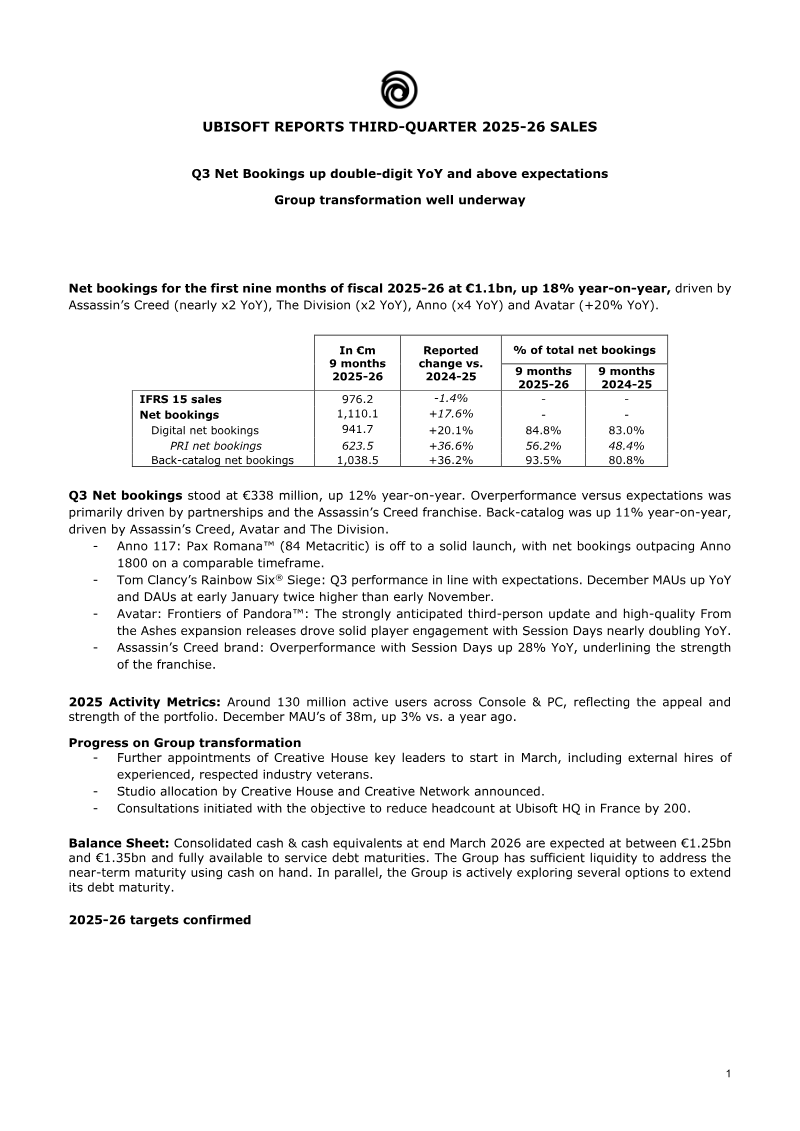
Ubisoft announced that net bookings for the first nine months of fiscal 2025‑26 reached €1.11 billion, an 18 % year‑on‑year increase driven by strong performance from Assassin’s Creed, The Division, Anno 117: Pax Romana and Avatar. Digital net bookings rose 20 % to €941.7 million, while back‑catalog sales grew 36 % to €1.04 billion, reflecting sustained demand for legacy titles and new releases such as Assassin’s Creed Shadows on Switch 2 and the Avatar: Frontiers of Pandora expansion. The third‑quarter figure of €338 million exceeded guidance by 12 %, with partnerships and franchise sales contributing most to the lift. Player activity metrics remained robust, with 130 million unique active users in 2025 and December MAUs at 38 million, up 3 % YoY.
The Group’s transformation continues, with the new Creative House operating model taking shape through studio reallocation and senior leadership appointments. Headcount reductions of 200 positions at Ubisoft HQ France are underway to streamline operations. Financially, consolidated cash stands between €1.25 billion and €1.35 billion, sufficient to cover near‑term debt maturities while the Group explores extensions of its debt profile.
Outlook for 2025‑26 confirms net bookings near €1.5 billion, non‑IFRS EBIT around –€1 billion, and free cash flow between –€400 million and –€500 million. Q4 launches include Rainbow Six Mobile, scheduled for February 23, and The Division Resurgence, with additional content planned across the franchise portfolio. Geographic revenue shares show Europe at 40 %, Northern America 46 %, and the rest of the world 14 %. Platform distribution remains dominated by consoles (55 %) and PCs (28 %), with mobile contributing 7 %.
- Ubisoft reported nine-month net bookings of €1.11 billion, an 18% year-on-year increase, with third-quarter results of €338 million exceeding guidance by 12%.
- Back-catalog sales grew 36% to €1.04 billion, driven by sustained demand for legacy titles and new releases like the Avatar: Frontiers of Pandora expansion and Assassin’s Creed Shadows.
- The company maintains a consolidated cash position between €1.25 billion and €1.35 billion while undergoing a restructuring that includes 200 headcount reductions at its French headquarters.
- Full-year 2025-26 outlook projects net bookings near €1.5 billion, with non-IFRS EBIT expected at –€1 billion and free cash flow between –€400 million and –€500 million.
- Player engagement remains strong with 130 million unique active users in 2025 and December monthly active users (MAUs) reaching 38 million, a 3% year-on-year increase.
+1
Ubisoft

Report30 pages
1Q FY2023 Presentation Material
The presentation outlines CyberAgent’s strategic focus for FY2023, emphasizing a dual‑stream business model that blends advertising revenue with game development while expanding into media and digital content. Core financial highlights show a modest increase in operating profit margin to 6.7 % from 5.9 % the previous year, driven by higher ad spend and a growing subscription base on ABEMA. Operating profit rose to ¥6.4 billion, with revenue growth of 8.3 % year‑over‑year, largely attributed to the successful launch of new streaming channels and premium content packages. Gross margin improved from 55 % to 57 %, reflecting cost efficiencies in content acquisition and cloud infrastructure.
Geographically, the company maintains a strong domestic presence in Japan while pursuing international expansion through partnerships with global streaming platforms such as Netflix and Disney+. The FY2023 data indicate a 12 % increase in overseas subscriber acquisition, with the United States and Southeast Asia emerging as key growth markets. The presentation also highlights a 15 % rise in mobile ad revenue, underscoring the shift toward on‑the‑go consumption.
Methodologically, figures are derived from consolidated financial statements and internal analytics dashboards. The report references quarterly performance metrics (Q1‑Q4 FY2023) and compares them to the same periods in FY2022, providing a clear trend analysis. Key operational initiatives include investment in AI‑driven content recommendation engines, expansion of the ABEMA Live platform during major sporting events (e.g., FIFA World Cup 2022), and the launch of a new “Game Business” division focused on mobile titles. Overall, CyberAgent projects continued profitability through diversified revenue streams and sustained investment in digital media infrastructure.
- CyberAgent achieved an 8.3% year-over-year revenue increase and an operating profit of ¥6.4 billion in 1Q FY2023.
- Operating profit margins improved to 6.7% from 5.9% the previous year, supported by a gross margin increase from 55% to 57%.
- Overseas subscriber acquisition grew by 12%, with the United States and Southeast Asia identified as the primary growth markets.
- Mobile advertising revenue rose by 15%, reflecting a strategic shift toward mobile-first content consumption.
- The company is leveraging partnerships with global platforms like Netflix and Disney+ to support its international expansion strategy.
+1
CyberAgent

Report40 pages
2Q FY2023 Presentation Material: Japan
2Q FY2023 Presentation Material The future information, such as earnings forecast, written in this document is based on our expectations and assumptions as of the date the forecast was made. Our actual results could differ materially from those described in this forecast because of various 1. Financial Summary (January - March 2023) 3. Internet Advertisement Business 6. Medium to long-term strategy FY2023 Quarterly sales hit a new record high.
- FY2023 Q2 sales reached a new record high of 195.6 billion yen, a 2.4% increase year-over-year, despite a 27.0% decrease in operating profit to 18.7 billion yen.
- The media business, particularly ABEMA, significantly reduced its loss, with sales up 22.4% year-over-year to 33.4 billion yen and operating profit improving by 1.3 billion yen year-over-year to -0.5 billion yen.
- The game business showed strong performance driven by anniversaries of major games like "Uma Musume Pretty Derby" and "Granblue Fantasy," with sales of 62.1 billion yen (down 10.0% YoY but up 51.9% QoQ) and operating profit of 15.2 billion yen (down 29.0% YoY but up 191.7% QoQ).
- Ad sales remained stable and hit a new record high of 100.2 billion yen, up 6.7% year-over-year, due to solid client acquisition, though operating profit for this segment decreased by 33.9% to 4.9 billion yen.
- ABEMA's Weekly Active Users (WAU) remained 1.5 times higher than the previous year following the FIFA World Cup Qatar 2022, indicating sustained user engagement.
+2
CyberAgent
Report41 pages
Presentation Material: Q1 FY2026
The future information, such as earnings forecast, written in this document is based on our expectations and assumptions as of the date the forecast was made. Our actual results could differ materially from those described in this forecast because of various risks and uncertainties. 1. Summary (October - December 2025) 4. Internet Advertisement Business 6.
- For Q1 FY2026, overall sales increased by 14.0% year-over-year to 232.3 billion yen, and operating profit surged 2.8x year-over-year to 23.3 billion yen, marking a strong start to the fiscal year.
- The Game business was a primary driver of growth, with sales up 69.2% year-over-year to 64.7 billion yen and operating profit increasing 5.3x year-over-year to 17.6 billion yen, fueled by existing titles and global expansion.
- The Media & IP business also contributed significantly, achieving a 12.5% year-over-year increase in sales to 62.6 billion yen and a 3.5x year-over-year increase in operating profit to 4.9 billion yen.
- Net income for Q1 FY2026 rose 2.5 times year-over-year to 12.4 billion yen.
- Ad Sales experienced a slight decrease of 2.7% year-over-year to 114.6 billion yen due to the loss of a large client, though the trend is showing gradual improvement.
+2
CyberAgent
Report2 pages
Mixi Report: FY2013 Business Results
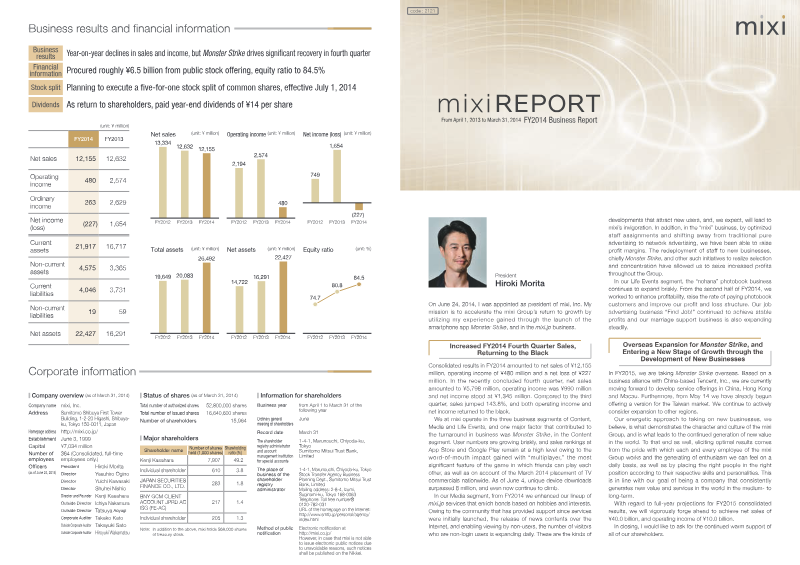
The FY2014 business results demonstrate a strategic pivot toward new growth areas after a period of declining sales and income. Net sales fell 3 % from ¥12,632 million in FY2013 to ¥12,155 million in FY2014, while operating income contracted sharply from ¥2,574 million to ¥480 million, resulting in a net loss of ¥227 million. The decline is largely attributed to reduced performance in the traditional “mixi” social networking segment, which has been restructured toward network advertising and staff redeployment to higher‑margin initiatives. In contrast, the Content Group’s flagship mobile game Monster Strike delivered a robust recovery: fourth‑quarter sales rose 143.8 % to ¥5,798 million, operating income reached ¥990 million, and net profit stood at ¥1,345 million. Monster Strike’s success is linked to aggressive marketing, including nationwide TV commercials and a focus on multiplayer features that encourage daily play among friends. The company plans to expand the game overseas, targeting China, Hong Kong, Macau, and Taiwan, with a partnership with Tencent to localize the service.
Other segments—Media and Life Events—continue to grow. The “nohana” photobook business achieved a 16 % increase in paid purchase rates, while the “Find Job!” job‑advertising service maintained a stable user base of 700 k members. Mixi’s equity ratio improved to 84.5 % after a ¥6.5 billion public offering, and a five‑for‑one stock split is scheduled for July 1 2014. Overall, the report highlights a shift from legacy social networking to diversified content and advertising services, with Monster Strike as the primary catalyst for returning profitability.
- Monster Strike drove a major recovery in Q4 FY2014, generating ¥5,798 million in sales—a 143.8% increase—and contributing ¥990 million in operating income.
- Mixi experienced an overall net loss of ¥227 million in FY2014, with net sales declining 3% to ¥12,155 million and operating income dropping to ¥480 million due to the decline of the legacy social networking segment.
- The company is aggressively expanding Monster Strike internationally through a partnership with Tencent to localize the game for markets in China, Hong Kong, Macau, and Taiwan.
- Mixi’s financial position was bolstered by a ¥6.5 billion public offering, improving the equity ratio to 84.5%, with a five-for-one stock split scheduled for July 1, 2014.
- The 'nohana' photobook business saw a 16% increase in paid purchase rates, while the 'Find Job!' service maintained a stable user base of 700,000 members.
+2
mixi
Report2 pages
FY2015 Annual Business Report: MIXI
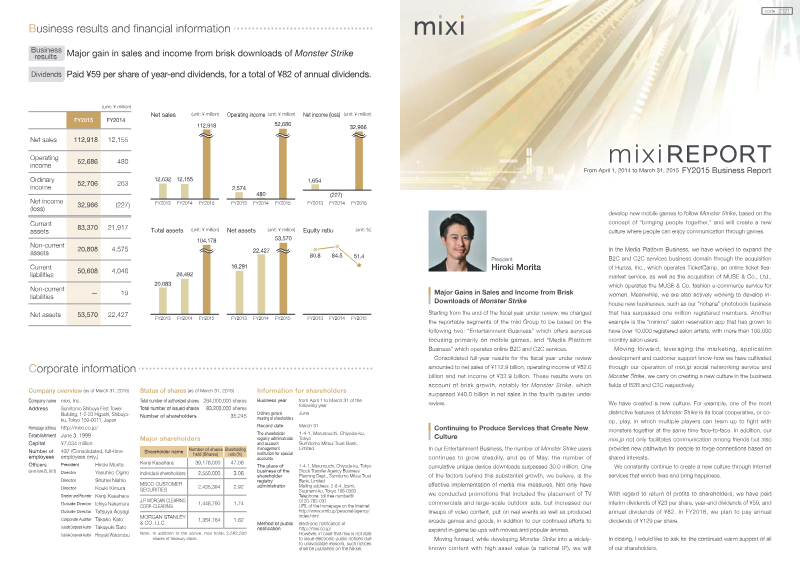
The FY2015 annual report demonstrates that mixi, Inc.’s core revenue engine remains the mobile game Monster Strike, which generated ¥112.9 billion in net sales and ¥52.7 billion of operating income, a 30‑plus percent increase over FY2014. Net profit rose to ¥32.9 billion, reversing the prior year’s loss, and dividends were raised to ¥59 per share (¥82 total). The company attributes the surge to Monster Strike’s rapid download growth—over 30 million cumulative unique device downloads—and its expansion into new markets, including China, South Korea, North America, and Hong Kong/Macau. Strategic media‑mix initiatives such as TV commercials, outdoor advertising, and in‑game tie‑ups with movies and anime have reinforced user acquisition and retention.
Beyond Monster Strike, mixi diversified its portfolio through acquisitions of Hunza, Inc. (TicketCamp) and MUSE & Co., Ltd. (fashion e‑commerce), strengthening its B2C and C2C services segment. The company also launched several new mobile titles in FY2015, including “nohana” photo‑sharing and “Kimidake LIVE,” a live‑streaming platform for artists, targeting family and children audiences. A planned annual release of one new game each year signals a sustained focus on in‑house development.
Financially, total assets stood at ¥104.2 billion with an equity ratio of 51.4 %. The report outlines a forward‑looking strategy that leverages mixi’s social networking foundation, media‑mix expertise, and newly acquired IPs to broaden its entertainment and platform businesses while continuing to deliver shareholder value through dividends.
- Monster Strike served as the primary revenue driver, generating ¥112.9 billion in net sales and ¥52.7 billion in operating income, representing a growth of over 30% compared to FY2014.
- The company returned to profitability with a net profit of ¥32.9 billion, leading to an increased dividend payout of ¥59 per share.
- Monster Strike achieved over 30 million cumulative unique device downloads and expanded its international footprint into China, South Korea, North America, and Hong Kong/Macau.
- Strategic diversification efforts included the acquisitions of Hunza, Inc. (TicketCamp) and MUSE & Co., Ltd. to bolster the company's B2C and C2C service segments.
- The company maintained a strong financial position with total assets of ¥104.2 billion and an equity ratio of 51.4%.
+1
mixi
Report3 pages
Summary of Questions and Answers: FY2017 2Q GREE Results Briefing
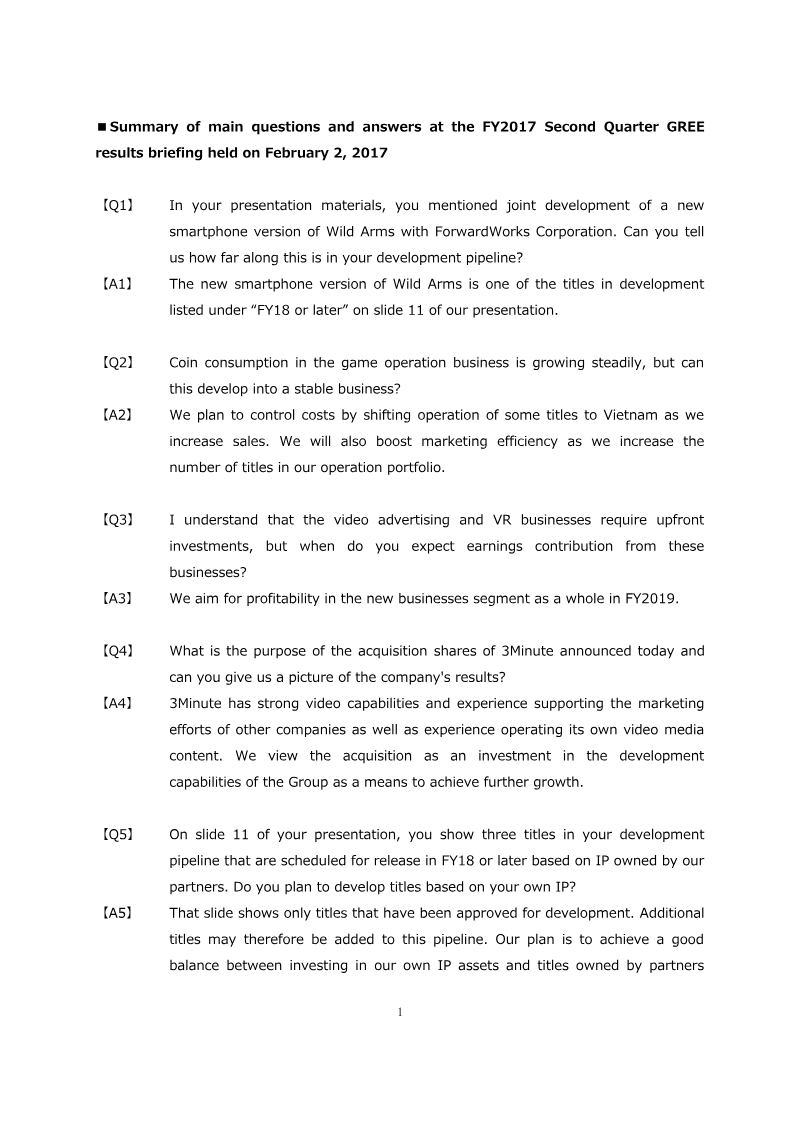
The briefing clarified GREE’s strategic focus for FY2017 and beyond. The company confirmed that a smartphone adaptation of Wild Arms, developed with ForwardWorks Corporation, remains in the FY18‑later pipeline. To stabilize coin‑consumption revenue from its game operation segment, GREE plans to shift operations of select titles to Vietnam and enhance marketing efficiency as its portfolio expands. New ventures in video advertising and virtual reality are expected to reach profitability by FY2019, while the acquisition of 3Minute is positioned as an investment in video‑content capabilities to support broader growth.
Regarding intellectual property, GREE indicated that its development pipeline includes both partner‑owned IP and its own assets, aiming for a balanced mix. The company highlighted Rara‑MAGI’s strong launch performance and noted that coin consumption for other overseas native titles has declined quarter‑over‑quarter, though a new title is slated for late second half release. Seven titles scheduled for the latter half of the year will see roughly half released in Q3 and the remainder in Q4, with Rara‑MAGI already live.
Operating income is projected to dip in Q3 due to increased fixed costs from new releases. GREE will evaluate ongoing titles, closing those unlikely to grow while reallocating resources to high‑potential games. Poor performance is attributed mainly to insufficient content depth or breadth at launch, and lessons learned will inform future development.
- GREE expects Q3 operating income to decline due to increased fixed costs associated with a pipeline of seven new game releases scheduled for the second half of the fiscal year.
- The company is shifting operations for select titles to Vietnam and improving marketing efficiency to stabilize coin-consumption revenue within its game segment.
- New business ventures in virtual reality and video advertising are targeted to reach profitability by FY2019.
- GREE acquired 3Minute to bolster its video-content capabilities as part of a broader growth strategy.
- The smartphone adaptation of Wild Arms, developed in partnership with ForwardWorks Corporation, is confirmed for release in FY2018 or later.
+3
GREE
Report3 pages
Summary of Main Questions and Answers at the FY2018 First Quarter GREE Results Briefing
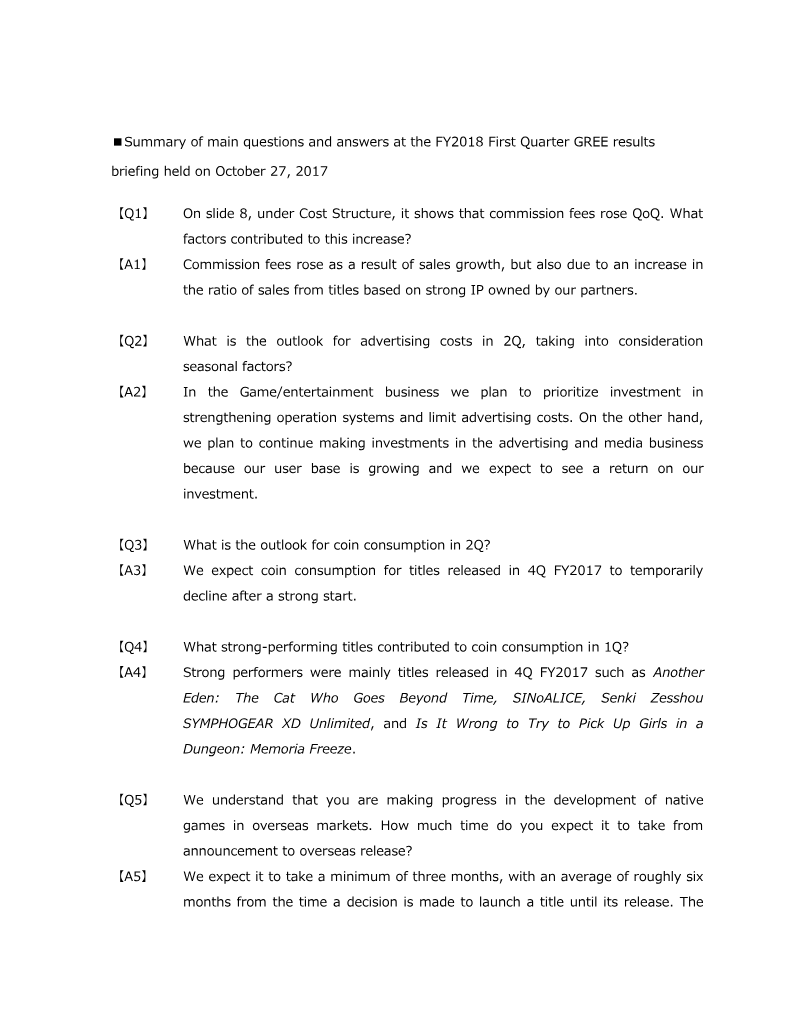
The briefing, held on October 27 2017, focused on GREE’s first‑quarter FY2018 performance and future strategy. Commission fees rose quarter‑on‑quarter, driven by overall sales growth and a higher proportion of revenue from partner titles with strong intellectual property. Advertising spend outlook for the second quarter varies by segment: the game and entertainment arm will tighten costs while continuing to invest in advertising for its expanding user base, expecting a return on investment. Coin consumption is projected to dip temporarily after the strong start of Q4 FY2017 releases, yet titles such as Another Eden: The Cat Who Goes Beyond Time, SINoALICE, Senki Zesshou SYMPHOGEAR XD Unlimited, and Is It Wrong to Try to Pick Up Girls in a Dungeon: Memoria Freeze drove robust coin usage in Q1.
GREE’s overseas native‑game development pipeline is expected to take a minimum of three months from announcement to launch, averaging six months. The company emphasizes delivering versions faithful to the original Japanese product and local operation for success in China, noting that Chinese users prefer authenticity and require localized fine‑tuning with strong local partners. In the VR arena, GREE is expanding its development knowledge base and partnering to provide access points for users lacking personal VR hardware, anticipating market growth.
Regarding the domestic native‑game environment, GREE acknowledges rising user expectations and a challenging acquisition landscape. Leveraging its financial strength and industry relationships, the company plans large‑scale development and mixed‑media initiatives to deliver hit titles. Sales of native games are expected to experience a temporary decline before operations are strengthened—through larger support teams, content enhancement, overseas launches, and tailored promotional activities—to drive subsequent growth.
- GREE’s Q1 FY2018 revenue growth was driven by increased commission fees from partner titles that leverage strong intellectual property.
- Key titles driving robust coin consumption in Q1 included 'Another Eden: The Cat Who Goes Beyond Time', 'SINoALICE', 'Senki Zesshou SYMPHOGEAR XD Unlimited', and 'Is It Wrong to Try to Pick Up Girls in a Dungeon: Memoria Freeze'.
- The company expects a temporary decline in native game sales as it transitions to larger support teams, enhanced content, and more aggressive promotional activities to drive future growth.
- GREE’s overseas native-game development pipeline requires a minimum of three months from announcement to launch, with an average lead time of six months.
- Success in the Chinese market is predicated on delivering versions faithful to original Japanese products while utilizing strong local partners for necessary fine-tuning.
+3
GREE
Report2 pages
Summary of main supplementary explanations questions and answers at the FY2020 First Quarter GREE results briefing held on October 30, 2019
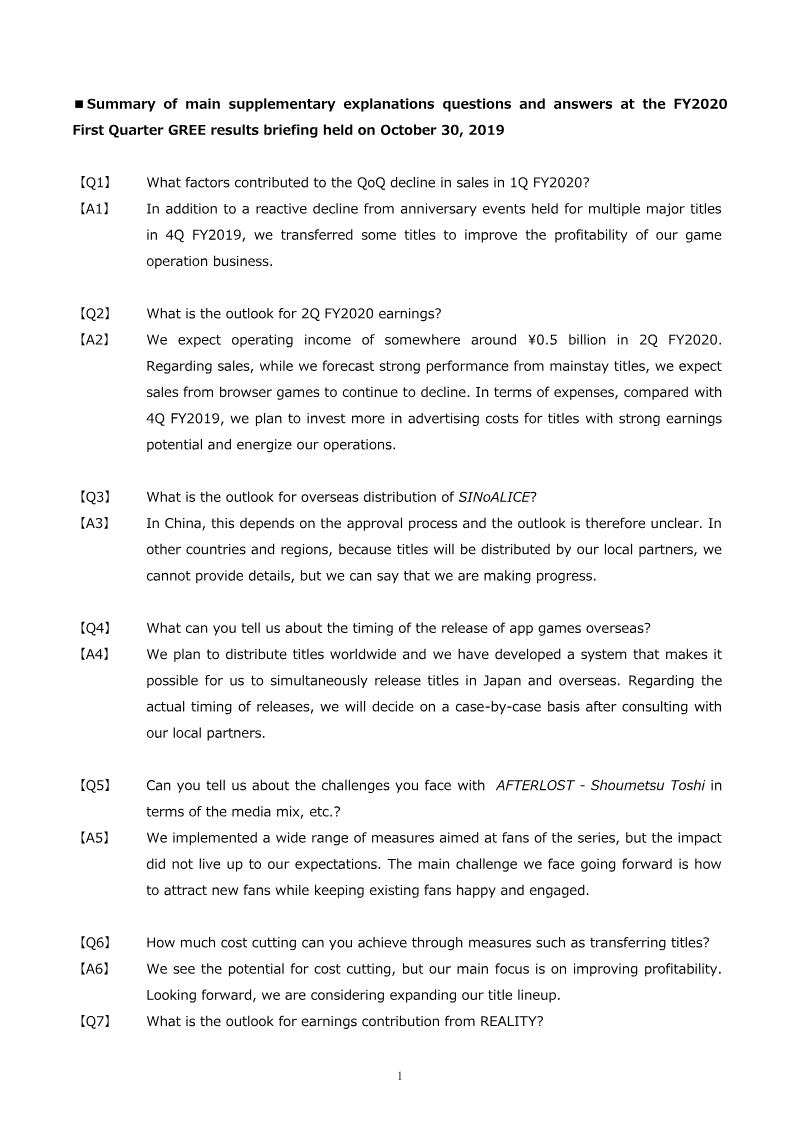
The briefing addressed key financial and operational questions for GREE’s first quarter of FY2020. A decline in sales was attributed to a reactive drop following anniversary events for major titles in the previous quarter and strategic title transfers aimed at improving profitability. Management projected operating income of roughly ¥0.5 billion for the second quarter, with strong expectations for core titles but a continued decline in browser game revenue; advertising spend was to increase on high‑potential games. Overseas distribution of SINoALICE remains uncertain in China due to regulatory approval, while other regions rely on local partners and progress is ongoing. Global release strategy now allows simultaneous launches in Japan and abroad, with timing set on a case‑by‑case basis after partner consultation. Challenges for AFTERLOST – Shoumetsu Toshi include attracting new fans while retaining existing ones, despite extensive fan‑targeted measures. Cost‑cutting through title transfers is viewed as a means to improve profitability, with plans to broaden the title lineup. Earnings contribution from REALITY depends on internal factors such as lifetime value enhancement and external 5G infrastructure development; the focus is on steady content portfolio expansion and platform functionality rather than rapid growth before full infrastructure deployment.
- GREE projects an operating income of approximately ¥0.5 billion for the second quarter of FY2020.
- First-quarter sales declined due to the conclusion of major title anniversary events and the strategic transfer of titles to improve overall profitability.
- Management expects browser game revenue to continue its decline while increasing advertising spend on high-potential mobile titles.
- The global release strategy has shifted to allow for simultaneous launches in Japan and international markets, contingent on partner consultation.
- The release of SINoALICE in China remains stalled due to pending regulatory approval, while other international markets rely on local distribution partners.
+3
GREE
Report1 pages
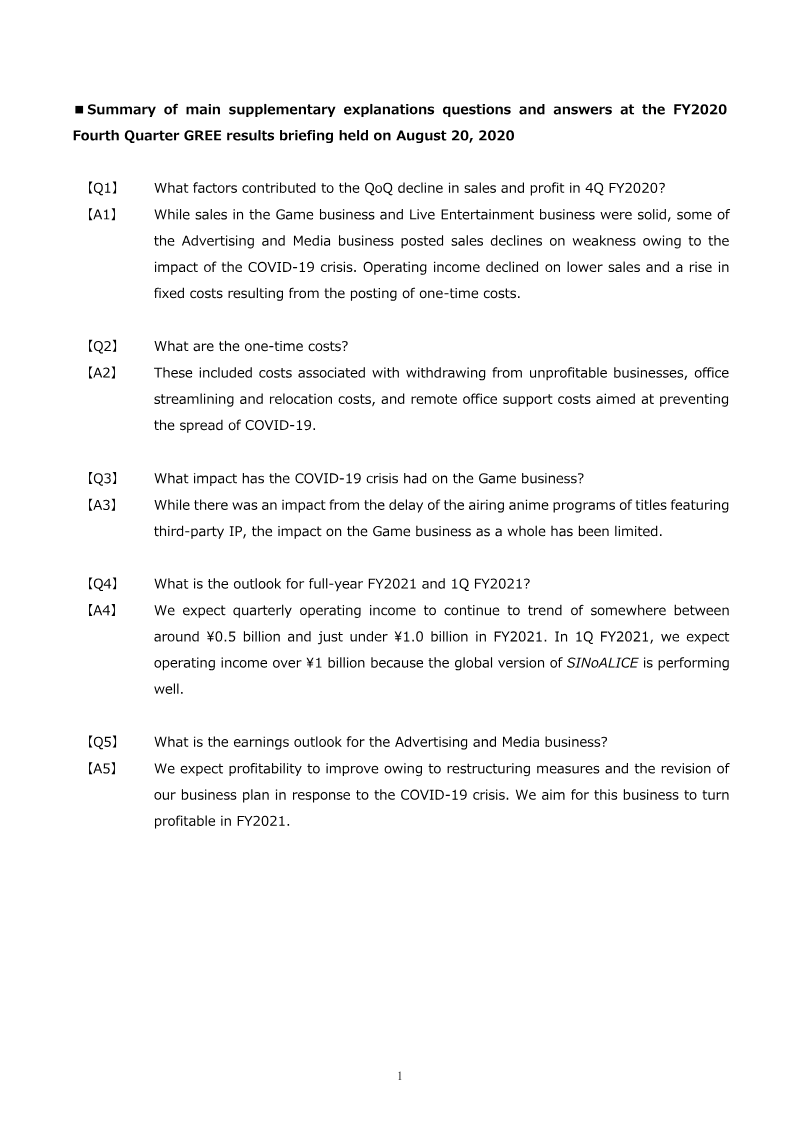
Summary of Main Supplementary Explanations Questions and Answers: FY2020 Fourth Quarter Results Briefing
The briefing clarified the reasons behind the quarter‑over‑quarter decline in sales and operating income for the fourth quarter of fiscal 2020. Core revenue streams from Game and Live Entertainment remained robust, while the Advertising and Media segment suffered sales drops linked to COVID‑19 disruptions. Operating income fell further due to lower sales and increased fixed costs, notably one‑time expenses such as divestitures of unprofitable units, office consolidation and relocation costs, and remote‑office support to curb virus spread. The Game business itself experienced only limited impact despite delays in anime broadcasts featuring third‑party intellectual property.
Looking ahead, the company projects full‑year fiscal 2021 operating income to stay within a range of approximately ¥0.5 billion to just under ¥1.0 billion per quarter, with a stronger first‑quarter outlook of over ¥1 billion driven by the successful global launch of SINoALICE. For the Advertising and Media division, profitability is expected to improve through restructuring initiatives and a revised business plan tailored to the pandemic context, with an aim to achieve profitability within fiscal 2021. The analysis covers Japan‑based operations across gaming, live entertainment, and advertising/media segments during the 2020–2021 fiscal period.
- The company projects fiscal 2021 quarterly operating income to range between ¥0.5 billion and just under ¥1.0 billion, with a Q1 forecast exceeding ¥1 billion.
- The Q1 2021 earnings surge is driven by the successful global launch of the game title SINoALICE.
- Fiscal 2020 Q4 operating income declined due to decreased sales and one-time costs, including unit divestitures, office consolidation, and remote-work support.
- The Advertising and Media segment is undergoing restructuring to reach profitability within fiscal 2021, following pandemic-related sales declines in 2020.
- Core revenue streams from Game and Live Entertainment remained robust throughout fiscal 2020 despite COVID-19 disruptions.
+1
GREE
Report1 pages
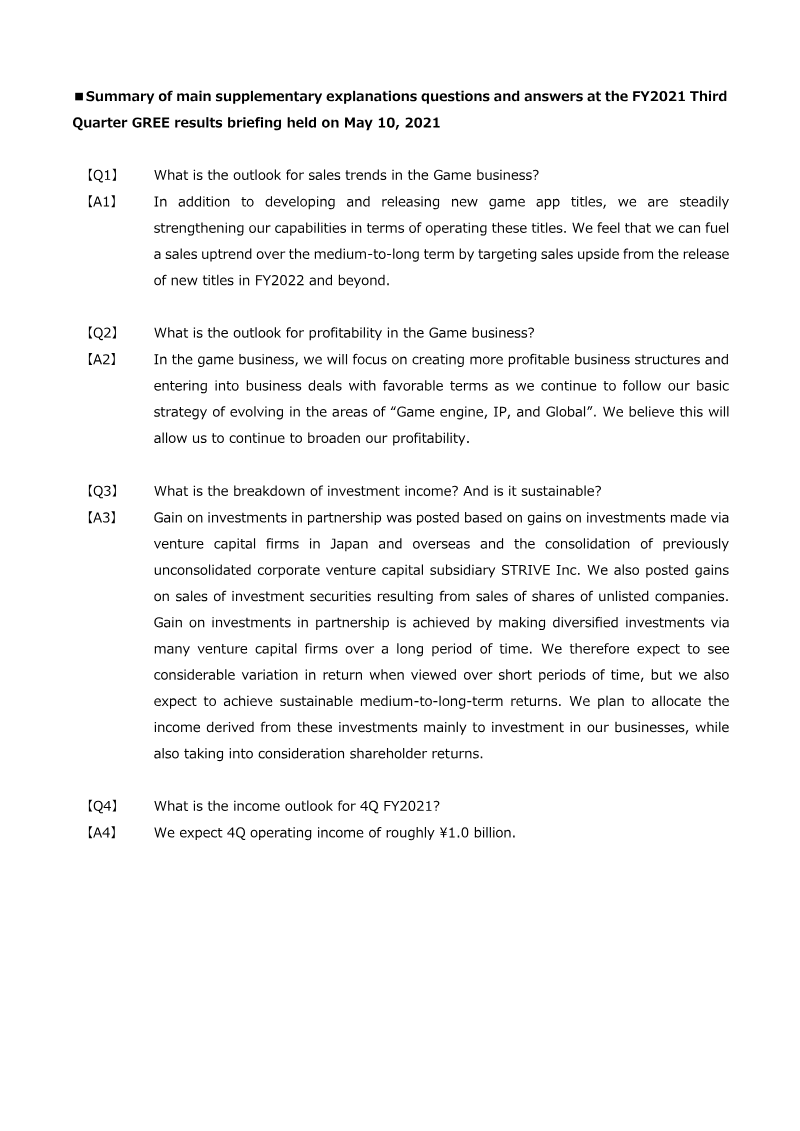
Summary of Main Supplementary Explanations Questions and Answers: FY2021 Third Quarter GREE Results Briefing
The briefing outlines GREE’s strategic outlook for the remainder of FY2021 and beyond, focusing on its core Game business, profitability trajectory, investment income sustainability, and short‑term financial expectations. GREE anticipates a medium‑to‑long‑term sales uptrend driven by the release of new game titles in FY2022 and subsequent years, while simultaneously strengthening operational capabilities for existing titles. Profitability is expected to broaden through the creation of more profitable business structures and favorable contractual terms, aligned with a strategy centered on Game engine development, intellectual property acquisition, and global expansion.
Investment income derives primarily from gains on venture‑capital partnerships in Japan and overseas, as well as the consolidation of previously unconsolidated subsidiary STRIVE Inc. The company notes that short‑term returns may fluctuate due to diversified investment portfolios, but medium‑to‑long‑term sustainability is projected. Planned allocation of these gains targets reinvestment in core businesses and shareholder returns.
Financially, GREE projects operating income for the fourth quarter of FY2021 at approximately ¥1.0 billion, reflecting confidence in its current revenue streams and cost management. The briefing covers Japan’s domestic market with implications for global expansion, covering the period up to FY2021 and projecting into FY2022. Methodological details are limited, but the focus remains on strategic investment, operational efficiency, and incremental revenue growth.
- GREE projects operating income for the fourth quarter of FY2021 to reach approximately ¥1.0 billion.
- The company anticipates a medium-to-long-term sales uptrend driven by a pipeline of new game titles scheduled for release in FY2022 and beyond.
- Strategic growth initiatives focus on game engine development, intellectual property acquisition, and global market expansion.
- Investment income is bolstered by gains from venture-capital partnerships and the consolidation of the subsidiary STRIVE Inc.
- Profitability improvements are being pursued through the restructuring of business models and the negotiation of more favorable contractual terms.
+3
GREE
Report1 pages
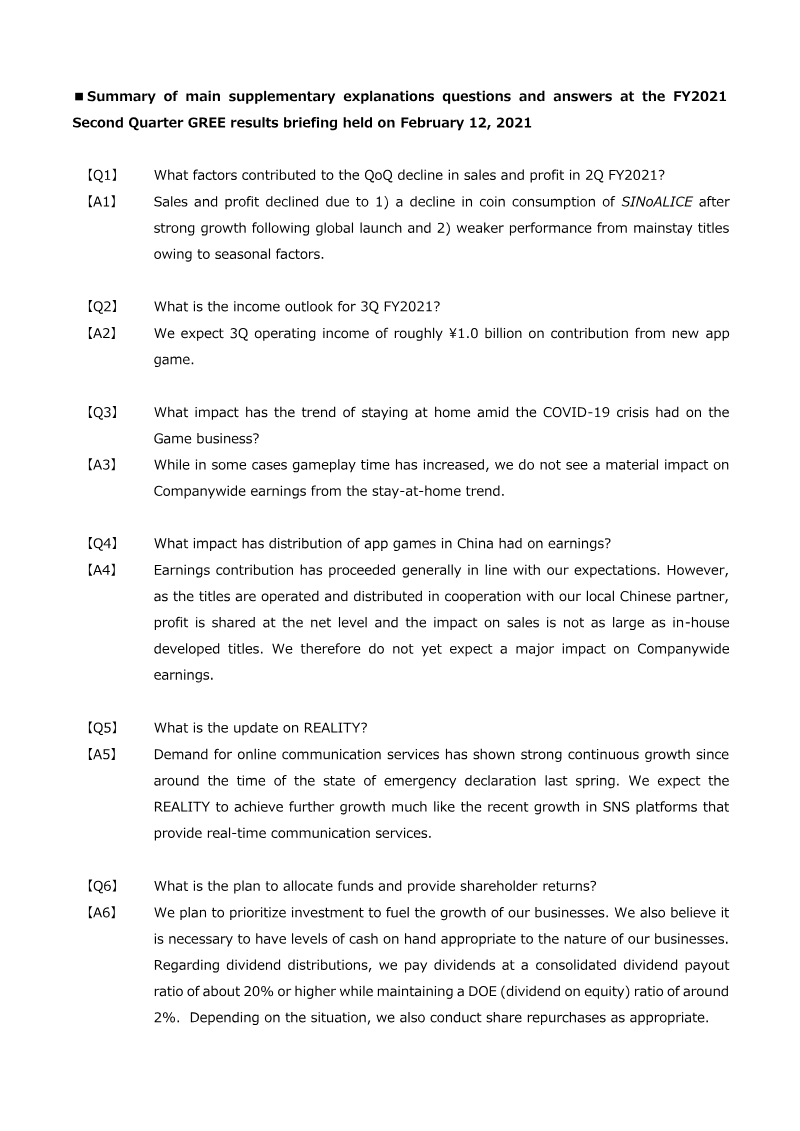
Summary of main supplementary explanations questions and answers at the FY2021 Second Quarter GREE results briefing held on February 12, 2021
The briefing clarified that the quarter‑over‑quarter drop in sales and operating income for FY2021 Q2 stemmed mainly from a slowdown in coin consumption of the mobile title SINoALICE after its strong global launch, coupled with seasonal weakness in other flagship games. Management projected operating income for Q3 FY2021 at approximately ¥1.0 billion, driven largely by a new app‑game launch.
The impact of the COVID‑19 stay‑at‑home trend was deemed limited; while overall playtime rose in some segments, companywide earnings were not materially affected. Distribution of app games in China was described as meeting expectations, though profit sharing with local partners reduces the net contribution relative to in‑house titles, leaving no significant effect on consolidated earnings.
Real‑time communication services under the REALITY brand have experienced sustained growth since the spring state of emergency, and management anticipates continued expansion comparable to that seen in social networking platforms offering real‑time interactions.
Capital allocation plans emphasize reinvestment into business growth and maintaining adequate liquidity. Dividend policy targets a consolidated payout ratio of at least 20 % with a dividend‑on‑equity (DOE) ratio around 2 %. Share repurchases may be undertaken as circumstances allow. The briefing covered domestic and international markets, focusing on mobile gaming and online communication services over the 2021 fiscal year.
- GREE projects Q3 FY2021 operating income at approximately ¥1.0 billion, primarily supported by the launch of a new app game.
- The quarter-over-quarter decline in FY2021 Q2 sales and operating income was driven by a slowdown in SINoALICE coin consumption and seasonal weakness in flagship titles.
- The REALITY brand for real-time communication services has seen sustained growth since the spring 2020 state of emergency, with management expecting continued expansion.
- COVID-19 stay-at-home trends had a limited impact on companywide earnings, despite increased playtime in specific segments.
- App game distribution in China is meeting expectations, though profit-sharing agreements with local partners limit the net contribution to consolidated earnings.
+1
GREE
Report2 pages
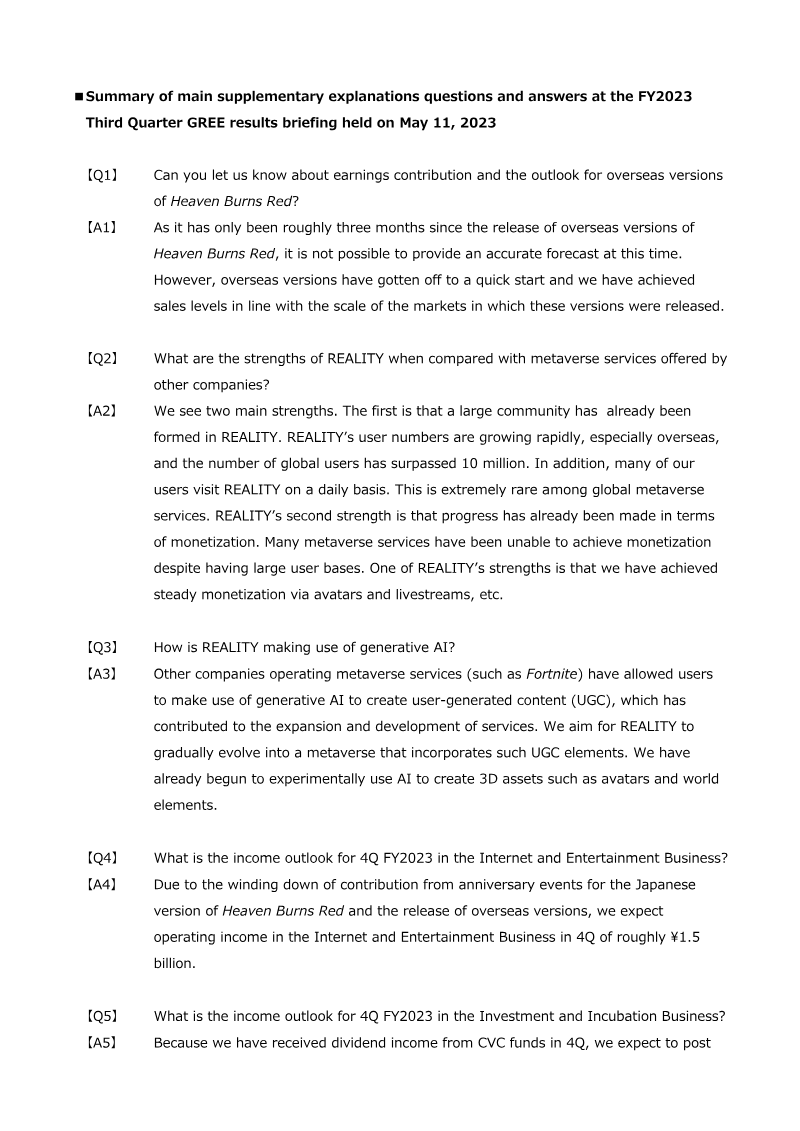
FY2023 Third Quarter GREE Results Briefing: Summary of Supplementary Explanations
The briefing clarifies GREE’s financial outlook and strategic positioning for FY2023, focusing on the third quarter results. It reports that overseas releases of “Heaven Burns Red” have begun to generate sales consistent with market size, though a precise forecast remains unavailable due to the short time frame. In the Internet and Entertainment segment, operating income for Q4 is projected at approximately ¥1.5 billion, reflecting a decline from the Japanese version’s anniversary event contributions but offset by overseas expansion.
The company highlights its metaverse platform, REALITY, as a key growth driver. REALITY boasts over 10 million global users, with daily engagement rates that surpass many competitors, and has achieved steady monetization through avatar sales and livestreaming. GREE plans to enhance the platform with generative AI, enabling user‑generated 3D content such as avatars and world elements, mirroring approaches seen in other metaverse services.
For the Investment and Incubation Business, Q4 operating income is expected to reach roughly ¥0.5 billion, largely supported by dividend receipts from corporate venture capital funds. Overall, the briefing underscores GREE’s focus on expanding overseas markets, monetizing its metaverse ecosystem, and leveraging AI to sustain growth across its entertainment and investment portfolios.
- GREE’s metaverse platform, REALITY, has surpassed 10 million global users and maintains high daily engagement rates through avatar sales and livestreaming.
- The Internet and Entertainment segment projects Q4 operating income of approximately ¥1.5 billion, balancing the decline of domestic anniversary event revenue with new overseas expansion.
- GREE is integrating generative AI into the REALITY platform to facilitate user-generated 3D content, including avatars and world elements.
- The Investment and Incubation Business is expected to generate ¥0.5 billion in Q4 operating income, primarily driven by dividend receipts from corporate venture capital funds.
- Overseas releases of 'Heaven Burns Red' are currently generating sales consistent with market expectations, though long-term forecasts remain pending due to the limited duration since launch.
+3
GREE
Report1 pages
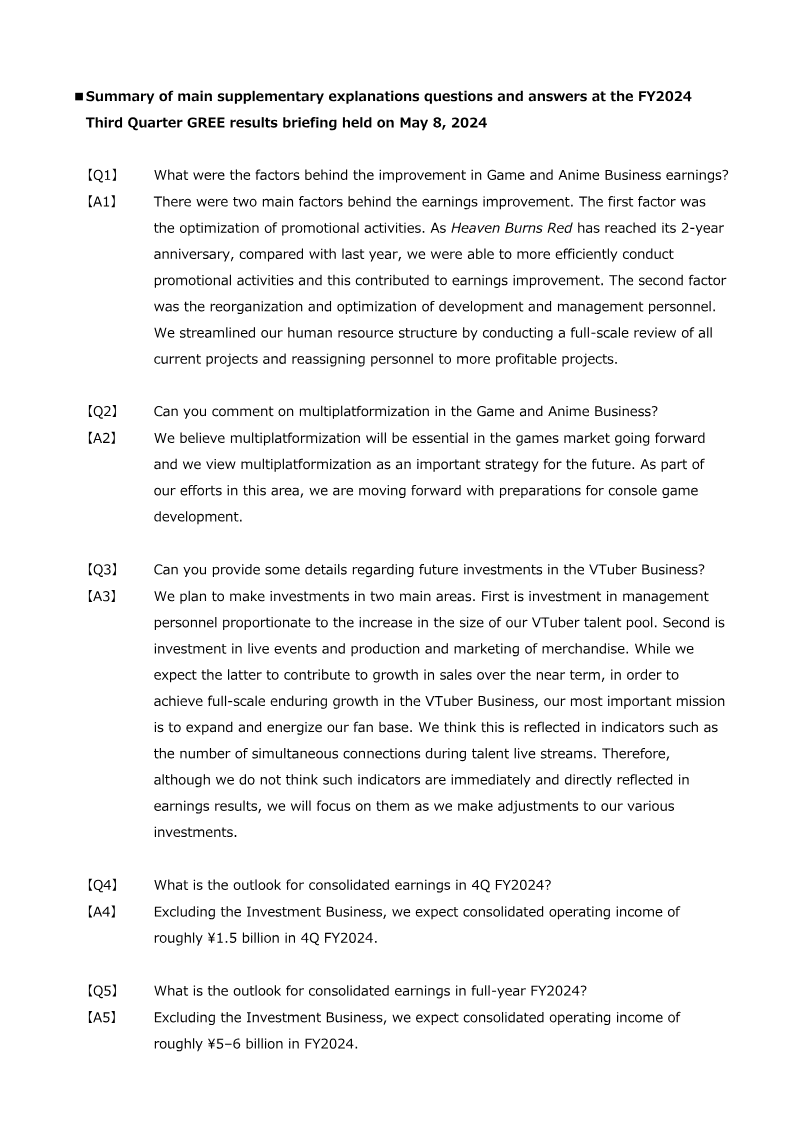
Summary of Main Supplementary Explanations Questions and Answers: FY2024 Third Quarter Results Briefing
The briefing clarified that the FY2024 third‑quarter earnings improvement in GREE’s Game and Anime Business stemmed from two primary initiatives: a more efficient promotional strategy following the second anniversary of “Heaven Burns Red,” and a comprehensive reorganization that reassigned staff to higher‑margin projects. The company emphasized multiplatformization as a strategic priority, noting active preparations for console game development to capture broader market segments.
In the VTuber segment, planned investments focus on expanding management capacity in line with a growing talent roster and enhancing live‑event production, merchandise marketing, and fan engagement metrics such as concurrent viewer counts. While these initiatives are expected to drive near‑term sales, the company views sustained growth as contingent on deepening fan base loyalty.
Financial outlooks presented exclude investment business figures. Consolidated operating income for the fourth quarter is projected at approximately ¥1.5 billion, and full‑year FY2024 earnings are estimated between ¥5–6 billion. These targets reflect the company’s confidence in its streamlined operations and strategic expansion across gaming, anime, and VTuber platforms.
- GREE projects a full-year FY2024 consolidated operating income between ¥5 billion and ¥6 billion.
- The company forecasts a consolidated operating income of approximately ¥1.5 billion for the fourth quarter of FY2024.
- Earnings growth in the Game and Anime Business was driven by optimized promotional spending for 'Heaven Burns Red' and the reallocation of staff to higher-margin projects.
- GREE is prioritizing multiplatformization, with active preparations underway to expand game development into the console market.
- VTuber segment investments are targeting increased management capacity, live-event production, and merchandise marketing to boost fan engagement metrics.
+2
GREE
Report1 pages
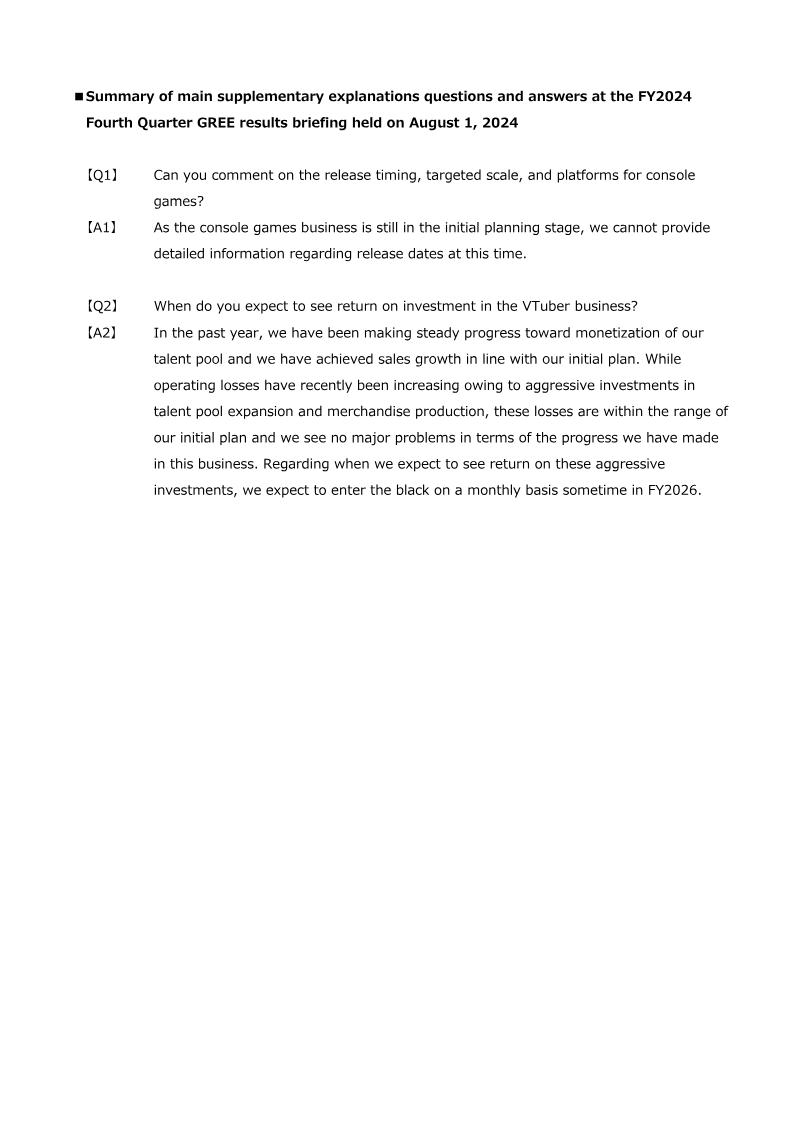
Summary of Main Supplementary Explanations Questions and Answers: FY2024 Fourth Quarter GREE Results Briefing
The briefing clarified GREE’s strategic outlook for FY2024, focusing on console game development and the VTuber business. The company confirmed that its console gaming venture remains in early planning, with no concrete release dates or platform commitments disclosed. This indicates a cautious approach as GREE evaluates market entry points and potential partnerships before committing resources.
In contrast, the VTuber segment is progressing toward profitability. GREE reported steady sales growth aligned with its initial projections, despite operating losses that have risen due to aggressive talent acquisition and merchandise production. These losses fall within the company’s planned range, suggesting disciplined financial management amid expansion efforts. GREE projects that monthly operating losses will be eliminated in FY2026, marking the anticipated break‑even point for its VTuber investments.
The briefing covered a domestic Japanese market focus, with no mention of international expansion for either segment. The time frame discussed spans FY2024 through FY2026, highlighting short‑term challenges and medium‑term profitability goals. Methodological details were limited; the company referenced internal financial metrics rather than external surveys or third‑party data. Overall, GREE’s communication signals a phased growth strategy: cautious console game development coupled with aggressive scaling of its VTuber platform, aiming for profitability by the middle of FY2026.
- GREE targets a break-even point for its VTuber business by the middle of FY2026, with monthly operating losses expected to be eliminated by that time.
- The VTuber segment is currently experiencing rising operating losses due to aggressive investments in talent acquisition and merchandise production, though these costs remain within the company's planned budget.
- GREE’s console game development remains in the early planning stages, with no confirmed release dates, platforms, or resource commitments disclosed.
- The company is pursuing a phased growth strategy that prioritizes cautious evaluation for console gaming while aggressively scaling its VTuber platform.
- GREE’s current strategic outlook is focused exclusively on the domestic Japanese market, with no stated plans for international expansion in the console or VTuber segments.
+2
GREE