
Presentation89 pages
Capital Markets Event 2025: Coffee Stain Group
Capital Markets Event 2025 showcases the Coffee Stain Group’s strategy of building a portfolio around small, autonomous teams that prioritize gameplay quality and community engagement. Ninety percent of net sales derive from a handful of flagship titles—most notably Goat Simulator, Deep Rock Galactic and Satisfactory—which consistently achieve high review scores (above 96 %) and generate lifetime sales up to SEK 2 bn. The company’s partnership model, publishing and investing in niche‑focused games, sustains long‑term value through continuous content updates and a symbiotic developer‑player relationship.
The global gaming market is projected to grow at 3 % CAGR across all platforms, driven by rising consumer spend and the expansion of Steam, mobile, Game Pass and PlayStation Plus. Despite saturation and increased competition for player attention, Coffee Stain maintains a strong presence; its titles enjoy high review counts (over 500 k for Goat Simulator) and retain players through regular updates, platform expansions and community‑driven development. Innovation, creative gameplay and long‑term support are core to the firm’s approach.
Strategic collaborations reinforce this model. The partnership with Tuxedo Labs leverages the proprietary Teardown physics engine, producing a highly engaged community (10 000+ mods, 20 major updates) and peak concurrent users of 60 k for Deep Rock Galactic seasons. The studio’s headcount grew from six to 47 FTEs over five years, illustrating the scalability of open development and a “make happy decisions” culture that drives both critical acclaim (e.g., 9.5/10 reviews) and commercial success.
Coffee Stain’s Roblox title, Welcome to Bloxburg, exemplifies a successful free‑to‑play transition. With 791 k daily active users and SEK 1.35 bn in lifetime net sales, the monetization mix of currency purchases, optional unlocks and a premium subscription maintains a non‑pay‑to‑win stance while rebuilding player trust. The company’s lean cost base and strong cash generation are amplified by launch‑driven sales spikes from new content releases and strategic stakes such as its 30 % share in Iron Gate’s Valheim publishing.
Financially, the group reports a net‑sales CAGR of 34 % to SEK 1.2 bn and a cash EBIT margin of 44 %. Cash reserves reach SEK 472 m in 2025, with no external debt, providing flexibility for capital allocation and potential M&A. The lean, autonomous team model underpins low overheads, high cash conversion (≈120 %) and a focus on developing existing IPs while selectively pursuing new opportunities across platforms and partnerships.
- Coffee Stain Group maintains strong financial health with a 34% net-sales CAGR to SEK 1.2 bn, a 44% cash EBIT margin, and 120% cash conversion.
- The company holds SEK 472 m in cash reserves with zero external debt, providing significant flexibility for future M&A and capital allocation.
- Ninety percent of net sales are generated by a core portfolio of flagship titles—Goat Simulator, Deep Rock Galactic, and Satisfactory—which consistently maintain review scores above 96%.
- The Roblox title Welcome to Bloxburg has achieved 791,000 daily active users and SEK 1.35 bn in lifetime net sales following its transition to a free-to-play model.
- Strategic partnerships and investments, such as a 30% stake in Valheim publisher Iron Gate and the collaboration with Tuxedo Labs, serve as key drivers for long-term value and IP expansion.
+3
Coffee Stain Group AB

Report12 pages
The Rise and Reset of Sweden's $19B Gaming Capital Machine
The analysis demonstrates that Sweden’s gaming sector has evolved into a $19 billion capital ecosystem, with 1,100 companies and 202 firms engaging in tracked transactions since 2014. Sweden contributes roughly 20 % of Steam’s projected 2025 gross revenue, and its developers produced five of the platform’s global top‑10 bestsellers in 2024–25. Capital flows have shifted from early‑stage seed rounds to late‑stage growth and acquisition deals, reflecting a maturation of the pipeline. Private investment rebounded in 2024 after a pullback; late‑stage rounds now dominate, with Aonic’s $157 million growth round and Arrowhead’s $80 million investment illustrating investor preference for studios with proven commercial traction. Early‑stage deal counts have normalized from 2021’s peak, indicating a steady but active pipeline.
M&A activity peaked in 2021–22, with ESL’s $1.05 billion sale to Savvy marking the cycle’s apex; subsequent deals have become more selective. Three transactions—King ($5.9 billion), Mojang ($2.5 billion), and ESL ($1.05 billion)—account for 93 % of total M&A value, underscoring the premium paid by global acquirers for Sweden’s IP and engineering talent. Public market activity has shifted from equity‑fueled growth to defensive debt financing; Embracer’s $4.4 billion raised through fixed income and PIPE in 2020–22 exemplifies this trend. Capital concentration is high, with the top ten private rounds comprising over $495 million of an $811 million total.
The data, sourced from InvestGame and market‑cap records through December 2025, cover Sweden’s entire gaming industry—mobile, PC & console, VR/AR, esports, and platforms—from 2014 to the present. Methodology includes tracking VC rounds, public offerings, PIPEs, and M&A transactions across all segments. The findings illustrate a resilient ecosystem that has transitioned from early‑stage bootstrapping to mature, high‑value capital flows driven by proven studios and strategic consolidation.
- Sweden’s gaming sector has matured into a $19 billion ecosystem comprising 1,100 companies, with Swedish developers producing five of Steam’s global top-10 bestsellers in 2024–25.
- Swedish studios contribute approximately 20% of Steam’s projected 2025 gross revenue, cementing the country's status as a dominant global gaming hub.
- M&A activity is highly concentrated, with three major deals—King ($5.9 billion), Mojang ($2.5 billion), and ESL ($1.05 billion)—accounting for 93% of the total transaction value.
- Investment trends have shifted toward late-stage growth, evidenced by significant 2024 capital injections such as Aonic’s $157 million round and Arrowhead’s $80 million investment.
- Capital concentration remains high, as the top ten private funding rounds account for $495 million of the $811 million total tracked investment.
+3
InvestGame

Report64 pages
Oświadczenie dotyczące zrównoważonego rozwoju: Polska 2025
The statement establishes MTG’s commitment to a comprehensive sustainability agenda for 2025, integrating environmental stewardship, social responsibility and robust governance across its entire value chain. The company’s board maintains a 29 % female composition, and ESG oversight is embedded in the audit/ESG committee with executive pay linked to performance. Science‑Based Targets drive a 46.2 % reduction in Scope 1–2 GHG emissions by 2031 and a 20‑point rise in the S&P Global CSA score by 2027, while a 5 % executive pay linkage to ESG outcomes reinforces accountability.
Operationally, MTG targets Scope 1–3 emissions through energy‑efficiency upgrades, renewable procurement and low‑carbon digital services. Climate risks are quantified via IEA/IPCC scenarios, revealing significant temperature rises in India, Israel and Spain but no severe droughts or flooding; indirect Scope 3 emissions dominate the materiality assessment. The company’s 2031 decarbonisation roadmap aligns with EU Fit for 55, and a 40 % GHG cut in scopes 1–2 and 25 % in scope 3 by 2030 is monitored annually against a 2024 baseline.
Human‑capital strategies emphasize flexible work, DE&I, health and safety, and AI‑driven productivity. Annual engagement surveys, performance reviews (93 % participation) and a 22.7 % gender‑pay gap are tracked, with no discrimination incidents reported. Governance frameworks address anti‑corruption, whistleblowing and cyber‑security, while data privacy is upheld through GDPR‑compliant DPIAs, “privacy by design” and age‑gating mechanisms for digital titles.
Geographically, the focus spans Poland with operations in India, Israel and Spain; temporally, the scope covers 2025 with forward‑looking targets to 2031. The statement aligns with CSRD/ESRS requirements, mapping disclosures and ensuring compliance across environmental, social and governance dimensions.
- MTG has committed to a 46.2% reduction in Scope 1–2 greenhouse gas emissions by 2031, with a 2030 target of a 40% cut in Scopes 1–2 and 25% in Scope 3 against a 2024 baseline.
- Executive accountability is reinforced by linking 5% of executive pay to ESG performance outcomes, overseen by a board committee with 29% female representation.
- The company aims to increase its S&P Global CSA score by 20 points by 2027 while aligning its decarbonization roadmap with the EU Fit for 55 framework.
- Materiality assessments indicate that indirect Scope 3 emissions are the primary environmental impact, with climate risk modeling identifying potential temperature rises in India, Israel, and Spain.
- Human capital management includes tracking a 22.7% gender pay gap and maintaining a 93% participation rate in annual performance reviews, with no reported discrimination incidents.
Modern Times Group

Report7 pages
The Essential UA Financing Guide: 2026
The guide outlines a non‑dilutive financing model designed to fund mobile studios’ user acquisition (UA) campaigns by leveraging cohort performance data. It argues that the global UA spend reached $78 billion in 2025, rising 13% year‑on‑year, and that studios typically allocate 50–70 % of revenue to paid UA while financing through equity. The proposed solution offers capital without equity dilution, with repayment tied directly to user revenue and a lock‑step mechanism that scales cash flow alongside UA spend. The repayment schedule follows the cohort’s return on ad spend (ROAS) curve, beginning when ROAS reaches 100 %.
Eligibility criteria focus on predictability rather than speed of payback. Studios must demonstrate at least six months of clean ROAS curves, a history of trending toward transaction data, and an average monthly payback around $100 k attributable to predictable cohorts. The financing partner evaluates whether recent cohorts mirror historically profitable ones, using a benchmark tool that compares a studio’s cohort against over 5,000 mobile app cohorts. Key metrics include cohort margin of safety, tail risk, payer retention, volatility, and scalability.
The methodology involves sharing cohort data from platforms such as Appsflyer, Adjust, GCP, or Snowflake. Underwriters then size a facility, allowing studios to draw up to 80 % of their monthly UA spend per cohort. Repayment proceeds once the ROAS curve reaches breakeven, with downside shared if cohorts underperform. The guide targets mobile studios worldwide operating in 2026, offering a structured pathway to unlock growth capital while preserving equity.
- Global mobile user acquisition (UA) spend reached $78 billion in 2025, representing a 13% year-on-year increase.
- Studios can access non-dilutive financing to cover up to 80% of monthly UA spend per cohort, avoiding equity dilution while scaling growth.
- Repayment is tied directly to cohort performance, with the schedule beginning only once the return on ad spend (ROAS) reaches the 100% breakeven point.
- Eligibility requires a minimum of six months of clean ROAS data and an average monthly payback of $100,000 from predictable cohorts.
- Underwriters evaluate studio eligibility by benchmarking cohort data against a database of over 5,000 mobile app cohorts, focusing on metrics like margin of safety, volatility, and payer retention.
+3
InvestGameApr 2026
Report20 pages
Global Gaming Report Q1 2026
LOS ANGELES | SAN FRANCISCO | NEW YORK | LONDON | PARIS | MUNICH | BERLIN | DUBAI PROVEN TRACK RECORD IN GAMING M&A AND GROWTH FINANCING ADVISORY PROVEN TRACK RECORD IN GAMING M&A AND GROWTH FINANCING ADVISORY MICHAEL METZGER JULIAN RIEDLBAUER Linkedin - Free social media icons MOHIT PAREEK Linkedin - Free social media icons MICHAEL METZGER JULIAN RIEDLBAUER ...
- Q1 2026 saw 106 private placement deals totaling $785 million, a significant decrease from Q1 2025's $5.0 billion across 149 deals, indicating a cooling investment landscape.
- Project financing is now the primary funding path for studios due to headwinds in studio equity, with dedicated User Acquisition (UA) funds emerging as a new lifeline for mid-stage mobile studios.
- Key strategics to watch include PIF/Scopely, KRAFTON, NCSoft, Tencent, MTG, Take-Two, Netflix, everplay, and Keywords Studios, while Private Equity is expected to drive take-private transactions of publicly listed gaming firms.
- AI, User-Generated Content (UGC), and tech platforms remain top investment areas, with a projected surge in Augmented Reality (AR) activity, exemplified by RayNeo's eSIM-enabled AR glasses and 24% AR glasses market share in Q3 2025.
- Notable M&A activity includes NCSOFT acquiring a 70% stake in JustPlay for $202 million, Nazara Technologies acquiring a 50% controlling stake in Bluetile Games for $100.3 million, and Mattel taking full ownership of Mattel163 for $159 million.
+1
Drake Star PartnersApr 2026

Report45 pages
Video Game Market Update: Q1 2026
This report is provided for general information and discussion purposes only and is intended solely for subscribers. It does not constitute a financial promotion, investment advice, or a recommendation to engage in any investment activity. The content reflects the views of the authors at the time of publication and may be subject to change without notice.
- The console market reached a record $21.7 billion in Q1 2026, primarily driven by the Nintendo Switch 2's first holiday season, while Sony and Microsoft experienced year-over-year revenue declines.
- Mobile gaming's in-app purchase (IAP) revenue has plateaued, with Q1 2026 gross IAP revenue at $20.6 billion, while install volumes hit multi-year lows, indicating a shift towards monetization efficiency.
- Mergers and Acquisitions (M&A) activity in Q1 2026 saw a high quarterly deal value of $7.7 billion across 52 deals, with mobile studios accounting for the majority of headline acquisitions.
- Public capital offerings remained subdued in Q1 2026, totaling $1.0 billion across 11 deals, concentrated in mid-sized fixed income deals (e.g., Hasbro, Stillfront) and strategic investments.
- Private investment in Q1 2026 totaled $0.8 billion across 101 deals, with early-stage activity falling to its lowest level in recent years at just 43 deals.
+1
Aream & CoApr 2026
Report185 pages
Annual and Sustainability Report 2024
Modern Times Group (MTG) concluded the 2024 fiscal year as a focused European mobile gaming entity, reporting net sales of SEK 6,015 million, representing a 3% currency-adjusted growth. Despite achieving an adjusted EBITDA of SEK 1,666 million, the group recorded a net loss of SEK 210 million. The company maintains a strong liquidity position with SEK 3,543 million in cash and equivalents and no utilized external debt, supported by a disciplined capital allocation strategy that includes active share buybacks and a commitment to long-term, evergreen game franchises.
The company’s strategic trajectory is defined by its "Gaming Village" model, which emphasizes organic growth and accretive M&A to bolster its portfolio of studios, including InnoGames, Hutch, and Ninja Kiwi. A transformative development in this period was the acquisition of Plarium Global Ltd, finalized in early 2025, which significantly scales the group’s mid-core gaming capabilities and adds the flagship title RAID: Shadow Legends to its offerings. This expansion is supported by the "Flow Platform," a centralized infrastructure designed to share business intelligence and user acquisition tools across the group’s subsidiaries.
Sustainability and governance remain central to the company’s operational framework. In 2024, MTG transitioned its reporting to align with the Corporate Sustainability Reporting Directive (CSRD) and European Sustainability Reporting Standards (ESRS). While this methodological shift resulted in a reported 118.2% increase in location-based greenhouse gas emissions due to expanded accounting scopes, the company has committed to a 50% reduction in value chain emissions by 2032. Furthermore, the group maintains a robust governance structure, reporting no incidents of corruption or bribery, and continues to prioritize consumer safety through transparent odds disclosure and data protection measures. The board remains focused on long-term shareholder value, integrating ESG metrics into executive incentive schemes while maintaining a stable, low-leverage financial foundation.
- MTG finalized the acquisition of Plarium Global Ltd in early 2025, significantly scaling its mid-core gaming capabilities and adding the flagship title RAID: Shadow Legends to its portfolio.
- The company reported 2024 net sales of SEK 6,015 million, reflecting 3% currency-adjusted growth, alongside an adjusted EBITDA of SEK 1,666 million and a net loss of SEK 210 million.
- MTG maintains a strong financial position with SEK 3,543 million in cash and equivalents and zero utilized external debt, supporting a strategy of active share buybacks and evergreen franchise investment.
- The group utilizes a 'Gaming Village' model supported by the 'Flow Platform,' a centralized infrastructure designed to share business intelligence and user acquisition tools across studios like InnoGames, Hutch, and Ninja Kiwi.
- Following a transition to CSRD and ESRS reporting standards, MTG reported a 118.2% increase in location-based greenhouse gas emissions and has committed to a 50% reduction in value chain emissions by 2032.
+1
Modern Times Group
Report30 pages
Q4 2023 Gaming Industry Report: Global & MENAP Outlook
The Q4 2023 Gaming Industry Report presents a global market that expanded to $212 billion, with the MENAP region contributing $2.8 billion and experiencing a 30% quarter‑over‑quarter rise in both gamers and investment activity. Mobile gaming remains the dominant platform, accounting for 46% of the global player base, while indie PC titles capture a growing share of revenue at roughly 30%. The report also highlights the continued diversification of the industry, noting that game‑to‑movie adaptations generated over $1.4 billion in 2023, underscoring cross‑media opportunities.
Regulatory scrutiny intensified across the sector, with a 15% increase in litigation and high‑profile antitrust cases against major platform holders such as Google and Apple. Significant fines were imposed for deceptive practices, reflecting a tightening legal environment that could reshape market dynamics.
M&A activity rebounded sharply in Q4, with transactions totaling $68.7 billion—a 769% jump largely driven by the Activision‑Blizzard deal—while global venture capital funding fell. In contrast, MENAP venture activity rose 30%, indicating a strategic pivot toward emerging markets including Asia, Africa, and MENAP for future consolidation. This trend presents both challenges and opportunities for indie studios, potentially enabling higher‑quality titles through increased resources.
Shorooq Partners focuses on early‑stage gaming investments within MENAP, targeting pre‑seed to Series A deals with ticket sizes of $1–8 million. The firm prioritizes studios that possess strong intellectual property, robust monetization models, and software solutions that enhance processing efficiency and scalable user connectivity. By engaging through conferences such as the WN Conference Abu Dhabi and LEAP 2024, newsletters, and partnership initiatives, Shorooq aims to nurture the growing MENAP gaming ecosystem.
- The global gaming market reached $212 billion in Q4 2023, with M&A activity surging to $68.7 billion, a 769% increase primarily driven by the Activision-Blizzard acquisition.
- Mobile gaming remains the industry's primary platform, capturing 46% of the global player base, while indie PC titles have grown to represent approximately 30% of total revenue.
- The MENAP region is a key growth area, contributing $2.8 billion to the market and recording a 30% quarter-over-quarter increase in both gamer population and venture capital investment.
- Regulatory pressure is intensifying, marked by a 15% rise in litigation and significant antitrust actions against major platform holders like Google and Apple regarding deceptive practices.
- Cross-media expansion is a proven revenue driver, with game-to-movie adaptations generating over $1.4 billion in 2023.
+1
Shorooq Partners
Report19 pages
Ubisoft First-Half 2025-26 Earnings Figures
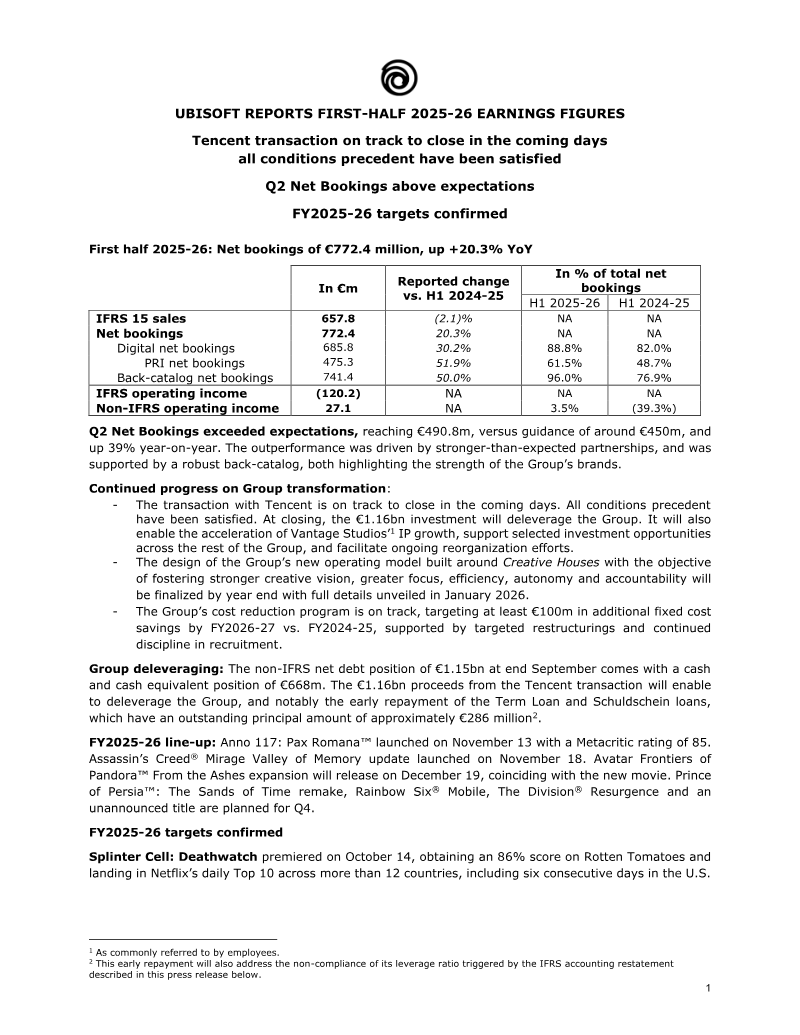
UBISOFT REPORTS FIRST-HALF 2025-26 EARNINGS FIGURES Tencent transaction on track to close in the coming days all conditions precedent have been satisfied Q2 Net Bookings above expectations First half 2025-26: Net bookings of €772.4 million, up +20.3% YoY Reported change In % of total net In €m vs.
- Ubisoft's H1 2025-26 net bookings reached €772.4 million, a 20.3% year-over-year increase, with Q2 net bookings exceeding expectations at €490.8 million (versus guidance of €450 million) due to strong partnerships and back-catalog performance.
- The transaction with Tencent, involving a €1.16 billion investment, is on track to close soon, with all conditions precedent satisfied, which will deleverage Ubisoft by enabling early repayment of approximately €286 million in loans.
- Ubisoft confirmed its FY2025-26 targets, expecting stable net bookings year-on-year, approximately break-even non-IFRS operating income, and negative free cash flow, but anticipates returning to positive non-IFRS operating income and free cash flow in FY27.
- Digital net bookings grew by 30.2% year-over-year to €685.8 million, representing 88.8% of total net bookings, while back-catalog net bookings increased by 50.0% to €741.4 million.
- Ubisoft's headcount decreased by approximately 1,500 employees over the past 12 months to 17,097, with a targeted Voluntary Leave Program and restructuring introduced at Nordic studios in October.
+2
Ubisoft
Report7 pages
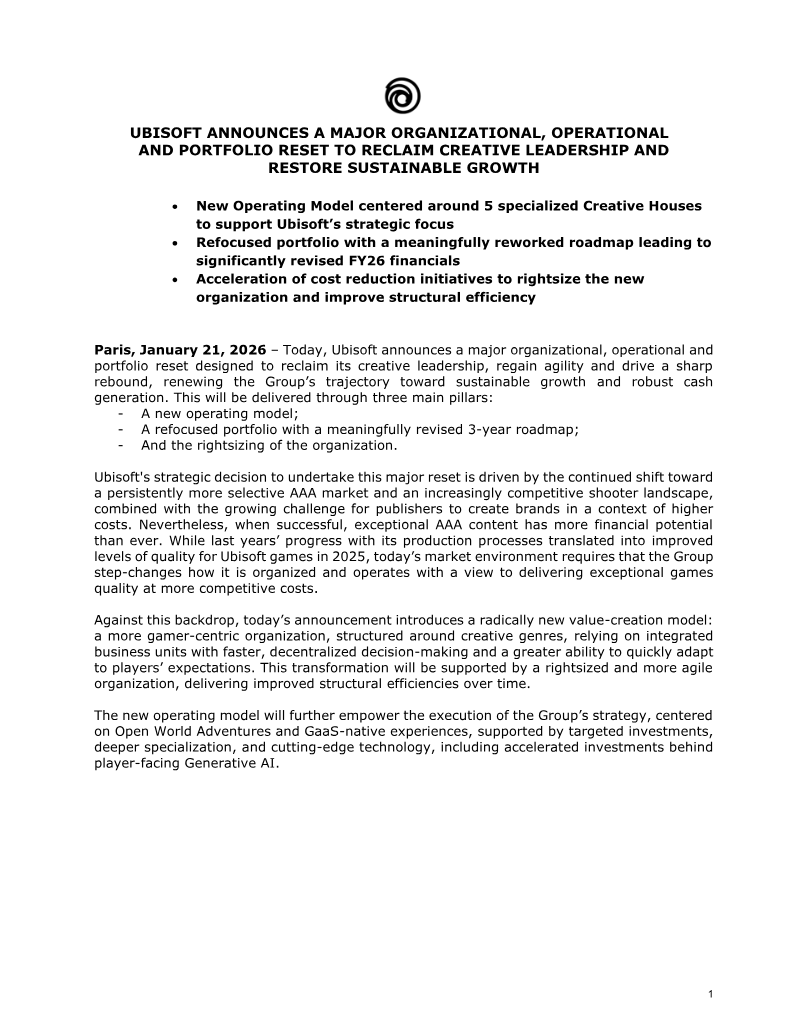
Ubisoft announces a major organizational, operational and portfolio reset to reclaim creative leadership and restore sustainable growth
Ubisoft announces a comprehensive reset aimed at restoring creative leadership and sustainable growth amid a more selective AAA market. The strategy centers on three pillars: a new operating model, a refocused portfolio with an updated three‑year roadmap, and organizational rightsizing. The operating model introduces five Creative Houses—each genre‑focused, fully responsible for development, publishing, and financial performance—supported by a Creative Network of studios and shared Core Services. This structure is intended to accelerate decision‑making, deepen specialization in Open World Adventures and GaaS‑native experiences, and embed generative AI initiatives.
Portfolio adjustments include discontinuing six titles that fail new quality thresholds, extending development timelines for seven games to meet higher standards, and reallocating resources toward high‑potential IPs such as “March of Giants.” These changes are expected to reduce net bookings for FY26 by roughly €330 million and push non‑IFRS EBIT into the negative, reflecting one‑off depreciation costs. Free cash flow is projected between –€400 million and –€500 million, with net debt rising to €150–250 million.
Cost‑reduction efforts target a total fixed‑cost savings of approximately €500 million since FY22, with an accelerated €100 million cut already achieved by March 2026 and a further €200 million planned over the next two years, bringing fixed costs to about €1.25 billion by March 2028. The reset is set to take effect in early April, with a revised FY26–27 financial outlook to be released in May.
- Ubisoft is restructuring into five genre-focused 'Creative Houses' to accelerate decision-making and specialize in Open World Adventures and GaaS-native experiences.
- The company is discontinuing six titles and extending development timelines for seven others to meet new quality thresholds, resulting in a projected €330 million reduction in FY26 net bookings.
- Financial projections for FY26 include negative non-IFRS EBIT, free cash flow between –€400 million and –€500 million, and a net debt increase to €150–250 million.
- Fixed-cost reduction targets aim to bring total costs to approximately €1.25 billion by March 2028, with an additional €200 million in cuts planned over the next two years.
- The organizational reset includes the integration of generative AI initiatives and a strategic resource reallocation toward high-potential IPs such as 'March of Giants.'
+1
Ubisoft
Report15 pages
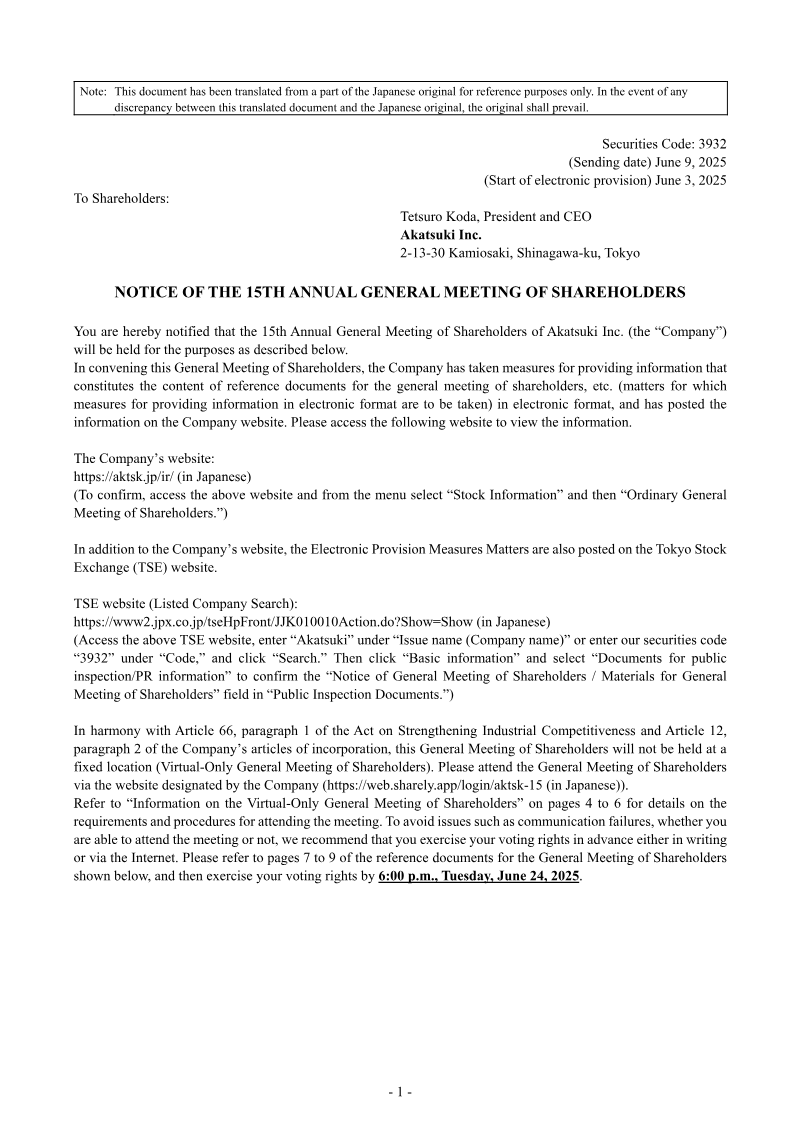
Notice of the 15th Annual General Meeting of Shareholders: Akatsuki Inc.
Note: This document has been translated from a part of the Japanese original for reference purposes only. In the event of any discrepancy between this translated document and the Japanese original, the original shall prevail. (Start of electronic provision) June 3, 2025 Tetsuro Koda, President and CEO 2-13-30 Kamiosaki, Shinagawa-ku, Tokyo NOTICE OF THE 15TH ANNUAL GENERAL MEETING OF SHAREHOLDERS You are hereby notified that the 15th Annual General Meeting of Shareholders of Akatsuki Inc.
- Akatsuki Inc. will hold its 15th Annual General Meeting of Shareholders virtually, with electronic provision of information starting June 3, 2025, and the meeting scheduled for June 25, 2025, at 10:00 a.m. JST.
- Shareholders are encouraged to exercise voting rights in advance either in writing or via the Internet by 6:00 p.m. on Tuesday, June 24, 2025.
- The company proposes the election of four Directors, as the terms of all five current Directors expire at the conclusion of this meeting. The Nomination Committee, comprising a majority of independent Outside Directors, provided a report on candidate selection.
- Tetsuro Koda, President and CEO, and Kazuhiro Ishikura, CFO, are nominated for re-election as Directors, recognized for their leadership, business development, and expertise in corporate finance and investment, respectively.
- Hisashi Katsuya and Tetsuya Mizuguchi are nominated as Outside Directors, with Mizuguchi expected to contribute to the game business and provide objective oversight on officer selection and remuneration.
Akatsuki
Report2 pages
Announcement of Consolidated Results for Fiscal Year Ended March 31, 2025, a Comparison with Prior Year Results, Extraordinary Loss, and Non-operating Expense
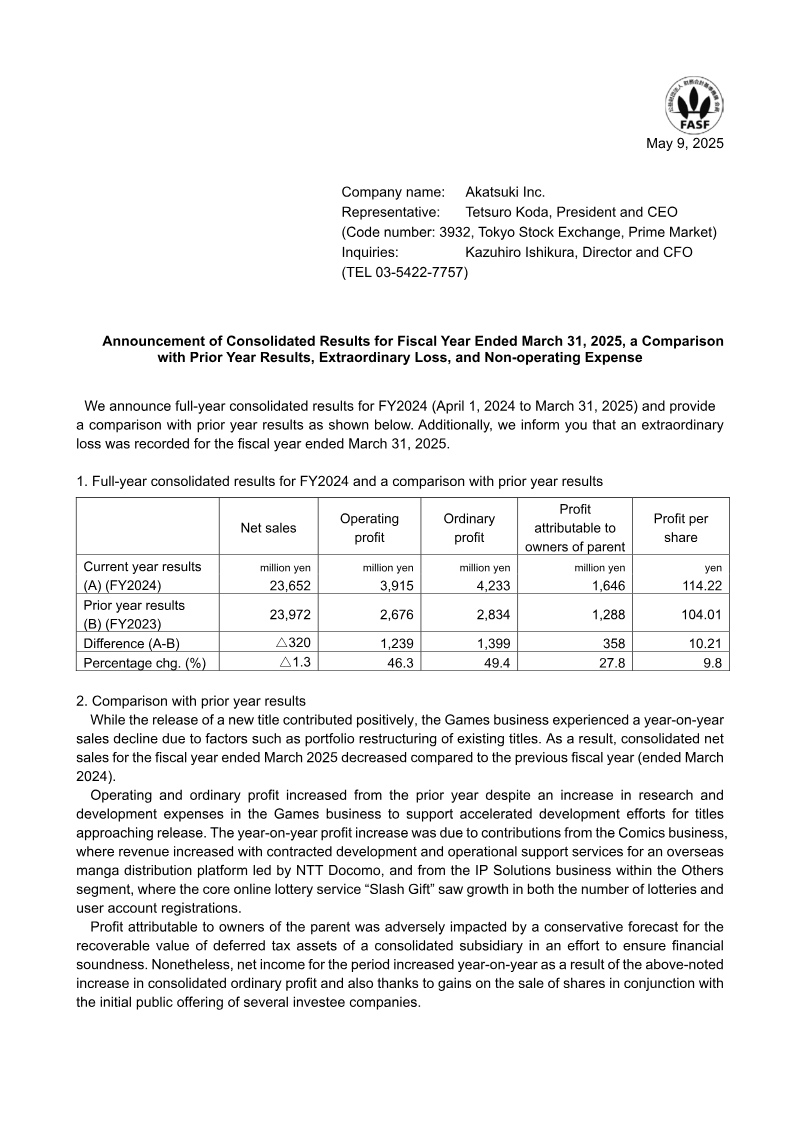
Akatsuki Inc. reported consolidated financial results for the fiscal year ending March 31, 2025 (April 1 2024–March 31 2025). Net sales fell by 1.3 % to ¥23,652 million from ¥23,972 million in FY2023, reflecting a decline in the Games segment despite a new title launch. Operating ordinary profit rose by ¥1,239 million (46.3 %) to ¥3,915 million, driven largely by gains in the Comics and IP Solutions businesses; the former benefited from contracted services for an overseas manga platform, while the latter saw growth in its online lottery service “Slash Gift.” Ordinary profit attributable to parent shareholders increased by ¥1,399 million (49.4 %) to ¥4,233 million, and net income attributable to owners of the parent grew by ¥358 million (27.8 %) to ¥1,646 million, aided by gains on share sales from IPOs of investee companies. A conservative write‑down of deferred tax assets reduced the profit attributable to owners, yet overall net income still improved.
An extraordinary loss of ¥593 million was recorded on the valuation of investment securities held by the group, reflecting a conservative assessment of recoverable value amid market uncertainty. On a non‑consolidated basis, the company recorded a ¥5,776 million provision for doubtful accounts and a ¥2,454 million loss on valuation of shares in affiliated companies; these items are largely confined to consolidated subsidiaries and have a minor impact on the consolidated results. The report covers Japan‑based operations for FY2025, with data derived from internal financial statements and market assessments.
- Akatsuki Inc. reported a 49.4% increase in ordinary profit to ¥4,233 million for the fiscal year ending March 31, 2025, despite a 1.3% decline in net sales to ¥23,652 million.
- Operating ordinary profit grew by 46.3% to ¥3,915 million, driven by strong performance in the Comics segment and the 'Slash Gift' online lottery service within the IP Solutions business.
- Net income attributable to owners of the parent rose 27.8% to ¥1,646 million, bolstered by gains from share sales related to the IPOs of investee companies.
- The Games segment experienced a decline in revenue during FY2025, failing to offset the overall sales decrease despite the launch of a new title.
- The company recorded an extraordinary loss of ¥593 million due to a conservative valuation of investment securities held by the group.
+1
Akatsuki
Report11 pages
Consolidated Financial Statements: Q1 Fiscal Year 2026 (Japan)
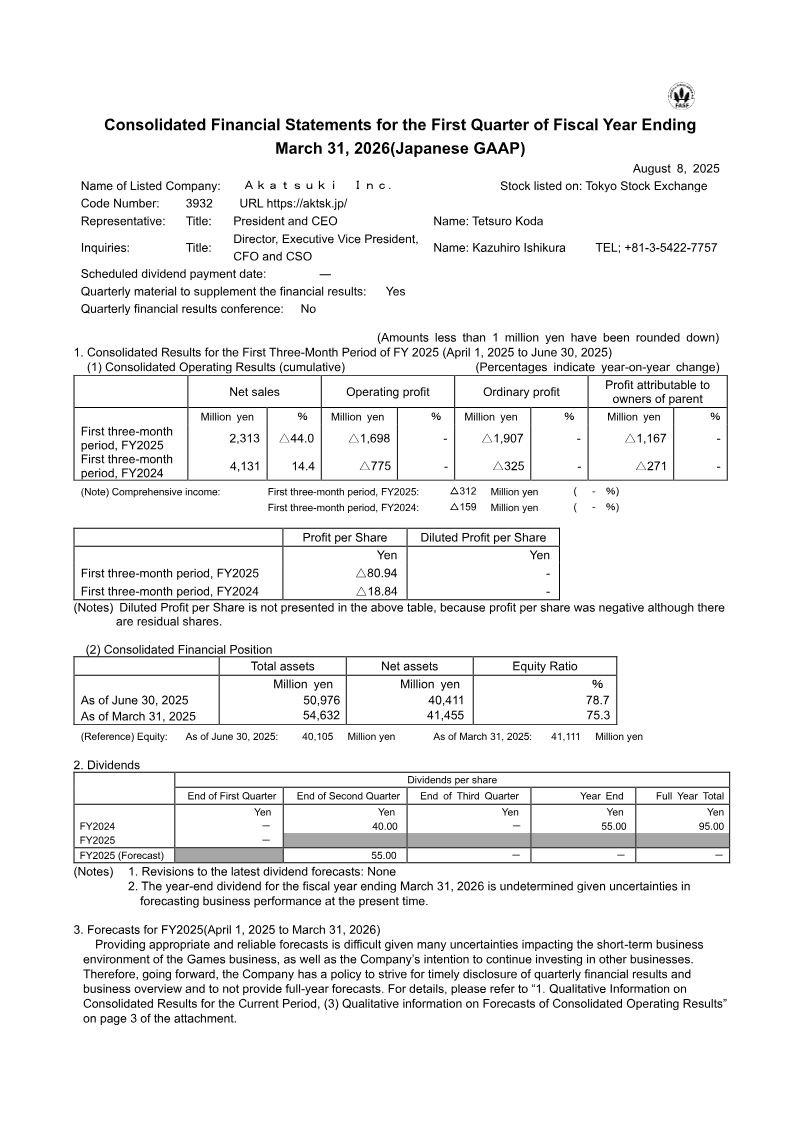
Akatsuki Inc. reports a first‑quarter fiscal 2025 performance that reflects a sharp contraction in its core gaming and comics businesses amid a challenging macro‑environment. Net sales fell 44 % YoY to ¥2,313 million, while operating loss widened to ¥1,698 million from a prior‑year loss of ¥775 million. The company’s consolidated equity ratio improved to 78.7 % from 75.3 %, but total assets declined by ¥3,656 million to ¥50,976 million. Net loss attributable to parent shareholders reached ¥1,167 million, a significant increase from the prior‑year loss of ¥271 million. Comprehensive income deteriorated to ¥312 million in losses versus ¥159 million previously.
Segment analysis shows the Games unit suffered a 52.3 % sales decline and an operating loss of ¥1,643 million; the Comics unit posted a modest profit of ¥20 million after an 18.3 % sales drop; the newly standalone IP Solutions unit grew sales by 167 % and generated a ¥122 million profit, largely driven by the inclusion of subsidiary CRAYON, Inc. The Others segment recorded a small profit after an 80.9 % sales increase.
Geographically, the report focuses on Japan with no disclosed overseas revenue breakdown. Methodologically, figures are based on Japanese GAAP quarterly consolidation; no full‑year forecasts are provided due to market uncertainty. The company maintains a policy of timely quarterly disclosure while withholding FY2026 forecasts, citing volatile gaming and investment conditions.
- Akatsuki Inc. experienced a sharp financial downturn in Q1 FY2025, with net sales falling 44% year-over-year to ¥2,313 million and operating losses widening to ¥1,698 million.
- The core Games unit was the primary driver of the deficit, suffering a 52.3% decline in sales and recording an operating loss of ¥1,643 million.
- Net loss attributable to parent shareholders increased significantly to ¥1,167 million, compared to a ¥271 million loss in the same period last year.
- The IP Solutions unit emerged as a growth driver, increasing sales by 167% and generating a ¥122 million profit, largely due to the inclusion of subsidiary CRAYON, Inc.
- The Comics unit remained marginally profitable at ¥20 million, despite an 18.3% decline in segment sales.
+1
Akatsuki
Report3 pages
Consolidated Results Supplementary Information: Fiscal Year Ended March 2025
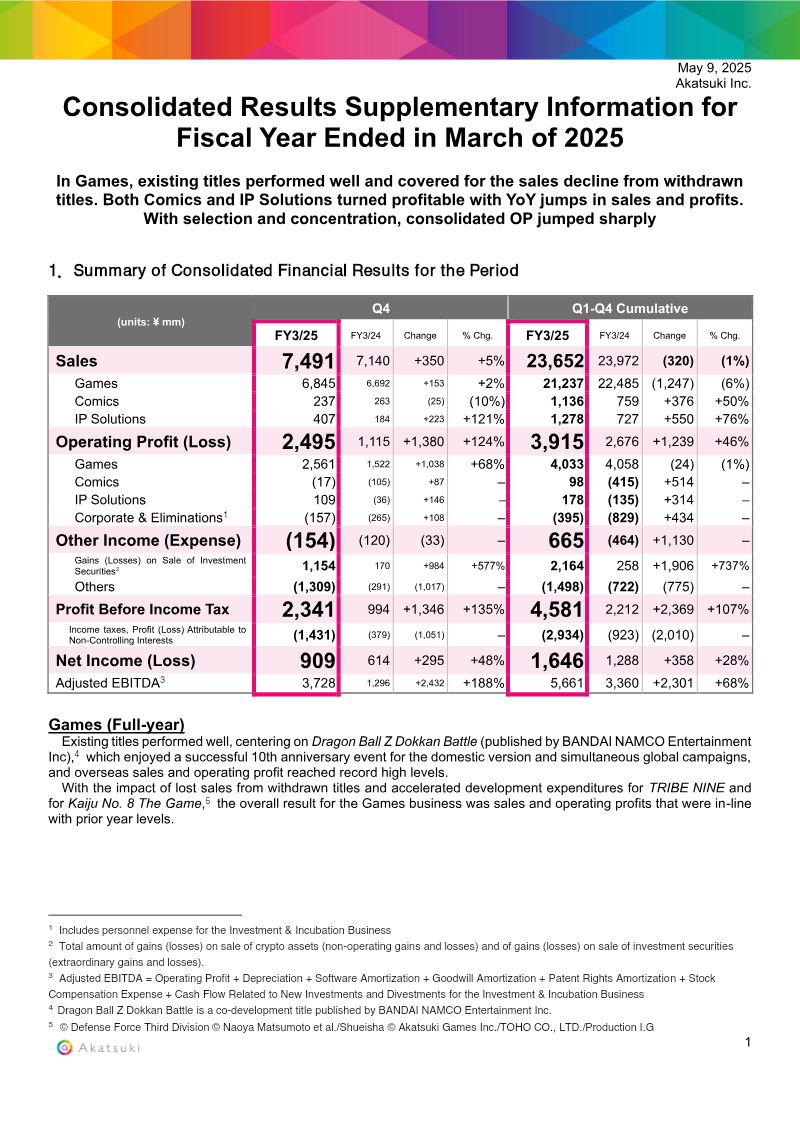
Akatsuki Inc. reported consolidated financial results for fiscal year ended March 2025, showing a modest 5 % increase in sales to ¥23.652 billion compared with the prior year, driven primarily by strong performance of existing games such as Dragon Ball Z Dokkan Battle. Games sales rose 2 % to ¥21.237 billion, while comics and IP Solutions segments returned to profitability with 10 % and 121 % year‑over‑year sales gains, respectively. Operating profit surged 124 % to ¥3.915 billion, largely due to a sharp rise in operating profit from games (68 % increase) and significant gains on the sale of investment securities, which contributed ¥1.154 billion to profit before tax.
Net income increased 48 % to ¥1.646 billion, supported by a 28 % rise in adjusted EBITDA (¥5.661 billion). The company’s balance sheet remained solid, with total assets of ¥54.632 billion and net assets of ¥41.455 billion, while total liabilities decreased to ¥13.177 billion. Cash balances were maintained at ¥33.300 billion, reflecting disciplined working‑capital management.
The results cover the Japanese market and global operations for games, comics, and IP solutions. Methodology includes consolidated financial statements with adjustments for investment and incubation business personnel expenses, and gains on crypto asset sales are classified as non‑operating. Overall, Akatsuki’s selective focus on high‑performing titles and profitable IP solutions has driven a sharp improvement in operating profitability despite the withdrawal of some titles.
- Akatsuki Inc. reported a 124% surge in operating profit to ¥3.915 billion for the fiscal year ended March 2025, driven by a 68% increase in gaming segment profit and ¥1.154 billion in gains from the sale of investment securities.
- Total sales grew 5% year-over-year to ¥23.652 billion, supported by the continued strong performance of existing titles like Dragon Ball Z Dokkan Battle.
- Net income rose 48% to ¥1.646 billion, while adjusted EBITDA increased 28% to ¥5.661 billion.
- The comics and IP Solutions segments returned to profitability, recording year-over-year sales gains of 10% and 121%, respectively.
- The company maintained a strong financial position with ¥33.300 billion in cash and a reduction in total liabilities to ¥13.177 billion.
+1
Akatsuki
Report12 pages
Consolidated Financial Statements: Second Quarter and First Half-Year Period of Fiscal Year Ending March 31, 2026
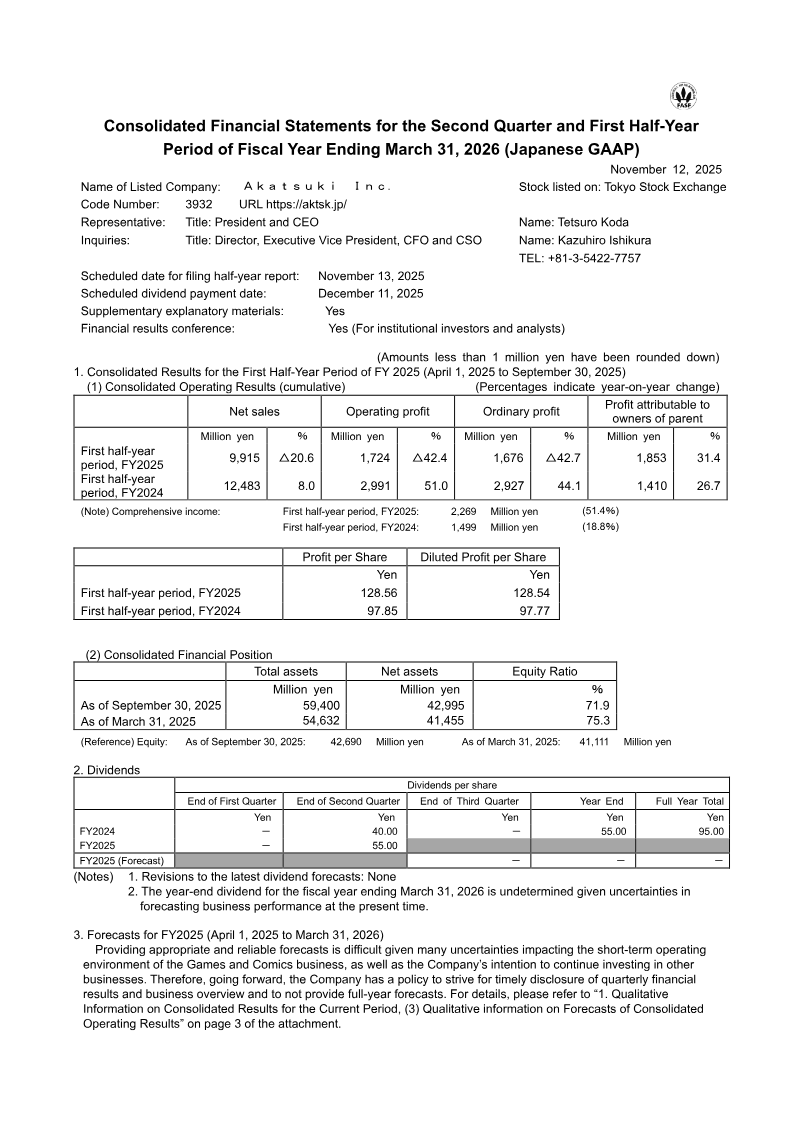
Akatsuki Inc. reports consolidated financial results for the first half of fiscal year ending March 31, 2026 (April 1–September 30, 2025). Net sales fell 20.6 % YoY to ¥9,915 million, while operating profit declined 42.4 % to ¥1,724 million; ordinary profit dropped 42.7 % to ¥1,676 million, yet net income attributable to parent rose 31.4 % to ¥1,853 million, driven by a higher comprehensive income of ¥2,269 million versus ¥1,499 million the prior year. Profit per share diluted increased from ¥97.85 to ¥128.56. Total assets grew to ¥59,400 million, with net assets rising to ¥42,995 million and equity ratio improving to 71.9 %. Cash flows from operating activities were modest at ¥369 million, while investing cash outflows of ¥5,433 million reflected significant purchases of investment securities and intangible assets. Financing activities generated net inflows of ¥1,775 million, offset by dividends paid of ¥795 million.
Segment analysis shows the Games and Comics business experienced a 23.2 % sales decline to ¥9,257 million and a 41.2 % profit drop, whereas the Entertainment and Lifestyle segment grew sales by 76.1 % to ¥649 million, achieving a 90.7 % profit increase. The Others segment recorded a sharp sales decline and continued losses.
The report notes significant consolidation changes: six new subsidiaries, including CRAYON Inc., were added; Akatsuki Fukuoka was liquidated. Goodwill increased by ¥4,316 million due to acquisitions of Natee and PAPABUBBLE JAPAN. No full‑year forecasts are provided, reflecting uncertainty in the Games and Comics market and ongoing investment plans.
- Akatsuki Inc. reported a 20.6% YoY decline in net sales to ¥9,915 million and a 42.4% drop in operating profit to ¥1,724 million for the first half of the fiscal year ending March 31, 2026.
- Net income attributable to the parent rose 31.4% to ¥1,853 million, with diluted earnings per share increasing from ¥97.85 to ¥128.56.
- The core Games and Comics segment, which accounts for the majority of revenue, saw a 23.2% sales decline and a 41.2% drop in profit.
- The Entertainment and Lifestyle segment showed strong growth, with sales increasing 76.1% to ¥649 million and profit rising 90.7%.
- The company increased goodwill by ¥4,316 million following the acquisitions of Natee and PAPABUBBLE JAPAN, while investing cash outflows reached ¥5,433 million.
+1
Akatsuki
Report4 pages
Consolidated Results Supplementary Information: Q1 FYE March 2026
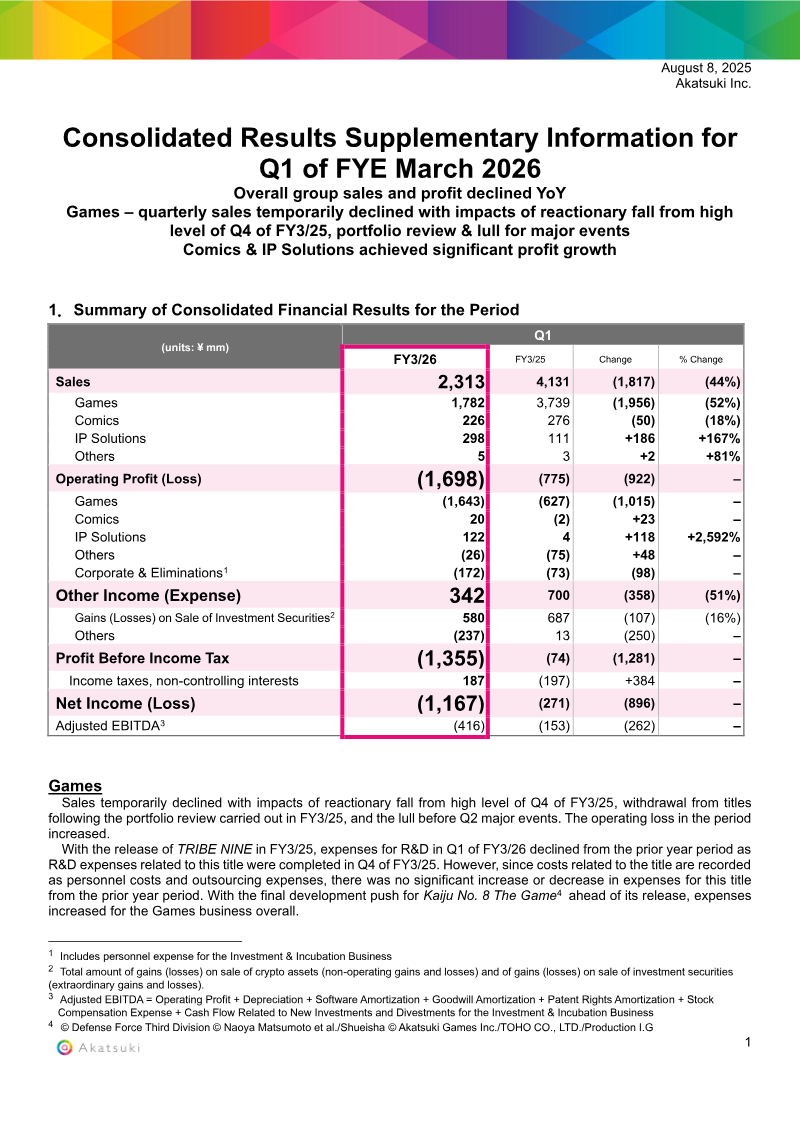
Akatsuki Inc. reported a sharp decline in consolidated sales and operating results for Q1 of the fiscal year ending March 2026, with total group sales falling 44% YoY to ¥2,313 million. The Games segment suffered the largest hit, dropping 52% to ¥1,782 million and recording an operating loss of ¥1,643 million, largely due to a post‑Q4 portfolio review withdrawal and the absence of high‑profile releases. R&D spending for the Games business fell from the previous year as development on “TRIBE NINE” concluded, but costs for the upcoming title “Kaiju No. 8 The Game” increased personnel and outsourcing expenses.
In contrast, the Comics division saw a modest 18% sales decline to ¥226 million but improved profitability, with operating profit rising from a loss of ¥2 million to ¥20 million. The division’s focus on original works and continued service provision to the overseas platform MANGA MIRAI contributed to this turnaround. The IP Solutions unit experienced explosive growth, with sales up 167% to ¥298 million and operating profit soaring 2,592% to ¥122 million, driven by the successful online lottery “Slash Gift” and the inclusion of CRAYON, Inc. in consolidation.
Other income sources shifted, with gains on investment securities decreasing by ¥107 million to ¥580 million. Net income swung from a loss of ¥271 million in FY3/25 to a larger loss of ¥1,167 million in FY3/26, reflecting the combined impact of segment downturns and higher operating losses. Adjusted EBITDA also deteriorated from ¥153 million to a loss of ¥416 million.
The financial data cover the Japanese market, covering all core segments—Games, Comics, IP Solutions, and ancillary services—from Q1 FY3/24 through Q1 FY3/26. The analysis relies on consolidated financial statements, trend tables, and explanatory notes detailing segment performance, expense composition, and investment activity.
- Akatsuki Inc. reported a 44% year-over-year decline in total consolidated sales to ¥2,313 million for Q1 FYE March 2026, resulting in a net loss of ¥1,167 million.
- The Games segment experienced a 52% sales drop to ¥1,782 million and an operating loss of ¥1,643 million, driven by a portfolio review withdrawal and a lack of major new releases.
- The IP Solutions unit achieved significant growth, with sales increasing 167% to ¥298 million and operating profit rising 2,592% to ¥122 million, bolstered by the 'Slash Gift' online lottery and the consolidation of CRAYON, Inc.
- The Comics division improved profitability, turning a ¥2 million loss into a ¥20 million operating profit despite an 18% decline in sales to ¥226 million.
- Adjusted EBITDA for the group deteriorated from a profit of ¥153 million in the previous year to a loss of ¥416 million in Q1 FY3/26.
+1
Akatsuki
Report3 pages
Consolidated Results Supplementary Information: Q2 of FYE March 2026
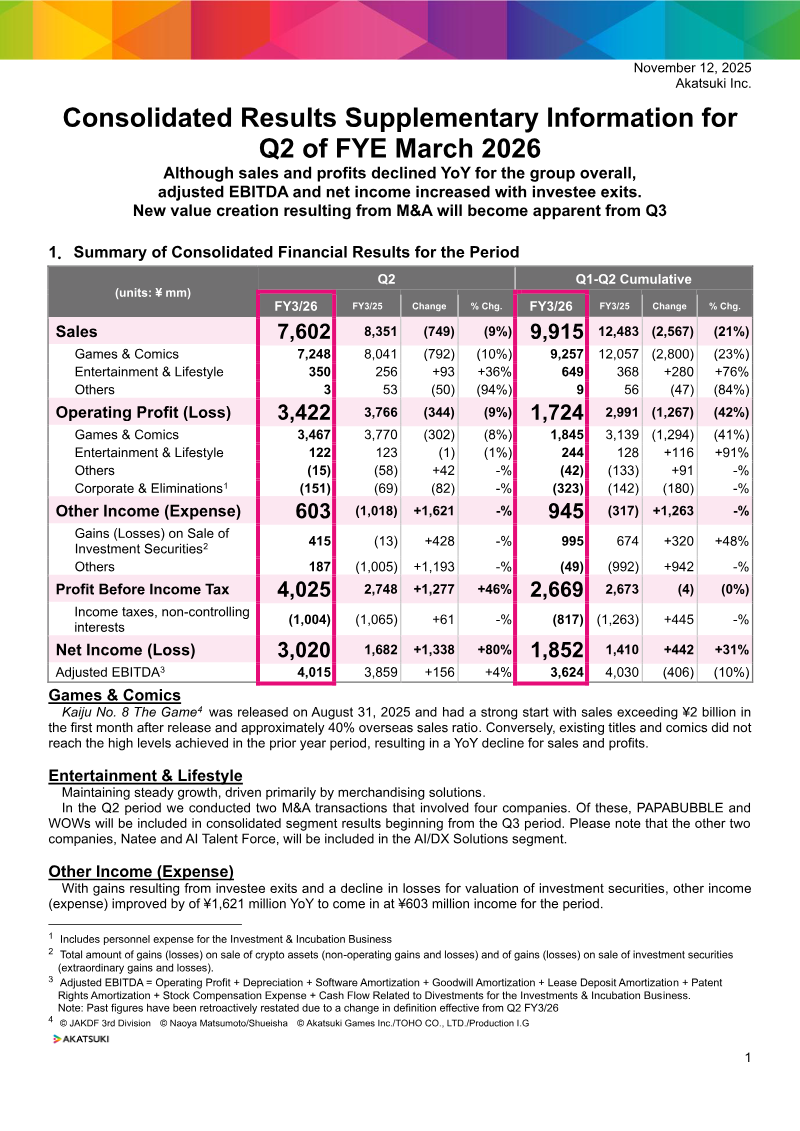
Akatsuki Inc. reported consolidated financial results for the second quarter of fiscal year ending March 2026, noting a 9 % decline in sales to ¥7,602 million and a 21 % drop in cumulative year‑to‑date sales of ¥9,915 million versus the prior year. The Games & Comics segment led the decline with a 10 % YoY fall to ¥7,248 million, while Entertainment & Lifestyle grew 36 % to ¥350 million, and the Others segment contracted sharply by 94 %. Operating profit fell 9 % to ¥3,422 million, largely due to weaker performance in the core Games & Comics unit; however, net income rose 80 % to ¥3,020 million, driven by gains from investee exits and reduced valuation losses on investment securities. Adjusted EBITDA increased modestly by 4 % to ¥4,015 million, reflecting a recovery in operating profitability after the release of new titles.
Key drivers include the launch of “Kaiju No. 8 The Game” on 31 August 2025, which generated over ¥2 billion in first‑month sales with a 40 % overseas share, partially offsetting declines from legacy titles. Two M&A transactions in Q2 added PAPABUBBLE and WOWs to the consolidated segment from Q3, while Natee and AI Talent Force will join the AI/DX Solutions segment. The company’s balance sheet shows a net asset base of ¥42,995 million and cash equivalents of ¥33,272 million, with current liabilities at ¥6,954 million.
Methodologically, the report aggregates data from all operating subsidiaries, restating prior figures to align with revised definitions effective Q2 FY3/26. The analysis covers Japan and international markets, focusing on the Games & Comics, Entertainment & Lifestyle, and AI/DX Solutions segments over a two‑quarter period.
- Akatsuki Inc. reported a 9% decline in quarterly sales to ¥7,602 million, primarily driven by a 10% YoY contraction in the core Games & Comics segment.
- Net income surged 80% to ¥3,020 million, bolstered by gains from investee exits and a reduction in valuation losses on investment securities despite lower operating profit.
- The launch of 'Kaiju No. 8 The Game' on 31 August 2025 generated over ¥2 billion in first-month sales, with 40% of revenue originating from overseas markets.
- Adjusted EBITDA increased by 4% to ¥4,015 million, signaling a recovery in operating profitability following the release of new titles.
- The company expanded its portfolio through Q2 M&A activity, acquiring PAPABUBBLE and WOWs for the Entertainment & Lifestyle segment, and Natee and AI Talent Force for the AI/DX Solutions segment.
+2
Akatsuki
Report11 pages
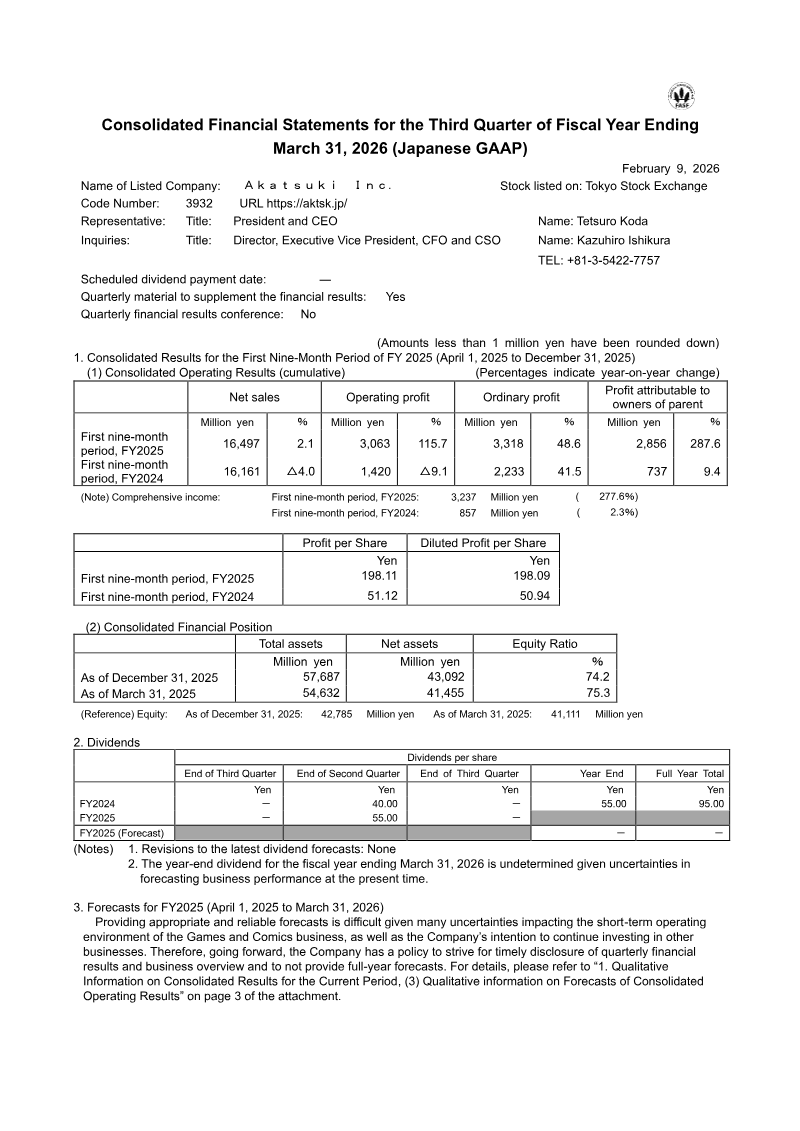
Consolidated Financial Statements for the Third Quarter of Fiscal Year Ending March 31, 2026
Akatsuki Inc. reports consolidated financial results for the first nine months of fiscal year 2025, ending December 31 2025. Net sales rose modestly by 2.1 % to ¥16,497 million, while operating profit surged 115.7 % to ¥3,063 million and ordinary profit increased 48.6 % to ¥3,318 million. Net profit attributable to parent shareholders climbed 287.6 % to ¥2,856 million, yielding diluted earnings per share of ¥198.11 versus ¥51.12 in the prior year. Total assets reached ¥57,687 million, up ¥3,054 million from March 31 2025, with net assets at ¥43,092 million and an equity ratio of 74.2 %. The company’s liquidity remained solid, with cash and deposits at ¥28,377 million and current liabilities down to ¥4,462 million.
Segment performance varied: the Games and Comics business posted a 5.3 % decline in sales but doubled operating profit through cost reductions; Entertainment and Lifestyle achieved a 76.1 % sales increase to ¥1,400 million but saw a modest profit decline; the newly reported AI/DX Solutions segment generated ¥600 million in sales and incurred a ¥112 million loss. The Others segment recorded a sharp 83.1 % sales drop and a ¥51 million loss.
The company added five subsidiaries to its consolidation scope, including CRAYON Inc. and PAPABUBBLE, while excluding Akatsuki Fukuoka after liquidation. No changes to accounting policies were noted. Forecasts for FY 2026 are withheld due to market uncertainties, and the company maintains a policy of not providing full‑year guidance.
- Akatsuki Inc. reported a significant surge in profitability for the first nine months of FY2025, with operating profit rising 115.7% to ¥3,063 million and net profit attributable to parent shareholders climbing 287.6% to ¥2,856 million.
- Net sales grew modestly by 2.1% to ¥16,497 million, while diluted earnings per share increased substantially to ¥198.11 compared to ¥51.12 in the prior year.
- The core Games and Comics business experienced a 5.3% decline in sales but successfully doubled its operating profit through effective cost-reduction measures.
- The Entertainment and Lifestyle segment achieved strong growth with a 76.1% sales increase to ¥1,400 million, though this was accompanied by a modest decline in profit.
- The company launched a new AI/DX Solutions segment, which generated ¥600 million in sales but incurred an operating loss of ¥112 million.
+1
Akatsuki
Report1 pages
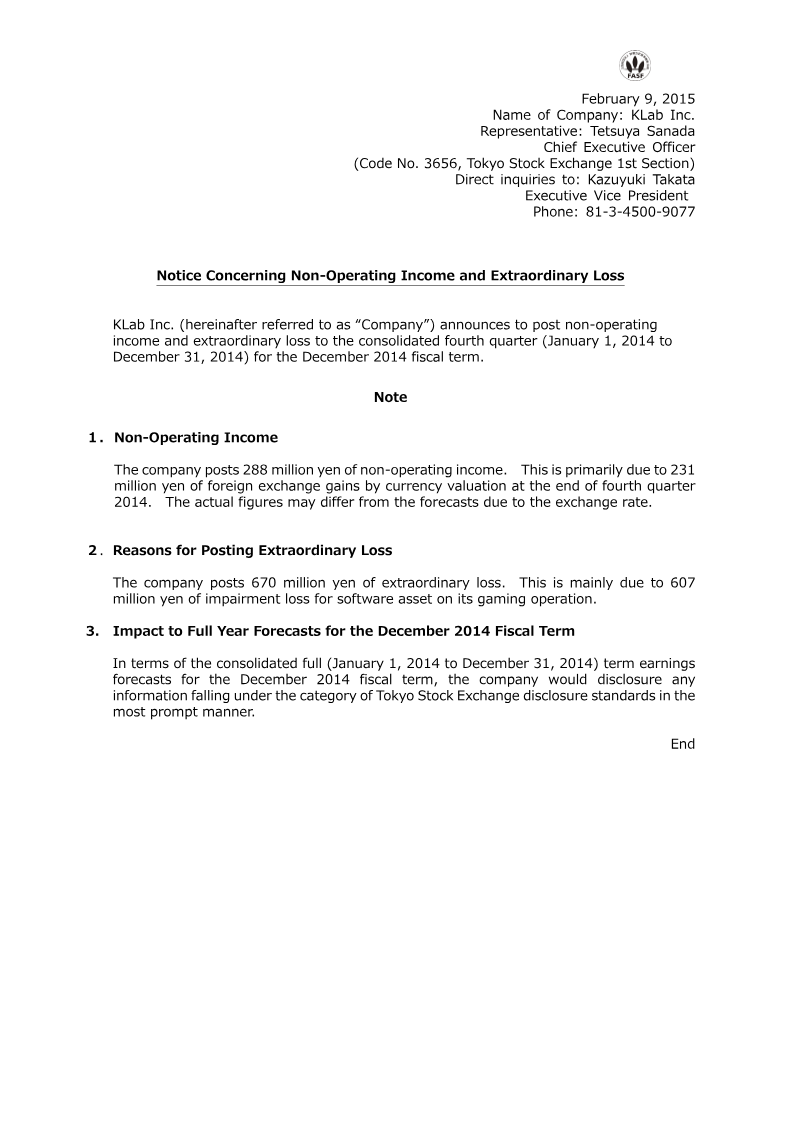
Notice Concerning Non-Operating Income and Extraordinary Loss: Japan
KLab Inc. disclosed a net non‑operating income of 288 million yen for the consolidated fourth quarter of its December 2014 fiscal year, driven largely by a 231 million yen foreign‑exchange gain from currency valuation at quarter‑end. The company also reported an extraordinary loss of 670 million yen, primarily attributable to a 607 million yen impairment charge on software assets related to its gaming operations. These figures represent the company’s first quarterly disclosure of such items for the year, indicating a significant impact on its overall profitability.
The announcement clarifies that the non‑operating income and extraordinary loss will affect the company’s full‑year earnings forecasts for the 2014 fiscal period. KLab commits to providing any additional information required under Tokyo Stock Exchange disclosure standards promptly, ensuring transparency for investors and regulators. The notice is limited to the Japanese market, covering a single fiscal year (January 1–December 31, 2014) and focusing on the gaming segment of KLab’s operations. No survey or external data sources are cited; the figures derive from internal financial statements and accounting adjustments made during the reporting period.
- KLab Inc. recorded an extraordinary loss of 670 million yen for the fourth quarter of the 2014 fiscal year, primarily driven by a 607 million yen impairment charge on gaming software assets.
- The company reported a net non-operating income of 288 million yen for the same period, bolstered by a 231 million yen foreign-exchange gain.
- These financial adjustments represent the first quarterly disclosure of such items for KLab in 2014 and will impact the company's full-year earnings forecast.
- The reported figures are derived from internal financial statements covering the fiscal period of January 1, 2014, to December 31, 2014.
- KLab has committed to ongoing transparency regarding these financial impacts in accordance with Tokyo Stock Exchange disclosure standards.
KLab
Report8 pages
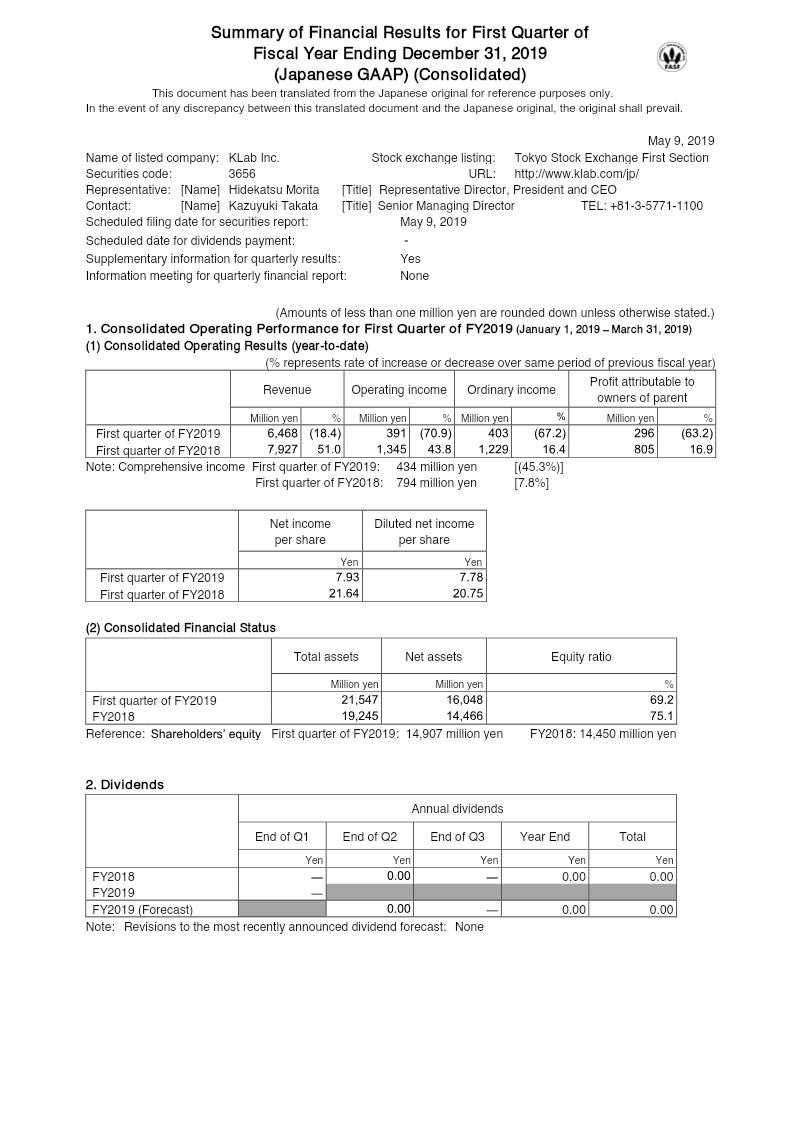
Consolidated Financial Statement: Q1 2019
KLab Inc. reported consolidated financial results for the first quarter of fiscal year 2019 (January 1–March 31, 2019). Revenue declined 18.4 % to ¥6,468 million compared with the same period in FY2018, largely due to a drop in sales of the Love Live! School Idol Festival title. Operating income fell 70.9 % to ¥391 million, ordinary income decreased 67.2 % to ¥403 million, and profit attributable to owners of parent contracted 63.2 % to ¥296 million. Net income for the quarter was ¥303 million, a 65 % reduction from ¥805 million in FY2018. Comprehensive income also fell sharply, from ¥794 million to ¥435 million, reflecting a 45.3 % increase in other comprehensive income components.
Total assets rose to ¥21,547 million, up ¥2.3 billion from the prior year’s end, driven by increases in operating investment securities and software in progress. Net assets increased to ¥16,048 million, an addition of ¥1.58 billion, largely due to equity in a newly consolidated subsidiary. The equity ratio declined from 75.1 % to 69.2 %. Current liabilities decreased, while long‑term debt increased, contributing to the shift in leverage.
KLab forecasted FY2019 revenue between ¥32 billion and ¥40 billion, operating income between ¥1 billion and ¥4.5 billion, ordinary income in the same range, and profit attributable to owners between ¥700 million and ¥3.1 billion. The company noted that future results will depend heavily on the success of new game releases and market conditions, and it applied a range‑based presentation for forecasts. No dividends were declared for FY2019, and no significant changes in shareholders’ equity or accounting policies occurred during the quarter.
- KLab Inc. experienced a significant Q1 2019 downturn, with revenue falling 18.4% to ¥6,468 million and operating income dropping 70.9% to ¥391 million compared to the same period in 2018.
- The primary driver for the revenue decline was a decrease in sales for the 'Love Live! School Idol Festival' title.
- Profit attributable to owners of the parent contracted by 63.2% to ¥296 million, while net income fell 65% to ¥303 million.
- Total assets increased by ¥2.3 billion to ¥21,547 million, primarily due to growth in software in progress and operating investment securities.
- The company’s equity ratio declined from 75.1% to 69.2% as a result of shifting leverage, characterized by a decrease in current liabilities and an increase in long-term debt.
+1
KLab