Market Forecast
Report
Q1 2026 Trader Client Sentiment Report
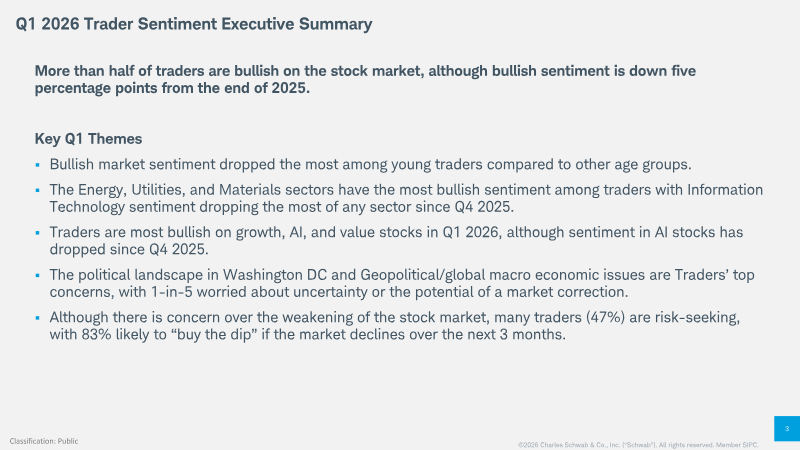
The Q1 2026 Trader Client Sentiment Report provides an analysis of investor outlooks, risk appetites, and strategic priorities among active traders. The primary thesis indicates that while bullish sentiment remains prevalent, it has experienced a modest decline compared to the end of 2025. Traders are currently navigating a landscape defined by geopolitical uncertainty and domestic political concerns, yet they maintain a high degree of confidence in their ability to manage their portfolios and execute investment decisions. Key findings reveal that over half of the surveyed traders maintain a bullish outlook, though this sentiment has softened by five percentage points since Q4 2025. Information Technology experienced the most significant drop in sector sentiment, while Energy, Utilities, and Materials remain the most favored sectors. Growth, Artificial Intelligence, and value stocks are identified as the top investment priorities for the quarter. Despite concerns regarding potential market corrections and macroeconomic instability, 47% of traders describe themselves as risk-seeking, with 83% expressing a high likelihood of buying into market dips over the next three months. The research is based on a survey of 2,121 active traders conducted between January 20 and January 27, 2026. The sample consists of Charles Schwab clients with at least $2,000 in retail assets, weighted by life stage and affluence to ensure a representative view of the active trader segment. The geographic scope is focused on the U.S. market, capturing sentiment during a period of heightened focus on federal policy, interest rates, and global economic conditions. The data underscores a resilient investor base that, despite identifying geopolitical conflict and market volatility as primary risks, remains committed to active participation in equity markets.
Charles Schwab

Report
Ram HD 3500: FY 2025 Guidance
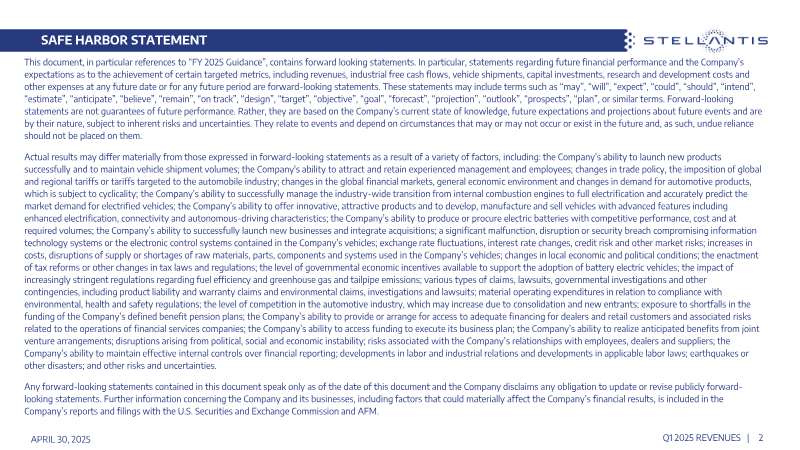
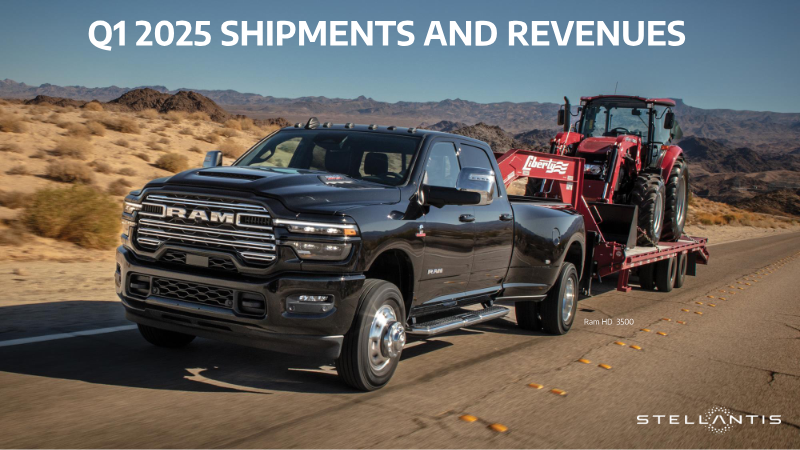
The first quarter of 2025 for Stellantis was characterized by a challenging commercial transition, resulting in a 9% decline in consolidated shipments to 1.2 million units and a 14% decrease in net revenues to €35.8 billion. These results were primarily driven by lower production volumes in North America due to extended holiday downtime, product transition impacts, and price normalization. Despite these headwinds, the company reported early signs of recovery, including a 190-basis-point sequential increase in EU30 market share and an 82% year-over-year surge in U.S. retail order intake for March 2025. The company is currently executing a significant product wave, featuring the launch of 20 all-new or upgraded nameplates, including refreshed Ram 2500 and 3500 trucks. However, due to heightened uncertainties regarding evolving tariff policies and their potential impact on the competitive environment, management has suspended its 2025 financial guidance. The company is actively managing these risks by calibrating production, engaging with North American government officials, and adjusting inventory levels to protect profitability. Geographically, performance varied significantly across regions. North America faced a 25% decline in net revenues, while Enlarged Europe saw a 3% decrease. Conversely, South America demonstrated resilience with a 6% revenue increase and maintained a market share of 23.8%. The company continues to monitor market pricing trends and is re-assessing capital spending plans to navigate the current volatility. This report reflects a strategic focus on stabilizing core operations while managing the transition toward a modernized product portfolio amidst a complex global trade landscape.
Stellantis