Updated Mar 23, 2026 by Stellantis
Report
Published by Stellantis
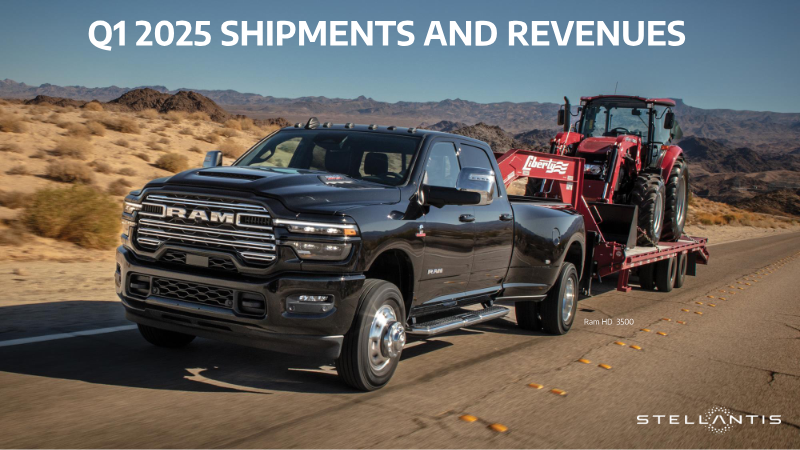
The first quarter of 2025 for Stellantis was characterized by a challenging commercial transition, resulting in a 9% decline in consolidated shipments to 1.2 million units and a 14% decrease in net revenues to €35.8 billion. These results were primarily driven by lower production volumes in North America due to extended holiday downtime, product transition impacts, and price normalization. Despite these headwinds, the company reported early signs of recovery, including a 190-basis-point sequential increase in EU30 market share and an 82% year-over-year surge in U.S. retail order intake for March 2025. The company is currently executing a significant product wave, featuring the launch of 20 all-new or upgraded nameplates, including refreshed Ram 2500 and 3500 trucks. However, due to heightened uncertainties regarding evolving tariff policies and their potential impact on the competitive environment, management has suspended its 2025 financial guidance. The company is actively managing these risks by calibrating production, engaging with North American government officials, and adjusting inventory levels to protect profitability. Geographically, performance varied significantly across regions. North America faced a 25% decline in net revenues, while Enlarged Europe saw a 3% decrease. Conversely, South America demonstrated resilience with a 6% revenue increase and maintained a market share of 23.8%. The company continues to monitor market pricing trends and is re-assessing capital spending plans to navigate the current volatility. This report reflects a strategic focus on stabilizing core operations while managing the transition toward a modernized product portfolio amidst a complex global trade landscape.
SAFE HARBOR STATEMENT This document, in particular references to “FY 2025 Guidance”, contains forward looking statements. In particular, statements regarding future financial performance and the Company’s expectations as to the achievement of certain targeted metrics, including revenues, industrial free cash flows, vehicle shipments, capital investments, research and development costs and other expenses at any future date or for any future period are forward-looking statements. These statements may include terms such as “may”, “will”, “expect”, “could”, “should”, “intend”, “estimate”, “anticipate”, “believe”, “remain”, “on track”, “design”, “target”, “objective”, “goal”, “forecast”, “projection”, “outlook”, “prospects”, “plan”, or similar terms. Forward-looking statements are not guarantees of future performance. Rather, they are based on the Company’s current state of knowledge, future expectations and projections about future events and are by their nature, subject to inherent risks and uncertainties. They relate to events and depend on circumstances that may or may not occur or exist in the future and, as such, undue reliance should not be placed on them.
of knowledge, future expectations and projections about future events and are by their nature, subject to inherent risks and uncertainties. They relate to events and depend on circumstances that may or may not occur or exist in the future and, as such, undue reliance should not be placed on them. Actual results may differ materially from those expressed in forward-looking statements as a result of a variety of factors, including: the Company’s ability to launch new products successfully and to maintain vehicle shipment volumes; the Company's ability to attract and retain experienced management and employees; changes in trade policy, the imposition of global and regional tariffs or tariffs targeted to the automobile industry; changes in the global financial markets, general economic environment and changes in demand for automotive products, which is subject to cyclicality; the Company’s ability to successfully manage the industry-wide transition from internal combustion engines to full electrification and accurately predict the market demand for electrified vehicles; the Company’s ability to offer innovative, attractive products and to develop, manufacture and sell vehicles with advanced features including enhanced electrification, connectivity and autonomous-driving characteristics; the Company’s ability to produce or procure electric batteries with competitive performance, cost and at required volumes; the Company’s ability to successfully launch new businesses and integra
dvanced features including enhanced electrification, connectivity and autonomous-driving characteristics; the Company’s ability to produce or procure electric batteries with competitive performance, cost and at required volumes; the Company’s ability to successfully launch new businesses and integrate acquisitions; a significant malfunction, disruption or security breach compromising information technology systems or the electronic control systems contained in the Company’s vehicles; exchange rate fluctuations, interest rate changes, credit risk and other market risks; increases in costs, disruptions of supply or shortages of raw materials, parts, components and systems used in the Company’s vehicles; changes in local economic and political conditions; the enactment of tax reforms or other changes in tax laws and regulations; the level of governmental economic incentives available to support the adoption of battery electric vehicles; the impact of increasingly stringent regulations regarding fuel efficiency and greenhouse gas and tailpipe emissions; various types of claims, lawsuits, governmental investigations and other contingencies, including product liability and warranty claims and environmental claims, investigations and lawsuits; material operating expenditures in relation to compliance with environmental, health and safety regulations; the level of competition in the automotive industry, which may increase due to consolidation and new entrants; exposure to shortfalls
s and environmental claims, investigations and lawsuits; material operating expenditures in relation to compliance with environmental, health and safety regulations; the level of competition in the automotive industry, which may increase due to consolidation and new entrants; exposure to shortfalls in the funding of the Company’s defined benefit pension plans; the Company’s ability to provide or arrange for access to adequate financing for dealers and retail customers and associated risks related to the operations of financial services companies; the Company’s ability to access funding to execute its business plan; the Company’s ability to realize anticipated benefits from joint venture arrangements; disruptions arising from political, social and economic instability; risks associated with the Company’s relationships with employees, dealers and suppliers; the Company’s ability to maintain effective internal controls over financial reporting; developments in labor and industrial relations and developments in applicable labor laws; earthquakes or other disasters; and other risks and uncertainties.
relationships with employees, dealers and suppliers; the Company’s ability to maintain effective internal controls over financial reporting; developments in labor and industrial relations and developments in applicable labor laws; earthquakes or other disasters; and other risks and uncertainties. Any forward-looking statements contained in this document speak only as of the date of this document and the Company disclaims any obligation to update or revise publicly forwardlooking statements. Further information concerning the Company and its businesses, including factors that could materially affect the Company’s financial results, is included in the Company’s reports and filings with the U.S. Securities and Exchange Commission and AFM.
Q1 2025 EXECUTIVE SUMMARY Shipments of 1.2M, Net Revenues of €35.8B Progress on Commercial Recovery Early Stage of with y-o-y declines of 9% and 14% EU30 market share increased 190bps from Commercial Recovery respectively, reflect certain product transition Q4 '24; U.S. retail sales showed improvement in key impacts, lower market share and re-calibrated products, while orders ended Q1 '25 at recent highs pricing 2025 New Product Strong Q1 Execution of Product Launches Increasing Benefit from '24-'25 Product Wave including three all-new products: Fiat Grande Panda, with 20 all-new or significantly upgraded products Launches Ongoing Citroen C3 Aircross, and Opel/Vauxhall Frontera, as launched in '24, half in the second half, and 10 well as refreshed Ram 2500 & 3500, Opel Mokka nameplates planned to begin production in '25 Responding to Safeguarding the Business Suspending 2025 Financial Guidance to protect profitability, progressing scenario due to tariff-related uncertainties including Tariff Challenges planning and engaging continuously with policy, market impacts, and the company's relevant North American governments evolving response. Q1 2025 REVENUES |4
The survey, conducted by Aream & Co., gauges executive optimism regarding consumer spending on gaming in 2025 across multiple channels and functional areas. Overall, 49 % of respondents view spending as “more optimistic,” another 49 % see it as unchanged, and only 2 % are less optimistic. When broken down by platform, mobile spending is perceived as more optimistic (49 %) while PC and console views are split between “more” (15–33 %) and “about the same.” In‑app purchases are viewed as more optimistic (80 %) versus in‑app advertising (41 %). Key challenges identified include content saturation and over‑supply, with 33 % citing these as concerns; marketing environment issues affect 49 %, and macro conditions are a worry for 17 %. Despite these, 54 % anticipate more new games in 2025, and 37 % expect higher average budgets. Marketing spend is expected to rise for 48 %, while engineering and game development are seen as more optimistic (71 % and 42 %). The survey also highlights a strong appetite for mergers and acquisitions, with 71 % expecting more M&A activity. Advanced integration across multiple functions is viewed as more optimistic (49 %) but limited implementation remains a concern. The data derive from a global sample of gaming CEOs, reflecting perspectives across mobile, PC, console, and various functional departments. The findings suggest a cautiously optimistic outlook for 2025, tempered by supply‑side pressures and marketing challenges.
Take-Two Interactive reported record-breaking financial results for the second quarter of fiscal year 2026, ending September 30, 2025. The company achieved net bookings of $1.96 billion, significantly exceeding its guidance of $1.7 to $1.75 billion. This performance was driven by the successful launch of NBA 2K26, which saw a 45% increase in recurrent consumer spending, and substantial overperformance in the mobile sector led by titles such as Toon Blast and Match Factory. While Borderlands 4 faced some initial technical challenges on PC, other major releases like Mafia: The Old Country exceeded internal expectations. Based on this momentum, management raised its full-year fiscal 2026 net bookings outlook to a range of $6.4 to $6.5 billion, representing 14% year-over-year growth. Recurrent consumer spending is now projected to grow by 11%, more than double previous forecasts. The company also provided a significant update on its product pipeline, officially scheduling the release of Grand Theft Auto VI for November 19, 2026. This shift is intended to allow for maximum polish, with the company anticipating that the title will help drive record net bookings in fiscal year 2027. The report covers Take-Two’s global operations across its primary labels: Rockstar Games, 2K, and Zynga. Financial data is presented on a GAAP basis with year-over-year comparisons. Key strategic focuses highlighted include the expansion of direct-to-consumer mobile platforms to improve margins and continued investment in live services. Despite a 13% increase in management-basis operating expenses due to higher marketing and performance-based compensation, the company maintains a positive outlook on long-term profitability and shareholder returns as it prepares for a series of major franchise launches.
The update delivers a comprehensive snapshot of the global video‑game ecosystem in the second quarter of 2025, emphasizing financial flows, consumer behavior and platform performance. It argues that the market is transitioning from pandemic‑driven expansion to a more differentiated growth pattern, with mobile spending stabilising at roughly $20 billion per quarter, while PC and console segments experience renewed vigor. Quarterly consumer spend on mobile games remains flat, yet download volumes have slipped, contrasting with a 20 % year‑on‑year rise in Steam revenue powered by several high‑profile indie releases. Console dynamics are buoyant: Nintendo’s Switch 2 set a record launch pace, and PlayStation reported over 120 million monthly active users, marking its most profitable hardware cycle. M&A activity reached $6.2 billion, led by the Niantic sale and a private‑equity round in Dream Games, whereas private‑equity and late‑stage venture capital inflows fell to a five‑year low of $0.4 billion. Public offerings generated $4.2 billion, with equities trading near 52‑week highs; valuation spreads have widened, as PC/console firms trade above 15 times EBITDA while mobile peers sit at historic lows. User engagement metrics show Fortnite sustaining 16 million concurrent users and Roblox 14 million, with Twitch delivering 2.2 billion hours watched. Creator payouts rose 25 % year‑on‑year, driven by major acquisitions in the UGC space. Financing trends reveal AI‑infrastructure startups accounting for 65 % of related deals, and debt providers now fund roughly 80 % of user‑acquisition capital, reflecting a shift toward non‑dilutive growth financing. The analysis draws on data from InvestGame, Sensor Tower, Alinea Analytics and company earnings, covering the period from 2020 through Q2 2025 across North America, Europe and Asia‑Pacific.
The provided text does not contain the content of the document titled Global Gaming Industry Takes Center Stage, as the source link is restricted and inaccessible. Consequently, it is impossible to extract the main thesis, key findings, or methodological details required for an analytical summary. The available information consists solely of a server-side error message indicating a lack of authorization to view the requested file. To provide a professional and accurate summary, the full text of the report must be made available. Once the content is accessible, the analysis will focus on identifying the primary industry trends, geographic scope, and statistical data points presented by the authors. Please provide the complete text or a functional link to the document to facilitate a comprehensive review of the gaming industry's current market position and future outlook.