Updated Mar 21, 2026 by Wealth Management Chief Investment Office
Report
Published by Wealth Management Chief Investment Office
From the Wealth Management Chief interpreting the economy & markets The Wealth Chief Investment Office is dedicated to helping our clients achieve financial wellness through the delivery of insightful thought leadership, disciplined management of high quality, diversified portfolios tailored to each client’s needs and objectives, and differentiated 01 | CIO Overview 04 02 | Market Recap 05 03 | 2026 Outlook & Key Themes 09 04 | Macro Overview ...
Q1 2026 CHARTBOOK From the Wealth Management Chief Investment Office: A guide to interpreting the economy & markets
W WEALTH CHIEF INVESTMENT OFFICE The Wealth Chief Investment Office is dedicated to helping our clients achieve financial wellness through the delivery of insightful thought leadership, disciplined management of high quality, diversified portfolios tailored to each client’s needs and objectives, and differentiated Wealth Planning services.
| 01 | CIO Overview 04 | | --- | --- | | 02 | Market Recap 05 | | 03 | 2026 Outlook & Key Themes 09 | | 04 | Macro Overview 35 | | CONTENTS 05 | Equities 44 | | 06 | Fixed Income 62 | | 07 | Alternative Investments 69 | | 08 | 2026 U.S. Midterm Elections 72 | | 09 | Portfolio Strategy 76 | | 10 | The Long-Term Perspective 97 |
tdown that distorted economic data, and a volatile Q4 2025 closed on a constructive note, capping a resilient year. Despite a record 43-day U.S. government shutdown that distorted economic data, and a volatile November largely attributed to artificial intelligence (AI) bubble fears, markets rallied as major asset classes ended at or near all-time highs. ech names and Al enthusiasm. Metals were standout U.S. large-cap equities, as measured by the S&P 500, delivered a total return for the year of 17.9%, driven by tech names and AIenthusiasm. Metals were standout performers, with gold and silver surging 65% and 146%, respectively. Gold peaked as investors sought a safe haven amid trade-war jitters and central banks continued stockpiling bullion. For the year, international equities outpaced U.S. markets with returns exceeding 30%, while U.S. fixed income posted a solid 7% gain. The consumer landscape remains K-shaped: affluent households continue to drive spending, while lower me consumers remain cautious. Against this backdrop, -income consumers remain cautious. Against this backdrop, the Federal Reserve (Fed) delivered two 25-basis-point cuts in October and December—three reductions in total for the year, marking the first time since 2024. Minutes from the December Federal Open Market committee (FOMC) meeting highlighted growing internal divisions, with a still-hawkish minority voicing concerns over lingering inflation risks.
oint cuts in October and December—three reductions in total for the year, marking the first time since 2024. Minutes from the December Federal Open Market committee (FOMC) meeting highlighted growing internal divisions, with a still-hawkish minority voicing concerns over lingering inflation risks. Investors were reminded once again of the tried-and-true first principles of remaining disciplined and avoiding the typical behavioral mistakes that come with attempting to time the markets. Having a diversified portfolio in sync with one’s financial plan is the best way to weather market storms, while staying invested through market cycles over time. The U.S. economy continues its careful balancing act in early 2026 —maintaining growth while remaining agile enough to respond to changing conditions. As AI and disruptive technologies continue to gain traction across industries, we are witnessing an innovation wave that demands similar agility from investors and businesses alike. Just as a skater must look ahead while remaining acutely aware of their positioning and the ice’s ever-changing texture, today’s investment landscape requires a blend of confidence in the trajectory of transformative technologies and The nimbleness to adapt as market dynamics evolve.
nesses alike. Just as a skater must look ahead while remaining acutely aware of their positioning and the ice’s ever-changing texture, today’s investment landscape requires a blend of confidence in the trajectory of transformative technologies and The nimbleness to adapt as market dynamics evolve. The AI revolution isn’t simply propelling us forward—it’s reshaping the very surface we’re gliding across, creating both opportunities for growth and moments that test our ability to maintain composure through transitions. In this environment, investors are seekin g to harness this momentum without sacrificing the precision and balance that separate a graceful performance from a stumble. rom a stumble. 2026 should bring its own set of surprises and lessons. The U.S. economy may continue to benefit from the AI infrastructure b uildout, but face challenges from a slowing labor market and weaker fundamentals for low-income consumers. Market volatility may pick up, given a higher bar from elevated valuations and potential for firmer inflation. Overall, our view is that we are transitioning into a new era of prolific and accelerating innovation and disruption, bringing opportunities and risks for the economy, markets, and society at large. isks for January 16, 2026 Niladri ‘Neel’ Mukherjee Chief Investment Officer, TIAA Wealth Management
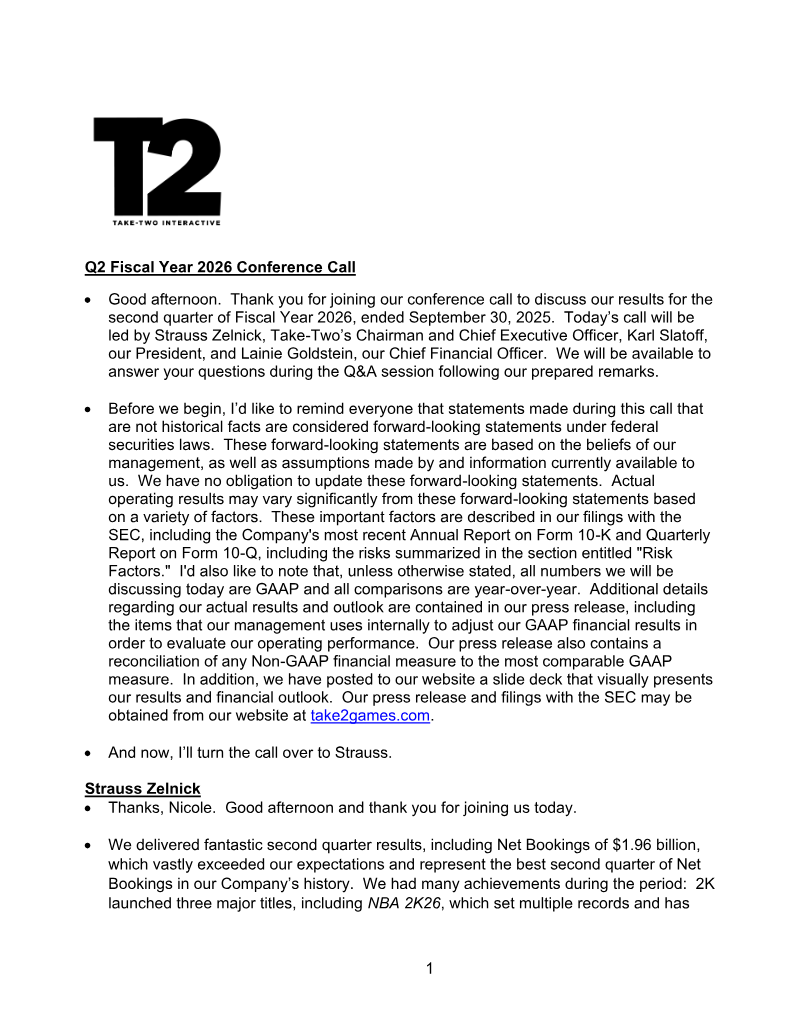
Take-Two Interactive reported record-breaking financial results for the second quarter of fiscal year 2026, ending September 30, 2025. The company achieved net bookings of $1.96 billion, significantly exceeding its guidance of $1.7 to $1.75 billion. This performance was driven by the successful launch of NBA 2K26, which saw a 45% increase in recurrent consumer spending, and substantial overperformance in the mobile sector led by titles such as Toon Blast and Match Factory. While Borderlands 4 faced some initial technical challenges on PC, other major releases like Mafia: The Old Country exceeded internal expectations. Based on this momentum, management raised its full-year fiscal 2026 net bookings outlook to a range of $6.4 to $6.5 billion, representing 14% year-over-year growth. Recurrent consumer spending is now projected to grow by 11%, more than double previous forecasts. The company also provided a significant update on its product pipeline, officially scheduling the release of Grand Theft Auto VI for November 19, 2026. This shift is intended to allow for maximum polish, with the company anticipating that the title will help drive record net bookings in fiscal year 2027. The report covers Take-Two’s global operations across its primary labels: Rockstar Games, 2K, and Zynga. Financial data is presented on a GAAP basis with year-over-year comparisons. Key strategic focuses highlighted include the expansion of direct-to-consumer mobile platforms to improve margins and continued investment in live services. Despite a 13% increase in management-basis operating expenses due to higher marketing and performance-based compensation, the company maintains a positive outlook on long-term profitability and shareholder returns as it prepares for a series of major franchise launches.
The update delivers a comprehensive snapshot of the global video‑game ecosystem in the second quarter of 2025, emphasizing financial flows, consumer behavior and platform performance. It argues that the market is transitioning from pandemic‑driven expansion to a more differentiated growth pattern, with mobile spending stabilising at roughly $20 billion per quarter, while PC and console segments experience renewed vigor. Quarterly consumer spend on mobile games remains flat, yet download volumes have slipped, contrasting with a 20 % year‑on‑year rise in Steam revenue powered by several high‑profile indie releases. Console dynamics are buoyant: Nintendo’s Switch 2 set a record launch pace, and PlayStation reported over 120 million monthly active users, marking its most profitable hardware cycle. M&A activity reached $6.2 billion, led by the Niantic sale and a private‑equity round in Dream Games, whereas private‑equity and late‑stage venture capital inflows fell to a five‑year low of $0.4 billion. Public offerings generated $4.2 billion, with equities trading near 52‑week highs; valuation spreads have widened, as PC/console firms trade above 15 times EBITDA while mobile peers sit at historic lows. User engagement metrics show Fortnite sustaining 16 million concurrent users and Roblox 14 million, with Twitch delivering 2.2 billion hours watched. Creator payouts rose 25 % year‑on‑year, driven by major acquisitions in the UGC space. Financing trends reveal AI‑infrastructure startups accounting for 65 % of related deals, and debt providers now fund roughly 80 % of user‑acquisition capital, reflecting a shift toward non‑dilutive growth financing. The analysis draws on data from InvestGame, Sensor Tower, Alinea Analytics and company earnings, covering the period from 2020 through Q2 2025 across North America, Europe and Asia‑Pacific.
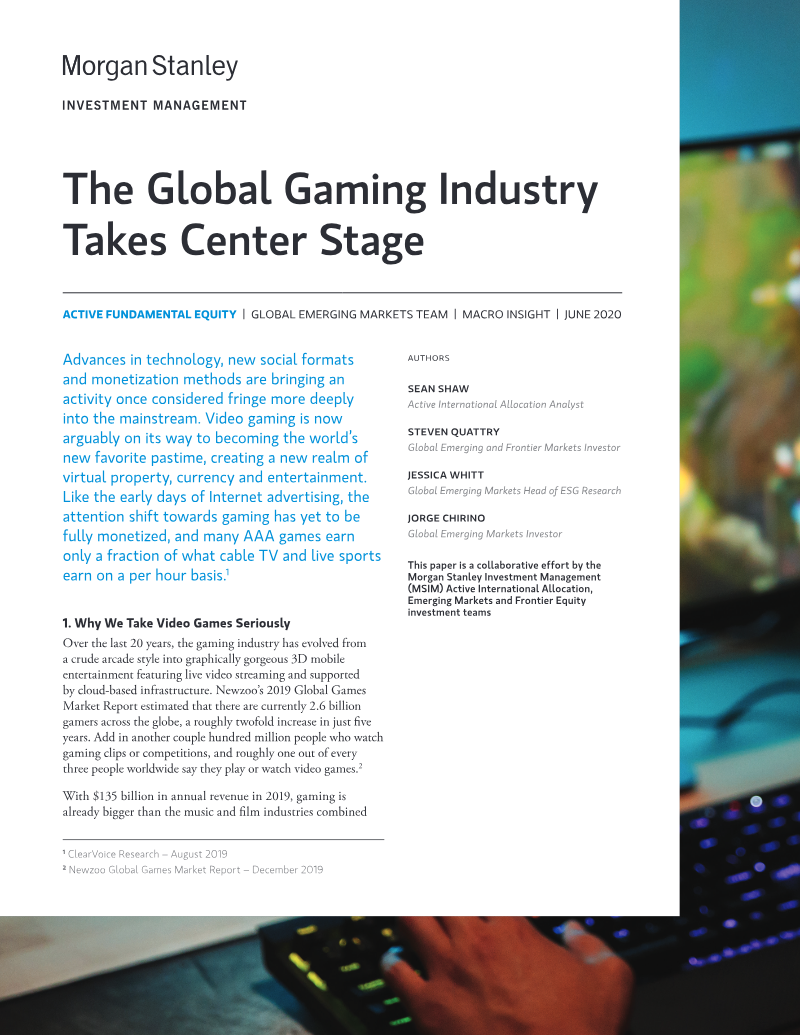
The provided text does not contain the content of the document titled Global Gaming Industry Takes Center Stage, as the source link is restricted and inaccessible. Consequently, it is impossible to extract the main thesis, key findings, or methodological details required for an analytical summary. The available information consists solely of a server-side error message indicating a lack of authorization to view the requested file. To provide a professional and accurate summary, the full text of the report must be made available. Once the content is accessible, the analysis will focus on identifying the primary industry trends, geographic scope, and statistical data points presented by the authors. Please provide the complete text or a functional link to the document to facilitate a comprehensive review of the gaming industry's current market position and future outlook.
The global gaming market is projected to reach $189.3 billion in 2024, representing a 2.9% year-over-year increase. Analysis of the first quarter of 2024 reveals a significant recovery in private market activity, with venture capital funding reaching $594 million across 124 rounds. This reflects a 94% increase in funding volume and a 28% rise in deal count compared to the previous quarter, effectively reversing a downward trend in deal volume that persisted since early 2022. While early and growth-stage funding have normalized to pre-pandemic levels, late-stage venture capital remains largely absent. Geographically, North America and Europe saw one-year highs in funding, increasing by 111% and 113% respectively. In contrast, Asia maintained a high deal count but reported lower disclosed funding totals. The quarter was characterized by major strategic moves, most notably Disney’s $1.5 billion investment in Epic Games to develop a persistent entertainment universe. This highlights a broader trend of intellectual property holders shifting toward user-generated content and live-service models. Additionally, the industry is monitoring a potential U.S. ban on TikTok, which could disrupt discovery and viral marketing for indie developers. Public markets show a healthy environment for future consolidation, with major gaming and tech companies holding approximately $302 billion in combined cash reserves. Emerging trends include the rise of indie developers, who are achieving critical parity with AAA studios, and increased regulatory scrutiny of the Apple App Store, which may facilitate the growth of third-party marketplaces. While the Apple Vision Pro introduced new spatial gaming use cases, its current impact remains limited by high costs and a lack of specialized gaming applications. Looking forward, the reopening of the IPO window and the democratization of development tools via AI are expected to shape the industry's trajectory.