Report1 pages
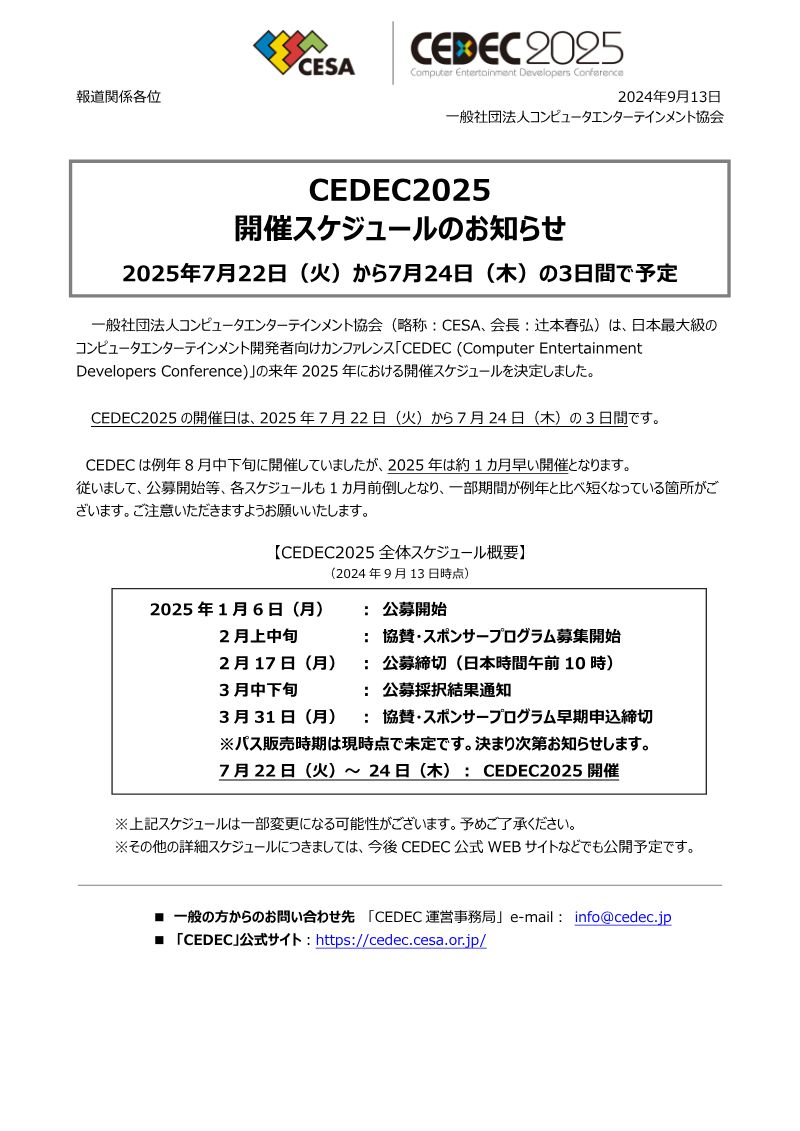
CEDEC 2025 Schedule Announcement
The announcement establishes the official timetable for CEDEC 2025, Japan’s premier three‑day conference for computer‑entertainment developers organized by the Computer Entertainment Developers Association (CESA). By moving the event to July 22‑24, 2025—approximately one month earlier than the traditional late‑August slot—the schedule compresses several preparatory phases, prompting participants to adjust their planning accordingly.
Key milestones are detailed: the public call for proposals opens on January 6, 2025, followed by the launch of sponsor and partnership programs in early‑to‑mid February. The final deadline for submissions is set for February 17 at 10 a.m. JST, with selection results communicated in late March. An early‑application deadline for sponsorships occurs on March 31, while ticket‑sale dates remain pending and will be announced later. The conference itself occupies three consecutive days, Tuesday through Thursday, in late July.
The scope is national, targeting Japanese developers, studios, and related stakeholders within the computer‑entertainment sector, and it outlines a timeline that spans from early January through late July 2025. Although the schedule is provisional and subject to minor adjustments, contact information for the CEDEC operations office and the official website are provided for inquiries and future updates.
- CEDEC 2025 will take place from July 22–24, 2025, shifting the conference approximately one month earlier than its traditional late-August schedule.
- The call for session proposals opens on January 6, 2025, with a strict submission deadline of February 17, 2025, at 10 a.m. JST.
- Selection results for proposed sessions will be communicated to applicants in late March 2025.
- Sponsorship and partnership programs launch in early-to-mid February 2025, with an early-application deadline for sponsors set for March 31, 2025.
- The conference is organized by the Computer Entertainment Developers Association (CESA) and targets Japanese developers, studios, and computer-entertainment stakeholders.
+1
Computer Entertainment Developers AssociationSept 2024
Presentation12 pages
Wyniki Finansowe 9M23
PCF Group S.A. experienced significant organizational growth and structural expansion during the first nine months of 2023. The workforce reached a total of 722 employees by September 30, 2023, continuing a steady upward trajectory from 612 in 2022 and 495 in 2021. This growth is distributed across a global network of studios, with a primary concentration in Europe, where the headcount rose to 473, and a substantial presence in North America, accounting for 249 staff members. The internal composition of the team remains heavily weighted toward production, consisting primarily of developers and quality assurance professionals, supported by back-office staff and specialized units such as GameOn and Incuvo.
The geographic footprint of the group spans multiple key hubs, including Warsaw, Rzeszów, Katowice, Kraków, and Łódź in Poland, alongside international locations in Newcastle, Dublin, Montreal, and New York. This infrastructure supports a diversified operational model that includes both core development studios and a dedicated publishing division. The expansion reflects a strategic commitment to scaling production capabilities across various territories to support ongoing development projects.
Financial positioning for the period is characterized by a balance sheet that emphasizes long-term value creation through development work in progress and intangible assets. Key financial components include significant investments in development projects, tangible fixed assets, and right-of-use assets, balanced against equity and liquid holdings in cash and bonds. While specific revenue figures for the nine-month period are integrated into broader reporting, the data highlights a period of intensive investment in human capital and project pipelines intended to drive future growth within the competitive global gaming market.
- PCF Group S.A. grew its total workforce to 722 employees by September 30, 2023, up from 612 in 2022 and 495 in 2021.
- The company maintains a global footprint with 473 employees in Europe and 249 in North America, operating across hubs including Warsaw, Newcastle, Dublin, Montreal, and New York.
- The organizational structure is heavily weighted toward production, with the majority of the 722 staff comprised of developers and quality assurance professionals.
- The group's operational model integrates core development studios with a dedicated publishing division and specialized units, specifically GameOn and Incuvo.
- Financial strategy for the first nine months of 2023 focused on intensive capital investment in development projects, intangible assets, and human capital to support future growth.
+1
PCF GroupNov 2023
Report68 pages
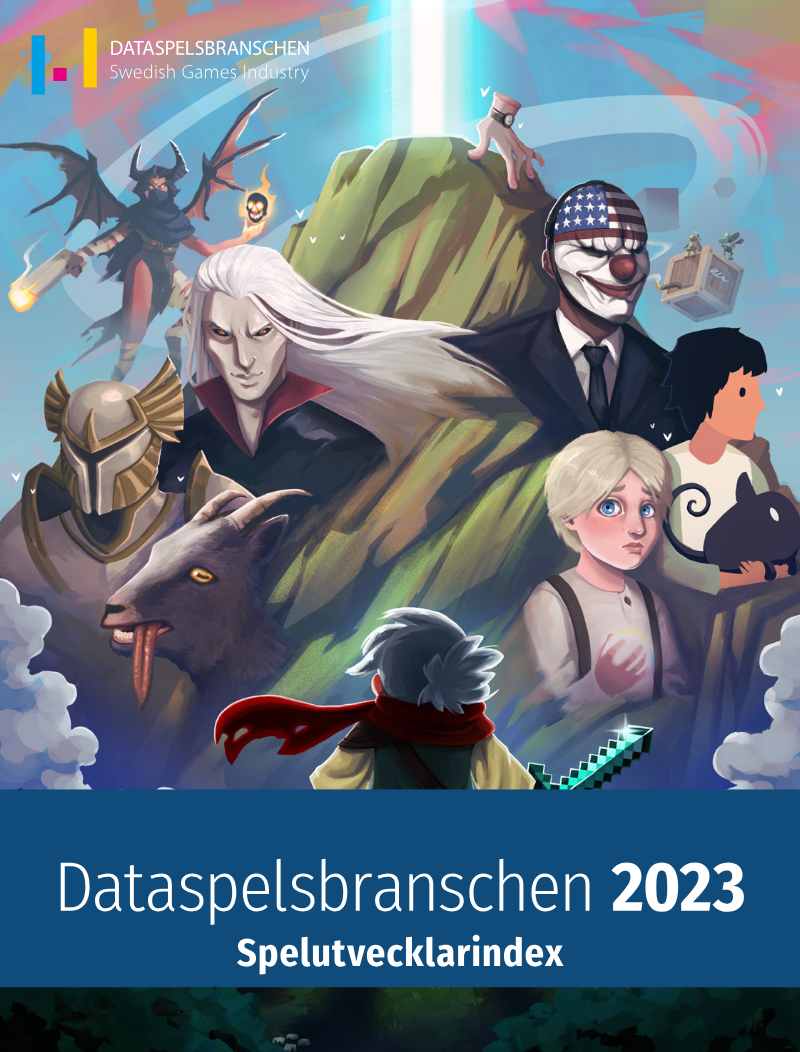
Spelutvecklarindex 2023: Swedish Games Industry
The Swedish games industry serves as a powerhouse of global digital entertainment, characterized by rapid revenue expansion and a vast international footprint. In 2022, the sector generated 86.5 billion SEK in global revenue, marking a 47% increase largely fueled by aggressive acquisition strategies. With 392 Swedish-owned studios operating across 59 countries, the industry employs approximately 25,000 people worldwide, including 8,445 domestic staff. This reach is immense, with Swedish-developed titles accumulating nearly 7 billion downloads and engaging roughly one-quarter of the global population.
Despite this commercial success, the industry faces structural bottlenecks that threaten long-term sustainability. A persistent talent shortage remains the primary constraint on production capacity, exacerbated by challenges regarding work permits and a lack of formal financial support structures for early-stage startups compared to European peers. To mitigate these issues, studios are increasingly leveraging productivity-enhancing technologies like generative AI, standardized game engines, and collaborative regional ecosystems that bridge the gap between specialized education and professional development.
Social and operational evolution remains a core priority for the sector. Efforts to improve gender diversity are yielding tangible results, with women accounting for nearly half of all new hires in 2022, bringing female representation to 23.4% of the workforce. Simultaneously, the industry is pivoting toward broader sustainability goals, focusing on reducing environmental footprints and fostering healthy, inclusive workplace cultures. As the sector navigates the complexities of hybrid work environments and the integration of emerging technologies, it continues to function as a vital catalyst for innovation, driving value that extends well beyond the boundaries of traditional game development.
- The Swedish games industry generated 86.5 billion SEK in global revenue in 2022, representing a 47% year-over-year increase driven largely by acquisition strategies.
- Swedish-owned studios now number 392 across 59 countries, employing 25,000 people globally with 8,445 staff based domestically.
- Swedish-developed titles have reached a massive scale, accumulating nearly 7 billion downloads and engaging approximately 25% of the global population.
- Gender diversity is improving, with women accounting for nearly 50% of all new hires in 2022, raising total female workforce representation to 23.4%.
- A persistent talent shortage and difficulties with work permits remain the primary constraints on production capacity, compounded by a lack of early-stage financial support compared to other European markets.
+2
DataspelsbranschenOct 2023
Presentation14 pages
Results Presentation: First Nine Months 2022
This analysis outlines the financial and operational performance of PCF Group S.A. (People Can Fly) for the first nine months of 2022. The primary thesis centers on the company’s strategic transition toward a self-publishing model and the expansion of its global production capabilities, despite facing financial headwinds due to the termination of a major development agreement with Take-Two Interactive.
Financial data indicates a year-over-year decline in key metrics. Revenue for the first nine months of 2022 reached 130.9 million PLN, compared to 131.8 million PLN in the same period of 2021. EBITDA fell from 54.9 million PLN to 40.3 million PLN, while net profit decreased from 46.4 million PLN to 42.1 million PLN. These declines are attributed largely to the conclusion of the Take-Two partnership. However, the balance sheet shows a significant increase in development work in progress, rising from 25.9 million PLN at the end of 2021 to 95.7 million PLN by September 30, 2022. This shift reflects higher internal resource allocation toward self-published titles.
The geographic and operational scope covers nine locations across Europe and North America, including studios in Warsaw, New York, and Montreal. The workforce grew substantially from 425 employees in September 2021 to 614 by September 2022. The group’s portfolio currently consists of seven projects, including major IPs such as Gemini, Dagger, and Bifrost, alongside VR titles like Thunder and Red. Four of these projects are in the pre-production phase.
Methodologically, the findings are based on consolidated financial results and internal management reporting. The data highlights a pivot from purely work-for-hire contracts to a hybrid model emphasizing intellectual property ownership and independent publishing, supported by a growing international team and the integration of specialized studios like Incuvo for VR development.
- People Can Fly is aggressively pivoting from a work-for-hire model to self-publishing, evidenced by a surge in development work in progress from 25.9 million PLN at the end of 2021 to 95.7 million PLN by September 30, 2022.
- The company experienced a financial contraction in the first nine months of 2022, with EBITDA falling to 40.3 million PLN from 54.9 million PLN and net profit dropping to 42.1 million PLN, largely due to the termination of a major development agreement with Take-Two Interactive.
- The studio is scaling its global operations rapidly, increasing its total headcount by 44% from 425 employees in September 2021 to 614 by September 2022 across nine locations in Europe and North America.
- Revenue remained relatively flat year-over-year at 130.9 million PLN for the first nine months of 2022, compared to 131.8 million PLN during the same period in 2021.
- The current development pipeline consists of seven active projects, including major IPs titled Gemini, Dagger, and Bifrost, as well as VR titles Thunder and Red.
+1
PCF GroupNov 2022
Presentation43 pages
1Q FY2022 Presentation Material: October to December 2021
CyberAgent demonstrated significant financial growth during the first quarter of fiscal year 2022, with consolidated sales reaching 171 billion yen and operating profit increasing nearly threefold to 19.8 billion yen. This performance was primarily catalyzed by the Game business, where sales nearly doubled to 58.3 billion yen. The massive success of Uma Musume Pretty Derby, which surpassed 12 million downloads, drove a 15.1-fold year-over-year increase in operating profit for the segment. Despite this momentum, the inherent volatility of the gaming market led to a cautious approach regarding full-year forecasts.
The Media segment, led by the streaming platform ABEMA, achieved 24.9 billion yen in sales but reported an operating loss of 3.8 billion yen. This deficit reflects aggressive reinvestment into the online betting platform WINTICKET and content expansion, including the acquisition of Babel Label and integration with the Nintendo Switch. ABEMA continues to scale its reach, recording over 76 million downloads and 18 million weekly active users. Meanwhile, the Internet Advertisement business achieved record sales, supported by the launch of three new subsidiaries focused on digital transformation.
The long-term strategic framework involves utilizing high-margin profits from the Advertising and Game segments to fund the evolution of Media into a primary growth pillar and essential social infrastructure. This vision is underpinned by a corporate purpose focused on overcoming economic stagnation through digital innovation and global expansion. Future growth in the gaming sector is anticipated through a robust pipeline of high-profile intellectual properties, including titles based on Final Fantasy VII and Jujutsu Kaisen, while broader corporate sustainability is managed through integrated ESG initiatives.
- CyberAgent’s consolidated sales reached 171 billion yen in 1Q FY2022, with operating profit nearly tripling to 19.8 billion yen.
- The Game business segment saw sales nearly double to 58.3 billion yen, driven by the success of 'Uma Musume Pretty Derby' which exceeded 12 million downloads.
- Operating profit for the Game segment grew 15.1-fold year-over-year, though management remains cautious about full-year forecasts due to gaming market volatility.
- The Media segment, anchored by ABEMA, recorded 24.9 billion yen in sales but incurred an operating loss of 3.8 billion yen due to heavy reinvestment in WINTICKET and content expansion.
- ABEMA reached 76 million total downloads and 18 million weekly active users as of the end of 2021.
+1
CyberAgentJan 2022

Report91 pages
Annual Report 2022
Games Workshop achieved record financial performance for the fiscal year ending May 29, 2022, reporting total revenue of £414.8 million and a profit before tax of £156.5 million. This growth was characterized by a 10% increase in core revenue and a near-doubling of licensing revenue to £28.0 million, bolstered by major agreements with partners such as Nexon. Despite macroeconomic pressures including Brexit-related supply chain costs and the conflict in Ukraine, the group maintained a debt-free balance sheet and continued its policy of returning surplus cash to shareholders, declaring £77.1 million in dividends.
The group’s vertically integrated business model remains centered in Nottingham, UK, supporting a global retail network of 6,200 accounts across 72 countries. Strategic investments focused on "future-proofing" operations, including £16.7 million in design, £5.7 million in tooling, and significant upgrades to North American warehouse capacity and UK manufacturing facilities. While core gross margins faced a 5.6% decline due to rising freight and inventory costs, the licensing division’s high profitability helped offset these operational headwinds.
Sustainability and governance were key areas of focus, with the establishment of a Social Responsibility and Sustainability strategy and a commitment to science-based carbon reduction targets. Although total greenhouse gas emissions rose by 5% due to business expansion, revenue-based emissions intensity decreased by 6%. Governance transitions included a leadership succession plan and the appointment of a new Audit and Risk Committee Chair. The board confirmed the group’s long-term viability through 2025, supported by robust cash reserves and a simplified executive remuneration structure that aligns leadership interests with long-term stability rather than short-term targets.
- Games Workshop achieved record financial performance for the fiscal year ending May 29, 2022, with £414.8 million in total revenue and £156.5 million in profit before tax.
- Licensing revenue nearly doubled to £28.0 million, driven by major partnerships including Nexon, which helped offset a 5.6% decline in core gross margins caused by rising freight and inventory costs.
- The company maintained a debt-free balance sheet and returned £77.1 million in dividends to shareholders, reflecting a continued commitment to surplus cash distribution.
- Strategic capital investment totaled £16.7 million in design and £5.7 million in tooling, alongside significant infrastructure upgrades to North American warehousing and UK manufacturing facilities.
- While total greenhouse gas emissions increased by 5% due to business expansion, the company achieved a 6% reduction in revenue-based emissions intensity.
Games Workshop GroupJan 2022

Report89 pages
Annual Report 2021
Games Workshop achieved record-breaking financial performance for the 2021 fiscal year, with revenue rising 31% to £353.2 million and profit before tax exceeding £150 million for the first time. This growth was primarily driven by the successful launch of the latest edition of Warhammer 40,000 and a 70% surge in online sales, which effectively offset the impact of global retail lockdowns. The company maintained a debt-free balance sheet and a strong cash position of £85.2 million, allowing for a significant increase in dividends to 235 pence per share and the distribution of £13.2 million in profit-share and discretionary bonuses to its global workforce.
The company’s vertically integrated business model remains centered in Nottingham, UK, where it designs and manufactures its core intellectual property. While the UK remains the production hub, the business is increasingly international, with 77% of sales generated globally across 73 countries. North America stands as the largest geographic market, contributing £145.5 million in revenue. To support this global expansion, the group is investing heavily in physical infrastructure, including new warehousing in the UK and US, increased plastic production capacity, and the development of the Warhammer+ subscription service and digital licensing portfolio.
Strategic priorities for the 2021/22 period focus on IP exploitation through media and digital content, alongside a commitment to environmental, social, and governance (ESG) goals. The company reported a 21% reduction in Scope 1 and 2 emissions and formalized an ESG steering group to oversee long-term sustainability. Despite operational challenges related to COVID-19, Brexit, and supply chain disruptions, the group’s high return on capital employed (184%) and robust liquidity position underscore a stable outlook for continued international growth and brand development.
- Games Workshop achieved record financial results in fiscal year 2021, with revenue increasing 31% to £353.2 million and profit before tax surpassing £150 million.
- Online sales surged by 70%, effectively offsetting the impact of global retail lockdowns and supporting the successful launch of the latest Warhammer 40,000 edition.
- The company maintains a debt-free balance sheet with £85.2 million in cash, enabling a dividend increase to 235 pence per share and £13.2 million in employee profit-sharing.
- International expansion remains a core driver, with 77% of total revenue generated outside the UK and North America serving as the largest geographic market at £145.5 million.
- Strategic focus for 2021/22 centers on scaling digital and media IP through the Warhammer+ subscription service and expanding manufacturing infrastructure in the UK and US.
Games Workshop GroupAug 2021
Presentation50 pages
3Q FY2021 Presentation Material: April to June 2021
CyberAgent experienced exceptional financial growth during the third quarter of fiscal year 2021, covering the period from April to June. Consolidated sales reached 192.2 billion yen, representing a 70.3% year-over-year increase, while operating profit surged more than fivefold to 44.5 billion yen. This performance was primarily catalyzed by the Game business, specifically the massive commercial success of Uma Musume Pretty Derby. The title surpassed nine million downloads within five months of its launch, driving segment sales up by 151.7% and operating profit by over 480%. The success of this intellectual property has further expanded into a multi-media franchise encompassing anime, music, and live events, prompting an upward revision of full-year forecasts to 650 billion yen in sales and 100 billion yen in operating profit.
The media segment, led by the streaming platform ABEMA, also demonstrated significant momentum with quarterly sales more than doubling to 10.5 billion yen. Weekly Active Users reached a peak of 14.9 million, supported by high-profile sports broadcasting and original content. A critical component of this segment's monetization strategy is the WINTICKET online betting service, which saw transaction volumes grow 5.5 times year-over-year to 39.3 billion yen through strategic integration with ABEMA’s programming.
Beyond current hits, the strategic focus remains on technological innovation and pipeline development. The advertising business reported high adoption rates for AI-driven creative tools, while the gaming division is preparing for future growth with high-profile upcoming titles based on the Final Fantasy VII and Jujutsu Kaisen franchises. These results indicate a robust diversification strategy where high-performing gaming assets and integrated media services drive record-breaking financial outcomes across the Japanese market.
- CyberAgent’s consolidated sales grew 70.3% year-over-year to 192.2 billion yen in 3Q FY2021, with operating profit increasing more than fivefold to 44.5 billion yen.
- The 'Uma Musume Pretty Derby' game drove a 151.7% increase in gaming segment sales and a 480% surge in operating profit, reaching nine million downloads within five months of launch.
- Driven by the success of 'Uma Musume', CyberAgent revised its full-year forecasts upward to 650 billion yen in sales and 100 billion yen in operating profit.
- The ABEMA streaming platform saw quarterly sales more than double to 10.5 billion yen, supported by a peak of 14.9 million Weekly Active Users.
- The WINTICKET online betting service, integrated with ABEMA, achieved a 5.5-fold year-over-year increase in transaction volume to 39.3 billion yen.
+1
CyberAgentJul 2021

Report25 pages
Intellectual Property in the Mobile Games Market 2021: An Analysis of IPs in U.S. Mobile Gaming
The mobile gaming landscape in the United States is significantly influenced by intellectual property (IP), which serves as a powerful driver for both revenue and user acquisition. While IP-based titles represent only 9 percent of the total mobile game market, they command an outsized share of industry performance, accounting for 23 percent of total player spending and 17 percent of all downloads in 2020. This trend underscores the efficacy of established brands in capturing market attention and maintaining stable growth compared to non-IP titles.
Video game-based IPs are the most dominant category, generating one-third of all licensed mobile game revenue in 2020. Other significant contributors include Manga, which emerged as the fastest-growing IP type with a 54 percent year-over-year revenue increase, followed by Television and Comics. Notably, the Marvel brand maintains a pervasive presence across multiple media formats, illustrating how successful IPs often transcend their original medium to achieve cross-platform dominance.
The impact of IP is most pronounced within mid-core genres, specifically Geolocation AR, Action, RPG, and Shooter. Geolocation AR is almost entirely comprised of licensed titles, while Action, RPG, and Shooter genres show the strongest correlation between IP usage and rapid revenue growth. Conversely, massive categories like Puzzle remain largely untapped by IP, with only 5 percent of revenue derived from licensed games, suggesting a potential area for future expansion.
This analysis utilizes data from the U.S. App Store and Google Play throughout 2020, employing a taxonomy that categorizes IPs originating from films, books, television, toys, celebrities, sports, board games, video games, comics, and manga. The findings suggest that as the mobile marketing landscape evolves, particularly following changes to identifier tracking, the strategic deployment of recognizable IPs will become increasingly vital for developers seeking to build awareness and drive sustainable user acquisition.
- While IP-based games represent only 9 percent of the total U.S. mobile market, they account for 23 percent of player spending and 17 percent of all downloads.
- Video game-based IPs are the leading category, generating one-third of all licensed mobile game revenue in 2020.
- Manga is the fastest-growing IP category, experiencing a 54 percent year-over-year revenue increase.
- IP usage is most concentrated in mid-core genres, with Geolocation AR being almost entirely composed of licensed titles, while Action, RPG, and Shooter genres show the strongest correlation between IP and revenue growth.
- The Puzzle genre remains an untapped opportunity for IP expansion, as licensed titles currently account for only 5 percent of its total revenue.
+3
Sensor TowerJan 2021
Whitepaper49 pages
Manual on International Cooperation for BSR-Wide Game Business Development
The manual summarises all the findings, lessons learnt and conclusions from the work on internationalisation, ideas for cooperation and recommendations to the different actors in game business. für internationale Zusammenarbeit mbH Hamburg Institute of International Economics für internationale Zusammenarbeit mbH Title page: © iStock.com-bedya, EXECUTIVE SUMMARY .4 1.
- The global game market is rapidly growing, with China leading in consumer spending, followed by the US and Japan. European countries, with smaller home markets, must focus on global markets, necessitating internationalization in game incubation.
- International cooperation is crucial for game incubators to stay updated on trends, tools, and opportunities, requiring resources like travel to events and partners, supported by sustainable business models or public funding.
- The Game Camps project (2017-2020), funded by Interreg Central Baltic, fostered cross-border startups by bringing together over 250 game enthusiasts from Finland, Sweden, Estonia, and Latvia, resulting in four new startups and support for over 15 existing ones.
- Establishing a common brand like 'Baltic Sea Games' for the BSR game industry involves questions about who creates and promotes it, their motivations, and target groups. The brand has a logo and social media presence, but its WordPress website is currently an initial landing page.
- Collaborative ecosystem activities, such as strengthening the incubation ecosystem, sharing expertise on specialized topics, and creating international environments for startups, are identified as key areas where transnational efforts can significantly boost quality and impact.
+1
BGZ Berliner Gesellschaft für internationale Zusammenarbeit mbHJan 2020

Report16 pages
Spillrapporten 2019/2020
Norsk spillbransje En global bransje Utfordringer og i dag i vekst muligheter «For å få oversikt over potensialet og utviklingen i dataspillbransjen er det viktig med et godt kunnskapsgrunnlag om spillbransjen og markedet, herunder tall og statistikk som er sammenliknbare med andre næringer og andre Sitatet over er hentet fra regjeringens ferske dataspill Vår ambisjon er at denne statistikken skal oppdateres og strategi, «Spillerom», for perioden 2...
- The Norwegian gaming industry's gross turnover from games was 550 million NOK in 2018, with 388 million NOK directly by companies and 162 million NOK through other distribution channels.
- Export revenue from Norwegian games is significant, estimated at 377 million NOK in 2018, substantially higher than the 87.3 million NOK from Norwegian film exports in 2015.
- Funcom is the largest company in the Norwegian gaming industry, a pattern seen in Finland (Supercell accounted for 88% of turnover in 2015) and Sweden, where dominant players drive overall industry growth.
- Access to private capital is a major barrier for growth in the Norwegian gaming industry, as many small companies with low equity struggle to secure funding for long development cycles.
- The Norwegian Film Institute (NFI) provided 23.7 million NOK in grants to data games in 2018, with 13.7 million NOK (58%) going to professional companies, indicating a focus on smaller-scale game development rather than growth-phase companies.
+1
Norsk Spill- og MultimedieforeningJan 2020

Whitepaper59 pages
Guide RGPD pour les Développeurs de Jeux Vidéo
Le Règlement général pour la protection des données (RGPD) constitue le texte de référence en matière de protection des données personnelles au sein de l’Union Européenne. Les principaux objectifs du RGPD sont d'accroître à la fois la protection des personnes concernées par un traitement de leurs données à caractère personnel et la responsabilisation des acteurs de ce traitement.
- The GDPR significantly increases potential penalties for non-compliance, with fines up to 20 Million Euros or 4% of annual global turnover, a substantial increase from the previous 3 Million Euros maximum under the 1978 French law.
- Data Protection Officers (DPOs) are not held responsible for GDPR non-compliance; the data controller or processor bears this responsibility. DPOs cannot be penalized for performing their duties due to their independence, though they can be dismissed for reasons unrelated to their DPO role.
- Consent under GDPR must be a free, specific, informed, and unambiguous indication of the data subject's wishes, given by a statement or clear affirmative action, and the data controller must be able to prove valid consent.
- Processing 'sensitive data' (special categories of personal data) is generally prohibited unless specific exceptions apply, such as explicit consent from the data subject for defined purposes.
- Data controllers must facilitate the exercise of data subjects' rights (access, rectification, erasure, etc.), responding within one month (or two for complex cases) and providing reasons if a request is denied, with these services generally being free unless requests are unfounded or repetitive.
reTeenmeepeJan 2018

Report34 pages
The Data Behind 10 Years of Google Play (2018)
This analysis examines the growth and performance of the Google Play Store over a nearly seven-year period, spanning from January 2012 to August 2018. Utilizing data from the App Annie platform, the findings track the evolution of the Android ecosystem from its early stages to a mature marketplace featuring over 2.8 million available apps. During this timeframe, the platform recorded nearly 330 billion total downloads and generated over $85 billion in consumer spend, with more than 5,000 individual apps surpassing the $1 million revenue milestone.
Geographic trends reveal a significant divide between volume and value. India leads the world in total downloads at 36.9 billion, followed closely by the United States and Brazil. However, Japan emerges as the most lucrative market, contributing $25.1 billion in consumer spend, significantly outpacing the United States and South Korea. The data highlights a shift in monetization strategies, particularly the 2017 transition toward in-app subscriptions. This change, supported by a reduction in Google’s transaction fees for long-term subscribers, resulted in a 55% growth in spend for non-gaming apps between 2016 and 2017.
The competitive landscape is dominated by major social media and gaming entities. Facebook-owned properties occupy the top four spots for all-time downloads, while LINE and Tinder lead in non-gaming consumer spend. In the gaming sector, Subway Surfers is the most downloaded title, but GungHo Online’s Puzzle & Dragons and Mixi’s Monster Strike lead in total revenue. Looking forward, the analysis projects continued aggressive growth, estimating that annual consumer spend on Google Play will reach $42 billion by 2022, a 90% increase from 2017 levels.
- Between 2012 and 2018, the Google Play Store generated over $85 billion in consumer spend across 330 billion total downloads, with more than 5,000 apps surpassing the $1 million revenue milestone.
- Annual consumer spend on Google Play is projected to reach $42 billion by 2022, representing a 90% increase from 2017 levels.
- While India leads in total download volume with 36.9 billion, Japan is the most lucrative market, contributing $25.1 billion in total consumer spend.
- A 2017 shift toward in-app subscriptions, supported by reduced transaction fees for long-term subscribers, drove a 55% growth in non-gaming app spend.
- Facebook-owned properties hold the top four spots for all-time downloads, while LINE and Tinder lead non-gaming consumer spend.
+3
data.aiJan 2018

Report104 pages
State of the Polish Video Game Industry 2017
This report was made possible thanks to funding provided by the Ministry of Culture and National Heritage, the Ministry of Development, Creative Europe Desk Poland and the Agency The research part of the project was coordinated by the Kraków Technology Park. The partners of the report include the Polish Games Association, Indie Games Poland Foundation, Grupa Onet S.A. and Gry-Online S.A.
- The Polish video game industry is growing, with 13 companies listed on the Warsaw Stock Exchange (WSE) having a combined worth of nearly PLN 9.5 billion and generating PLN 270 million in earnings last year. These WSE-listed developers contributed over PLN 67 million in taxes to the Polish treasury in 2016.
- Poland is a significant test market for game soft launches, particularly for mobile games, due to its comparable market significance to the US, UK, or Germany, and lower user acquisition costs compared to Western or Asian markets. While the percentage of paying players and amounts spent are lower than in Western Europe or North America, the gap is narrowing.
- The PlayStation brand, especially the PS4, dominates the console market in Poland, significantly outselling Xbox One. This trend is partly attributed to the high system requirements of cross-platform titles like The Witcher 3: Wild Hunt, which encouraged many PC players to switch to consoles for a smaller hardware investment.
- The age distribution of Polish gamers shifted in 2016, with a significant decrease in the 15-24 age group (from 43% in 2015 to 31% in 2016), largely due to their migration from social network and PC gaming to mobile games (a 5% increase in mobile gaming for this age group).
- Asian companies are increasingly acquiring Western game developers and publishers, a trend observed over the past 1.5 years, with examples including Youzu buying Bigpoint, Netmarble acquiring Kabam, and Tencent purchasing Supercell. This indicates a growing interest from Asian giants and media conglomerates in the global video game market.
+2
Kraków Technology ParkJan 2017

Whitepaper34 pages
Le Marché Illicite de la Distribution Digitale de Jeux Vidéo sur PC: France
SYNDICAT NATIONAL DU JEU VIDÉO jeux pc et parasitisme 6 1.1 canaux d’exploitation officiels provoqué par le marché des jeux vidéo pc illicite par téléchargement 11 1.2 émergence et consolidation 23 1.3 agissements illégaux à la base développement du marché illicite efficacement contre le 30 2.1 tarir les sources marché illicite d’approvisionnement 33 2.2 permettre une meilleure distribution officiels et de leur Ce document est destiné à des plate...
- The digital PC game market in France is significantly impacted by an illicit market, where game keys are resold at prices up to 60% lower than official retail prices, often before a game's release, leading consumers to perceive official prices as too high.
- This illicit market is fueled by geographical price differences (e.g., keys sold for €19 in Poland vs. €49 in France) and physical wholesalers reselling keys from boxed games to unofficial sites, with German wholesaler Gross Electronic GmbH identified as a major supplier to MMOGA.com from 2013-2015.
- Major illicit platforms like MMOGA (sold for €306M in 2015 with over €100M revenue) and G2A operate from offshore locations (e.g., Hong Kong, Eastern Europe) to avoid European VAT and consumer protection laws, despite often having significant European customer bases (e.g., over 60% French audience for some sites).
- These illicit sites exploit loopholes in VAT collection by registering offshore, though EU rules since 2015 require VAT to be paid based on the buyer's location; they also benefit from search engines like Google and specialized price comparison sites (e.g., Allkeyshop, DLcompare) promoting their discounted offers.
- The illicit market is characterized by widespread VAT fraud and non-compliance with consumer protection laws, with authorities largely inactive in pursuing these offshore entities despite clear evidence of local ties (e.g., French-speaking support, local payment systems like Hipay, significant local social media presence).
+1
Syndicat National du Jeu VidéoJan 2015