Key insights
7 slides
The shift
People Can Fly is pivoting from work-for-hire to self-publishing.
The company is transitioning toward a self-publishing model and expanding its global production capabilities.
The decline
EBITDA and net profit fell in the first nine months of 2022.
EBITDA fell from 54.9 million PLN to 40.3 million PLN, while net profit decreased from 46.4 million PLN to 42.1 million PLN. These declines are attributed largely to the conclusion of the Take-Two partnership.
Page 12 of the report202027.5
202154.9
202240.3
Flat revenue
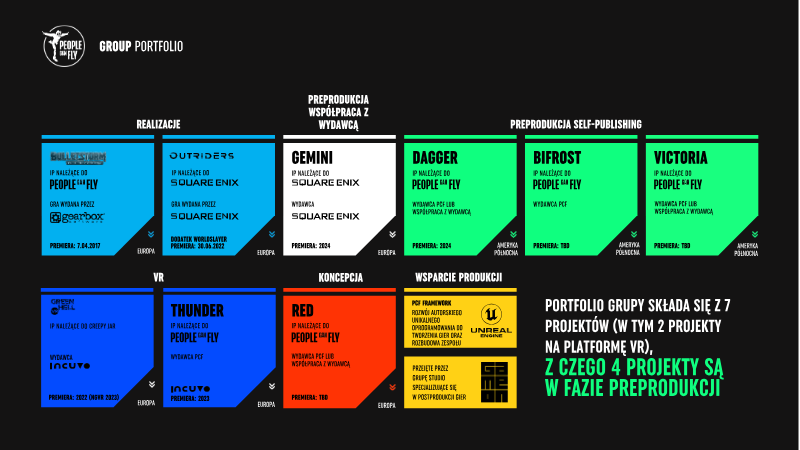
Revenue remained relatively flat year-over-year at 130.9 million PLN.
Revenue for the first nine months of 2022 reached 130.9 million PLN, compared to 131.8 million PLN in the same period of 2021. The geographic and operational scope covers nine locations across Europe and North America.
Headcount growth
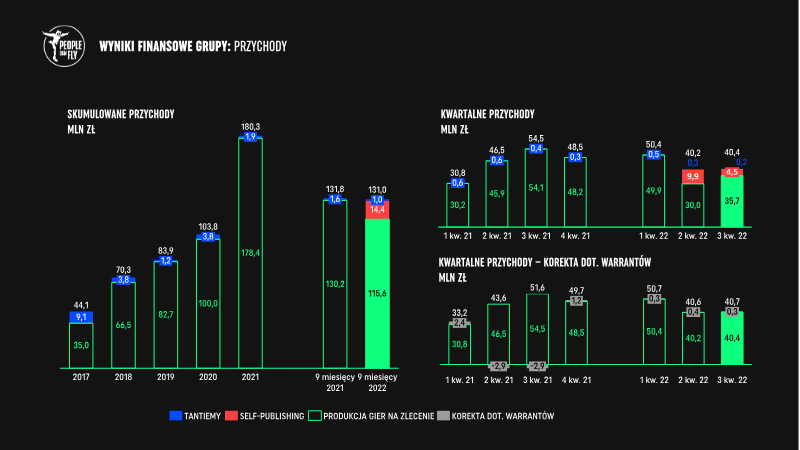
The workforce grew from 425 to 614 employees by September 2022.
The studio is scaling its global operations rapidly, increasing its total headcount by 44% from 425 employees in September 2021 to 614 by September 2022. The group operates across nine locations in Europe and North America.
The pipeline
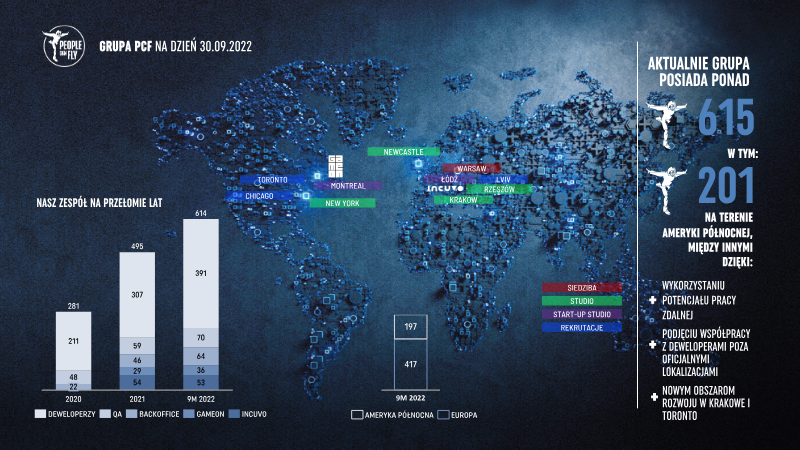
The development pipeline consists of seven active projects.
The portfolio includes major IPs such as Gemini, Dagger, and Bifrost, alongside VR titles like Thunder and Red. Four of these projects are in the pre-production phase.
Balance sheet
Development work in progress rose to 95.7 million PLN.
The balance sheet shows a significant increase in development work in progress, rising from 25.9 million PLN at the end of 2021 to 95.7 million PLN by September 30, 2022. This shift reflects higher internal resource allocation toward self-published titles.
The model
The company is moving to a hybrid model emphasizing IP ownership.
The findings are based on consolidated financial results and internal management reporting. The data highlights a pivot from purely work-for-hire contracts to a hybrid model emphasizing intellectual property ownership and independent publishing.
1 / 7
Ask AI about this report