
Wolfenstein 3D
GameBy id Software · Released May 5, 1992
Documents about Wolfenstein 3D

Thomas Brush6 min
This Is Why Your Indie Game Will Fail
The primary driver of commercial success in the video game industry is the presence of a unique, distinctive hook that differentiates a title from existing market offerings.
- Commercial success in the modern game industry is primarily driven by a unique, distinctive hook that differentiates a title from existing market offerings.
- Games lacking a clear, defining hook are considered derivative and face a significantly higher risk of failing to achieve viral success or financial viability.
- A game's defining hook does not need to be present at the start of development; for example, the iconic bullet-time mechanic in Max Payne was only introduced halfway through production.
Thomas BrushNov 2022

Game Developers Conference56 min
The Early Days of id Software
The founding of id Software marked a pivotal shift in PC gaming, driven by a breakthrough in smooth, pixel-by-pixel scrolling that enabled the creation of the Commander Keen trilogy.
- Between the early 1990s and mid-1990s, id Software produced 28 games in five and a half years, including industry-defining titles like Wolfenstein 3D, Doom, and Quake.
- The studio pioneered the modern game engine licensing model, which was catalyzed by a technical breakthrough in smooth, pixel-by-pixel scrolling used in the Commander Keen trilogy.
- Development efficiency was maintained by a strict policy of not reusing code between major projects, ensuring every title was built on a fresh, optimized foundation.
Game Developers ConferenceOct 2016
Game Developers Conference59 min
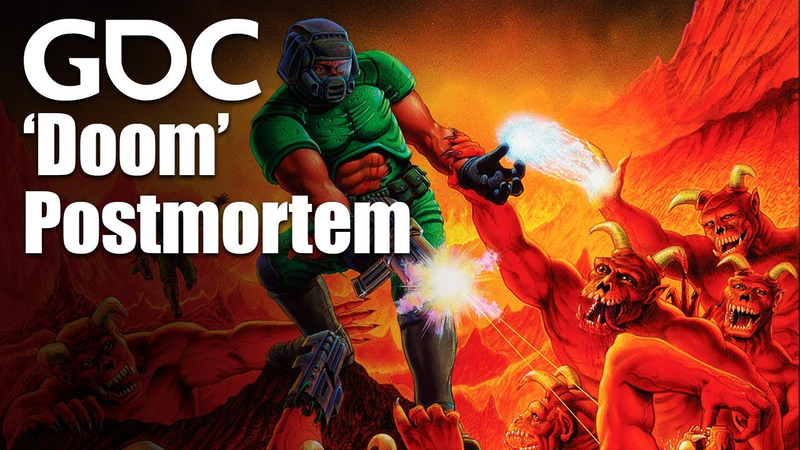
'Doom:' A Classic Game Postmortem
The development of Doom, initiated in late 1992, represents a pivotal evolution in first-person shooter design, transitioning from the rigid, military-themed architecture of its predecessor, Wolfenstein 3D, toward a more abstract and atmospheric aesthetic.
- Released on December 10, 1993, 'Doom' revolutionized the first-person shooter genre by shifting from the rigid architecture of 'Wolfenstein 3D' to complex, non-orthogonal environments enabled by Binary Space Partitioning trees.
- The development team prioritized high-speed, skill-based gameplay over complex narrative or inventory systems, utilizing NeXT workstations to achieve technical performance that exceeded contemporary hardware limitations.
- The project was defined by a lack of formal pre-production and significant internal creative friction, which led to key personnel changes and the abandonment of external collaborations like a proposed 'Aliens' project.
Game Developers ConferenceMay 2016