
The Banner Saga
GameBy Stoic · Released Jan 14, 2014
The Banner Saga is a Viking-themed tactical role-playing video game.
Connections
Each row is a game or company named alongside The Banner Saga, each column a document, oldest first. A mark means that document names it. Select a row to see those documents.
About the game
- Released
- Jan 14, 2014
- Developer
- Stoic
- Publisher
- Versus Evil
- Genres
- Role-playing (RPG), Simulator, Strategy, Tactical, Indie
- Platforms
- PlayStation 4, Linux, Android, PC (Microsoft Windows), iOS, Mac, Xbox One, Nintendo Switch
- Links
- Wikipedia
Game data from IGDB.com
Documents about The Banner Saga
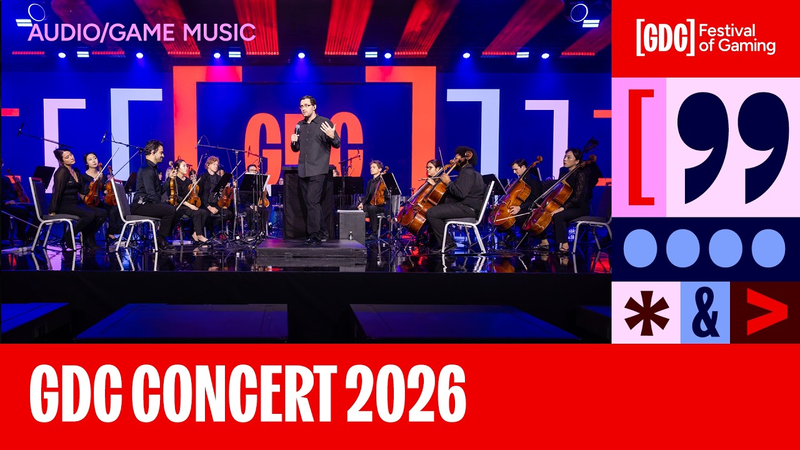
GDC Concert 2026: Expedition 33, Hades II, DOOM (2016), and more; feat. Austin Wintory & Troy Baker
The 2026 GDC Developer’s Concert serves as a comprehensive celebration of the evolution of video game music, tracing its trajectory from technically constrained early compositions to the sophisticated, emotionally resonant orchestral scores defining modern titles.
- The GDC Developers Concert, held during the March 2026 festival, featured live orchestral performances of scores from titles including Hades II, Rift of the Necrodancer, ABZU, and Clair Obscur: Expedition 33.
- Composer Austin Wintory and voice actor Troy Baker co-hosted the event, emphasizing the importance of integrating voice acting and musical composition early in the game development process.
- The concert served as a platform to highlight emerging talent, specifically showcasing first-time commercial releases from composers alongside established industry veterans.
Why You Can't Crowdfund Video Games | Design Club
Crowdfunding serves as an ineffective and unsustainable primary model for financing modern video game development.
- Crowdfunding is not a viable primary funding model for modern video game development because the actual costs of production—often millions of dollars for a two-year project—far exceed what can realistically be raised through public campaigns.
- Over a 16-year period, only about 60 video game projects have successfully raised more than $1 million on Kickstarter, highlighting how rare high-level crowdfunding success is for the industry.
- Successful crowdfunding campaigns often function as pre-order platforms rather than development funding, requiring developers to already possess a playable alpha or significant concept art to attract backers.
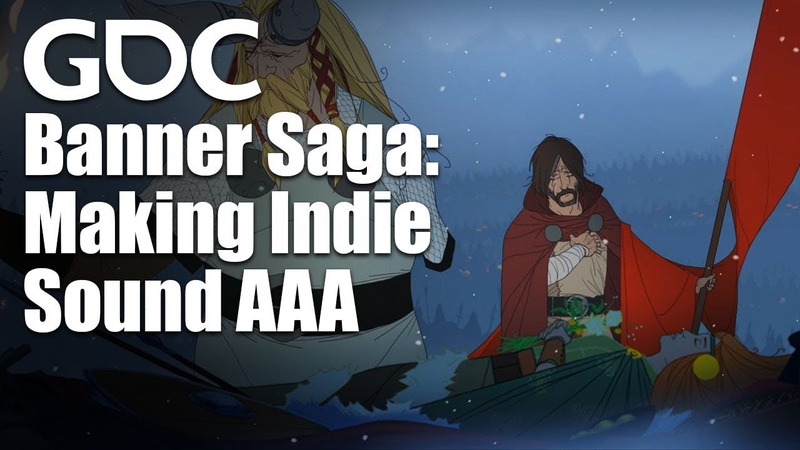
The Banner Saga Franchise: Making Indie Sound AAA
The Banner Saga trilogy demonstrates that high-fidelity, AAA-quality audio is achievable within indie-budget constraints through strategic creative choices and unconventional financial models.
- To achieve a high-production sound on a limited indie budget, embrace creative constraints by using specialized ensembles—such as the Dallas Wind Symphony—rather than attempting to replicate a full orchestral score.
- Leverage non-traditional talent pools like YouTube stars (e.g., Peter Hollens) to provide unique, cost-effective, and high-quality vocal performances that add a distinct emotional core to the project.
- When recording budgets are tight, prioritize spending on crucial, high-impact moments rather than spreading resources thin across the entire score, filling the gaps with creative sound design and smaller, specialized instrument groups.
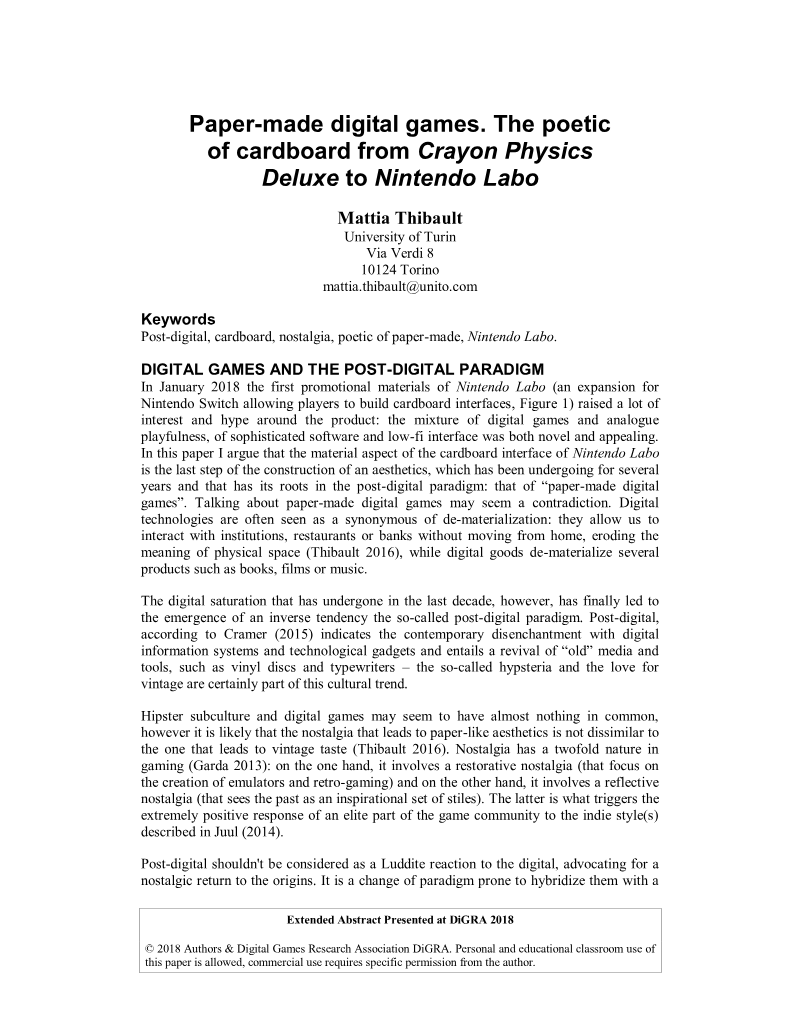
Paper-Made Digital Games: The Poetic of Cardboard from Crayon Physics Deluxe to Nintendo Labo
The paper argues that the cardboard interfaces of Nintendo Labo, released in 2018, represent the culmination of a broader aesthetic movement in digital games that Mattia Thibault calls "paper-made digital games."
- Mattia Thibault's paper argues that Nintendo Labo (2018) is the culmination of a broader aesthetic movement he calls "paper-made digital games," in which the material presence of cardboard is deliberately poetic rather than merely practical.
- The author draws on the post-digital paradigm, which describes contemporary disenchantment with digital systems and renewed appreciation for analogue media, to explain the appeal of paper and cardboard in games.
- The paper proposes a three-part typology of paper-made games by depth of material relationship: imitation (e.g., Crayon Physics Deluxe, Tearaway), digitization (e.g., Cuphead, The Banner Saga, Lumino City), and hybridization, where cardboard becomes part of the interface (e.g., Google Cardboard, Nintendo Labo).
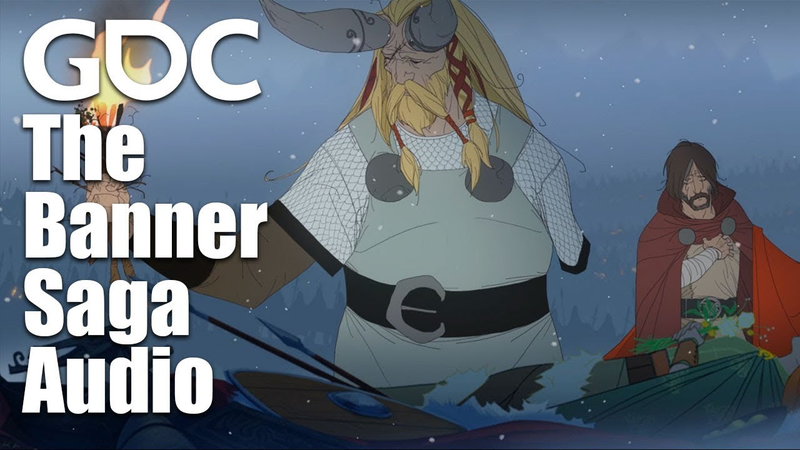
The Banner Saga Audio
Creative success in game audio relies on the composer’s willingness to make bold, intentional choices that prioritize artistic identity over industry-standard conventions.
- The core of successful game composition is 'owning your choices' by committing fully to creative decisions, regardless of how novel or unconventional they may seem.
- When scoring games, composers should prioritize an overarching musical structure to prevent the game's non-linear mechanics from causing the soundtrack to feel like a collection of disconnected musical universes.
- Musical choices should be derived organically from the game's specific mechanics and narrative themes rather than relying on direct, on-the-nose cultural or genre-based corollaries.