King of Thieves
Game
8 documents in the library are about King of Thieves, from writers such as Deconstructor of Fun, Nazara Technologies and Game Developers Conference. Each has a summary and key insights with the page they come from.
Connections
Each row is a game or company named alongside King of Thieves, each column a document, oldest first. A mark means that document names it. Select a row to see those documents.
Key figures from the reports
Nazara acquired C.A.T.S. and King of Thieves from ZeptoLab for an aggregate consideration of US$7.7 million, with asset ownership housed directly under the parent company.
Nazara Technologies, 2025 · Nazara Technologies 26th Annual Report 2024-25, p. 12
In the case of King of Thieves, optimizing early-stage retention during soft launch—increasing D1 from 26% to 57% and D7 from 9% to 32%—resulted in an LTV increase of more than 25 times by the time of global launch.
Deconstructor of Fun, 2020 · Long-Term Retention: Why D180 is the New D30
Documents about King of Thieves


Nazara Technologies Annual Report FY 2025-26
Nazara Technologies Limited's FY 2025-26 annual report covers India's only publicly listed gaming company, which describes itself as a diversified global gaming and interactive entertainment platform spanning mobile gaming, PC and console publishing, offline entertainment, esports, sports media and adtech.
- Consolidated revenue reached 1,829 Crores and EBITDA reached a record 255 Crores in FY 2025-26, with the company citing a 66% year-on-year EBITDA increase.
- Gaming's share of group EBITDA rose from 56% in FY 2024-25 to 90% in FY 2025-26.
- The US and UK together contributed 67% of gaming revenue in FY 2025-26, and the company says more than 90% of gaming revenue came from international markets.



Nazara Technologies 26th Annual Report 2024-25
Nazara Technologies Limited's 26th Annual Report for FY 2024-25 presents the India-listed gaming company's consolidated results, segment performance, governance disclosures and audited financial statements for the year ended March 31, 2025.
- Nazara reported consolidated revenue of ₹1,623.9 crores and its highest-ever EBITDA of ₹153.5 crores for FY 2024-25.
- The Gaming segment reported ₹518.2 crores in revenue with a 19.9% margin, while Others contributed ₹1,109 crores at a 7.3% margin.
- Fusebox Games reported revenue of ₹161.7 crores from August 22, 2024, with EBITDA of ₹30.2 crores.
Nazara Technologies Investor Presentation: Quarter Ended December 31, 2024
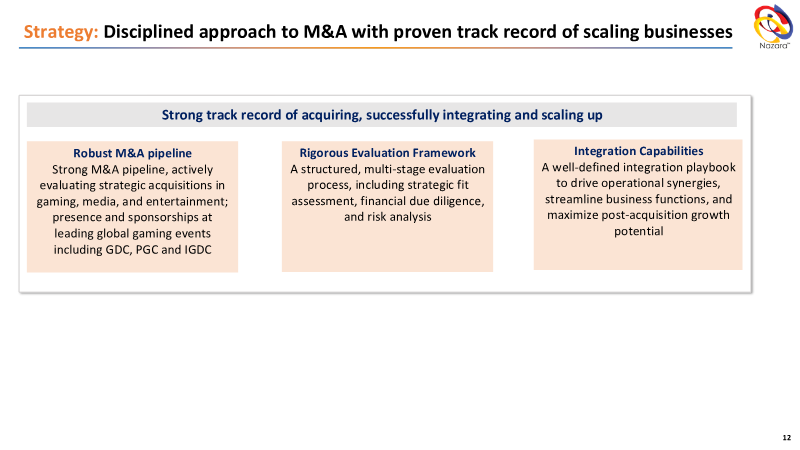
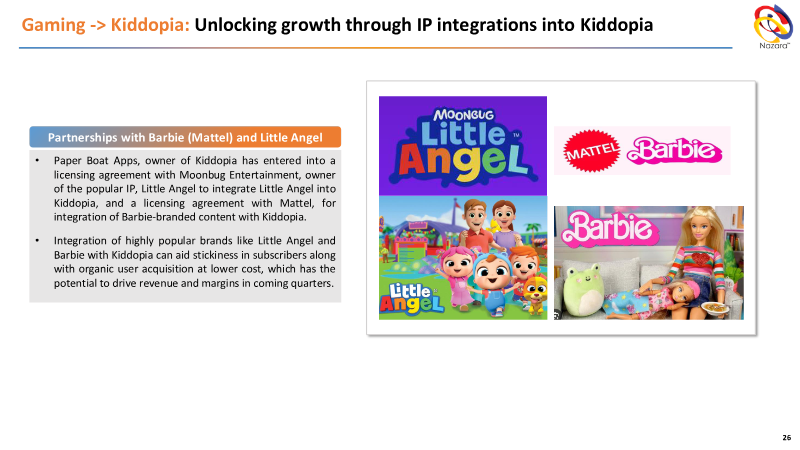
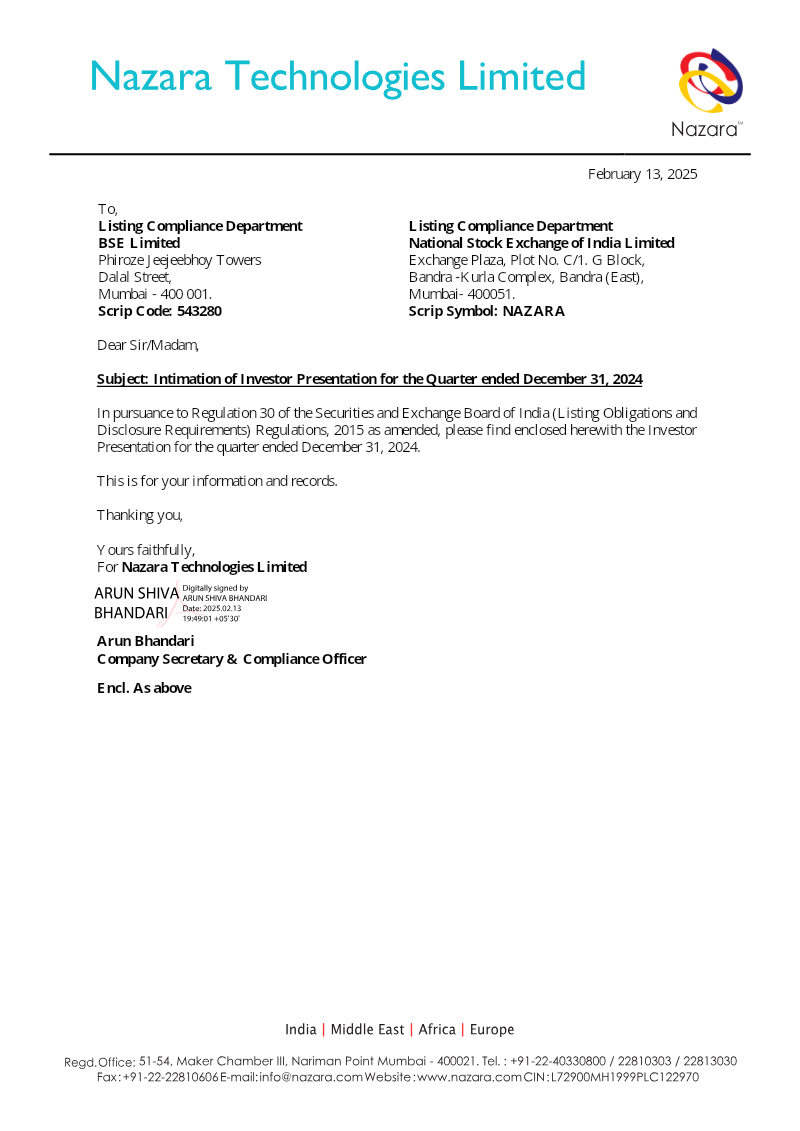
Nazara Technologies Limited, an Indian gaming and entertainment company listed on BSE and NSE, filed this investor presentation on February 13, 2025 under SEBI listing regulations, covering the quarter ended December 31, 2024 (Q3FY25) and nine months to that date (9MFY25).
- Consolidated Q3FY25 revenue from operations was INR 534.7 crores, up 66.9% year on year, with EBITDA of INR 52.4 crores.
- Gaming segment revenue reached INR 154.9 crores in Q3FY25, up 53% year on year, with a 22.2% EBITDA margin.
- Q3FY25 profit before tax and profit after tax declined year on year, which the company attributed to a one-time impairment.

Long-Term Retention: Why D180 is the New D30
Mobile game teams overwhelmingly optimize for Day-1, Day-7, and Day-30 retention, but sustained success and a place in the top-grossing charts depend on retention beyond Day 30.
- Long-term retention (D180) is a more critical indicator of a game's growth potential and sustainable revenue than short-term metrics like D30, as games with poor long-term retention eventually reach a plateau where churn equals new user acquisition.
- Games with high long-term retention often exhibit lower initial short-term retention because their depth and complexity create a higher entry threshold, appealing to a specific, dedicated audience rather than a broad casual base.
- The shape of the retention curve is a more reliable indicator of success than any specific D180 value; developers should aim for a curve that flattens out and runs parallel to the x-axis within 30 to 60 days.

How To Use Data to Build and Grow Hit Games: Part 2
Oleg Yakubenkov of GoPractice argues that mobile game teams should treat data as a decision-making tool for reducing uncertainty and product risk early, rather than as a retrospective reporting device.
- A game is likely to achieve top-ranking status and organic growth if it outperforms competitors in key metrics, specifically by maintaining higher retention, higher LTV, and lower CPI than similar titles in its sub-category.
- Small changes in game economy can have catastrophic, unintended consequences, such as the case where a minor gold-bonus adjustment in 'King of Thieves' triggered uncontrollable inflation, ruined monetization, and decreased retention.
- A single A/B test on a game icon can have a compounding effect on growth; in one instance, a new icon increased page conversion by 80% but resulted in a 200% increase in total downloads due to improved click-through rates in app store recommendation algorithms.

How to Use Data to Build and Grow Hit Games: Part 1
Data in mobile game development, argues GoPractice CEO Oleg Yakubenkov, should be treated as a forward-looking tool for making decisions, reducing uncertainty, and eliminating major product risks as early as possible, rather than as a means of reviewing past performance.
- Use market testing tools like Geeklab to validate user interest and estimate CPI before full-scale development to avoid wasting resources on products the market does not want.
- Analyze the behavior of retained versus churned users by mapping event sequences to identify core engagement loops, such as the discovery that forcing PvP engagement increased Day 7 retention from 9% to 20%.
- Before entering a market segment, evaluate competitor performance using tools like App Annie or Datamagic to ensure the niche is growing, has manageable competition, and offers a clear path for differentiation.


King of Thieves: Designing a F2P Game That's Different
A presentation by Eugene Yailenko, Senior Game Designer at ZeptoLab, traces the design of King of Thieves, which was released in February 2015, reached 24 million downloads, and had two years in development.
- Day 1 retention rose from 26% in Version 1 to 57% at the global launch, and Day 7 retention rose from 9% to 32% over the same versions.
- Version 2.1 was presented as an experiment with a new economy: 10x upgrade cost increase, 5x timer duration increase, and a 10x decrease in coin cost.
- Version 3 reported Day 1 retention of 45% and LTV of 10x, and its plan included leagues instead of a single leaderboard.
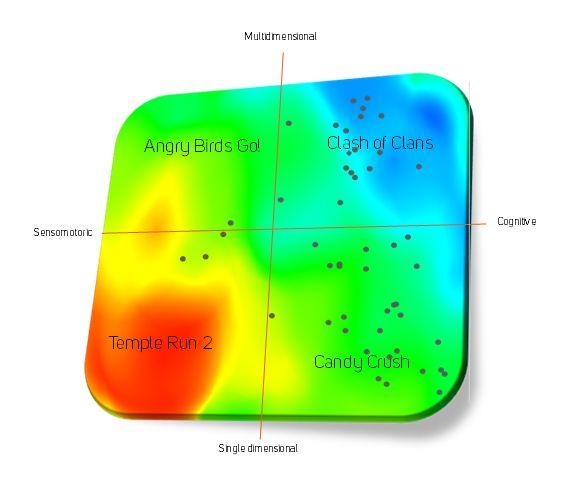
Game Refinery Fact Snippets Vol. 2: In-app Purchases
Mobile game design in the free-to-play era demands a more flexible way of classifying titles, and this 2015 installment of GameRefinery's series applies that framework to sensomotoric games in the US iOS market.
- Sensomotoric games, which focus on aiming and reaction-based mechanics, struggle more with monetization and retention in the current free-to-play market compared to slower-paced cognitive games.
- Developers should move away from being overly protective of hard currency by rewarding players with it through gameplay, such as leveling up or participating in tournaments, rather than requiring real-money purchases for every item.
- Incorporating non-linear level progression, such as offering special side stages alongside a main path, improves a game's chances of success by providing players with a sense of choice and freedom.
Companies behind it

As the documents state it.