Far Cry 4
11 documents in the library are about Far Cry 4, from writers such as Ubisoft and Game Developers Conference, the newest from 2018. Each has a summary and key insights with the page they come from.

Discover the most diverse Far Cry world ever created. With terrain spanning from lush forests to the snowcapped Himalayas, the entire world is alive… and deadly. From leopards, rhinos, black eagles, and vicious honey badgers, Kyrat is home to abundant wildlife. As you embark on your hunt for resources, know that something may be hunting you... Scout enemy territory from above in the all-new gyrocopter and then plummet back to earth in your wing suit. Climb aboard the back of a six-ton elephant and unleash its raw power on your enemies. Choose the right weapon for the job, no matter how insane or unpredictable that job might be. With a diverse arsenal, you’ll be prepared for anything.
- Released
- Nov 18, 2014
- Developer
- Ubisoft Montreal
- Publisher
- Ubisoft Entertainment
- Genres
- Shooter, Tactical, Adventure
- Platforms
- Google Stadia, Xbox Series X|S, PlayStation 3, PlayStation 4, PC (Microsoft Windows), PlayStation 5, Xbox 360, Xbox One
- Links
- Wikipedia
Game data from IGDB.com
Key figures
Back-catalog sales increased by 59.3%, driven by sustained demand for Assassin's Creed Unity, Far Cry 4, The Crew, and Watch_Dogs.
Ubisoft, 2015 · Ubisoft Reports First Quarter 2015-16 Sales, p. 1
Market share grew to 12.8% in 2014, up from 9.6% the previous year, driven by titles including Assassin’s Creed, Far Cry 4, The Crew, and Watch Dogs.
Ubisoft, 2015 · Ubisoft Third Quarter 2014-15 Sales Results, p. 1
At E3 2014, Ubisoft secured a 27% share of total YouTube views, driven by high interest in upcoming titles Assassin’s Creed Unity and Far Cry 4.
Ubisoft, 2014 · Ubisoft Reports First Quarter 2014-15 Sales, p. 1
Documents about Far Cry 4

Fast Iteration for Far Cry 4 - Optimizing Key Parts of the Dunia Pipeline
The development of Far Cry 4 necessitated a fundamental overhaul of the Dunia engine pipeline to address the productivity bottlenecks that plagued previous projects.
- By implementing a central build cache that shares object files between users, the team reduced full rebuild times for the PC release target from 40 minutes to under 58 seconds.
- The pipeline was optimized for massive parallelization, utilizing a 32-core machine to spawn over 1,000 processes simultaneously for efficient task distribution.
- To eliminate redundant data distribution, the team implemented a slicing system that breaks packages into parts, hashes them using MD5, and only distributes the specific parts that have changed.

Rendering the World of Far Cry 4
The development of Far Cry 4 centered on the implementation of a physically based rendering pipeline designed to achieve high-fidelity material realism while maintaining performance across five distinct hardware platforms.
- The development team implemented a physically based rendering (PBR) pipeline using the Disney BRDF model, incorporating metallic and anisotropic parameters to achieve high-fidelity material realism across five hardware platforms.
- A custom anti-aliasing solution combining SMAA with temporal super-sampling achieved high-fidelity image quality at a performance cost of only two milliseconds.
- The transition to a GPU-based virtualized radiance transfer system eliminated CPU-GPU synchronization bottlenecks, while offline G-buffer baking and real-time GPU filtering reduced memory overhead by approximately two megabytes.

Adaptive Virtual Texture Rendering in Far Cry 4
Adaptive Virtual Texture rendering serves as a foundational technology for Far Cry 4, enabling the display of high-fidelity terrain and thousands of procedural decals without exceeding strict memory constraints.
- Ubisoft's Adaptive Virtual Texture (AVT) rendering technique allows for the rendering of thousands of terrain decals in under 1 millisecond, achieving a high resolution of 10 pixels per centimeter.
- The AVT system dynamically adjusts texture resolution based on camera distance by dividing the world into 64x64 meter sectors, allocating larger virtual image sizes for sectors closer to the camera and smaller sizes for those further away.
- To minimize memory footprint and bandwidth, the system uses a 32-bit page ID buffer during the G-buffer rendering pass, with bits allocated specifically for page ID, mipmap level, and virtual image size.

Far Cry 4: Gameplay Team Workflow, Iteration and Philosophy
The development of Far Cry 4 centered on a cross-functional, autonomous team structure designed to prioritize systemic gameplay and player agency over mere visual fidelity.
- The development team utilized a cross-functional, autonomous structure that embedded programmers, animators, designers, and testers into single units to prioritize systemic gameplay and player agency over visual fidelity.
- Development was managed across six global locations by treating remote studios as integrated partners rather than traditional outsourcing vendors, utilizing dedicated co-dev teams to manage communication and ownership boundaries.
- The project employed a rigorous de-risking strategy that evaluated the return on investment for every mechanic, resulting in the elimination of features that lacked depth or introduced excessive technical debt.
Ubisoft Reports First Quarter 2015-16 Sales
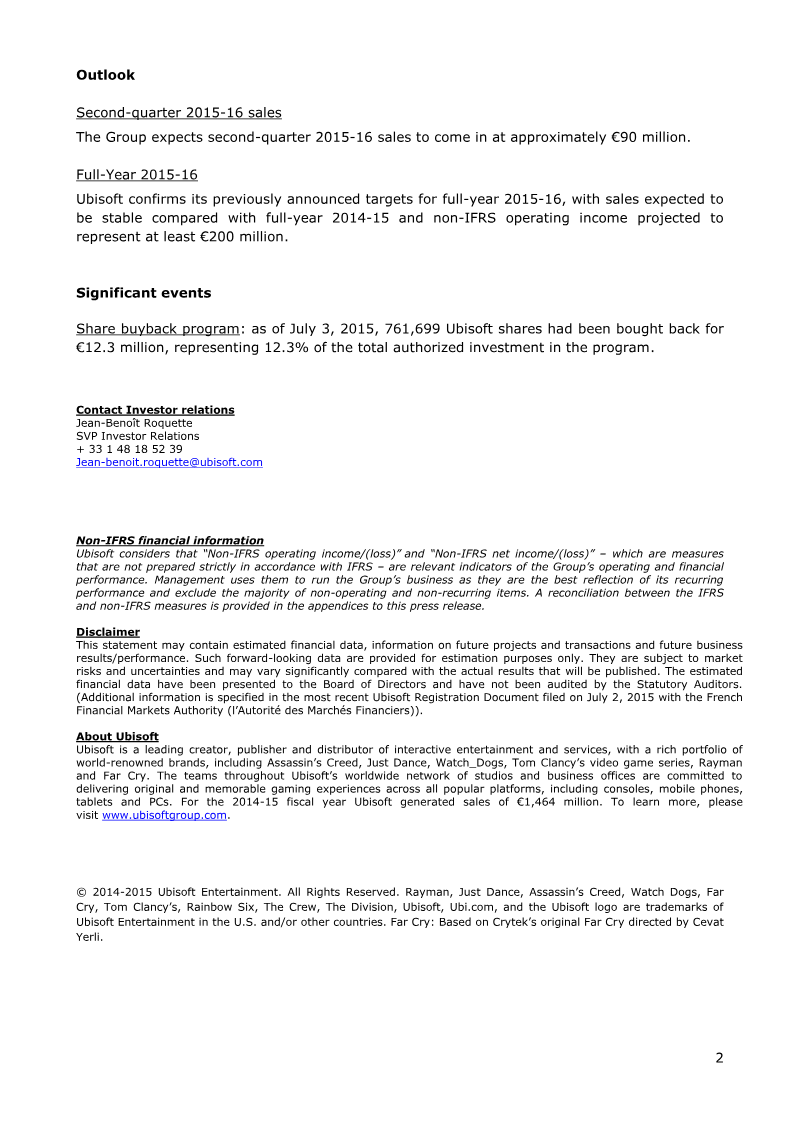
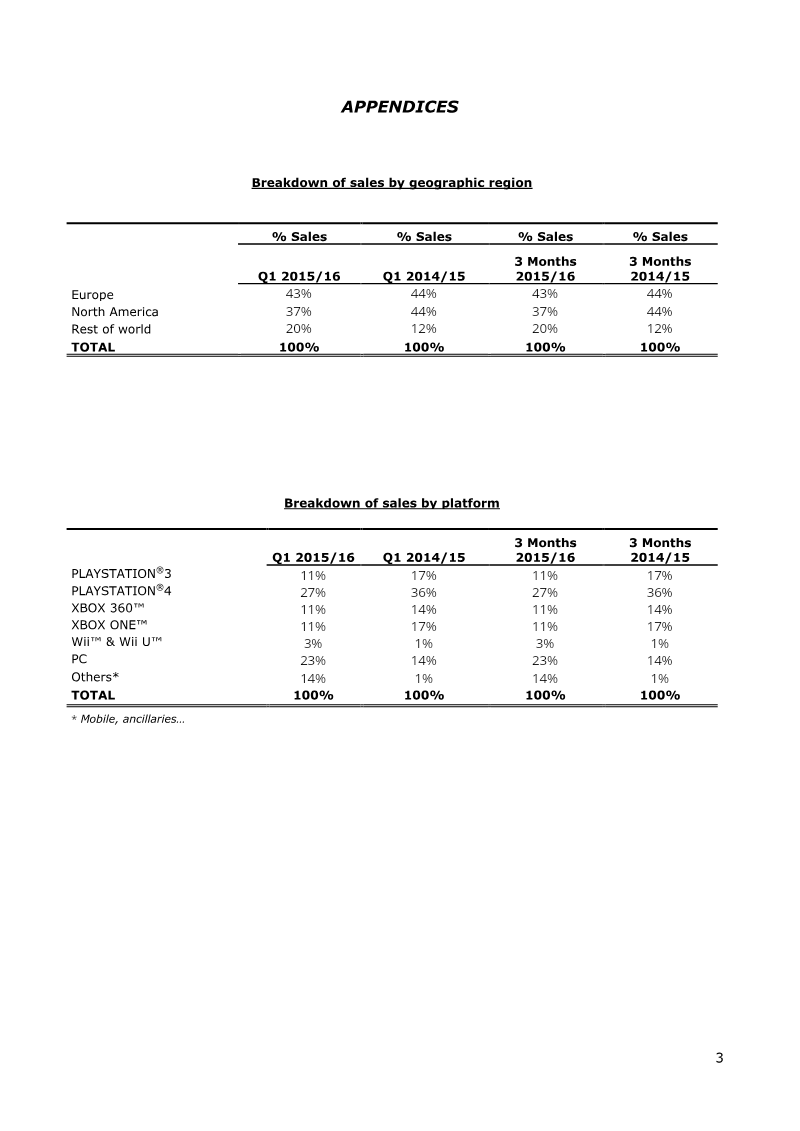
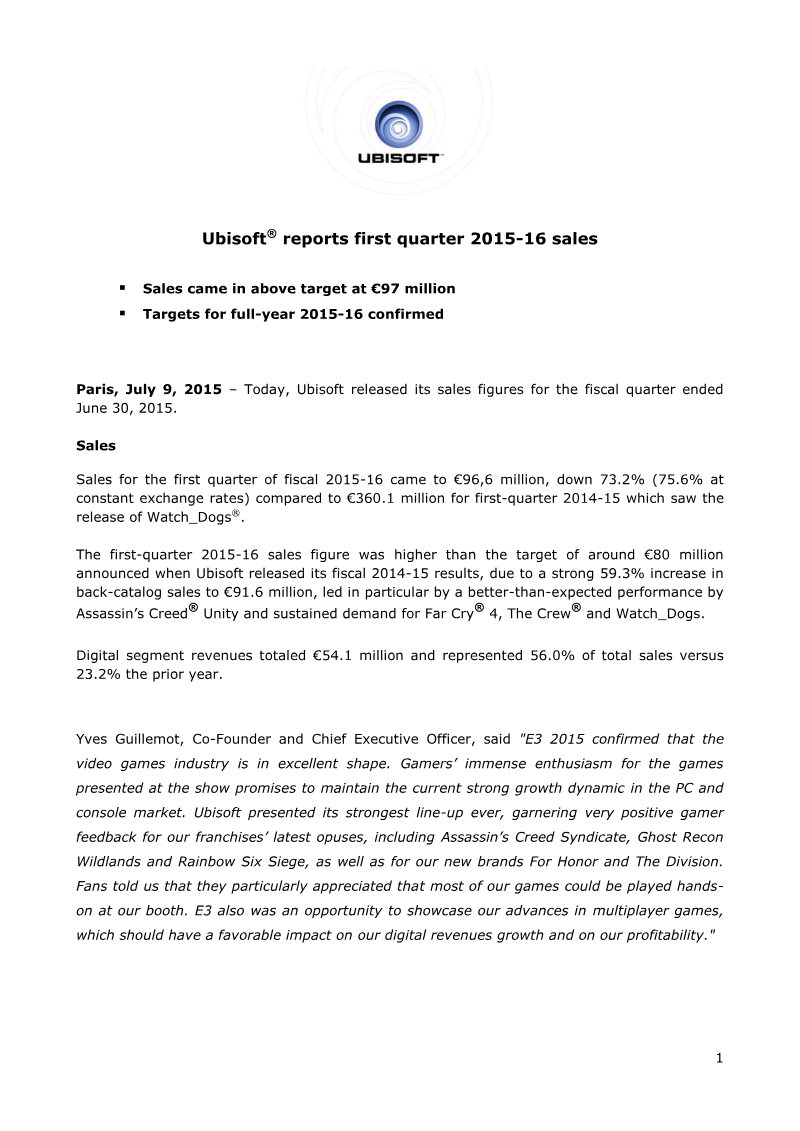
Ubisoft’s first-quarter sales for fiscal year 2015-16 reached €96.6 million, exceeding the company’s initial target of €80 million.
- Ubisoft’s Q1 2015-16 sales reached €96.6 million, exceeding the initial €80 million target despite a 73.2% year-over-year decline caused by the absence of a major launch comparable to the previous year's Watch_Dogs.
- Digital revenue grew significantly to account for 56% of total sales, up from 23.2% in the same period last year.
- Back-catalog sales increased by 59.3%, driven by sustained demand for Assassin's Creed Unity, Far Cry 4, The Crew, and Watch_Dogs.
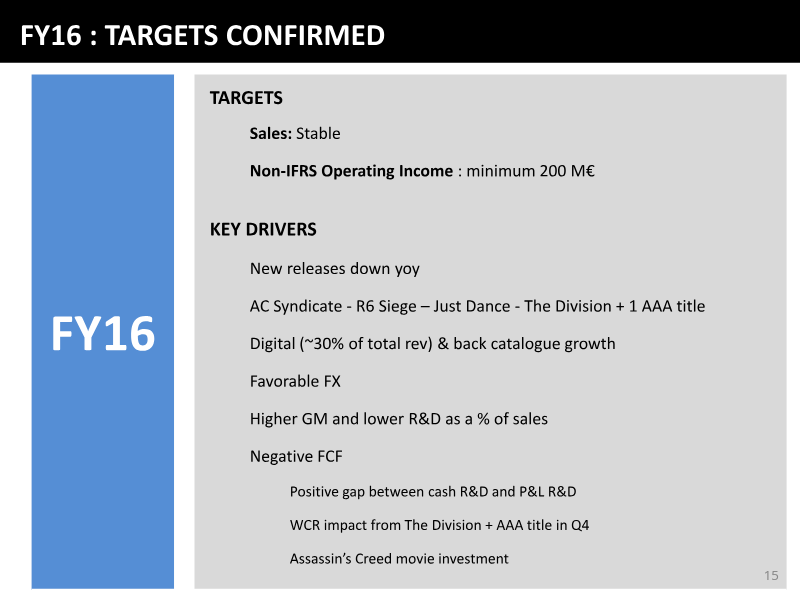

Ubisoft FY15 Earnings Presentation
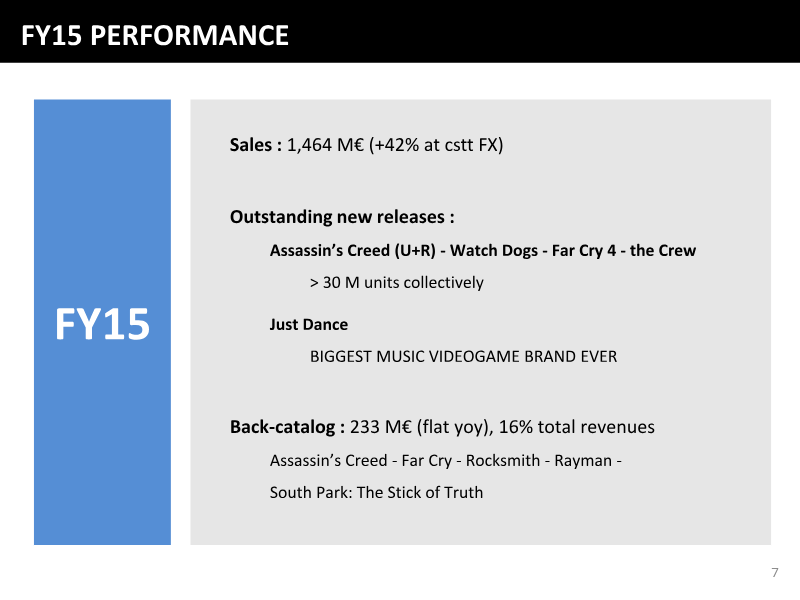
The Ubisoft Fiscal Year 2015 earnings presentation outlines a period of significant financial recovery and operational growth, driven by the successful execution of a strategy centered on systemic open-world games, digital expansion, and community engagement.
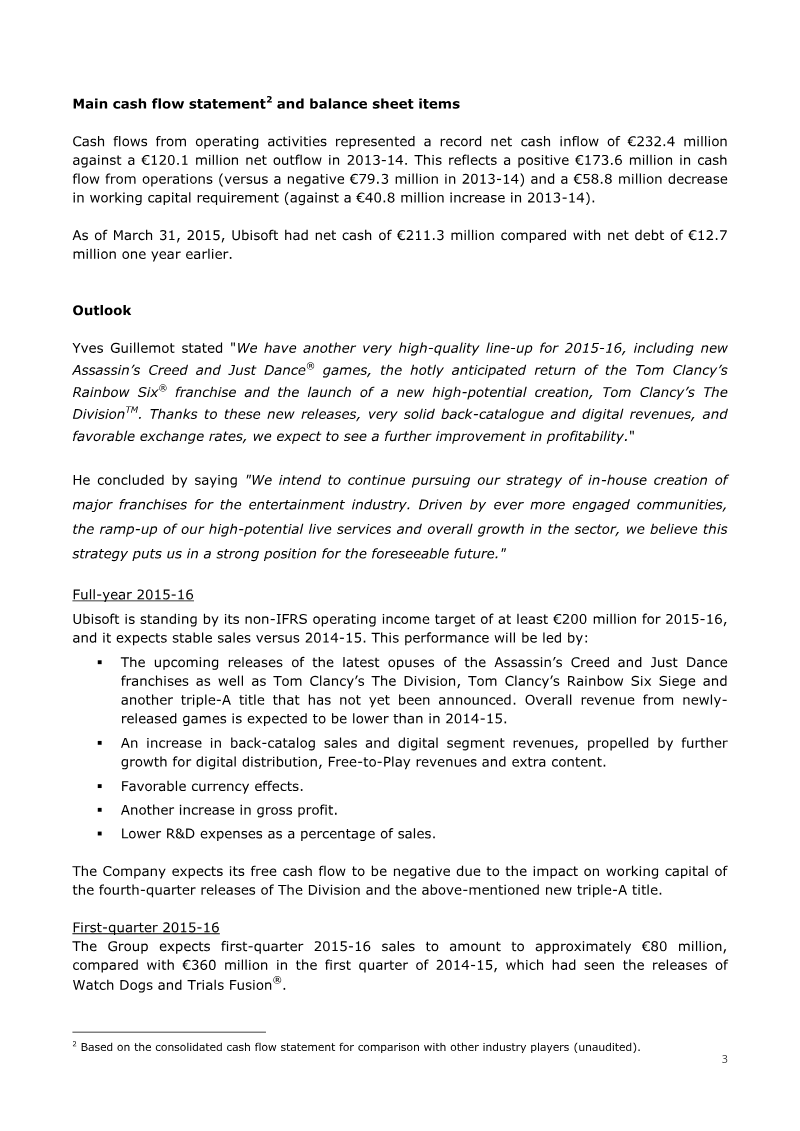

Ubisoft Full-Year 2014-15 Sales and Earnings Figures
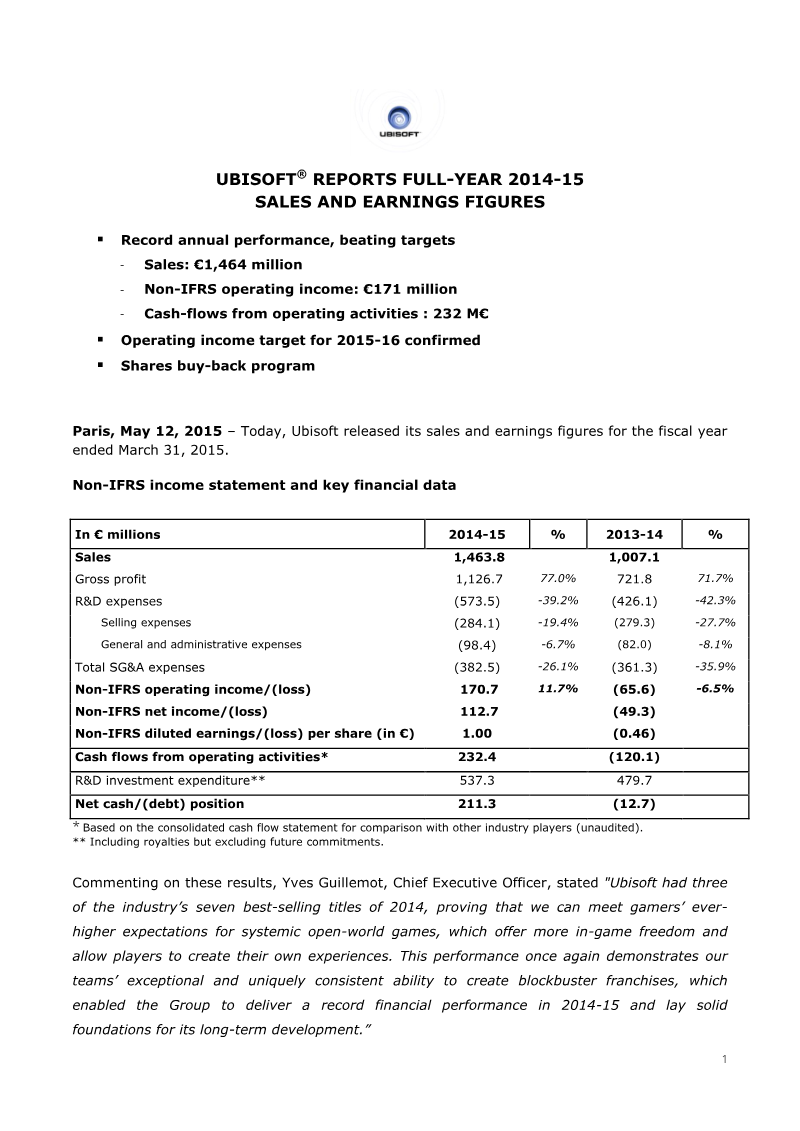
Ubisoft achieved record financial performance for the 2014-15 fiscal year, ending March 31, 2015, with total sales reaching €1,463.8 million. This represents a 45.3% increase compared to the previous fiscal year.
- Ubisoft achieved record financial performance in fiscal year 2014-15 with sales of €1,463.8 million, a 45.3% increase over the previous year.
- The company shifted from a non-IFRS operating loss of €65.6 million in 2013-14 to a record non-IFRS operating income of €170.7 million.
- Digital revenue surged 96.8% to €382.7 million, representing 26.1% of total sales and contributing to a record 77.0% gross profit margin.
Ubisoft Third Quarter 2014-15 Sales Results
Ubisoft’s third-quarter fiscal 2014-15 sales results demonstrate significant financial growth, characterized by record-breaking quarterly performance and an upward revision of full-year targets.
- Ubisoft reported third-quarter fiscal 2014-15 sales of €809.7 million, a 55.8% year-over-year increase that exceeded initial projections of €730 million.
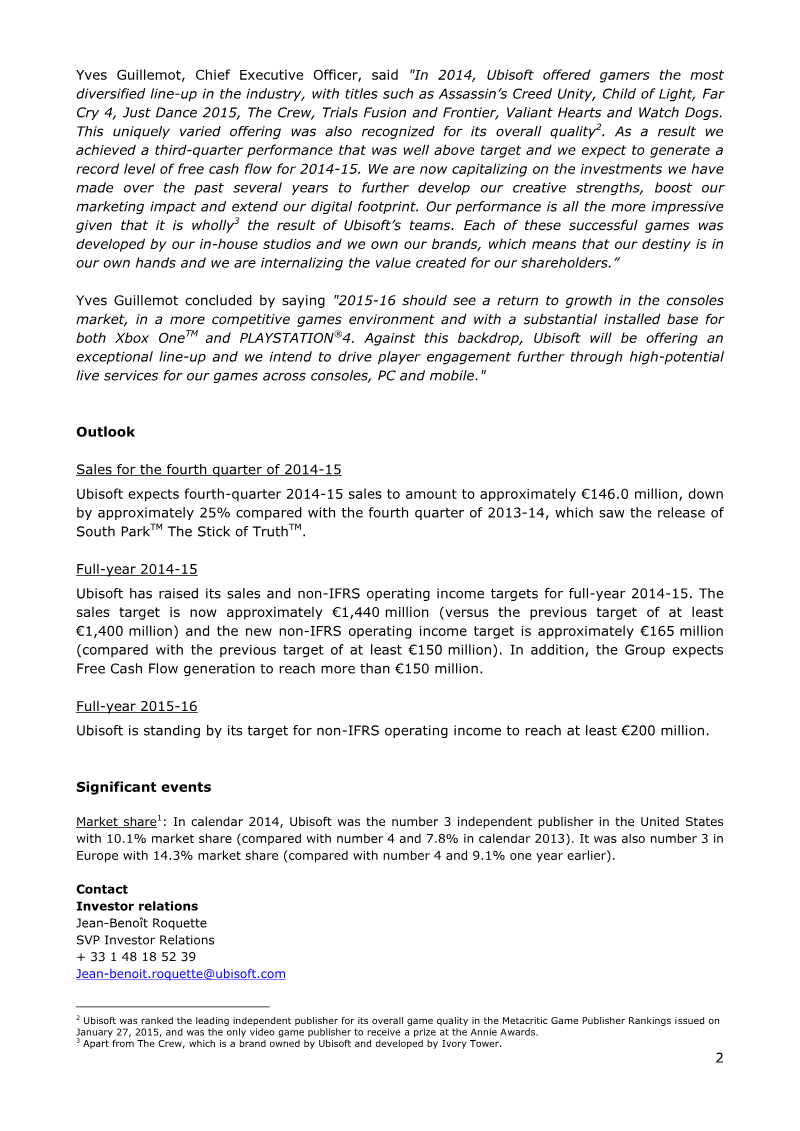
- Full-year sales targets were raised to approximately €1,440 million, with non-IFRS operating income projected at €165 million.
- Digital revenue surged by 157% during the quarter, representing a significant strategic shift in the company's income composition.

Ubisoft Reports First Quarter 2014-15 Sales
Ubisoft’s first-quarter fiscal 2014-15 results demonstrate significant financial growth, driven primarily by the successful launch of the new intellectual property, Watch Dogs.
- Ubisoft achieved record first-quarter sales of €360 million, a 374% year-over-year increase that surpassed the company's initial €310 million projection.
- The launch of the new intellectual property Watch Dogs was the primary growth driver, achieving 8 million sell-in units and establishing the title as a major franchise.
- Digital segment revenue grew by 149% to €84 million, fueled by Watch Dogs, mobile Free-to-Play titles, and smaller digital releases.

Ubisoft FY14 Earnings Presentation
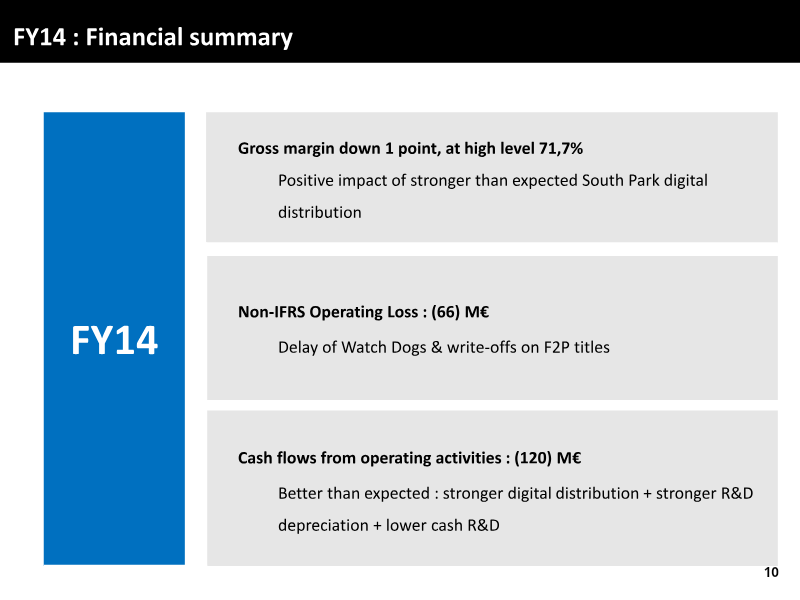
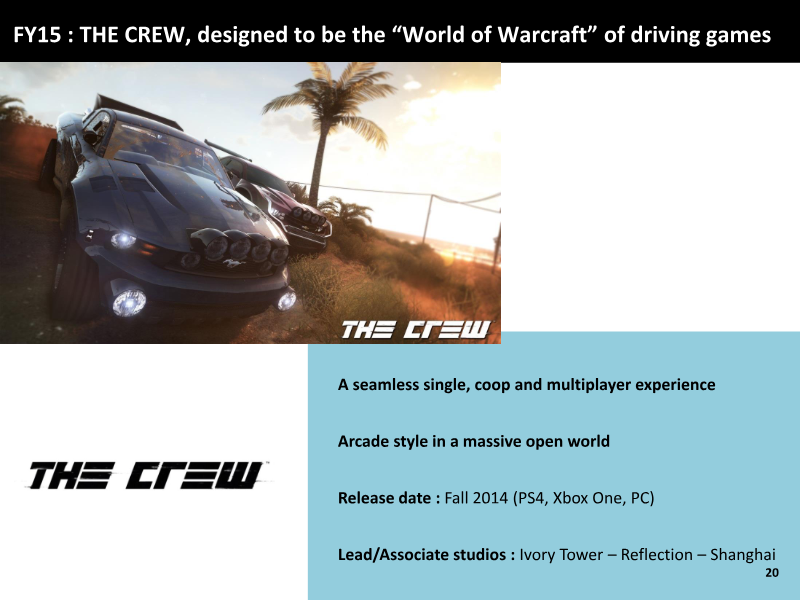
The Ubisoft Fiscal Year 2014 earnings presentation outlines the company’s financial performance for the period ending in 2014 and establishes its strategic roadmap for the subsequent fiscal year.

Ubisoft Full-Year 2013-14 Sales and Earnings Figures
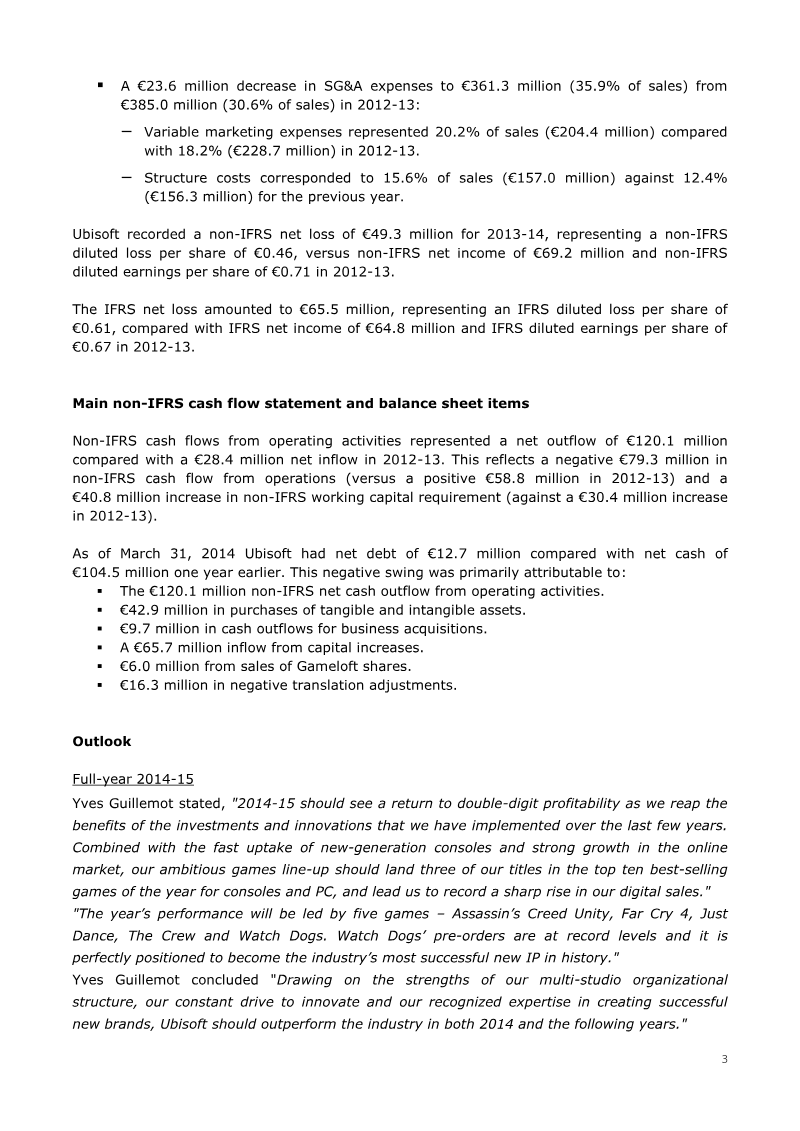
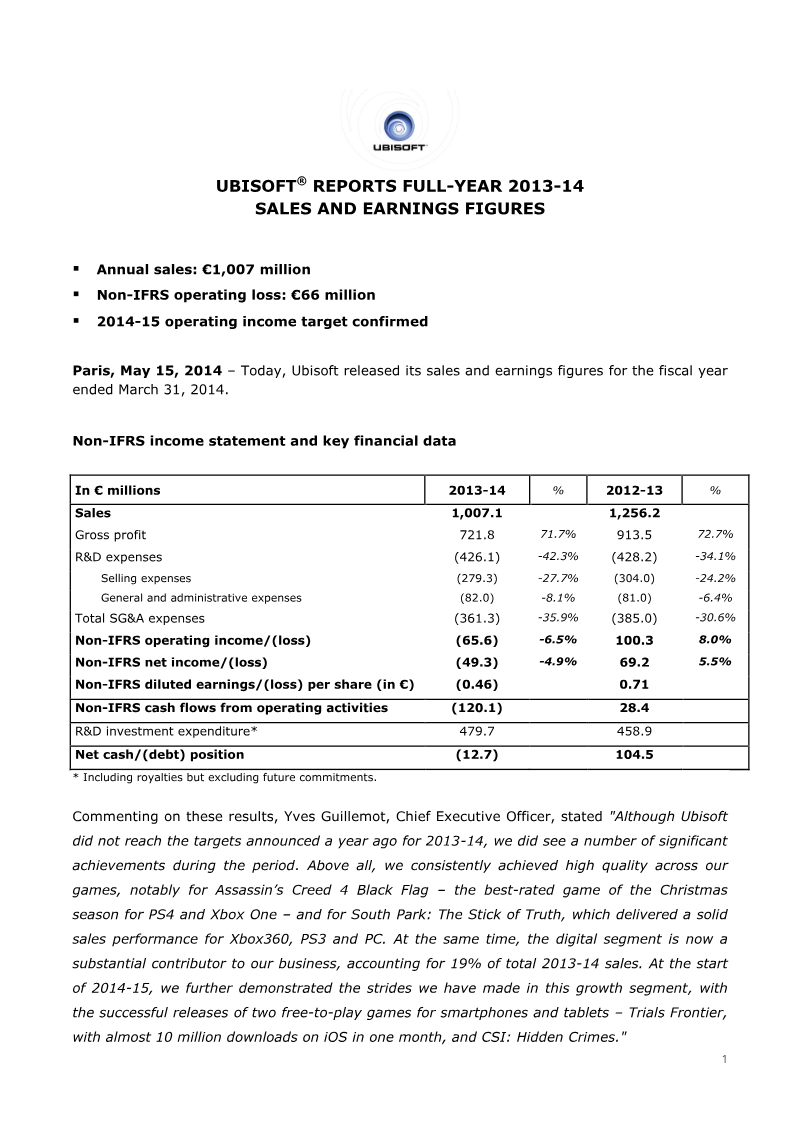
Ubisoft’s fiscal year 2013-14 financial results reflect a challenging period characterized by a decline in annual sales and a shift toward digital revenue streams.
- Ubisoft reported annual sales of €1,007 million for fiscal year 2013-14, representing a 19.9% decline compared to the previous year.
- The company recorded a non-IFRS operating loss of €66 million, a significant downturn from the €100 million operating income achieved in 2012-13.
- Digital revenue grew by 32% to reach €195 million, accounting for 19% of total annual sales for the fiscal year.