
Black & White
GameBy Lionhead Studios · Released Mar 25, 2001
Play the role of a deity in a land where the surroundings are yours to shape and its people are yours to lord over. Be an evil, malevolent god and the natives will worship you with fear in their eyes. Play as a kind, benevolent god and they will worship you with love in their hearts.
Connections
Each row is a game or company named alongside Black & White, each column a document, oldest first. A mark means that document names it. Select a row to see those documents.
About the game
- Released
- Mar 25, 2001
- Developer
- Lionhead Studios
- Publishers
- Electronic Arts, Feral Interactive
- Genres
- Puzzle, Real Time Strategy (RTS), Simulator, Strategy
- Platforms
- PC (Microsoft Windows), Mac
- Links
- Wikipedia
Game data from IGDB.com
Documents about Black & White
The Need for Governance and Strategy on AI's Impact in Game Dev
The video game industry currently faces a critical need for formal governance and strategic planning regarding the integration of artificial intelligence.
- Game studios need clear AI governance and strategy to move from the current "chaos phase" to a "usable phase," ensuring AI complements teams, is IP and legally safe, and ethically sound.
- Many AI tools currently available are poorly built, lack enterprise costing, have operational security concerns, or feature problematic legal terms, with Keywords Studios testing 500 tools but finding only about half a dozen production-ready.
- A lack of AI controls and governance contributes to developer concerns, as companies often fail to explain their AI strategy, leading to uncertainty about job security and acceptable tool usage.

Peter Molyneux and friends tell us how it feels to reunite for one final game
The development of Masters of Albion marks a significant creative reunion for Peter Molyneux and his core team of industry veterans, including Mark Healey, Kareem Ettouney, Ian Wright, and Russell Shaw.
- Peter Molyneux has reunited with core industry veterans from the Bullfrog and Lionhead eras—including Mark Healey, Kareem Ettouney, Ian Wright, and Russell Shaw—at 22Cans to develop a new god game titled Masters of Albion.
- The gameplay of Masters of Albion synthesizes mechanics from the team's legacy titles, specifically Dungeon Keeper, Black & White, and Fable, by featuring a cycle of daytime city-building and nighttime survival.
- The project is structured as the first of three planned chapters, though the team has not committed to the full series due to the intense resource demands of independent development.
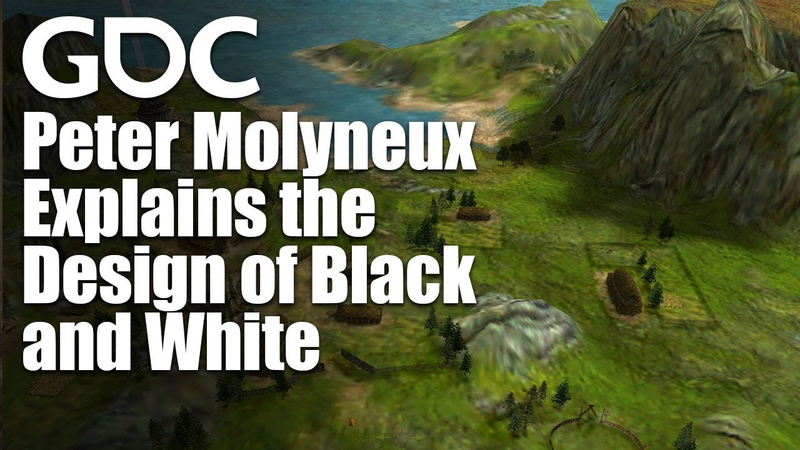
Peter Molyneux Explains the Design of Black and White
The design philosophy behind Black & White centers on creating a deeply immersive, personality-driven god simulation that prioritizes emotional engagement over traditional mechanical difficulty.
- The core design of Black & White prioritizes emotional engagement and player agency over traditional mechanical difficulty to evolve the god-game genre.
- The game utilizes a minimalist, icon-free interface that relies on intuitive mouse gestures for navigation and spellcasting to maintain immersion.
- The central companion creature functions as a learning entity that evolves its physical and behavioral traits based on the player's moral reinforcement and AI-driven mimicry.
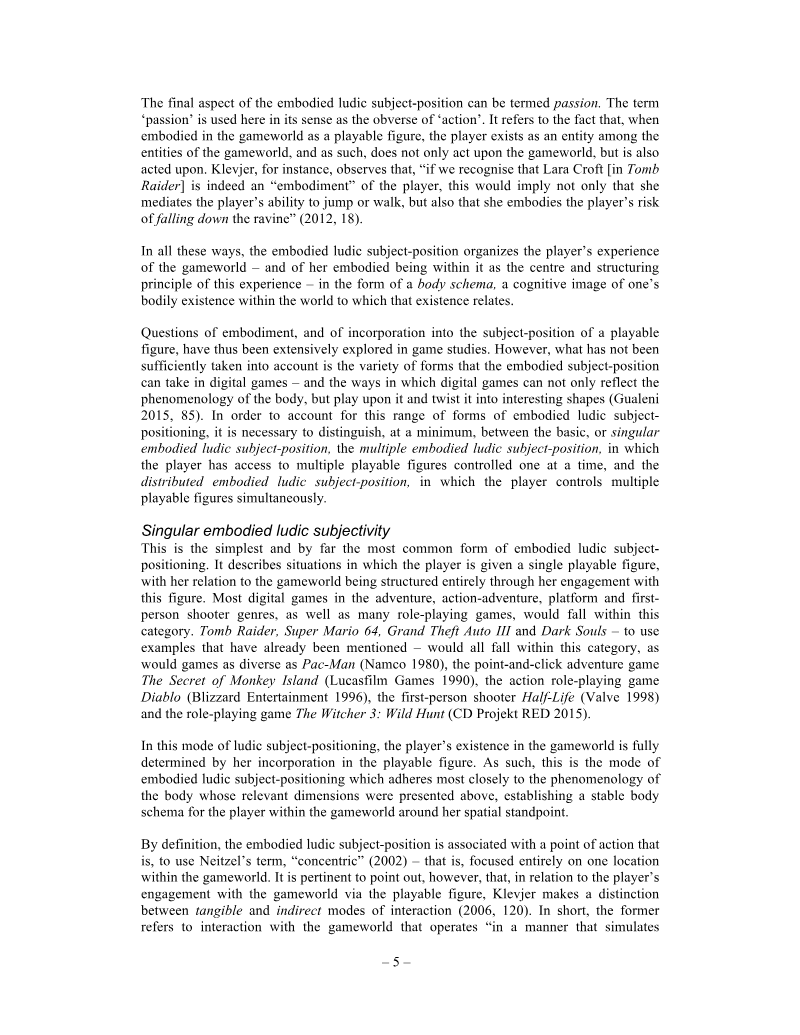
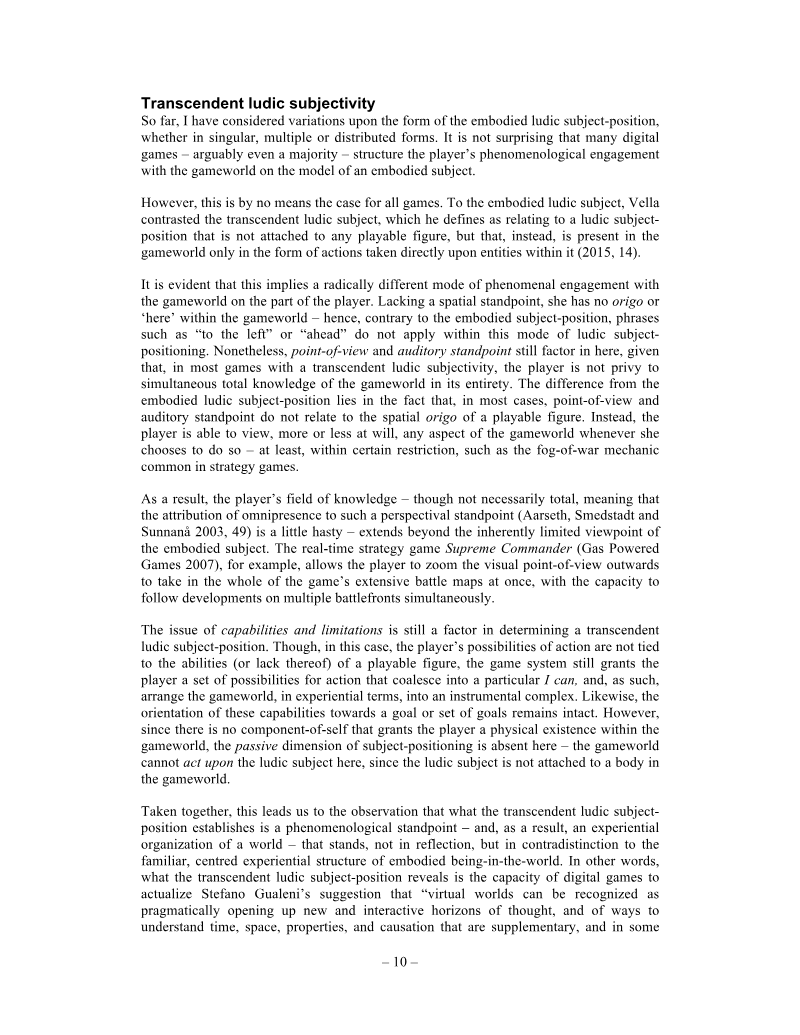
Who Am 'I' in the Game?: A Typology of the Modes of Ludic Subjectivity
Daniel Vella's paper proposes a typology of "ludic subject-positions," the modes through which digital games establish an "I-in-the-gameworld" for the player.
- Vella proposes a typology of 'ludic subject-positions' grounded in phenomenology (Sartre, Merleau-Ponty), arguing the player's sense of self in a game is an experiential Gestalt built from interacting formal mechanisms rather than a single existing framework like point of view or Wilhelmsson's 'Game Ego'.
- The embodied subject-position is structured by four linked aspects: spatial standpoint, capabilities, goal-orientation, and passion.
- The typology identifies five variants: singular embodied (e.g., Tomb Raider, Pac-Man), multiple embodied (e.g., Valkyria Chronicles), distributed (e.g., Baldur's Gate), semi-transcendent (e.g., FTL, Warcraft II), and pure transcendent (e.g., SimCity, Black & White).

Enhancing Gameplay: Challenges for Artificial Intelligence in Digital Games
Darryl Charles's paper argues that rapid growth in computing power gives game designers a timely opportunity to pursue radical advances in artificial intelligence rather than incremental refinements.
- The paper argues that rapid growth in computing power gives game designers a timely opportunity to pursue radical AI advances rather than incremental refinements, and that AI innovation is essential to avoid industry stagnation and establish games as a serious artistic medium.
- Current titles still rely largely on established techniques such as finite-state machines, A pathfinding, and scripting, with designers prioritizing the appearance of intelligence over realistic behavioral models.
- The paper identifies three priority areas for innovation: storytelling (especially player-driven narratives in MMORPGs), dynamic online learning (illustrated by the rare example of Black & White), and emotional expression, where real-time character animation lags well behind pre-rendered film.