AI Dungeon
Game
3 documents in the library are about AI Dungeon, from writers such as DiGRA. Each has a summary and key insights with the page they come from.
Connections
Each row is a game or company named alongside AI Dungeon, each column a document, oldest first. A mark means that document names it. Select a row to see those documents.
Documents about AI Dungeon
When AI Promises to "Cure" You: Individual Experiences, Systemic Biases, and Community Action for Marginalized Players in Video Games
This study critiques the prevailing narrative in gaming that positions artificial intelligence as an inevitable and benevolent force for democratizing play, arguing instead that AI's effects on marginalized players are contested and shaped by socio-technical context.
- AI assistive features can deliver large gains for players: the 'AI Eyes' feature for visually impaired players in Justice Online cut task completion time by 42.7% and interaction errors by 61.3%, with 87.5% of participants reporting restored agency and immersion.
- AI systems in games carry measurable representational bias: a computational audit of 547 AI Dungeon narrative variations found female-coded protagonists were 71.8% more likely to appear in passive or rescue-oriented roles, while ethnically associated names were linked to exoticism or aggression and underrepresented in authority roles.
- Efficiency gains from AI can erode social bonds: in a controlled Sea of Thieves experiment with 112 participants, AI teammates correlated with 23.1% lower social connection scores and a 34.8% reduction in non-instrumental, socially affective communication.
The Infinite Game in the Engine of Control: Proletarianization, Platform Capitalism, and the Future of Playful Pleasure
Game engines and AI narrative tools are reshaping how games are made, according to this analysis, which argues that they pull developers away from open-ended creative play, the "infinite game," toward the optimization-driven "finite game" of platform capitalism.
- The paper argues that game engines and AI narrative tools pull developers from open-ended "infinite game" creative play toward optimization-driven "finite game" logic of platform capitalism.
- Drawing on Stiegler's proletarianization and Adorno and Horkheimer's culture industry critique, the author contends that Unity's Asset Store deskills developers through a modular, Taylorist workflow that encourages aesthetic homogenization.
- Unity's analytics suite is portrayed as substituting quantified behavioral data for designers' creative intuition, turning design into KPI optimization.
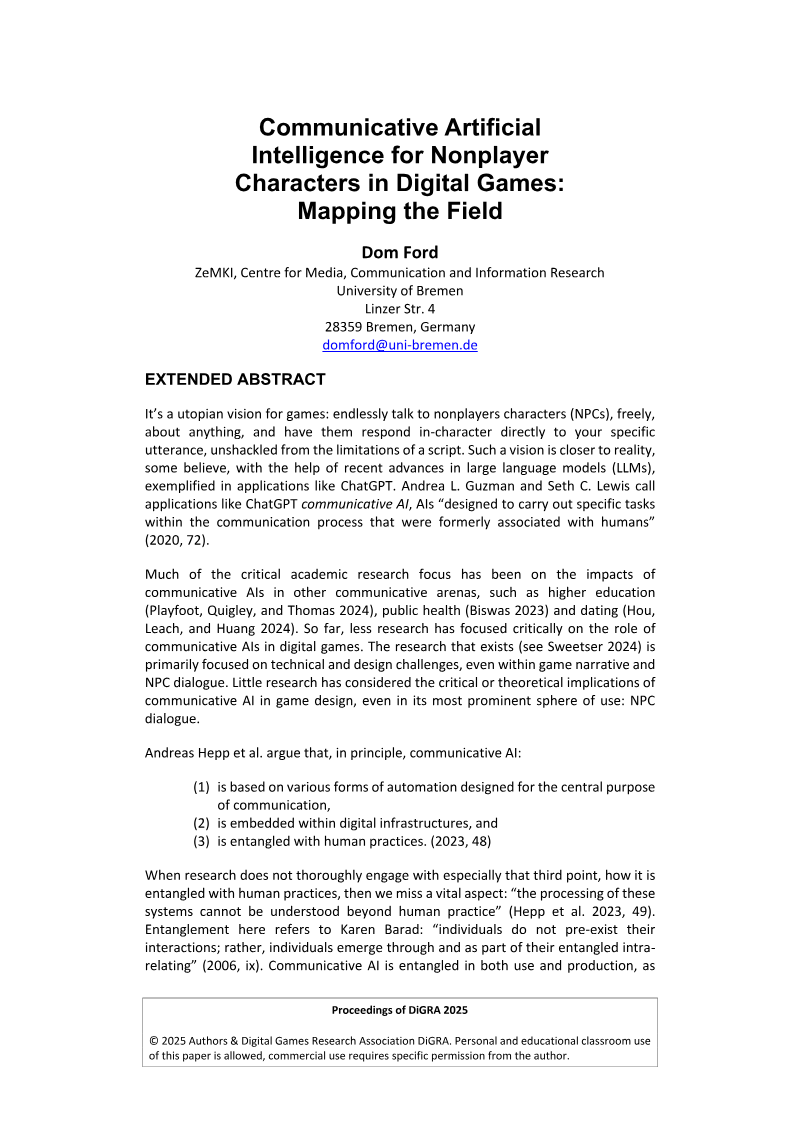
Communicative Artificial Intelligence for Nonplayer Characters in Digital Games: Mapping the Field
This paper maps the emerging intersection of communicative artificial intelligence and nonplayer character (NPC) dialogue in digital games, arguing that the field has received far less critical and theoretical attention than the technical and design challenges it poses.
- The paper's central thesis is that LLM-driven NPC dialogue may fundamentally change how players communicate with gameworlds, so it deserves scrutiny through established frameworks like the philosophy of fiction rather than being treated as a detached technology.
- Drawing on Hepp et al.'s definition of communicative AI (automation for communication, embeddedness in digital infrastructures, entanglement with human practices) and Barad's concept of entanglement, the author argues such systems cannot be understood apart from the human communication data used to train them.
- The analysis centers on Van de Mosselaer and Gualeni's 'implied designer' concept, warning that AI-generated dialogue could erode players' sense of intentionality and make a gameworld feel less alive.