1 free read left. Create a free account for unlimited reading + AI research.
Create free account
What Mythical City learned from developing a new virtual reality game
Key insights
6 takeaways- 01The transition to VR development necessitates a shift toward natural, immersive mechanics that require minimal instruction to ensure accessibility for new users.
- 02Because developers cannot control the camera in VR, they must use environmental design and physical interactions to guide player attention rather than relying on fixed-perspective UI.
- 03Successful VR design requires replacing traditional 2D screen-based overlays with diegetic UI elements that are physically integrated into the game world.
- 04Developers should replace abstract health bars and button-based menus with intuitive visual and physical cues, such as snow accumulating on virtual mittens or using levers to trigger game actions.
- 05To mitigate motion sickness in room-scale VR, developers should utilize teleportation for movement and a 'pinch and pull' gesture for map navigation instead of artificial camera zooming.
- 06To overcome the limited initial audience size of room-scale VR, studios should implement cross-platform play to allow VR users to compete against players on PC and mobile devices.
Ask AI about this video
Transcript
hi there okay everybody can hear me okay great so if I can just ask you guys for a second who here has developed vieira content okay so we've got a couple people and room scale VR or mobile VR room skill VR okay a little bit cool so we're going to talk about one of the games we've released already for VR called snow fortress and one of the games that we are bringing to VR that is at one of our existing titles I have to figure out how to use this thing okay there we go so mythical city games is a mobile pc NVR development studio based here in Vancouver our main series of
games is called battle fleet and so world war two strategy game series and then we've also released a couple of mobile casual games and most recently snow fortress which is our VR game so i'll show you guys the trailer for snow fortress to get an idea of how what the gameplay looks like and how it works or i can go back and play that there we go that playable Oh perhaps not so this should be a video and we showed up a video separately as well for it any
tents now there we go this is the keynote presentation yeah that'll be it so the top slide there on the left yep right there I don't feign just hit play on that one oh the trigger to make a snowball I know you're Thor for the blocks around you I'm the chair to make a snowball I know you're Thor little blocks around you
Oh No yeah take that mr. snowman ow cool so that's snow fortress and it's out on steam for the HTC vive now go to
the next slide the real so snow fortress is a more of a casual game where you can build a snow fort out of the blocks around you and then you can have snowball fights and VR this is the first VR game we've developed and it's currently in early access on Steam and the reason we did that is as this is our first VR title we really wanted to learn a little bit more about the VR development process what the community wants what works and what doesn't work in VR so I think that's a great way to go if you're developing some new content want to test some stuff out in VR is put it up on early access the game is in room scale VR as well so it allows you to walk around your play area and actually interact with the blocks and objects around you it's designed for the HTC vive but we are planning to bring it to some of the other hmds this year as well so for oculus Oh SVR and other ones and then the full game should be released later this year so y room scale
VR so right now there's a couple of different types of VR there's the mobile VR there's sitting VR and there's room scale they are we found that the room scale is really one of the most immersive VR experiences you can have so that's something that we really wanted to wanted to go for the positional tracking gives your body presence in the space which is really fantastic so when you can actually walk around the space you start to feel like you're really there the other great thing about it is it's a physical and natural movement so it's something that everybody is pretty much it able to pick up very quickly without a lot of instructions without having to learn control schemes or gamepads you can if you want to walk over somewhere you just walk over to it if you want to pick something up you just pick it up with the track controller so the third part of fourth part of it is the track motion controllers and this is where I think we are and room scale VR especially really starts to take off once you're able to interact
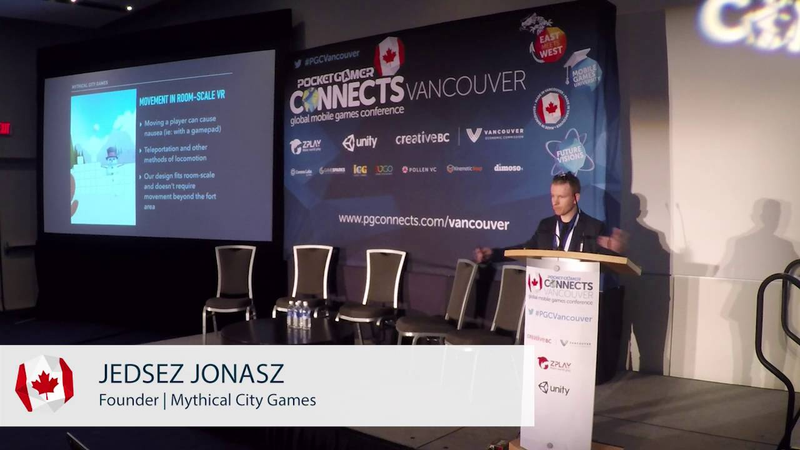
the world around you in a physically natural way that's when it really starts to kick in for people that yeah I'm actually here I can really participate in this world so just a little video of youtuber playing the game so you can get the sense of kind of how much interaction and motion there is in this process while you're playing it's a very physically demanding kind of experience after a while which has been really great for four people playing it so some of the VR development challenges I'll touch on some of the same things that we were talking about in the previous talk but just really quickly movement in room scale VR so this is still an issue beyond the actual space that you have to walk around in your room how do you get to further parts of the map how do you get it cover walk around in a big world so teleportation is one of the main
means of locomotion right now it allows you to point at a parts of the terrain and just suddenly teleport there it sounds a little bit odd but once you start to actually play around with that and you play with the teleportation for a few minutes really becomes very natural but as this was our first VR game we didn't want to add too much complexity to it we wanted to do something that's simple and fast I'm to put together and something that we could we didn't have too many variables that we had to control so we designed the game to fit just within the actual players play area so that's where you can put together the fort it's just right around you say you don't have to go anywhere you don't have to learn any controls about how to move you don't have to get used to any of these other movement techniques one of the other big area is focusing the players attention so in a traditional game as I guess they might be called from now on you would have if you wanted to get somebody's attention you would simply move the camera to that spot so if you wanted to
show them something you would move the in-game camera to something to the position and you would show the player what you want to show them in a VR game you can't control the camera because the camera is the players heads so they can look around at any point they can turn around they can interact it and look anywhere so one of the things that becomes really important is level design and guiding the players attention through something that would be in the film terminology meson sin where you'd does sign the scene to guide where somebody should be looking where they should be walking towards what they should be interacting with it's an example of that in snow fortress we have a main menu scene where we have a couple of menu options and things that you can game modes that you can pick so but what if the player loads in facing backwards because we don't know actually which direction they're going to be facing and when they start the game so to help resolve that we've put sort of we've built the environment around that so we put trees and a forest behind them so that if they load in facing the wrong
direction they'll see a forest of trees so they'll know that that's there's nothing to do that way they'll be able to turn around and see what we want them to interact with in the actual game when you're fighting the other snow forts there's little signs that show you which directions so for it is we found that that knot isn't really necessary but we just put it in for testing and one of the other big areas is positional audio how do how do we get players attention when we know that they're going to be most likely wearing headphones for any of the kind of desktop room scale VR stuff to get the full experience people probably have headphones on so positional audio is going to be very key to guiding players attention and getting their attention to look at something and inform them of what's going on in the world around them so if you have a monster coming up from some direction you if the monster is making a sound the and the audio is done in with positional audio they'll instantly know where that
sound is coming from so one of the other issues is UI and interaction with you I traditional 2d flat UI doesn't really work for the most part in VR because there's no screen area to really attach the UI to there's no screen corners because the person can look around in any direction and people are usually only really focusing on a very small spot in the very center of the actual screen so even if you have things that are attached to the outside of their player of their actual head they most likely won't notice them and if they do notice them those things can become a little bit annoying it's sort of like wearing glasses and having a sticker on your glasses or something that's constantly in front of you where you look so figuring out new ways of doing ui/ux and interactions is very important some of the things that we've come across for example as player health so the first thing we started off is showing little hearts in the floating up
in the UI above the play area we found nobody really noticed those while they were playing then we tried to put the hearts on to the players gloves in the left example there with the green myths and we thought well you're holding these gloves all the time they're always around you in probably going to notice the hearts but found most people didn't notice them the people that did notice them thought they were just decoration or like a little bracelet so they really had no idea what that was and then we came across the idea of putting snow on the players hands the more damage they took so as they started to lose health their mittens would become a little bit more more snowy and that was kind of like a little subconscious way of getting across the idea that they were getting more covered in snow as they took more hits and that's worked very well for the game so far we still left a little you I with the hearts floating up on the screen is a reference so that they know exactly how many hearts they have if they want to check but most people intuitively just get it some of the other UI areas are for example to
start the game once you finish building your fort once you want to start the game and start throwing we have to figure out some interaction for that so the first thing we did is just mapped one of the buttons on the controller's to start the level but then we found we had to always explain what that button was we had to show where that button was on the controller for people and maybe weren't used to it and because we don't show the actual controllers as the representations in VR we show the mittens we didn't really have a good way of pointing where that actual button was so instead we put in a physical lever as you saw in the trailer people can just turn around on the table pull this lever and it'll start the game for them another example of that is level selection so traditional level selection you would have a UI window with a whole bunch of levels a little grid on there and that's you'd click on a level to select it so instead we've put our to make it a little bit more into active we've put our levels into little snow globes that show representations of
each of the snow forts they're going to be facing off against and then when the player picks up that snow globe they're able to be transported into that level so that brings me to badly too so this is one of our existing games that came out about a year ago on steam for desktops as well as on tablets for Android and iPads battle fleet to is a world war two naval strategy game here's a brief trailer of the regular version of the game just to get an idea
so as you can see it's a bit of a complex strategy game it's got a lot of content in it a lot of features a lot of ships to control fleets and campaigns so the idea of bringing it to VR is sort of like into a miniatures war game like a table in front of you where the ships are little models and miniatures that move around except in VR they're all they have life to them they actually move by themselves they're on fire they can you can interact with them and they can shoot their weapons things like that so it's kind of a really fun interface a weighted to to play a strategy game and one of the challenges we had with that is the scale of the environment usually the battles and battles way to take place over a large island chain the ships are kind of very small as you can see there and when this is a table in front of you in a room scale-space they may be very very tiny so it's the idea of being able to see a little more
detail on them and getting closer to those ships is something that we really are working hard to bring into the game from this little clip here you can see well you can just look down at the ships so you can just bring your head in closer and that's one way of zooming in in VR that's very natural and one of the other things that we wanted to do is control other ways to be able to move this battlefield around and maneuver around it and zoom in and out so traditional sort of zooming with maybe some sort of a button or something it could be a little bit difficult in VR because it would make you feel like you're actually changing size vertically and that can cause a lot of motion sickness so one of the things we did is brought over a technique from mobile of sort of a pinch and pull to be able to interact with that environment so you press down the two buttons on your two controllers pull them apart and that way you feel like you're actually changing the map and the world around you rather than you're shrinking or you're actually
changing in height and that's that's been really great for for interaction with the game the other issues again directing the players attention how do we get them to look at something so this is a complex game with a lot of different ships there may be 10 20 different ships on the battlefield at one point how do we get them to know what ship what ship is currently selected whose turn it is right now what's happening somewhere it could be something behind them that the next ship is going is moving so one of the things that we did to solve that very simply it was attached a sort of a string from the controller to the currently selected ship so whenever you're holding your controller you instantly knew because you could just trace where the string is connected to you instantly knew what ship was selected so that made it very easy to know and then one of the other issues is and this was touched on the left talk about audience size for
multiplayer so in VR especially room scale we are with vive the audience size is still very small so to get enough of that critical mass to have people to play against is still a little bit difficult so one of the ways we're going to solve that is try to bring our cross-platform multiplayer from the regular battle fleet into VR so if you're playing the VR version on a vibe you can play against somebody who might be playing it on a tablet or playing it against somebody who's already playing on a PC so that opens up the multiplayer base to all of our players across the entire game and now to give you guys a little taste of what this will look like this is a sort of a preview early version trailer of battle fleet NVR as work in progress
so that is the end of my talk today again I'm JJ for mythical city games thank you very much for listening and if anybody has any questions I'm happy to answer them
Summary
Mythical City Games, a Vancouver-based studio, shares insights from its transition into virtual reality (VR) development, specifically focusing on the creation of the room-scale title Snow Fortress and the adaptation of the strategy game Battle Fleet 2. The primary thesis is that successful VR design requires moving away from traditional 2D interface conventions in favor of intuitive, physically grounded interactions that leverage the unique spatial presence of room-scale hardware.
Key findings emphasize that user interface (UI) design in VR must be diegetic—integrated into the game world—rather than relying on flat, screen-based overlays. For instance, the studio replaced traditional health bars with visual cues, such as snow accumulating on a player’s virtual mittens, which proved more intuitive for users. Similarly, the studio replaced button-based menu navigation with physical interactions, such as pulling a lever to start a game or using snow globes to select levels. These methods solve the challenge of guiding player attention in an environment where the developer cannot control the camera, as the player’s head movement dictates their perspective.
The studio also addresses the technical challenges of locomotion and scale. To avoid motion sickness, they utilize teleportation for movement and a "pinch and pull" gesture for navigating large maps, which mimics natural physical manipulation rather than artificial camera zooming. Furthermore, the studio highlights the importance of cross-platform play to overcome the limited initial audience size of room-scale VR. By allowing VR users to compete against players on PC and mobile platforms, developers can maintain a viable multiplayer ecosystem. These strategies reflect a broader shift toward prioritizing natural, immersive mechanics that require minimal instruction, ensuring that VR experiences remain accessible and engaging for new users.
















Comments