VideoDeconstructor of Fun
Secrets to Sustainable Success on Roblox with Andrew Rose, CPO at Voldex
28 Apr 202468 min video
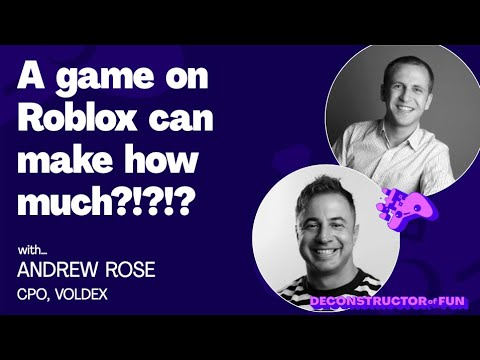
Andrew Ross, chief product officer and co-founder of Voltrax, a Roblox company, welcome to the podcast. Thank you. I just do want to correct you. I'm not one of the co-founders of of Voltrax. You're not one of the co-founders? know if you want to start it all over again. I'm not. There's only one co-founder. is this is going to be a sentiment This is going to be a sentiment to Voltrax that they should have made you a co-founder originally, but There you go. Yeah, let's keep that. Don't cut that. Leave that in this podcast. we're we're we're keeping we're keeping we're keeping Exactly, we're keeping this. We're keeping this that you should have been a co-founder, but you are a chief product officer. And let's talk a little bit Well, let's talk about you for for a minute. So, you are in addition to being chief product officer of Voltrax, you previously worked in at Zynga as director product and with Friends franchise, Words With Friends, right? That's correct. Great. You're based out of Toronto and
before, so between Zynga and Voltrax, you worked on kids math games for a year or so. So, that's kind of gives a broad overview that I saw about your career, but why don't you tell me a little bit more about yourself? Yeah, I I like to sort of go way back in time and and tell people that my mom didn't let me play video games when I was a kid. Oh, we're going This is This is going to Yeah, we're going to go there. Uh it's going to age me too in a real quick second. My grandfather, bless the man, gave me a Game Boy for my birthday and I mean mom can't say no to that. So, the rest is kind of history. I was hooked from that point. Um And anyway, I went off, did my undergraduate, didn't realize that video games are a thing I could work in all the while I was just playing the crap out of them. Um went off, did my MBA, was in London, England, and finally realized like, wait, this is a thing I could do. This This right around when Facebook games were starting to take off and sort of that sort of a need for analytics started to play out as well. And so
I was like, "Holy crap, this is it. This is the moment." I uh moved to LA and joined a company that was willing to sort of take a flyer on an unproven person. This guy. Uh and that company ended up being Scopely, which was just an awesome experience. Um I got there day one and just immediately sort of felt like it was home. Uh just working in product, working in games, everything about it was exciting. Uh and I loved working at Scopely as well. Uh spent a few years there, but moved back to Canada. Wanted to sort of continue to build my family here. Tried to fly back and forth. Just wasn't a sustainable model. Uh I left and joined a mobile sports company. Um They were building free-to-play daily fantasy products, which is honestly probably a whole podcast onto itself. This was right around like crazy legislation time. Uh I really missed sort of true play games and Zynga came knocking. Uh instant messenger, Facebook instant, we're building a games platform. And Words With Friends was one of the big
games on it. So they said, "Hey, we need somebody to run that." So I came over uh and sort of look never looked back from there. I ended up being the head of product for Words With Friends as a whole, which is Words With Friends, Words With Friends 2, Words With Friends Classic, Logo With Friends, Crosswords With Friends, all the all the With Friends, if you will. Um and again, I was looking for a new challenge. Uh Zynga was a wonderful organization to work for. I enjoyed it immensely. Uh and had the opportunity to join what is sort of the most popular supplemental classroom tool in North America, which is Prodigy Education. It's a math game. It's like an RPG. You go around and battle monsters. To do damage, answer questions. Um honestly, just a really brilliant tool. Uh I had no intention of leaving. Got this weird cold message on LinkedIn. Um you know, how they come through. Uh and I reached out to a former manager, Josh Lu. Uh he's at Andreessen now, and I said like, "Look, should I talk to these people cuz I y'all just invested in them? Like, maybe that's the thing I should do." Uh and he said, and I think I'm going to
quote this, "Alex is a wonder kid. You should have the conversation." Uh lo and behold, a year later, here I am um as chief product officer. You've heard of Heroic Labs by now, and we keep talking about them because in today's mature market, you need every edge to be successful. Rather than spending those precious company dollars on building game tech, focus on building your game and shipping it. Get into your players' hands faster and grow your community. Heroic Labs is battle-tested partner and friend of the podcast. Their tech enables you to be flexible, creative, and scale for success. Heroic Labs has your tech stack covered, whether you're looking for world-class back-end game server, an amazing game development framework, fantastic live ops tooling, or reliable mass scalability, Heroic Labs has solutions for all of these challenges. And it's not just us at Deconstructor of Fun praising Heroic Labs, the company works with some of the world's biggest publishers on many of the beloved games. Focus on your game, save a big chunk of
cheese, and avoid tech risks with Heroic Labs. Step into the future of game monetization with Xsolla. Xsolla empowers developers and publishers to market, sell, connect, and optimize their games globally. From payment solution to a full suite of tools designed to grow your games revenue while fostering a loyal player base, Xsolla is your game's gateway to worldwide success. With Xsolla, the world is your playground. Visit xsolla.com today and find all the solutions that will help you to power your games into success everywhere. So, you asked the you asked the investors whether you should join their portfolio company. Yeah. I know. Thinking back on that, I was like, "There's no way that's a good idea." It's like asking your mother. It's like, "Is this the son is Is the son a good employee?" It's the best son you could ever wish for. This This is a fair point. But, I mean, I went and did some other due diligence
cuz like there's a couple people that were no longer with Voldex, and I did hard reach outs on LinkedIn to them. I'm like, "Hey, I'm interviewing at this company. You used to work there. Tell me more." Yeah, that's a that's a good one. That's a good one. Yeah, I I did I did a bit of my homework. Yeah, I did a little bit of my homework about Voldex. So, it's a young company, really, really young. Raised seed round in 2022 from investors like Makers Fund, an awesome fund, Dune Ventures, and later, just a year later, raised Series A. So, clearly having a lot of traction, led by a16z, so one of the biggest funds in in gaming. Um that's impressive. Two funds and the two raises back-to-back from such an impressive set of investors. Uh that really shows that given the quality of these investors, there's clearly something great going on. Uh so, can you tell Can you like talk to me about Voldex from 2022 to present day? Like, how come all these great investors were putting in money into the
company? Yeah, I think I'm going to I'm going to answer your question not answer your question a little here. As a As a co-founder, yeah. Yeah, as a co-founder, I get to break the rules here. I'm going to go back in time because I mean, I mentioned Alex is the wonder kid. Um let's let's go back in time to 2015. Uh Alex is 14. He's making and monetizing Minecraft servers, which is already just like a wild concept for me thinking back to myself as a 14-year-old. Um he purchases some additional servers, and Voldex is formed. Um fast forward, Voldex starts getting into Roblox, and that's I think really where the traction started landing, where we started to see momentum. Honestly, Roblox is just I'd say a more mature uh advanced UGC platform. Um let's jump again today. Alex is 22. He got the Thiel Fellowship last year. We raised money with Andreessen. And then we're now a 60-person company. Um and so sort of what's gone on in the past couple of years is ultimately what we
do, which is acquire UGC games from developers. We put mature teams against them and then we scale them further and rinse and repeat. Um I think the really crux of it all is that our operational costs are covered by our live games portfolio. So, the funds that we raise are to accelerate acquisition. So, that's what we've been doing for the past 2 years, which is acquiring games and scaling our live operations. So, if you look at sort of the Voldex portfolio and this plays out for those last couple of years, you've got Driving Empire, which is the number one driving game on Roblox, acquired that like 2022. We've got a football game, which we literally just finished closing this past week. Um it's the number one grossing sports game. We've got the original Roblox dungeon crawler, which is Dungeon Quest. That was acquired in Q3 of last year. You've got Base Battles, which is an arcade shooter with vehicles. That was also in 2022. And then we also made an acquisition in Fortnite last year, too. So, I mean, we've been busy. Um we've raised the
money to fund the acquisitions, which again helps us fuel further growth for the acquisitions. Interesting. Okay, so that's a that's a very interesting model. I did not know that. So, uh talk to me a little bit about the Roblox business because there's a there's a lot of So, you were in the Deconstructor Fun Slack channel and you saw what people were were posting there. And And people I'm using all of your questions, so this is nothing that's nothing innovative. Um and and there was a lot of a a lot of conversation, a lot of questions people wanted to know about Roblox. And of course, the uh the the top most is what does the business look like? So, you have a you have a company of 60 people. Um you're acquiring titles. That means you have, you know, a pretty significant burn. What is the you know, what is a revenue of a of a good Roblox game? Like, what are we talking about here? Yeah, I mean, that's totally fair. Uh and I mean, Roblox releases the data. So, on some level we can kind of go into
a bit of that if it makes sense. But I I might want to step back for just a second and talk about the net versus I don't know whether you call it gross here. I think there's a different Yeah, gross is with the platform. Yeah. if we if we say gross putting it with the gross. We're going to include the platform fees. And net means like after What do you want to call it? Do you call it a triple net? Do you Do we call it double net? Like, cuz we can go we can go net after all funky times. Exactly. So, I'm I'm going to call it I'm going to use net as as net of the like when you get DevEx, developer exchange, that's what we call net on our side. Got it. after Roblox have like paid you out. Got it. And double net would be minus marketing fees and triple net would be minus also the other development fees. So, we'll go just net. We'll We'll go net. I mean, double net will be I'm going to touch on double net for a hot second there, too, cuz I think that one's a really interesting one. But um I I think it's important to start there and then go into some of the revenue numbers, which I will. But look, Roblox are taking what? Roughly 71¢ on the
dollar. That's what they announced, which is you're like, holy crap, 71¢, that's insane. Um Ap- Apple sounds good against that. So, that is not a good scenario for you. So, I mean, like if somebody coming from mobile, when Apple is twice as kind as your platform, you got a problem. Yes. Yes, I agree, which is the initial thing. And I'm going to sound a bit like a Roblox shill here for a second, but I'm going to do it cuz I believe in it. Um look, it's covering a bunch of operational costs that would otherwise be absorbed by the developer, right? You've got those App Store fees, they're in that, right? You've got payment processing, hosting and storage, localization and support, authentication, the tooling itself. I mean, think about the Unity fees uproar that we've had in the last year or so. All of that is in that 71%. So, it's kind of like a not quite apples to apples to mobile, and then we just spoke about net net. I mean, we don't spend on
marketing. Vindex spent 0.3% of its revenue on marketing last year. It'll be lower this year, as well. It is all organic growth. So, I think it's just a weird ecosystem dynamic. So, like net net and net to me are kind of one in the same, effectively. Well, that's a big difference because because net net on on iOS is a lot smaller. Yeah, it is a whole different grab bag. And I mean, like I'm quoting a few numbers. I've been working on a GDC presentation, so like I'm not some savant. I actually have them on the top of my my head, but I mean, I was looking at publicly traded game companies, and they're spending anywhere between like 10 and 35% of their revenue as a on marketing and sales, whereas we're at 0.3%. Like, that's a big difference. But anyway, so going forward, let's talk net. So, like after the 71%. Um Roblox top 10 games are averaging 27 million. Um so, again, if you gross that up, it'd
be what? Around 100 million. That would put them in the top 100 games on mobile. So, I knew the top one or yeah, I knew only 20 something net. Got it. Averaged, right? So, and again, there's a curve cuz those top one or two games, I'm pretty sure they're making in that 70 million net range, which is hefty. Top 100 creator made 950k last year. So, that's the top 100. And then we have four games right now in that top 100 curve and then a long tail of products after that. So, again, maybe not uh I don't know the Words With Friends style scale of business, which is a giant behemoth, um but meaningful numbers uh particularly as you stack games together. Got it. And when we're talking about so comparing ARPDAUs and ARPU's, so average revenue per daily active users and average revenue per users, uh there's a there's a word on the street that they're phenomenally low and quoting somebody from the Slack, I
should I shouldn't say somebody, but you know the person. I I just blanked on the name. I just blanked on the name. I'm really sorry for it, but this was a great question. Uh when someone says our Roblox game has millions of players, that's much closer in revenue sense to millions of YouTube views that it is to millions of players on free-to-play mobile game. And my question would be, can you talk about what successful business in Roblox looks like in terms of top line and net revenue, which you did. So, we're talking about between 900 to 70 million when when you get to the the top 100. Okay. Yeah. Uh the the other point that was raised I I'll check this gentleman's name actually from the Slack room. Almost all the games an Andrew. Yes. Actually. Yeah. So, almost all the games that break into the top 100 in Roblox seem to collapse really quickly. Uh and there was an example cited as Piggy sliding. Uh Mhm. Uh as Piggy and it slid it from
Piggy. Yeah, just Piggy. Slid it from 45 million active users, uh monthly active users to 5 million monthly active users in just 6 months. And we hear that some of the best in class day one retention numbers are between like like a little bit over 21% for day one and the day 30 being uh pretty much close to zero. Are these type of numbers accurate and how do you build a business around this if they are accurate numbers? Yeah, um I I really like the the commentary there. I want to say I'm I'm excited we're going into this cuz I saw the question and I was like, "Okay, this this is kind of the meat of it, if you will." Um I'm trying to decide whether I go off on like a vector for a second. I might. I'm going to I'm going to go midway through and then maybe tell a story and then come back in if that works. It'll be a It'll be fun It'll be a fun one. Bear with me. Um I think there's part A I want to talk about like the all games collapse piece
uh and then part B I think I want to tell my story and then part C I'm going to structure into some of those retention conversations. I think is probably how I'd order this. So, all games collapse. I just don't agree with that. Um I mean, again, working on this GDC talk, 50% of the top 25 earning games on Roblox past year are the same as in 2021. So, 50% uh and the other 50% haven't necessarily collapsed. They're still existing and still meaningful businesses. So, yes, Piggy is an example. It has slid from 45 million MAU to 5 million. I mean, there's tons of mobile games that have also slid from the top down, too. So, I I can't make sort of a a blanket statement off of the one example here when I would say the broader numbers say otherwise. Um So, I mean, that's I think a call out. The other interesting part here I will go into maybe the revenue itself. Um and so, uh it kind of sits in the retention
piece here. But, yeah, our day 30 retention is 1 to 3%. Uh and that's in our top titles. So, that's really good for the platform. Like, really good. Roblox are kind enough to share D90 percentiles for each of the key metrics relative to your genre and we're sitting above. Now, we're getting over 100,000 new players a day on all of these titles, so like some portion of it is volume. Um but honestly, I think and this is kind of the misunderstanding of the platform is just players behave differently. Uh and so looking at it from like that traditional retention curve is maybe a little wrong. Um on a weekly basis, reactivation, so like the players that have played historically, did not play last week and then came back this week, that's our biggest player segment by like a significant margin. Uh and so that's sort of just different than your mobile ecosystem where your biggest player segment is generally those players that played last week and returned this week. Uh and I think it's just the nature of the platform. I like to tell people that players go on vacation. So you open up Roblox, you're
like, "What am I going to go do today? Where am I going to visit? That looks exciting. That icon's cool. I'll go play that game." Lo and behold, what do you do once you're done on vacation? You go home. And home in this instance is your favorite games, your favorite experiences. And so that's kind of what happens is that players will go off and explore, but they return home to the games that they love. Uh and we see that in our data, too. Look, uh 75% of our daily revenue is coming from players that are 6 months or older. So, that speaks to some level of retention going on that is maybe not shown in that day 30 number. Uh the second part is Dungeon Quest where we have more granular data. 60% of our Q4 revenue came from players who installed 3 or more years ago. Years. So again, that's a huge number and we 3x DAU in Q4. So it's not like us just like increasing a percentage on a declining player base. No, that's a percentage of a bigger player base. So, we're not just milking an aging audience
there. And again, yes, the retention curves are lower, the volume is substantially higher at the top, right? So you're pumping into yes, a leaky ear bucket, but then there's this like reactivation volume as players come back and re-love your experiences you're adding to it over time. So, there's sustainable businesses in there. Got it. That's a That's a very interesting insight into into the uh the numbers actually of of your of your top games. And actually these questions are by the way by Andrew सीडotal, CEO of Playmaker. So, I I took others questions as well, but his his were the the most forthcoming. So, uh credit where credit is due. Um and This podcast is brought to you by data.ai. Now, you're asking didn't they get acquired by Sensor Tower? They did. And that's awesome. Here's why. Whether you loved using data.ai or Sensor Tower, the combined company will offer customers even stronger and more detailed insights on the full digital customer journey. Exciting times lie ahead as Sensor Tower data.ai join forces. Go to data.ai or
sensortower.com and get on board with undeniably the best data partner in the business. Now, back to the episode. This podcast is brought to you by AppsFlyer. In today's digital world, understanding your app's journey from discovery to download is more than just insightful. It's essential. Enter AppsFlyer, the leader in mobile attribution and marketing analytics that allows you to measure the full potential of your marketing efforts, making every ad dollar work smarter. With AppsFlyer, that's your new reality. Dive deep into data-driven insights that reveal exactly where your users come from and how they interact with your app. AppsFlyer, where your app's potential meets performance. Yeah, I mean it was it was a good question. Just like the caveat, there is a lot of like baloney that comes out or fluff that comes out where you see like oh, we had 5 million visits. I'm like, okay, cool, but like there's 70 million
players playing every day like visiting multiple games. So, like is that really meaningful? That is a very much a vanity metric metric on the system is like impressions and visits and you see it played out a lot on the marketing side where they're like, "Look, our experience got, I don't know, 100 million visits." I'm like, "And then?" That that's not that's not sense to dollars. And and the the point that Andrew was kind of like making is that if the revenue pie is small and the staying power is low, you need to essentially ship a ton of hit games, at least one every quarter to just sustain a business. But now that you described the business of Voltax where you're actually acquiring a lot of assets or games and then putting your product live ops expertise on top of them, that is how Voltax is is not able to only sustain, but actually grow. So, you're not So, you're you're a publisher in Roblox. In a way, yeah. That's a interesting way to say it.
You're a Voodoo of Roblox. In a way, although we take 100% stakes in the things that we acquire. So, I think that might be the slight difference. so has Voodoo often times they've acquired the asset and then put into into into their especially Voodoo of today, they acquire assets and then put it through their product to the product teams that then grow them. So, in that sense. But do you do do you do internal development also or only acquire the assets? Uh we In the history of Voltax, they went down that road. This is before my time with the company. They tried to make new games for a brief period and weren't able to find the same success and traction uh from this sort of bringing from one to 100 versus the zero to one. I think it's just a different skill set um Yeah. So, not quite like Voodoo. They also do internally new stuff and so 50/50. Yeah, no the focus is 100% on saying, "Can we find interesting developers?" The preference is for them to actually come join us 100% full-time and then we put teams with them that have sort of different cross-functional expertise and again scale it from there, operate them
successfully. So, switching a little bit of a gears and talking about the audience you're making your games to. Um, a lot of the time when we're talking about Roblox games, it's almost seeming to be predicated on on the fact that the audience is growing up quickly. And then through that potentially moving off to different games like Fortnite. Which is often mentioned. Um, are you seeing this reflected in the data or Is this uh is this just a hypothesis that has no legs? Um I mean, look, Fortnite are moving down, right? Like Lego, that's clearly going down in age. Um, although I'm all I love Lego, so I mean, let's let's call spade a spade here. Um, I mean, we're seeing Roblox also move up. I mean, look They released numbers today. I I don't know what the exact age groupings are. I only have their older data on the tip of my tongue, but
like 41% of their DAU are 17 or older. I think it's like 50 6 or 7% or 13 or older. So, like Yeah, they're growing up, but they kind of already have grown up in a way. I don't think the future growth of Roblox is born on the back of players under the age of 13. Um, and honestly, Roblox have shown pretty good track record in growth. Um Now, this is all kind of hand-wavy and again, I'm feeling like a bit of a Roblox shill for a second. What's Yeah, so um, like like maybe I'll just maybe I'll I'll tangent off into something different here, which is um I think the part that's maybe misrepresented or misunderstood is I sit here and I say yeah, like Of course of course they're getting older. You You used to have 30 million players that were 14 and now they're 18. Like Like that's just math. Like that's just going to happen. Um And I think part of it is one, yeah, they are getting older players and I
think we should have some conversation just around the nature of the games themselves cuz that's misunderstood. Um but I think the other part maybe is under appreciated just like how strong that Roblox identity and social graph is. It is incredibly sticky. Um I mean, I have teammates who I work with. They don't use their real names in real life. They use their Roblox usernames. I honestly don't know their real names. I just refer to them by their Roblox names. Um again, I have a teammate who met her husband on Roblox. Like pull that forward. I've got my kids introduced to Mario as soon as I possibly could. Like where are they going to put their kids? Roblox. So like there's just some sort of ecosystem going on that I think sure it's aging up, but like this platform is sticky and people are there. They're sticking around and I I can see that stickiness continue to play through for a very long period of time. I have to ask, what is what is the name of of your Roblox colleague? The Roblox name of your colleague. Oh, we've got like Dyson and Wizard. So
yeah, those are a couple examples right now. Yeah. Dyson? Good times. Okay. And Wizard. All right. Okay. Yeah. Those would be two examples just off the top of my tech tip of the tongue. That's I hope they I hope they listen to this podcast honestly. All power to them. Um So talking like like before we start before we talk the type of games that you make for the type of audience that you have, what is the um given that the platform has a lot of underage users, uh does that limit the data collection uh and do you see is there any kind of a regulation that is hampering uh your normal product live ops tools or what is what is the effect of of happy having basically this COPPA COPPA compliant group of users? Yeah, it's a it's a tricky space to operate in. Um I mean I mentioned the kids a couple times. I've got two under the age of 13.
They will play Roblox any chance they get. So, I think I can appreciate the parental point of view. Um so, I'm going to try to be pretty unemotional and pretty rational when thinking about this. Um it gets in the way in parts. Uh in parts because one having conversations with children, you can't do that, right? Like I just came from a educational game that is oriented to kids between grades one and six. Like you need to do a lot of legwork to be able to start having user conversations. So, there's a a whole grab bag of fun there. Like how do you build understanding? But I'd say at Vuldex our focus is very much on the older audience. So, I kind of disregard that younger group. Um there's also the piece of just like monetization, right? Ads don't get served to under 13. So, from a Vuldex point of view again, it's hampering our ability to monetize because I can't put ads to that group. Uh and then last but not least is just like from a data tracking point of view, we don't store anything. It's not attributed to the
individual. Roblox like hides a bunch of it. So, it's actually not from an in-game point of view a problem because there's no connection back and identity back to the individual. I can't use any of the data that we have to say like that's I don't know some child in America. Mhm. So, I don't see it as a huge hampering on that front. I understand. I understand. So, so some definitely no ad revenue. So, that is that is a a challenge, but understand that. And And when we're talking about these the type of games for this audience, like what are you know, what are those games? Like I've I'll be honest, I've never played a Roblox game. Wow, that's that's a tweak session for you right now. Get all of you going and playing the top Roblox games. I think there's something fun to be had there. I would have like I was so close to playing Frontlines because it looked super cool and it looked exactly like the type of a game that I would play. And then Frontlines wasn't a hit. Like it looked It looked like this game is
going to be the the sliced bread of Roblox. And and that kind of got me thinking that the platform is definitely not typical. If if you know what I mean. So Frontlines is the other first-person shooters for the Yeah, I know. I'm I'm to uh for our listening. They should all go check it out, too, cuz it is a bit mind-blowing. Let's Let's go into that. Let's Let's talk about Frontlines a bit, cuz I think it's an interesting case study almost of uh and maybe highlight some of the Roblox stuff. Um yeah, I mean it hasn't wildly succeeded, right? It's 2 to 3,000 concurrent, so what is that? Like 100,000 DAU? Couple hundred thousand? Depending. Um but again, like you're also going against COD. COD is the biggest gorilla in games by like a country mile in my mind. I mean, I just read a Polygon article that said they're the top-selling game in the US 12 of the last 15 years. Are you kidding me? That's insane. So, I mean, look at Frontlines. Is it any different than COD?
No. So, we've really only seen one like first-person shooter do well on the platform, like scale to high CCU, Gun Fighter Arena, recently new, but it's differentiated to COD. Um and so, like think about it, why would I go and spend cuz I think it kind of maybe cuts at some of the things that we knew to be true all along, right? Like maybe visual fidelity isn't the thing players care about. Like maybe the underlying fun of the game is the most critical important thing. And again, we see that played all the time off Roblox, right? Like million-dollar development budget, looks amazing, wah wah, falls flat. Um so, and I actually think it then cuts into the Roblox piece the second way, which is the other thing we know to be true about games, right? Like they're more fun with friends. Um I can't think of any time or any game where I wouldn't have enjoyed it with someone beside me. Like it's just
better. And so that just plays out across the board here as well. Um Frontlines didn't really succeed cuz it didn't really offer anything new. It looked great, but it wasn't really taking advantage of the platform in my mind. Yeah. I think there's an interesting data point again cuz I've been pulling some of this, but like on all of our titles about 1/3 of our returning players, they come back and just to hang out. They don't do the core loop. They're just there to hang out. And I'm not talking about like that classic like app open, app leave that you'll see on the mobile side. I'm talking like come in and just chill, talk with their friends, hang out in a 3D world with their existence. And so I think that also just cuts back. Like they weren't supporting that and it's just it's just a different ecosystem from that point of view. It's a it's a interesting It's an interesting point that that that Frontlines did not work because it is made for the audience like us. And something that you said in the beginning was that you acquire these games, but
you don't develop them. And you tried to develop them, but you weren't able to be successful despite being much more seasoned game developers, but it seems like you can't tap to this Roblox audience. You can identify what works because you have the data. You can grow what works, but you can't kind of come up with with the idea. Am I thinking in the right direction? Uh the they there being Voltrax or just people in general? Not calling it Basically like like or like by they I mean us, the the more seasoned game developers, that it's hard for us to develop a game that based on all of the our knowledge from all these games that we've been developing for 15, 20 years, is like when we come to this new platform, we're like, "Of course we're going to do a god damn shooter." Yeah. Of course. Cuz they work. Yeah, cuz they work on every. And then you make it and
it's really cool. It's the type of game that we would love to play, but then these kids are like, "No, I'm not here to play a shooter. I'm here to play these type of games." Like is is this the correct way of thinking that that uh we as seasoned game developers are just not fit to make games for the Roblox or how do you see it? We're fit to We're fit to grow the That's a depressing take. I'm really loving that. Um Well well there's well there's I I I get you. But yeah. But but isn't free to play, you know it. Like making a game is the first step. Growing a game and running a game is the much more difficult step. Uh that requires organization, that requires a lot of know-how and knowledge and so forth. So we are able to do that, but we are unable to almost to tap in consecutively with that that those hits to this audience. Yeah. Um Oh man, I feel like we get real philosophical on this path. Look, I I I truly believe
there are like just some underlying premises to good games that carry from platform to platform. That's kind of the philosophical angle. So like what is fun and how to make fun? I'm not Let's not go there, but like to me I believe that that's transferable. Um but the platform is different. I do believe that let's call them traditional game makers could bring over their products, but I don't think you can just one-to-one port them. You have to be thinking about how players engage, the things they do differently. You're also working in 3D worlds. Um so, I think it's there's just nuance there that has to be appreciated. Um where it may not just apply in that straight straight line. So, maybe this is like the uh the the free-to-play games that came in, whether they were on Facebook Canvas or whether they were on mobile, um the traditional game makers at that point, the ones that were doing console games, the PC games, they always felt like whatever they ventured into
free-to-play, they were with an attitude of we're going to bring some real games to this platform now. Now the the boys are back in town. And they it never worked out. And I remember being in that on on the other side of the fence kind of like, "Okay, another AAA developer comes in and tries to do what worked on their platform, and it will fail miserably despite higher production values and and this and that on this new platform that has a totally new new different type of rule set." Is that more of a type of a thinking that Roblox is its unique platform? What you know from other platforms uh can work, but can also not work. I think on honestly, I think that's just such a great comparison. Um yeah. I mean, I I think you you have a Supercell link in your background and Zynga as well here, but like Zynga back in the day did wonderful on Facebook and just missed that mobile touchscreen, and Supercell came in with Hay Day and said, "We understand the platform. We understand the tool, how it should be engaged with." I think
it's the same thing. They're both farming simulators, right? They're both social farming games, but one just understood Yeah, one just like They're just There was enough of a difference that one company understood it and took advantage of it, and the other lost their opportunity. So, I think it's that that to me is a similar story. Interesting. So, uh you know probably a lot of other developers and publishers in this in this sphere. Of course, as a as a publisher in this sphere. Um Are there other companies that are using this model, or is it typical more that that that there are these developers who are kind of making their one-off games? Um like how Basically, what I'm trying to ask is like how crowded is this market? Yeah, it's a fair question. Um there are others quasi like us. Um again, we take 100% stance. There are not many that take 100%. They will do like shared deals. Um so, that's just a different one. Or there is others that will also have a
portfolio that's dev for hire, or doing a lot of branded integrations. We don't do any of sort of like the standalone branded experiences. Um there are some that are playing in the space. We'll call them They're almost more like angel investors, if you will, where they will take um large stances in much smaller, more new titles. We only acquire stable, proven businesses. So, there's kind of like a difference in the risk profile there. Uh but, yeah, I'd say the majority of people are sitting in um smaller one-off shops, just one or two people working together. So, do I think the space is crowded? Um I mean, there's some big games at the top, but uh I'd say there's always opportunity, right? Make a good game, and you can see it shoot up. We've seen that one of like the biggest games come out with Blade Ball this year. It's in the top 10 now. It's brand new, and it's because it's honestly just fun to play. And because there's a less there's less much less staying power with these titles, that means there's rotation. And when there's rotation, then there's accessibility to the market, because
when we look at again, a mobile market, the uh the rotation is much smaller, and it's much harder to break in, because these live games are just holding their players for a decade, and so. Um so, a part of that. I think there's just like the algorithm. I mean, there's also just it's it's how do you get to the top of the mobile charts? Like how do you get How do you scale? Let's say you have a game, and it's showing good early metrics. What do you need? You need cash, full stop. Like I could have amazing LTV, but if I do not have the money to spend to acquire, it's meaningless to me. So, on Roblox, I don't necessarily need that cash because the platform is going to send me players. If I have the best metrics out of any game on the platform, they're going to start funneling traffic to me, and I'm going to scale organically. Oh, interesting. I I think there's like a a difference there as well, which says like from a crowded marketplace, if I have the best product, I will rise to the top. On mobile, I don't necessarily think that's the case. Yeah.
That's That's true. You need You need the additional. So, Roblox as a platform looks at the other performance of these apps, and then based on performance, they move it up the algorithm based on the KPIs. Yeah. I I mean, this is a This is This is the be-all and end-all of the platform. I I mean, like I said, we don't spend on marketing. It's all organic traffic, and it is all driven primarily through a Roblox algorithm that determines which player sees what game at what point. Um and I mean, we don't have insight into that. I have some pretty good guestimates of what they care about, but I don't know the exact details. Do they care about you doing positive podcasts about Roblox? Uh I hope they do. I mean, like maybe they could throw a few more users my way. Cough cough, Roblox, hint hint, nudge nudge. Uh got a few games. And and when when you're acquiring these assets from from players, like who are these players you're acquiring them from? Like like you're seeing like, you know, you're
looking at the market, hundreds of thousands of different games, and then you see this one game, and do you call their dad, or like who who makes these games? Like, "Son, put your put your dad to the phone. We need We want to acquire this game." You're making a joke, but there's like a quasi element of truth in some of that. I mean, like think about Alex who started when he was 14. Um I mean, that's kind of the amazing part of the platform. I I mean, when I was first interviewing at Voltax, I sat down and started using Roblox Studio. My 10-year-old was looking over my shoulder and takes over my computer and lo and behold, she's made like a basic obby. And I was like, wait, what is Wait, what? How? What what? Um same thing applies, right? Like these these creators come in and they're like, "Eh, I'm going to make a better game." And then they do. And they're 15, 16, 17, 18. So, we've acquired from people of all ages. Um again, yeah, sometimes we do have to reach out to the parent first and do everything through the parent. And other times, they're age of majority, so we work directly with them and they get legal representation and and do the
whole kit and caboodle down that line. Um but yeah, you make a joke, but like on some level, I I wasn't I wasn't making a joke. I wasn't making a joke. It's like, you know, It's wild to me. I mean, the whole ecosystem is different on that front. I always I mean, lots of people talk to me and they're like, "This Roblox thing is different. Like, what's going on?" And I'm like, "Yeah, it is different." I mean, like we have talked to creators that will do vid calls with them and they'll only text back. Like, no video, no voice, just us talking at them and then them typing back, which is just a whole other different thing. Um we've talked to like co-creators that have worked together for years, never seen each other. Like, not in person, but also not in vid call. I'm like, how do you work with somebody for multiple years and never turn on a camera? Like, this is just like not not for me. Um so, I think it's just like there's a just a different mindset. It's just this age of creation where they get into studio and they say, "What am I going to make? That's cool. I can do better." And then
they do. And then we come in and say, "Listen, you've done this great job going from zero to one. You've used your intuition so well, but live operating a game is tiring. Bringing it to 100 is hard. We can help. And when when you're when you're having these negotiations, like like this is something that I've been I've been thinking about on a on another level with Steam games. Like there's there's Steam games that launch like, you know, I'm blanking on all of them, but the uh the shooter that makes light of boom boom something. Anyways, Battlebit. Uh that Battlebit, sorry. Battlebit, exactly. Uh these type of games launch and and there's just not enough power behind them because it's developed by four guys or five guys or six guys and and or Valheims of the world and they don't have the uh the the capability, the expertise, nor the will even to create this into a live operation hit. And they kind of fizzle away because there's no effort put into it. And I was also presuming
that when publishers come in and want to acquire these assets, the developers don't really care that much because I think they at that point when the game hits it big hit hit hits it rich, they already made a few millions. And now it's almost like a like a a a lifestyle for them. But I mean I do want to maybe unpack some of that. Like it's and that comes back to that like social identity piece. You think about a mobile game releasing. Um Yeah. Very few of those top games, you probably would say the players can identify who the creator was. Right? Like who the actual person or persons who made it. Like Roblox games, the top games, they are associated identities. Like a lot of these people who created them, that is their identity. It is like wrapped up in who they are. I am the maker of X. And you And if they sell it, it's like selling a piece of themselves. Exactly. It's like selling who they are. And they sit there going like, "Well, if I sell, then who am I? Like
what do I do next?" Right? And that's that's like a different switch than you would think of somebody on the same mobile side where like "Sweet, I hit it big. I'm out. Peace." And they're sitting there like they're like "No, this is my identity. I want my baby to be treated with respect. I want to be part of this team." Like it's crazy. Yeah. Well, that's why I was making the the not the mobile example, but more of the Steam game example where I would assume that that's how they feel. Yeah, I I think it probably is the same way and and I think that's also why I actually love it more when we acquire a game and the original creators want to join us because it just keeps that authenticity. It allows them to be part of that development and again when we're deal structuring, I prefer when we have them shared in the future payouts as well because again it's just all incentives aligned. So, Dice joins you because Dice felt so so so good about the the game and wants to be a part of the Dice is Dice wasn't original creator, but yeah, just just a great example. Yeah. Interesting. And but but that also leads
to another question like if if you have these, you know, uh Roblox creators join you, what does that that do to a company culture? Like you're you're trying to build a certain type of a culture and you're hiring them based on a product that they built, but are you also trying to hire them against the type of a culture that you want to build or just against the other product that they built? Yeah, that's a very good question. Again, having literally just completed an acquisition this week, so we're facing the same conversation because the team is going to be joining us. Ooh. I mean, Alex and I are sort of in our various presentation pitches have talked about yin and yangs, right? Like you probably got a good set of, let's call it, traditional folks. That would be me as an example. And then we've got a bunch of Yeah, OGs. Nice. This is great. Never thought I'd reach this point. I feel really proud of myself. Um I'm OG. And then you've got a bunch of just people who have grown up on the platform. We kind of call them UGC
natives. Uh they come with different skill sets. They come with sort of different passions and viewpoints. But, I don't know, that that friction in between, if you will, is kind of what yields the best results. So, to me, it's like, how do you bring them together and say, "Hey, creator, you've never looked at a data point in your life. How do we start incorporating data into your decisions? How do we start thinking about sort of the choices that you're making that aren't just necessarily gut feel, but maybe reflected in moving our metrics?" Uh and so, I think that's kind of the balance. If that makes sense. From a culture point of view, is reconciling those two states. So, if I would assume correctly, there's the uh the deal structure is in a way that you can join, but let's see how this goes. Because if you if you don't like data, and if you don't like doing live ops, then maybe this is not the uh the right place. But, you can try. I mean, uh again, it's different. It all depends on the different people, but like, they are expected to join us as full-time employees and are treated as full-time employees with a manager uh as the same as any other peer if they
weren't coming as an an original creator. Like, the decision-making is no longer theirs. Roadmap decisions are no longer theirs. Like, if they don't like it, that's unfortunately just not their decision any longer. They sold the product. Now, they know the game and the players frankly better than anybody, so it behooves us to at least listen to them, right? To hear what they have to say. And so, they're critical part of the sort of formation of strategy and roadmap going forward. Yeah. Yeah. And um Got it. Got it. Uh interesting. Just just uh just thinking about how your going to your 60-people organization grows and you're bringing in people. It's like, now you go from a creator who uh I would assume most of them are over 18 of the games that monetize, and they're coming in, so they're of of you know, of working age, and they're joining a company, and they might have never actually worked at a company before. So, those are the type of a culture shocks that I was I was thinking, like, hey, now you have to install Slack, for example, or if you use Discord and you have to do
slides Yeah, we're we're all we're all Discord, so no Slack over here. No, so Discord it it is true. Like a lot of these people have not worked in let's call it corporate environments before or like um yeah, it it is a change. I mean, just having to say like work in a team might be a change unto itself or and it's different. You mentioned that they'd be building products without even talking to the uh the uh the person they were building to. So, all of this is is great when you go to from zero to one, but you guys are going from one to 100 and it is a totally different job. Yeah, it is. Uh and so I I honestly again, it's their baby, right? And like I don't know what what parent doesn't want their baby to succeed. So, on some level they're sitting there going like this is great. I can be a part of their growing up, but I don't need to do it alone. Yeah, I understand. So, it's the same challenges Same challenges but at a different scale with with other acquisitions where you're acquiring and then there's founders and there's this company and how does this company uh work inside of this larger corporation
and and there's always fric- not always, but there's often frictions with that as well as we know from from the uh from the history. Um What are the sort of a learning? So, you have the uh the OG background, the MBA background, the MBA PM DOP background, Zynga DOP, Scopely. So, what are the sort of a learnings that you can take from your free-to-play jobs, from your jobs in educational games that are helping you to succeed as a co-founder in quotation and a CPO of of Voltax. So, we're going to write this. They better make you a co-founder. is good. This is good. This is good. This is good. I can talk to Alex. Yeah. Let's Let's put the hard crank on Alex right now. Let's bring in Roblox as well and be like Roblox will send a few installs our way for a two. Like if we can just work together on this, it'd be wonderful. Um but yeah. Just as a title. Oh man, I'm a This could be rough. Uh I'm going to have to we got prep Alex for this in advance. So, this is good. I'm glad that we've got a couple weeks here before
this stuff hits uh reality. Um that's good. Uh Um this is probably high-level. I'm going to go to two fronts. Um I'm going to call it taking the long view, maybe thinking long-term. Um Look, Scopely was about building franchises, still is, really. Like Zynga's turnaround with Frank Gibeau was about focusing on franchises, right? Um and I think really some of those learnings are on the execution and delivery side that is saying like, "Hey, can we take a longer view in mind? What are the things that we're doing today that affect tomorrow? Can we do sustainable growth? Are we not just pulling revenue forward?" Um and I think that's one of the big tweaks. Um honestly, at Voltax, there was a time where the team would come in Monday morning and they'd say, "Great. What are we going to release on Friday?" Like, no clue on Monday, Monday morning. What's coming on Friday? Like, that sort of roadmap doesn't play out
anymore on sort of the other side of the equation. Um and so, that I don't know velocity and energy and uh that sort of mantra is amazing and exciting, but it does come with costs, right? Those downstream consequences of decisions you're making Monday morning may not be understood. Um It's just uh Zo Samurai is a samurai game. You collect cosmetic skins for your weapons. Um we released a feature where you get 100 kills with a cosmetic, you can take it to a blacksmith and get it engraved with a unique number, starting at one. Um again, interesting feature, right? Give players a way to invest in their product to make it unique because there's a trading economy as well. But like, once there's 100,000 numbers engraved, do I really want 100,001? Mhm. Like we have a some level of carrot problem is we don't have enough rewards. Like why are we allowing players to do this for free every time? Like why not require currency to be able to do that
sort of like grind on it. Um those are all decisions and thinking that you can't do in a rush on a Monday morning. Right? You have to think about the choices that you're making today and how they cascade into the future decisions of the future iterations. And so I'd say like one of the big changes is just thinking through some of those big decisions earlier and understanding the impacts in the long term and connecting through the features that we're adding so that they're not just kind of like Monday morning chaos. That's really the big one. Um the second one is data informing our decisions. I can't take credit honestly for much of the data stuff at Builderman even though I am a co-founder. Um but our head of growth Harry Bienstock, he's actually an ex-Playtika guy and he came in and built the whole growth and data team. him. There you go. Big fan of the podcast, too. I hope you have him on here sometime. Is he a co-founder? Uh I you know he should be a co-founder, too. So bring him on here sometime.
We'll just make everybody a co-founder. I'm all in on this. Uh but like I think that's the big part of it is um taking data and using it to inform decisions. Um but again we are running AB tests now. We are looking at funnels. We're looking at every end game data point that you can to sort of help drive the choices that we're making on what we build for players. Um I don't know. We'll be an example of Dungeon Quest. We acquired Dungeon Quest last year. Um on sort of common Roblox games, I actually really want y'all to do this on a tweak cuz it'd be amazing. You'll drop in and you'll go what what am I supposed to do now? And you'll have no clue what to do. Like literally none. And somebody will be like Oh, it cuz there is none. And you'll ask people and you'll go into the chat and be like, "How do I play?" And then some stranger will come explain everything to you or you'll have to go on YouTube. Um it's just a very different experience. Um but like we ran a bunch of AB tests trying to put little arrow guides in and
helping drive players. We weren't seeing any results and it was just like, "You know what? Let's go all in." And we added a new tutorial where there was none. I mean, this is a dungeon crawler. They used to just drop you in a lobby and be like, "Figure it out." Um which doesn't really work, right? Like it's just a wild scenario. So, we added a full tutorial, split tested that, looked at the funnel, started to see where the drop off points were, iterated on those drop off points, and then just had meaningful lifts in our retention as a result, pretty hefty ones. Um but again, just using that data to inform decisions that wouldn't have existed previously. So, a lot of like super basic stuff. Yeah, in this case very basic. Yeah, 100%. what What are What are your teams look like for for different games? Like when you have, let's say this dungeon quest game, uh what is the team running live ops? Like like what is the size of a team and the composure of the team? Yeah. So, we got a product manager, producer, game designer, analyst, three
developers. And our art and QA team are centralized. So, small. Small and nimble. Okay. Like five Yeah, so like a small small mobile game team. Got it. Like six to eight people. Exactly. I think any bigger and we start to sort of hamper ourselves down um and lose some of the sort of velocity that we can get in the sort of camaraderie. I think the the difference is that all these people wear multiple hats, too. That's I think the the different part from say my mobile side where like the swim lanes are a lot more clearly defined. Like you're going to do X. You're going to do Y. That's Zinga. But Yeah. Yeah. Smaller mobile game teams like this is this is pretty normal. that's fair. That's fair. Again, I'm my my experience is on the bigger games here. So, like yeah, the smaller ones are probably many hats. This is maybe why I like it so much at Buildaxe cuz I'm like this is great. We get to do all the things. I'm not in my little swim lane anymore. Yeah, I've been I've been in both, but yes, you're describing a small gaming company. But also in that sense like we
started seeing, you know, if you're very if I'm assuming you're profitable with with um Dungeon Quest, we're talking about eight developers working on it full-time. Um yeah, it's a sounds like a like a legit business. Yeah, it is. And again, like I do believe you can have sustainable businesses on the platform. Um and there is staying power for many of the games. Yes, many of them decline, but not all of them. Um and in this case, we acquire products that have that longevity and have that proven longevity. So, uh that's the goal. What are the other sort of a differences then when it comes to mobile live ops development to Roblox develop mobile live ops Oh, sorry. Mobile live ops development to Roblox live ops. Man, that's a mouthful. Yes, I know. I like that you're like prr prr Uh Uh I mean, there's there's
I mean, maybe the two big ones, maybe the one big one I'll go 1.5. Um there's just a different tolerance for imperfection. Um I mean, on the mobile side, think about you're putting it through QA. You are making sure you're checking every bug. You're triaging them all. When you're going out live, you're pretty confident that this is going to be a bug-free release. Um on the Roblox side, you kind of just I mean, we go through QA, but you're you're kind of testing in production in a way a little bit more. Um and players are almost okay with it. They want that roughness because this exploration and discovery is kind of part of the magic of the platform. Um, during my interview process, I was like, "What is this?" Honestly, it was a culture shock for me. It's like this UI UX is terrible, the games are choppy, what is going on? Um, I saw everything that was wrong. Roblox players kind of see everything like it could be. They're imagining that future state. And I think developing in that world is different because there's just more
tolerance for that imperfection. Um, and this maybe that's the half point. The big point is really this community co-development. The community is involved in our development in a way I didn't ever have. Um, maybe I'll go back in time a bit. Like, I first joined Scopely, one of the first things I did was pull a bunch of emails from the database of the top players that was on the game that I was assigned to and email them all. I mean, there's probably like giant privacy issues with that now, but whatever. GDPR wasn't a thing yet. sailed. Yeah, I like we're safe. Now, um, few years later, like, yeah, it's fine. It's fine. It's fine. Like, please don't sue me. Um, they appreciated it. I had great dialogues with them all. Um, but like as a product person, you have to build that empathy and understanding of the player, right? And the way to do that is to talk to them. Um, few years later, like, different company, I do the same thing. They're like, "No, no, no, no, you can't do that. No talking. Like, you have to go through customer support, blah, blah, blah." I mean, at Zynga, we had weekly calls with VIPs. We did very structured user research. They have an amazing user
research team. But again, like, it's all very structured. Um, and I'd say the big difference on the Roblox side is it's maybe more organic. We have great conversations with people on our Discord communities. They're very active. And I think the important part is like, literally with a button switch, I can turn one of our QA pilot places public. I can pop the link in the Discord. I can go into the game in real time and play with the players and experience what they're experience, see what they're typing in the chat, and just really get that sort of real-time organic feedback. And I don't I don't know, that's I find different than the mobile worlds where you may be relying on a test flight or having to drag people in and watching them play and pay them a few dollars and it's just a different experience. The The community are part of the development. Got it. Really interesting. Is there something that I didn't ask that I should be asking? Uh I mean Uh let me think about let's we should
look up all these questions from the uh the chat people. We talked about retention. Retention curves are a good one to go over. deals. Branded Branded Oh, you want to do branded deals. There we go. That's That's the one. That's the one. Like what Those I've seen the the Gucci outfits on those. Yeah. Yes. What is What is the uh What is the average brand deal look like? Yeah, that's fair. We can also do a bit more on UA if you wanted. We can talk about ads, too. Yeah. Um those are all ones that we could go into later. not not really a lot of marketing. So I don't think the uh the UA is worth of conversation. If you don't spend on UA, then let's not even talk about UA. Let's talk about Let's talk about Gucci outfits for uh for the uh the characters. Like I'm I'm surprisingly interested in that. Okay, this is good. This is good. Um Trying to like break apart the market. Uh the commonly There's maybe two commonly associated ones. The one you're keying in on, which is just like the UGC items, my Gucci branded outfit, right? Like that's one angle. Like I honestly
don't think I can speak to that a ton. It's just not where Rolvex plays. The other angle that's commonly associated is sort of those um branded experiences. Like I go to a physical I don't know, there's a Walmart location right now, right? I can go into Roblox and visit the Walmart world and move my player around in Walmart Mhm. etc. etc. We don't do any of that either cuz it's sort of traditionally a work for hire program. What we focus on are integrations within the games and within the portfolio we have. We've done one to date which we shipped. It's Target's home day delivery service. Took their product. It's a home day delivery service so we stuck it in our driving game. We let players go deliver products to their friends cuz again it's all a social ecosystem, right? Complete enough deliveries, get a reward. Those are sort of the experiences that we look to deal with on a branded side. We just think you get a more authentic experience by delivering that. Whereas those sort of like
branded experiences I find are maybe falling into the vanity metric side which I suspect Roblox would not like me saying but here we are. And and okay and do you get paid a lot? Like have you seen these deals? Like like are they worthwhile or are they just more work for hire smaller things when it comes to these branded The the like the the the branded deals like building up the places? I don't know the valuations that are are doing those but I mean there are companies that are running in the millions of dollars a year revenue that are doing these so they have to be collecting enough to make it worthwhile to pay a set of developers to build it, right? They're not doing it for free. Or maybe that was a metaverse play. We don't know. If something happened in 20 between 2020 and 2022 that was anomaly. So so we should That's that's fair. You're just writing off those years. Yeah. Yeah. It's like at least I use the metaverse years. Exactly. The covid metaverse years like
we don't know about that. And what what makes really Roblox interesting is the um is the fact that it's on Xbox as well. And so Yeah and PlayStation. And PlayStation. And and VR actually. Well let's not talk about VR. I'm just kidding. Mainly PlayStation and Xbox. Like Like those are I would assume a different type of an audience. And so whenever you make an update, it goes on all three platforms simultaneously and then you are a multi-platform double A developer or triple A developer. Like however you want to put it. Nice. Yeah, I should have keyed into that from the when you asked about like development differences. Yeah, that whole multi-platform thing is a whole grab bag of fun, right? Like from a UI/UX point of view. Exactly. It's just different, right? Like you're designing for multiple platforms concurrently or saying screw it, um, which happens in a lot of games. And how how are the people chatting by the way?
Like if you're playing this on Xbox or PlayStation, um There is There is no There is no typing chat that's open, but there is voice. They've got voice chat. There's voice chat enabled. And is there, uh, I saw the latest news about the, um, them translation tool? The translation tool? Is that translating your voice into Like can I speak Korean? I Oh, I'm going to go with probably not, but if it is, I feel like Roblox have hit the holy grail. I'm going to guess that it's just in the written chat. So whenever you're playing on PC or mobile, there's going to be a little chat area up in the upper left. I could really use that. I mean, my in-laws speak French as a first language. I could That would I would very much appreciate if I could So whatever whatever what Whenever your in-laws have anything to say, you'd be like, "See you in Roblox." Merci. what? You say that, but I feel like Roblox would actually appreciate that. That's like the future Roblox. Isn't that what we heard at RDC recently? Well, that will age up the audience for sure if the in-laws start getting in for
a conversation. Get the great Get the great hair in there. That's really That's going to hit those averages real nice. Yeah. Yeah. Well, damn. We talked a lot of about a lot Roblox. This is my first time recording a podcast with somebody who's making games for Roblox and and it's definitely interesting. It is It seems like it it is a it is a platform that is growing unlike many other platforms. And 100% And when I was, you know, looking this from the side, there's a lot of shade thrown at the other Roblox developers because it's not it's not legit as the kid would say kids would say. And you saw the the Slack conversation, but there's also a lot of a lot of interest. And for somewhat reason the UFN, the Epic's program, the other Fortnite's UGC was the one that is getting so much hype, but I think it's also because it's the platform that we understand and that we have interacted and Roblox isn't. And that's why the other ones are are getting much more interest, but it seems like at least
talk after talking to UFN developers as well, that there's much more robust business case on Roblox at this point. So, thank you for for sharing all the all the information. Andrew Appreciate it. Thank you so much for having me here today. Enjoyed it immensely. Well, welcome back to the podcast anytime to talk about the the development of Roblox like we always like to have co-founders on and uh Nice. I love it. I got a promotion and got to be on a podcast. This is amazing. That's need to sell this more. This is double net. That's what it's called. That's good. Double net. I like Uh so so thank you thank you Andrew. We'll be having more context from from Roblox probably next time maybe somebody from the platform side to to talk about the other changes and and really overall of the market. I'm I'm very uh curious and excited is the wrong word. I think it's the right thing to do to talk about platforms that are growing because so
many platforms are going down and there's difficulties of finding a business case, but you are a developer who came in from free-to-play and is now working successfully in the Robux sphere using a lot of your previous knowledge, but also acquired new ones to tap into this new platform and new audience. So, thank you for sharing all this information. Great. Thanks so much. Thanks everybody for listening. You can find Andrew Rose, Chief Product Officer and Co-Founder at Voldex on LinkedIn. So, so and also Deconstructor of Fun's Slack channel. On that note, thank you everybody and thank you Andrew.
Auto-generated captions from YouTube — names and numbers may be misheard.
The Roblox ecosystem represents a unique paradigm for game development, characterized by high organic discovery and a creator-led culture that prioritizes community engagement over traditional marketing. By acquiring successful user-generated content titles and applying professional live-operations strategies, firms can achieve significant profitability despite the platform’s substantial revenue-share requirements. This model thrives by leveraging the platform’s inherent social graph and algorithmic discovery, which effectively eliminates the need for paid user acquisition while maintaining a steady flow of high-volume traffic.
Sustainability on the platform is driven by long-term player retention and the ability to scale proven franchises rather than relying on the high-risk development of new titles. Although traditional metrics like day-30 retention appear low compared to mobile gaming standards, the platform benefits from strong reactivation loops and a demographic that is increasingly aging up. This shift toward a more mature player base, combined with the platform’s cross-platform accessibility across PC, console, and mobile, ensures long-term business viability and provides a stable foundation for revenue growth.
Operational success in this environment requires a hybrid approach that balances the fast-paced, intuitive nature of community-driven development with structured, data-informed decision-making. By maintaining small, nimble teams and integrating A/B testing and roadmap planning, developers can refine gameplay without stifling the creative identity that initially attracted the community. Furthermore, the ability to iterate in real-time based on direct player feedback creates a powerful competitive advantage. Ultimately, the most successful strategies on Roblox treat games as evolving, community-co-developed franchises, ensuring that technical updates and branded content remain authentic to the player experience while fostering deep, long-term engagement.

Deconstructor of Fun · 2026

Deconstructor of Fun · 2026

Deconstructor of Fun · 2026

Deconstructor of Fun · 2026

Deconstructor of Fun · 2026

Deconstructor of Fun · 2026

Deconstructor of Fun · 2026

Deconstructor of Fun · 2026

Deconstructor of Fun · 2026

Deconstructor of Fun · 2026

Deconstructor of Fun · 2026

Deconstructor of Fun · 2026

Deconstructor of Fun · 2026

Naavik · 2025
Naavik · 2025

Deconstructor of Fun · 2025
Deconstructor of Fun · 2024
Naavik · 2024
Naavik · 2024
Naavik · 2023

The Game Business · 2026

Deconstructor of Fun · 2026

Deconstructor of Fun · 2026
The Game Business · 2026
Comments