1 free read left. Create a free account for unlimited reading + AI research.
Create free account
Uncover Market Opportunities & Expand Your Product Portfolio by Understanding Gamer Preferences
Key insights
6 takeaways- 01Mobile gaming is the dominant sector, projected to reach $100 billion in consumer spend in 2020, significantly outpacing both PC and console platforms.
- 02Core games, specifically strategy and RPG titles, account for approximately 50% of global mobile consumer spend.
- 03Key subgenres driving mobile growth include turn-based RPGs, city battle games, and slots.
- 04Monetization strategies vary significantly by region, with Western markets relying heavily on in-app advertising while Asian markets favor gacha and loot box models.
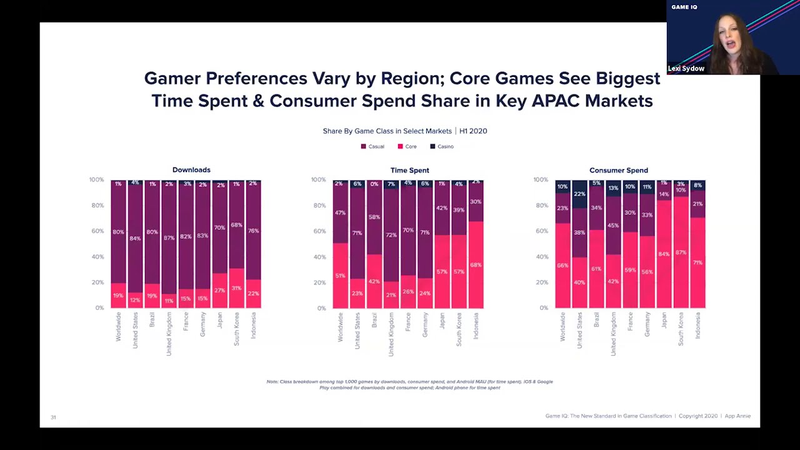
- 05While hyper-casual games lead in total download volume, core games command the majority of user time and revenue.
- 06Consumer preferences during the COVID-19 pandemic shifted toward fantasy themes, social-oriented gameplay, and digital adaptations of traditional board and card games.
Ask AI about this video
Transcript
so i am delighted to be able to uh welcome to the virtual stage a uh friend of mine for some for some many years many many years back in the early days of uh penny and uh and pocket gamer um i'll be shortly welcome to stage yonder you who will be uh talking about how to uncover market opportunities to expand your product portfolio by understanding gamer preferences and he'll do it in a much more compact way than that i think so um he'll be coming up shortly uh he's being wrangled for stage at the moment we've got a absolutely rammed session ahead of that so we'll have to come up and we've got loads loads of stuff i'm with you all morning um
and hopefully slightly less sweaty in about five minutes yonder how are you doing hey hey chris it's been a while it has been a while yeah yeah you're looking good you haven't aged at all i will see you in this honor in a bit yeah okay fair enough i'm gonna stop talking now and are you ready to go i'm ready we're ready i'm gonna i'm gonna mute myself and let you take the stage so off you go thank you thank you chris so good morning everyone welcome to pgc helsinki and welcome to the athany session my name is junda i'm from apani and today i'm here with my colleague lexi we are really excited to present apani's brand new product game iq this is a product we just launched this month and it's a product that's designed specifically for games companies so with game iq we will show we will today we will show how you can uncover market opportunities and expand your product portfolio by understanding gamer preferences alright so before we start here is a short
disclaimer about our data and presentation oh okay all right so we will start with a short introduction of our data of ourselves and our company so my name is junder i'm the general manager of gaming and apani i've been an athlete for seven years today i'm based out of our singapore office which is one one of our 12 global offices and throughout throughout my career i've worked with lots of game companies globally across market data and analytics demand and monetization and also today with me i have my colleague lexi hello everyone i'm lexi sedo i am a senior marketing insights manager at appiani and i am lucky to be one of the the lead analysts working with our mobile data and have been at the company for about five years
so a quick intro about an introduction about apne we are the mobile performance standard through our mobile data and insights platform we help create winning mobile experiences for those expiring to achieve excellence and here are some of the global companies who trust in our data products and teams so what is game iq today's presentation we will cover two parts i will do a short introduction of the game ip product and lexi will go on to present some of the most unique and granular insights powered by game iq so let's first start by discussing some of the problems we see today when the app stores first started the first group of gamers mobile gamers were gay core gamers were already playing pc games and console games and fast forward to today there is a much more diverse consumer base in gaming including segments like your older
generation your younger ones and a lot of casual gamers as well so to cater to this very much more diverse audience there is also a much more diverse offering of games so just within the casual games category we now see huge subgenres such as asmr word music puzzle runner sandbox tamagotchi and more so here lies the issue given our diverse range of game consumers and offerings with the existing taxonomies these would all be classified under the broad category of casual games so this brings up some questions that we hope to answer firstly how can we then size up the market opportunities today today as in reflecting the sophistication of the present market in the most granular way and what are the design monetization and gameplay mechanics that work inside of such games so enter game iq game iq is a game changer for the game
industry it's developed based on dozens of conversations with the world's major game publishers it's technically ambitious and massively scalable and it best of all it combines a comprehensive taxonomy with app annie's industry leading market estimates so again you can easily get the roi insights on these reports so this is what our game iq looks like at a high level our taxonomy where we break down every game into the class the genre and sub genre and if we were to zoom in you can see that just within the puzzle category you can we have broken this down into various sub genres like shooter cardboard hidden object match 3 match and build and so on what about what happens inside of games so we've grouped these tags into five types namely art style and orientation gameplay features ip monetization and theme and setting so if we were to zoom in you can see that
under just under the monetization type a tag we have tags like advertising cosmetic items gotcha loot boxes power ups and so on to label in every single game how do they actually monetize so if we were to put all of these together so let's take a look at how this looks at an app level for this app marvel strikeforce so under the existing taxonomy this is categorized under the role playing category and if with apani game iq what this will look like is that firstly this is a core game and then this is a core rpg game and and then we call it a turn-based rpg game together with all these 18 tags to tell you uh what kind of theme is it what kind of ip does it have what kind of features does it have and so on so this is what it looks like at an app level what about at a report level so together with our taxonomy and tags and all of any comprehensive market data we will bring you powerful insights that are easy to use
via reports like the market size report which gives you insights like say within the huge hyper casual genre what are some of the biggest sub-genres for ad monetization or which countries have the biggest revenue for battle royale or what's the total estimate revenue of all games that contain the harry potter ip next we also have the very powerful insights generator report that combines both store store store performance and user engagement data for advanced analysis the shared user report gives you insight on for instance like battle royale gamers which others gaming subgenres do they have the highest overlapping usage with and next we have the top games report and also the top companies report these let you conveniently filter top competitor reports by sub genres like match 3 match plus build poker games slots games as well as tags like games with anime theme or games with multiplayer games with mario ip and so on
and finally we have custom iq so when we first tested this product with our beta some beta customers we had feedback on you know how we classified the huge global monster hit pokemon go so in in some countries game developers we spoke to they said oh this is a casual game and in japan you know however in japan developers told us oh no this is a core game hardcore game so that's why we built custom iq you can customize on top of our taxonomy by building your own custom tags so that's the end of my introduction i'll hand it over to lexi to take you through the unique and granular insights all right thank you jinda um and so i will take you through a little bit about some of the um the trends that we're seeing that game iq in action so this is looking at how you can use game iq data to uncover market opportunities to expand your product portfolio and to amplify your ua and marketing
so just kick it off with a bit of a level set here on the gaming market overall uh so what we've seen is that when you look at gaming um in general and you look at mobile versus all other forms of gaming so that includes pc mac gaming home console and handheld console and we see that mobile gaming is far and above leading the pack here and in 2020 alone we expect to see a hundred billion dollars of consumer spend in mobile games and that is a 45 or 1.5 x um differential to all other gaming um and that's actually 2.8 x the next highest bucket on its own which is pc mac gaming all right so now for some of the good stuff here um so that same sort of consumer spend look we're looking at h1 2020 here and again consumer spend is through the app store so we're not looking at enough advertising um any of that we're looking at just the consumer spend through in-app purchases and um subscriptions but largely purchases for games obviously uh so this view is showing that um core
games take the lion's share of consumer spend um and within that this is where game iq kind of comes in we see that within that actually strategy and rpg which are genres within core take up about they make up about half of all consumers spend globally in mobile games and when you look at the layer deeper at the sub genres we see turn based in action rpg and then city battle are the kind of three largest sub genres driving that consumer spend we also can look at that um again at the subgenre level where we're looking at the growth within subgenres so this view is really powerful to let you see kind of the more granular side of where this growth is happening so as you can see what's really interesting in the top four subgenres globally um we see all kind of major categories represented there's a casual uh casino and two core sub-genres so we have city battle um we have slots which is under traditional battle royale and match and build within
puzzle and those are showing those are growing the fastest before consumers spend and then what's also particularly interesting is with game iq what we've done is we've categorized roblox under simulation while casual first then the genre simulation and subgenre sandbox which is very different than what you'd see in just the app store under adventure this is another great view that jinder had showed a preview of so this is what we look at for um kind of understanding how the analysis can be a little bit deeper this is our insights generator view so i want to just take you through a few kind of highlights in this view there's a lot going on uh but the first is that battle royale so this is looking at um some sub genres here so we've got core the genre action and then within that specifically the subgenre of fatal royale and what you can see here is that battle royale games have seen strong growth in not only the active user base so how many people are playing the game but also the depth of engagement um the average time spent per user and as a
result it's the category has moved from kind of niche players into that attention leaders sector then we also want to call out um this is so separate to core kind of the opposite here we're looking at casual so within the simulation genre we're looking at the sandbox subgenre and as you can see again they've seen similar growth in time per user and active users and that's taken them from the average performers category into a challengers category which is important especially for other casual games that are monetizing through in-app ads um that time spent and that breadth of users and depth of engagement is very important and again this last kind of one for casual so here's where you can see that active user base really shoot out and drive them far into the challengers quadrant and that's for the subgenre card and board all right so this is another view that we wanted to show you um so looking at sort of some of these main i the modifier tags that gender had presented before this is kind of
an action so we're looking at the themes and settings kind of modifier tag that we have and what that allows you to do is get a really comprehensive lay of the land across all regions and we've pulled three markets per region so what's really interesting is in these top two in h1 2020 we actually saw the number one theme or setting was fantasy across the board for all the markets we analyzed here and that's really compelling because uh what we've seen is i guess people you know as covet has kind of gripped the world and we've been at home more um people need a bit of an escape and that's kind of manifesting here and their choices for the top games they're downloading um what's also compelling is that the number two varies widely as well so we have in germany war games ranking number two by downloads in us it's casino and gambling and we see that play out across um the different markets so that's another view i wanted to call attention to here so just to call out a few different markets you can
see one what types of themes and settings are popular in each market and how those vary across where the competitive advantages are by market and then also within that you can see what are the games that are ranking the highest by downloads within that and are performing well um so an example is in fantasy brawl stars does particularly well in france and south korea and brazil but isn't present in the us's top downloads it's coin master uh pokemon go so a mario kart tour this is one example of some of the breadth and the depth of the data that you can get with this type of analysis another key area we wanted to call out is our modifier tag for ip so we're looking at um japan actually leads the world in the share of uh both downloads top games by downloads and by spend for games that have ip um and what we've done here is showing just a snippet of kind of what to what you can see so for globally the top among all top games by downloads the number one game with um by ipv first downloads and spend
globally is pubg and then there's also differences in markets right when you look at the us and the uk that's call of duty in the us and scrabble go for downloads being the number one for game with ip but by spend its pokemon go so you start to see some of the big differences that come up across metrics and geographies this is another view that i really like um so we also have the monetization tag um and then we also layer that within some of our our categorization so this is the monetization tag used within core games and what we see here is that gotcha and loot boxes is the number one um among most markets here uh monetization method used by core games what's also interesting is to look at the advertising one if you look at the global uh bar which is that dark blue bar here um this would actually rank towards the end of these different monetization methods not used as much in core games which is um something you probably would expect but it does show that it is being used
um and we can see that it is there's an increase in the kind of hybrid game model also to call out here um another view that you can see with this is the breakdown by market so i wanted to call out that the dark pink here or bright pink rather is uh china and so we're seeing that these types of monotony monetization methods over index in china relative to other markets among core games so they're used more heavily and then another note about advertising is that in america and europe so brazil us uk germany france we're seeing that um those core games over index and also including in-app ads so they're using the hybrid model to monetize more than say in some of the apac markets and globally all right um and so i'll just kind of breeze through and know we're coming close to time um so we've also looked at kind of how these different um sort of the genres play out across different metrics so
first in downloads you'd expect to see largely casual games dominate per share across most markets it does vary in some of the other markets core starts to play a bigger role in time spent again over indexing in markets like japan south korea indonesia and then in consumer spend we see core play a big role um a very big role in japan south korea and indonesia and in the u.s i want to call out that casino games actually represent 22 of the consumer spend yet only four percent of downloads so that's why they're really punching above their weight and it's important to know that about the us market another quick view here so this is us looking at hyper casual which is a genre within casual we can see that the us ranked number one for the total share of downloads of hyper-casual games however it's only at 15 so it is still spread largely across the world and they also rank number one for global rank we can also cut that view by parent headquarter company so when we look at that we see that actually a lot of the downloads
of games are coming from french publishers so in the us a lot of the most played or the most downloaded games in the us actually are from french publishers and we can look at this view for subgenres which we look at the core and then strategy genre and then city battle subgenre and we also see that the us is number one for downloads but the market share is only at 11 globally we can also look at the parent hqs and we see that china um publishers actually have the most downloaded city battle games among many markets and if you look at the us it's about 70 but then important to note that also um there's a high the second highest bucket is u.s publishers for city battle games among those that are downloaded in the u.s okay so just a quick couple of great stats from some of the research we've done um we've actually seen that in h1 2020 over five billion um global downloads were um or sorry
uh five billion hyper casual games were downloaded in h1 globally and we've seen that over half of all time spent among the top games in h1 were from core games globally we also saw that casino games grew 40 year-over-year and consumers spend in h1 which is a testament i guess to people staying home and largely turning to their phones to kind of stay entertained and to play casino games versus actually going out uh we also see that twenty percent of time spent among top mobile games um in h1 2020 so like the top 1000 was by battle royale games so they represented twenty percent of all time spent globally but only three percent of total downloads so that's really an important figure to know of how much time they're commanding with users oops all right um and then also we wanted to show you that around 80 of actually spend in action or pg games came from apac markets so they're really punching above their weight in that
respective category all right just to close this off if you are looking to get started with game iq two resources for you one if you want to learn more um go to bitly game iq app annie and then if you're interested in more insights and the power of the data and what you can do with it you can read our leaders to report um which is bitly slash report game iq all right wow that's a lot of stuff packed in there i'm exhausted and not only because i had fair sleep that was incredible um really i was trying to make notes so i was going on let's let's just kept coming it was rattling at you so um yeah i was gonna ask how you get it but you said at the end uh probably a question people have i've got some plenty of questions to ask you thank you so much for that talk by the way um what's what we're talking about from a business model with i know apani has lots of different kind of models and ways of getting in that looks like a very powerful uh kind of service and product game iq is that something to be available to
so smaller devs or is that your sort of premium top of the top of the pile service uh it's definitely a a premium offering as in you have to pay to access it but i guess it's uh any kind of developer would be able to use it as long as you know you're kind of data driven and you're really trying to find out you know with this huge market where exactly are the opportunities and you want to be precise i think as a small smaller developer you kind of need to be even more precise and you can't take chances or make too many mistakes and so on yeah no exactly i was gonna say i mean that that looks invaluable if you if you're gonna have to pick a niche because you're not gonna be able to compete with the 10 cents and the zingers and the kings or whatever then this data is incredible so like you'll be putting out reports right sharing some aspects of that yeah yeah of course okay let's say if you're going for a niche like let's say uh within everyone says hyper casual is big but which sub genre beneath hyper casual let's say i want to do match plus build okay great but which are the biggest market for biggest markets for metropolis bill and how do these games monetize best yeah i
want to ask about hyper casual it's something that's come up quite a lot there's a few pundits i mentioned no names deconstructive fun beacons doctor fun uh that have been basically saying you know hyper casual's on its last legs this is going to end those the hype's over but you know based on what you were showing there the downloads are only going up uh what we've seen elsewhere you know in other talks previously it seems to be going from strength to strength is that do you see that backed up you see the continual growth of viper casual i think it's definitely growing i mean it hit a record high last quarter where i mean last quarter was a q2 was a global high for across all categories and especially for hyper casual when i think it's a category where a lot of new gamers first uh engage with i mean if i i'm not a gamer at all and i first download the game because i'm stuck at home and i have nothing to do and i don't like to take care of my children the first game that i play would be hyper casual because that's the easiest for me to play and also there are lots of you know hyper casual casual games globally that
you know um can be played by gamers casual gamers without translation so that also you know relieves a lot of work from from all these developers and i think the biggest point about hyper casual is my earlier point where a lot of people have played there is now a bigger gaming market as in a lot more non-gamers have become gamers have become hyper casual gamers and over time they may drop off they may go back to work in the office or they may actually explore more games so i think this is great for the the gaming market in general if we have more gamers and they do come in first via hyper-casual yeah i was gonna i was gonna say that um one of the the questions let's have a look i'm gonna look through the q a one of the questions here is uh about changes in trends um obviously we're in pretty crazy times the moment so we all know there's been big upswings in in in engagement and new users and time spent during covert are you seeing that what are the major areas of change you're saying hypercast the entry level right so people can come in it's it's not a hard game to play and spend
money directly with it are you seeing you know other other major changes that put down to covert and and are you also seeing changes as we kind of come out of lockdown in in various parts of the world yep no questions sorry hyper casual is one theme the other thing that i think really uh took off was a lot of multiplayer games especially in the moba moba arena multiplayer on battle arena games they took a lot of time they took the line share of the time spent for for last quarter and in terms of revenue we saw that a lot of the turn-based rpg games they they made the most money uh during this period as well yeah okay cool um maybe some questions here i'll just add to that as well there's definitely been um also an increase in in games not just um so we've seen you know core games that come to mobile have migrated to mobile and that's definitely tapping into that poor market gender is talking about we've also seen games that are um
traditionally board games or card games do particularly well where it's again is that level of like physical real world that's migrating into a mobile space so scrabble go is a great example of that um and there's many board games that have seen success um as well and any games that have really incorporated social features as well any type of way of connecting so not just passing time or staying entertained but reaching out and connecting with people um especially when you're you're socially distant um but those are trends that we think will still hold yeah it makes sense people want to play four games and yeah you can't do all that stuff you know it's not as easy now to to to get all i used to board game nights but you decided to play both games against the ai you just keep losing yeah yeah i'm afraid i'm not very good so um i got a couple more kind of questions so what and then we'll have to move you on you'll know you're back later so we'll be able to get more questions later on so um it's interesting in top trends like games like pokemon go i i think it's astonishing i think niantic should get a special award for
managing to make a location-based game work when you can't leave your house uh that's great but but what is interesting about that is you see a lot of the familiar games in those genres that you said so how much does like one massive game shape the popularity of those genres because obviously at the moment we've got fortnight gate right so that could i'm assuming there's going to be some drop-off in engagement in fortnight until that gets sorted out so we'll have to see like because that's so huge will that affect modern the modern war categories is it like one or two games that really shape how popular these spaces are i think pokemon go i think we will need to dive into the data to give you kind of like a percentage of you know how this is dominated by major games but i mean if you look at the fortnight the the battle royale segment uh it's they're quite a number of big titles in this space there's pubg there's call of duty and free fire and so on so i i guess it depends on the category fair enough okay all right i was throwing horrible questions at you every day it's too early in the morning
where where are you guys all from you coming from australia lexi right are you talking from us to us from yes i am this is so international i'm in melbourne yeah absolutely now right it's like i've been i'm in london it's the morning where are you are you uh cool fantastic see like this is a totally international yeah thank you hell thank you today warren helsinki i'm going to have to leave it there some being some great more questions but we will try and pass them on um uh to to the speakers they can they can pick them up and and apani will return uh this afternoon starts afternoon sessions i don't know if both i don't know if lexi will still be up but up to we'll see what the time will be there but thanks so much it's a great start uh i'm i'm gonna go and work out how i can get free free uh free account with that now because it's so amazing uh but that was fantastic that looked really great great service and a great way to start with loads of data so thanks a lot to uh apani who are track sponsors of course of global trade trends
you
Summary
The presentation introduces Game IQ, a specialized analytics platform designed to help mobile game publishers identify market opportunities and refine product portfolios through granular data. By moving beyond broad app store categories, the platform utilizes a comprehensive taxonomy that classifies games based on genre, subgenre, and specific attributes such as art style, gameplay mechanics, monetization models, and intellectual property. This approach allows developers to size market segments more accurately, analyze competitor performance, and understand the specific design elements that drive user engagement and revenue.
Data analysis highlights the dominance of mobile gaming, which is projected to reach $100 billion in consumer spend in 2020, significantly outpacing PC and console platforms. Within the mobile sector, core games—specifically strategy and RPG titles—account for approximately half of global consumer spend. Key subgenres driving this growth include turn-based RPGs, city battle games, and slots. Furthermore, the analysis identifies shifting consumer behaviors during the COVID-19 pandemic, noting that fantasy remains the leading theme globally, while social-oriented games and digital adaptations of traditional board and card games have seen increased traction as users seek connection and escapism.
The methodology relies on App Annie’s proprietary market estimates and user engagement data, combined with a flexible tagging system that allows for custom classification to account for regional differences in how games are perceived. The findings emphasize that while hyper-casual games lead in total download volume, core games command the majority of user time and revenue. The data also reveals regional nuances, such as the high reliance on in-app advertising in Western markets compared to the prevalence of gacha and loot box monetization in Asian markets. These insights provide a framework for developers to optimize user acquisition and monetization strategies in an increasingly diverse global gaming landscape.














Comments