VideoDeconstructor of Fun
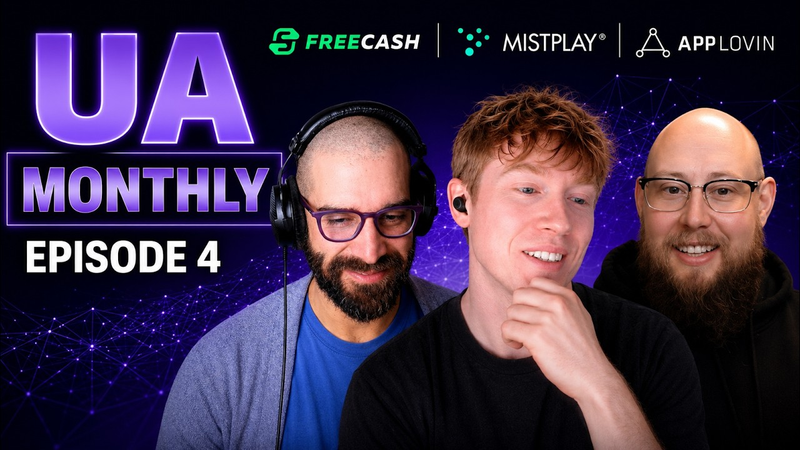
UA Monthly #4: Freecash Android Comeback, Mistplay Goes All In & Can Anyone Stop AppLovin?
18 May 202659 min video
There's some sort of person in Apple that is holding the power, you know, by pressing a button and and it it can go either way, man. It just depends on who this dude is. Like everyone's trying to find this dude or person for years, you know, who controls this and no one knows who they are.
[music]
Greetings and welcome to UA Monthly episode 4. I'm your host today, Josh Chandley, president and COO of Wildcard Games. We have four stories today. Sensor Tower acquires our top competitor again. FreeCash is back on Android. Then another rewarded story, Misplay has made two acquisitions
[music]
and is now launching an audience network. What does that mean? Finally, Apple and Unity both reported their Q1 numbers. The headlines say both are winning.
But those networks are positioned very differently. So we'll dig into that, too. Joining me today
Vincent Siemou, 52 Entertainment.
John Wright, CEO of Taboola.
So first story today, Sensor Tower has acquired the mobile app intelligence platform AppMagic for an undisclosed amount. They're positioning it as not consolidation, but as AppMagic creating the SMB tier, or the small to medium business offering. This is the second time they've purchased a top competitor. Two years ago, they acquired Data.ai, which was formerly named AppAnnie. Guys, what's your take?
Look, Josh, from my perspective, this is just the typical consolidation play, man. I don't think that Sensor Tower are going to get a huge amount of of unique product value from this transaction. There is some differentiation between the way that App Magic work on the product side and there's some things on
the the creative piece and stuff which are different. But I don't think there's like a massive differentiation between what Sensor Tower does and then what App Magic does. I think App Magic have done a good job over the last couple of years coming to market and and with a lower lower price point and they've been able to to scoop up some business and I think Sensor Tower thought, you know what? We don't want this to become an annoyance. Let's just swallow it up. And then let's just go, baby. You know, consolidation. So, that that's my personal take. But Vince, what what do you think?
Yeah, I would agree with that. Indeed, App Magic did a good job, you know, to put their name out there. I saw, I don't know, a bunch of people more and more using them, but for me it was more like a indeed like a long tail or a first tier. As you said, you know, they entered the market. I guess, you know, on the price winning market share things to prices, right? The pricing strategy being a little bit lower. So, if you're Sensor Tower, you're the dominant
player, the data.ai acquisition was, in my view, fantastic. It was a huge deal. And now this one is just like, okay, you're just shutting down competition. So, indeed that will allow them to integrate, you know, all segments, you know, first tier, second tier, and long tail. The downside for the market is less and less competition. So, you when you have one dominant player, you know, as a client, hopefully you just finger crossed that this player going to play nice and not strong-arm you in term of rising prices and everything. So, which I think, I mean, so far my experience with them or what I've heard was pretty good, you know, Sensor Tower. Yeah. I had a different experience with App Annie or data.ai, which was super expensive enterprise. You know, they had some great products as well, but yeah, the pricing policy was a little bit different. So, I mean, finger crossed, we're not going to all be strong-armed in the future, but if I'm Sensor Tower, I'm happy. I'm winning a bunch of new clients. I'm winning market share. I'm just consolidating my strong position,
right?
Yeah, and you know, if it's I think you touched on a really important point. So, I remember after the AppAnnie acquisition, I'd been a long-standing client of Sensor Tower, and there was a concern that, you know, if you become a monopoly, then you can dictate price. And I've got to say at the time after the data.ai AppAnnie acquisition happened until now, there hasn't been this like big price hike that people were kind of expecting or worried about. So, I think Sensor Tower did it in a very kind of fair way if I'm honest. At least again from my personal experience, I didn't see any kind of consolidation hike because of this. So, so fingers crossed that continues with AppMagic.
I agree.
Josh, what do you think?
It's interesting cuz I really I think the reason that we're worried about pricing, right, is that AppMagic was the value offering. I heard so many people specifically not going with AppSensor Tower because AppMagic was cheaper. And so on one
hand, the negative case in my head is the parable of like Spirit Airlines in the US. Spirit Airlines was this big airline in the US, and the concept was this, we're cheap. And it created amazing price enforcement. And they just went bankrupt this year. And so everyone's worried about what's going to happen with pricing in the US of flights. So, the the bear case is, okay, now they can charge more. The The other way of thinking about it is that this is just a different tier and they're acquiring and they're consolidating. One thing I I wonder about is when you when you be worried about pricing power, is it possible that other products will gain share? Mhm. Is it possible that there's still going to be pretty much the same pricing power, and what happens after the data.ai acquisition is what happens here. Or
I don't see competition, you know, from Sensor Tower. I mean, now it's just the standard. Yeah, I mean, we can argue if the data is accurate or not. We also always, you know, add some kind of
caveat when we share Sensor Tower figures and hey, it's not 100% reality, but you know, it's but it's just the standard now, you know, it's the currency we all looking at when we comparing downloads, we doing M&A's, we just take Sensor Tower as, you know, this kind of benchmark. We know it's not 100% accurate because, you know, it's just like an outside, you know, analysis company looking at data and signals, but again, it's not in your P&L, right? We all know that, but it's still the benchmark today. So, and this is a super dominant position to be in, right? It's kind of the currency of the definition of a download. It's like, okay, source is Sensor Tower. All right, so I know where I am, you know, it's like a leveling kind of benchmark.
Yeah, I think one concern for this industry though, and I think you touched on it right then, Vincent, is the quality of their data, in my view, is getting harder and harder to be accurate. I think downloads are always going to be pretty accurate from them, but revenue, specifically,
you know, the share of revenue coming from App Store and Google Play is going down. D2C with companies like App Charge continues to grow, and then IAA is growing, too. Does that make the tool less valuable to you, or is it still pretty mission critical?
I was at a a Sensor Tower event where I spoke about a month or so ago, and you had like Anthony, their their chief strategy officer. And the thing I said to him was like, "When are you going to get D2C revenue?" Because, you know, Playtika are saying they're doing a billion a year now in D2C. So, I wanted to know like actually how much money because, you know, it's another very popular thing I've seen recently is, "Oh, apps are making more money than games now for the first time." And I'm like, you have no idea the true revenue of games now because of the portion of D2C going through the major players. So, you know, you can't accurately predict that stuff, but completely agree with Vincent. It's the only thing we can go from. So, it's something's better than nothing, Josh. So, I I I don't see I agree and I think
I think the bigger shift as well is that they're adding new ways of providing interesting data faster than anything like that gets fuzzier. Cuz like think about like creative reporting. Creative is so insanely competitive now. The ability to pull all those ads in in real time, like that's a massive value add.
Uh I use it a lot. What I'm missing is your, you know, share of voice in terms of UA, it's not always accurate, you know, I I'm looking at the competitor, I want to know if they are spending on whatever on Misplay, on AppLovin and it's like, yeah, not really. It's like I'm still, you know, working working progress. But I guess it's just inferred from, you know, creatives and they're doing some share in terms of, you know, assuming or retro-engineering, you know, the spend based on the creative they are scrapping, but it's not super accurate. But the creative part, I mean, they did an amazing job the past few years to really give the market a good benchmark, right? To see what's going on and I guess John, you were recently on the podcast talking
about creative trends and this is a This is how we all look at creative trends thanks to the Sensor Tower creative report, which is very good. Particularly the last 30 days upload thingy, right? That they added.
I think it's become part of the creative strategy process for internal teams is to to utilize what Sensor Tower has built to look at what is performing, right? So, you go to, you know, a top 10 game in the US and then you you drill down on whatever that game is and you look at the creative library and then you're seeing like a plethora of different influential kind of creatives that would then you take back into your own strategy, right? And some of them are mini game kind of rip-offs or your standard like you know, royal match, save the king type thing that's now you're like, "Okay, that's really popular. How can I apply that to my game?" But some of it is like new concepts, some of it is UGC, some of it is completely like crazy 6-second AI-generated hook stuff. But without Sensor Tower
having a place where you can see that other teams wouldn't be exposed to it and know what these kind of hot trends are. So, that transparency and exposure to these creative trends as they happen allow other game studios to implement that and grow with the times. So, very, very valuable in my opinion.
Just download straight away. Which is bad. We don't do that, but Josh, go ahead.
Yeah, no, I was going to say I think one of the hardest parts of of building a game studio historically for me has been getting artists close to data. Mhm. And I have never seen a tool be adopted so fast by artists on the marketing side as as these creative tools. And when you start seeing, you know, artists using data, that means the tool is adding value. Free Cash is back on Android. Last month, Warren Vince and I covered on Media's rewarded app, Free Cash, being unceremoniously deplatformed from both iOS and Android
stores. It was a huge story. So, half a billion-dollar plus business gone overnight. This was a a very popular app that players used to earn rewards for playing games. Well, 3 weeks later Google has reinstated the app. But Apple still hasn't said a word. That divide is interesting. Same app same alleged violation but two binary outcomes. You know, John Vincent, does anybody actually know clearly what the rule was that FreeCash broke or are we still guessing?
From my understanding, it was around this like earn money through TikTok creatives that that were in breach of Apple and Google policy. With that being said, Josh, I I actually can't tell you if that's really the reason or not, right? I I think that's what there's a lot of surmising. There's a lot of people that said that this was the reason.
How much like factual or how much of that is fact versus fiction, I'm not I'm not even sure, but that's that's at least what I think the story was portrayed in terms of the TechCrunch article and and all of that, the exposure. But look, I'll be straight. I think LMedia, you know, got the rough end of the stick on that. It felt like when there was all these articles were shorting AppLoving stock, you know, like it just Oh, it just so happens this this article appears just as someone is trying to short the stock or or you know, influencing that. But look, we're not going to talk about this kind of financial stuff here, but look, I think it's good that they're back on Android. Will they be back on iOS is the big question because Apple operates very differently to to Android in the way that they approach this stuff. And there's some history there, right? So, let's just wait and see. But look, I think LMedia and FreeCash are still you
are still able to operate on iOS, but it's not done in the same capacity. Like there's not an app. There's it's probably like an APK situation, right? Where if you go through like a bunch of hoops, you can still download the the app to your phone on an iPhone, but it's not the same as having the app deployed and, you know, easily accessible. So, so is that going to hurt their business cuz iOS was the biggest growth factor for them in the first half of this year. Definitely. Will Apple re-accept them? Who knows. So, yeah, that's my kind of take on it.
Um you compare it to Appleovin with the short sellers, and their motive was very clear. They were shorting the stock and trying to make money. Free cash I I believe either is still bootstrapped or was until recently bootstrapped. And it's private. So, the only people that could gain in my mind from Free cash going down would be the the competition. Is that right, John?
So, I would actually say that's a really
bad idea. If you're one of the competition and you leak this, then you're not doing a good job for the industry, and you're not doing a good job for Rewarded cuz you're shining a light on something that doesn't need to have a light shown on it. So, if it did come from competition, Josh, I would be very curious to know who it was and why they did it, and what their motivations were, because it's not a good thing. It just felt very suspect to me. You know? Like they're just Something didn't sit right with me when I saw that article, and maybe it's because they've grown so much, but then they were also, if I remember right, they were in like the third or fourth fastest growing company in Europe or something like that, like in some sort of tech capacity. So, there was a lot of positive accolades that were being celebrated, and then this article comes along and it just it felt like a bit like a smearing type campaign, if I'm honest. Maybe some reporter just like uncovered this dirt that they thought was really really really bad. But it felt like the same way that these
people were in the Appleovin articles were saying like, "Oh, with with the how they do the tracking is very malicious." And then we were just like, "That's the the way the industry works. Like, what are you talking about?" It's the business. Yeah. That's how we track. So, I don't know. It just It had the same kind of taste for me. But I am super happy they're back on Android. And you You I was looking at Sensor Tower, actually, benchmark, right? And, you know, they really back strong to the level of downloads, you know, they had before. So, I was looking at 70,000 installs per day globally and 20,000 in the US, which is pretty much what was happening before they got shut down. This is all Android only. And, you know, we were just launching some tests ourselves, you know, and it was doing pretty well. And now, you know, really the delivery is picking back up. So, I'm super pleased that they are back on Google. It's a good signal for the industry. Again, rewarded Rewarded is a very important trend and now a very established, you know, UA channel, I want to say, but
also from a consumer perspective, it's really in our day-to-day lives, you know. So, it's not going to go away. And again, my understanding was potentially, you know, these TikTok affiliation practices or it was going too big. But indeed, actually, when I look at the history, you know, from Q4 to Q1, they really blew up. As you mentioned, John, you know, they were really fast-growing. So, I'm actually not sure what happened, you know, November, December coming come to January, but on both stores, it's really a huge It's not even a hockey stick, right? It's a mountain. A very sharp-angled mountain. So, maybe, you know, they went too big too fast and then, you know, you just burn your your wings, you know, going too close to the sun. But again, on Google, it's super cool they're back. I'm happy personally for themself, you know, for them, for the company, for the employee there and also just for me as a marketer. On iOS, you know, you asked the question. I think it's going to potentially take a little bit more time, if any, but I think they can survive with only, you
know, Google. Google is such a huge platform now. Or yes, for sure, in the US, high-value users are probably more, you know, on on iPhone, but they can survive. At least they can continue to grow, deliver their campaigns, and they have time, you know, to just figure things out with with Apple, right? So, that's my opinion.
Like 10 years ago, I remember I launched my my first Fix Zoo campaign. And I was I was just paying
Yeah, yeah.
Yeah.
And for those and I I I blasted a a cribbage game to the top of the charts paying for installs, and the day one retention rate was, I think, closer to 0% than 5% because it was just pay for install and you know, we called this traffic in
That's it.
And
the word, yeah.
Yeah. And so, it used to be that, you know, this kind of program was just purely like incent. And and now the the the terminology that we're calling it is more of rewarded. And my my thesis is that
these are turning into loyalty programs. Where just just like, you know, whether it's your your airline rewards or your credit card rewards, you're you're being rewarded for engaging and making purchases, which is should be a good thing for the ecosystem. Like every reward a user earns is funded by purchases that Apple's taking 30% off. I I I still think that's true. So, one way of looking at this is that Apple is choosing to lose money. If that's true, Apple is run by people who don't understand that revenue model or there's something about free cash that's worth more to kill than the revenue it generates. What do you guys think?
also an image problem because again let's say you are an iPhone users. I mean, you're supposed to be a high net worth, you know, an iPhone now costs more than a laptop, right? You obviously have cheaper Android phone. You have, you know, expensive Android phones, but yeah, let's assume iPhone is really high
net worth on this of the spectrum. And you know, you are browsing in in your Apple products, meaning the Apple Store, and you have, you know, some apps claiming, you know, you can earn, you know, $5 if you do, you know, ta-da-da. But the image thing is maybe also coming into play because if you if you just glance at it, it can look like a scam, you know, those kind of cashback, which is again, another word which essentially is cashback, you know, you do an action, you're rewarded for that action and to actually repeat that action, you know, go back and purchase to our store, we're giving you back, you know, some vouchers. And maybe it doesn't fit in terms of the image that Apple want to portray in the App Store. Again, I'm just expanding on why would they want to shut down something that is making themselves, you know, some kind of money, right? And it's a real trend. But yeah. What do you think?
Now, look, from my side, guys, I think it's very simply, you know, Apple not getting any 30% tax,
right? Like you're talking about the wider ecosystem play, for sure. But there isn't the immediate sort of satisfaction of of getting that dough in the bank. And I I think that's what it is. I think that they weren't directly attributing any revenue to this, and so it's less of a priority for them, you know? But I just don't think that yeah, the fault there is of the wider impact to the ecosystem, the industry. What about the millions of users that are using the app and doing so because they want to. I don't think they think about that. I think it's just a dollar sign thing and they're not seeing the direct value for that.
It's not direct, but to your point, Josh, you know, those apps are generating downloads, so it's generating activity in the App Store and therefore potentially some IAP in some IAP games, right?
most of these apps offer direct cashback. So, if you make, you know, a $10 purchase, you might get 30 cents back in rewards or a dollar back in rewards or something. And so it's
literally discounting purchases in a way that doesn't touch Apple or Google.
Yeah, but it's Wait, a good Are you guys users of these apps? Cuz like I'm a I'm actually a I'm a Misplay user as well.
a Mis- Misplay Play user.
Yeah. It's a fun way to find things. It's a fun way to discover new games. There's this weird like way of focusing where if I see a game come in and it's offering massive numbers of rewards, I'm like, "Okay, there's something new about this business model. Let's Let's go in and take a look at this game and evaluate it." So, I I think they're really fun and they do make me play more games. They they really do. I play more games on iOS because of Misplay.
So, for me
Great discovery platform.
Yeah, look, I think it's a discovery thing for me actually. Like, I'm not actually using it per se to get the rewards themselves, but I'm using it to find new games and games that maybe I'm not familiar with and then it's giving me some sort of, you know, incentivization to to to do it, but I never really like capitalize on the reward part of it.
It's It's a discovery platform for me and I think that in at least both as a professional as well as a a gamer, that is the the value for me.
All right. Hot takes, will Apple put this app back on the App Store?
In in what
Yes or no? This year.
It's a really tough question, honestly. Like, there's there's there's some sort of person in Apple that is holding the power, you know, by pressing a button and and it it can go either way, man. It just depends on who this dude is. Like, everyone's trying to find this dude or or or person for years, you know, who controls this and no one knows who they are. My guess would be no. I don't think it's coming back anytime soon. Maybe by end of year, but I think it's going to be a really drawn out long process. It It's not fair, but it's again it's this one person is controlling this stuff and they don't move quickly.
Same. I don't see the app coming back this year. Maybe next year, but yeah, I expect a long process indeed as well, yeah. Unfortunately.
John's right. It's not fair. It's business. I think your build for iOS not coming back. I don't I don't know if it'll ever come back. Which is too bad. I like the business a lot. And I I actually think more options for users is a good thing. But I I No. I don't think Apple's changing their minds. All right. Next, uh another rewarded story.
Kick-ass live ops need kick-ass tools. That's where Heroic Labs comes in. They just released a massive update to their Satori live ops platform. And having done my research, I can say with confidence that it's second to none. In a single product, you get everything you need, including event capture, player segmentation, feature flags, remote configuration, AB testing, experimentation, live events calendar, messaging, retention graving, analytics,
and so much more. If you're serious about running live services in a game, get serious about the tools you use. Connect with Heroic Labs and make some serious cheese with your live ops. Unless you've been living under a rock, you know this is Web Store Rumspringa. 70% of top apps are using a Web Store, and the best ones, they're doing it with AppCharge. Do you want a $20,000 in-app purchase? Yeah, AppCharge does that. How about using web-based Apple Pay checkout? Yeah, AppCharge does that. Do you want to pretend that subscriptions are still a viable monetization strategy for games? Yeah, AppCharge even lets you do that. Look, these guys are backed by Supercell, Moon Active, and Playtika. They get what high average revenue per paying customer means, and they're already doing over half a billion dollars in transactions a year. So, are you going to be the first to do a $20,000 IAP? Don't accept microtransactions, embrace macrotransactions. Learn more at appcharge.com.
Missplay has been busy. After making two acquisitions this year, they they topped it off with the launch of an audience network. So, quick refresher. So, Missplay's core app is similar to Almedias free cash, which we just covered. Players earn rewards for downloading and playing games funded by publishers using it as a UA channel. So, what's an audience network? In this case, it's a way that games and apps can access Missplay's demands. So, for advertisers, it allows you to buy additional users from whoever implements that SDK. Missplay already has an offer wall called loyalty play. That's an SDK that games and apps can implement to access Missplay's demands.
So, I really like this move. Again, I mean, they've they've been very busy, you know, like this is three big announcements in the span of, I don't know, 60 days, right? So, two M&As,
which is all about indeed expanding outside of their O&O inventory, which I believe is a very strong signal and it's a good sign. Again, if you think about Facebook when they launched audience network, it was actually to be able to deliver their campaigns, meaning the business is doing well, you know, they're selling advertising campaigns, but they want to protect, you know, the ad pressure on their own O&O audience, first party audience, but so you just deliver this outside of your apps. So, I think a similar logic applies here, you know, Missplay has their own app, which is all gaming, which I guess is my second point. Also, it's just to expand into a retail audience, a retail oriented audience, or at least a non-gaming, which if you think about it, you know, one big loyalty app in the US is Fetch. Right? Ad Joe is actually doing super well and going strong on
this same kind of retail loyalty program where they can actually run their campaigns. So, if you don't have that and you are Misplay, although you are the OG, you're just capping in term of inventory both in scale and in quality, meaning in diversity of of audiences. So, I think it's a great play and it's a great avenue for them to grow. You know, you deliver your campaigns outside of the Misplay ONO app. Hopefully, it means because they have too many campaigns to deliver and you know, advertisers want scale always. And also, it allows them to deliver and to reach a different audience, which is like retail-oriented, which is necessarily different. But, you want that, you know, if you're a network. So, great move.
I think here's the missing context. Misplay's downloads have dropped over 30% on Android worldwide from 2023-2025. In the US specifically, they've dropped 43%. Downloads are shrinking at the exact same time this category is
exploding. Uh I don't even think that they're at scale yet on iOS. And in my opinion, one of the things we're seeing here is that Misplay is struggling to grow organically. So, they're they're buying growth instead to play catch-up. They've already made two acquisitions this year and 2 hours before they announced the Misplay Audience Network, which I think is like a wrapper that combines these acquisitions with their loyalty play offer wall into one pool of supply. But, stitching together ad networks is really hard. You know, ironSource and Tapjoy is the classic offer wall example of how hard it was. And then there's ironSource and Unity. There's what Digital Turbine did with AdColony and Fyber and AppLovin. I think it is hard to combine all these different tech stocks and different pools of users when you start to move from everything being inside your own app to managing all these different apps and
trying to scale that with businesses that didn't have the scale. So, I'm a Misplay user. I love I use it almost every day. Even I don't play a game, I'll like scroll just to see if anything's new and I enjoy it. But I do think they have a tough slog ahead. You know, I I expect this network to grow slower than some of the other, you know, blue chip rewarded platforms. But Misplay is definitely a blue chip premier rewarded network. That's my take.
Look, I think that Misplay are playing chess right now when other people are playing checkers. I'll be straight. I rate the decisions they're making right now because I think they're evolving. I think they're coming from being the OG rewarded network and the first of their call, the first notable one in our industry of their kind. And they're expanding something more, Josh. They're going through this, yeah, this evolution of like what does it mean to be a major player in that field? And they're One, yeah, they're buying growth, but that's consolidation for any business and any industry, right? That's we've seen it throughout gaming in the last 10 years both studios and tech providers.
But I think what they're realizing is, yeah, they're you know, the rewarded users themselves, there is a finite amount of people, right? Who who have like want to be rewarded. And how do you make those users more valuable, right? If you can't get download growth, you best believe you better be getting LTV growth, right? And even if your your download volume is going down, depending on your DAU, right? If the LTV goes up, then you can still make a lot more money. So, I think they're just finding out ways, means, additional tech, you know, processes, whatever, so how do they maximize every user that comes in? Because also, the other thing we haven't touched, right? UA for rewarded is very expensive. Like if you're if you're our media or Misplay, you're buying like a user for like hundreds of dollars, right? So, your unit economics better be strong. And I think Misplay have realized that. And I think they're like, "Okay, we're going to do everything we can to maximize every user that comes into our ecosystem. We're going to maximize how much that user can generate for us as a
business." And I think that's a smart strategy. Remember, they are they're a PE-backed company, right? So, they none of this hiding, you know, in the financials. So, yeah. I I think, you know, they could they could spend a lot on UA very very badly, loss, and make it look like the numbers are going up, or they can do smart business, and they can do what they're doing, and they're going to maximize every user. That's my personal take. Also, there is a clear correlation between the takeoff of Freecash {slash} AdMedia, and actually, as you mentioned, Josh, some kind of downtrend on downloads on Misplay. So, yes, competition. And John, you touched on the CPI when you do acquisition for such an app. But when I look at DAUs, actually, the the DAUs are not falling, which is interesting, right? So, the as you mentioned, the downloads are down on the Misplay front, but the DAUs are fairly stable, at least globally, as far as I saw, which is a good sign, right? The user base is there. They just calmed down the UA,
right? Well, that's good business then, Vince, right? So, if your DAUs are consistent and the cost of your UA is going down, it means that you as a business are becoming more profitable.
You're expanding your margins.
Exactly. And you have cash to do some M&A. This is what AppLovin kind of did, right? They grew, grew, grew, and then they optimized their OpEx, and then their EBITDA just kept growing and growing quarter over quarter. So, like, I think this is a smart strategy. I think Misplay are doing some very interesting stuff, and it's one to watch.
Yeah, I think the business is financially healthy, but if DAU is stable and relatively flat in an industry that's exploding, it kind of was a question of like what's the benchmark, right?
Yeah, again, I think the answer is really the competition. I mean, if I look at my own UA, you know, 2 years ago, it was only one or two rewarded platforms. Now, I have five, six. So, yeah. And my budget is unlimited. Yes, if the ROAS is there, meaning there is a ceiling, and so I just distribute across more more vendors now. So, I think the
good it's good that they are more on the aggressive front, I mean, strategically at least, to just, you know, try to consolidate or take back their leadership position in terms of market share. And And at the end of the day, it's about, you know, delivering your UA campaigns and delivering and scaling ROAS for your clients, meaning you need users. And so, buying your way, you know, with acquiring, you know, networks or or or other O&O, it's actually pretty good.
With all of this, how are you guys feeling about Miso Play over the next year?
I think they've got a bit of a power play on iOS now, if I'm honest. I think it's an amazing opportunity for them. Very unfortunate for our media, but if I was Miso Play, I would capitalize right now. Even from a CPI perspective, Josh, the CPIs must have gone down because our media was buying so much that Miso Play have to be have to have better metrics now, right? And if the CPIs are down, again, like from unit economics
perspective, things are moving in the right direction. Margin goes up, and then they can reinvest that money to to expedite growth. It creates that flywheel effect. So, again, I think, you know, Miso Play should capitalize. But, let's see.
Only problem is, as far as I know, and I'm checking since the tower, they've always always been a little bit weak on the iOS front. So, they don't have much scale. So, it's maybe their time to, you know, be bullish, unless there is a huge switch meaning the App Store, right? Being super super, you know, constrained there to do anything. But, yeah, there is a window.
Yeah, what's the take? Is it like well, cuz like my first reaction is like exactly what John just said. Like, okay, my number one competitor that I'm bidding against is either paused or gone. I don't know which one. Strike while it's cheap. The other way of thinking about it is my competitors try to scale and
AppLovin or Apple just smites at them from the heavens. Do I Do I try to scale? It's an impossible choice when you think about it.
Double-edged sword, man.
You know, you might be cut the wrong way. It's For sure it's a risk, but I'm a gambler. I'm going for it.
All in, baby. All in, baby.
Vegas.
Well, good thing in May is next week. Yeah.
[laughter]
Oh, man.
Last story. Both AppLovin and Unity reported Q1 earnings last week. AppLovin did 1.84 billion in revenue, up 59% year-over-year. Not only is AppLovin's Axon dominant in gaming, but their consumer segment is now the fastest-growing part of their business. Unity's ad networks combined for 352 million, about 1/5 the size of AppLovin. Vector is growing fast, and it's increased to about 1/8 the size of Axon.
So, objectively speaking, both AppLovin's Axon and Unity's Vector specifically are They're executing very well, but Axon is just in a whole different league in terms of scale. I realized was AppLovin added more revenue this quarter, and they added more revenue than all of Unity's ad networks combined.
Which is insane.
I was like
It's an insane metric or parallel you're doing here.
Yeah, and so my my first question to you both, it's so hard to talk about at least for me to talk about AppLovin without talking about Unity. What makes them linked in the mind of UA managers, whereas Google and and Meta might be less linked than AppLovin?
Honestly, for me it's not linked. If I take my UA hat, if I'm thinking about my AppLovin campaigns, you know, and such, I'm not thinking about or putting in parallel or even, you know, arbitraging anything, you know. Unity for now it's indeed in another league,
at least from my perspective, you know, as a client. So, for me they are not linked. Of course, they are operating in the same business. Unity is trying to do some kind of a comeback. They're fighting on the mediation, we all know that. But in terms of UA, for me it's just like absolutely different league. I don't know how is it for you, John, but yeah, that's
Yeah.
I think look, we we spend a lot more on AppLovin than we do on Unity. That's the the honest truth. I think both both companies and channels have have their their positives and and both do good things in in their select areas, but I mean, the traditionally I would bucket them as the SDK networks, right? That's from a from a UA perspective. They were you had the way I would define it was you had you had Facebook or Meta, you had Google, then you had the SDKs, then you had the DSPs, and you know, like they were those kind of buckets for me. I feel like over the last couple of years AppLovin has kind of broken out of that and has become its own one. I would differentiate and be like, you know, Facebook, Google, AppLovin, you know,
and then kind of the remaining SDKs. So, I do think AppLovin is definitely in a bigger league. And honestly, Josh, that stat's wild, man. The fact they've added on more revenue than the total of Unity, that's a big thing, right? I think they're also non-comparable in the sense that AppLovin has transcended now. And Unity is doing great work, like Vector now is so much better than it was kind of six months ago. The accuracy and the ROAS campaigns we're getting much better results, you know, things are growing. I'm I'm happy with the the performance even though the scale is less than say Axon. But yeah, I don't I don't think you can put them in the same league anymore. I I hope that Unity, you know, challenges, but it's a long way there's a long divide to fill, you know.
It's interesting though cuz you're spending on both. And you know, AppLovin, Unity, but also Mintegral, Liftoff, and Moloco, you know, they're all for the most part competing for the same traffic. AppLovin so far ahead, why are you buying on more
than just AppLovin?
I think it's depend on the waterfall position on the supply side though, right? Like AppLovin might have more first impressions, but then other people have other stakes in the waterfall. So, you can't just buy all through one source. Like so, it might be the same apps, but the way you come up in that breakdown, right, is kind of different in my opinion.
Those numbers are absolutely impressive. Kudos to AppLovin and the team. And also again, I was looking at the number of employees, which is insane. Unity is like 4,500 and you know, a couple of years back it was I think it was like 6,000 or something like that. AppLovin is I believe below 1,000. Of course, Unity has two businesses, you know, the engine, which is the bulk of the number of employees as far as I know. Whereas, you know, AppLovin is supposed to be I mean, I don't know, but only on a network, you know, they sold Lion Studio. There is Adjust, but Adjust is not a huge number of employees. But
yeah, the the number, absolute value number, the year-over-year growth, and the number of employees is absolutely staggering. So, that's my first comment. Unity I think Unity is on fire, but the problem is it's like super super small scale, particularly if you compare with AppLovin. But I mean, I don't know if you followed, but the past 2 weeks, they announced a huge amount of things, and one parallel we could do is the brand demand. The brand demand approach is very, very different. Obviously, AppLovin is all about e-commerce, which I believe they rebranded consumer to just broaden, you know, it's not about retail and in commerce only, it's about travel apps, it's about fintech apps. So, I understand, you know, here, but it's all consumer app oriented. Unity announced they joined the IABTCF Europe framework, you know, for consent, and this is my my read there, it's it's all for their programmatic demand. They announced, you know, integration
with Nexxen, which is, you know, formerly Unruly, which is like video, CTV, but very much brand oriented. So, that's a couple of things that tells me they are doubling down on brand demand. And that's one big announcement and a big difference compared to the AppLovin approach, which I believe, and that's just my very subjective take, is AppLovin is dropping the brand demand. Again, I'm talking about branding, you know, the New York, you know, big five media agencies. I mean, nobody's talking about their SSP, you don't really have any other conversation about what the brand requires, you know, for the longest time, apps and game developer were asked to integrate this SDK, this SDK. Yes, because, you know, the brands have specific requirements. This is gone, you know. Again, consumer app is performance, it's a little bit different, and I love that. So, I see two different approaches there, again, between AppLovin and Unity. I'm going to pause there. I have more comments, but I think that's that's a very different
approach.
I think that the fundamental difference is the with mobile targeting, like there's a digital targeting in general, pure pure brand plays where there's nothing hard to optimize against means that the the revenue per impression there like the amount of spend you're going to get is it's not competitive enough to to bid against very performance-driven consumer Like I'm I'm pretty impressed with the scale AppLovin's already achieved with consumer. So I I think that's the the right approach in my opinion.
I think I saw some comments that it was actually not growing as fast as the market expected. I mean, I think they shared something around 1% or from 0 to 1% of their overall business is now coming from e-commerce. And I think the ambition by 2031 is to for that number to be up to 20 and 30%, which is, you know, very ambitious. So I think there is the market, again, I'm talking about
market perception. I think the market is a little bit disappointed by the growth of e-commerce. But again, it's not easy to build from scratch a new vertical. It's a different algorithm, different client set. And so I understand it takes time basically. But I think it's not going as fast as they wanted.
Yeah, I agree. And I think that the way I heard the earnings call was that their pivot was like, yeah, and that's okay because self-service opening in June. Do you buy that? Do you buy it? Like do you guys believe that? Is it purely just they need to have a better way
to onboard all these clients?
John, go ahead.
Do you know what, man? Look, at least from what I know, it's been invite-only and very select people and all of that and that does put a cap on things, right? So there is definitely some truth in that. But it also, you know, I've seen a lot of their marketing on LinkedIn and stuff has been like pick these sort of videos with these people who are like these traditional marketers
and being like, have you
Yeah, I was in one of those videos.
Yeah.
Have you heard about AppLovin'? Like do you know what AppLovin' is? And then we went from spending $100 to $10,000 per second? You know, like it's it's all of these videos. So, I think look, man, they're hyping it up and when the self-serve goes live, you know, the money will might will start rolling in, you know.
Yeah, they're definitely trying to scale. And I think that it's very interesting that they're now running UA for UA platform. I think they claimed that the payback periods were very good. I do wonder how scalable that will be. So, I think we all know when you're doing something at a small scale, you want to if you want to 50 or 100x your spend, you can't assume even 70% your prior ROAS.
Guessing where your users come from? That's so 2010. AppsFlyer is like having a cheat code for mobile marketing. Pinpoint attribution, real-time insights, and
analytics that actually make sense. Stop flying blind and start flying smart. AppsFlyer, because your data is your best co-op partner.
Let's be honest, you're tired of chasing installs across the same crowded networks. We all are. That's why Vibe built a new playbook. They're the fastest growing gamified rewards platform and they are helping studios scale smarter, not just bigger. Their AI-powered targeting means you will finally hit the audience you want and with their new ROAS optimization engine, performance doesn't just grow, it actually levels up. So, if you're looking for a growth with a fresh angle, check out Vibe. It's built different, it's designed for growth, and it's powered by good vibes. So, head over to v y b s.co and get yourself some good vibes.
Attention app and game developers, the difference between scaling and failing
comes down to one intelligence. Sensor Tower delivers the ultimate competitive edge that separates market leaders from the forgotten. Their platform doesn't just show you what's happening across global app stores, it reveals why it's happening and what to do about it. Need to crack new markets? Track competitor UA performance in real time? Reverse engineer the monetization strategies powering today's billion-dollar games? Sensor Tower transforms in pregnable market noise into actionable signals. The platform goes beyond raw data offering intuitive tools and expert analysis that convert insights into revenue-generating decisions. That's why thousands of studios from scrappy Indies to global powerhouses rely on Sensor Tower to outmaneuver the competition. Stop flying blind. Start your free trial today at sensortower.com. That's sensortower.com.
[music]
What about the Unity Shall we go back to
Unity?
Yeah, one second.
Yeah, again, part of their recent announcement was the Unity commerce platform, which I think is very smart. And again, my understanding is now the engine will allow game developer to essentially do IAP everywhere, cross-platform. So PC, you know, console, app. And I think it's very smart because again, we touched on on Sensor Tower not showing, you know, the off-store revenue. And here you have Unity going after that and taking a cut. So essentially playing some kind of App Store tax, right? So I think this is really leveraging, finally, you know, leveraging the engine in a very creative and smart way to tap into the IAP off-platform, meaning off as off App Store revenue, which is growing tremendously. So again, it's very early days. I'm not sure how it's going to pan out and, you know, if everybody's going to adopt it. As far as I'm concerned, it's removing a friction. You know, instead of having a bunch of different
services, different vendors for each environment, I'm just going to leverage the Unity engine. And I think on the on the PR piece, they mentioned a partnership with Stripe. So, you just use whatever, you know, payment specialist, but everything is embedded and you have one pipe across platform, which I would which I like. You know, it's just simplicity.
Yeah, makes it easy. I agree.
And then that data just all feeds Vector, basically.
We know that they're just
Probably, yeah.
But I mean, look, there's the engine data piece, which also is something that's been expanded to recently. Data is king, Josh. This is This is why other companies, you know, we talked about AppLovin, but the reason they were able to dominate was because they had so much data, right? They had adjust They had MoPub. They had all of this stuff and and data is king in our business. So, coming up with new unique data points and other ways to be able to to model data is is very important, especially for like a young algorithm like Vector.
Yeah, and Unity is clearly going all in on Vector. They've pulled resources away
from ironSource aggressively enough that now as of today, ironSource is no longer an active ad network. It's just an an exchange, basically, at this point.
Mhm.
Mhm.
Did you get to the pop-up to opt in to share, you know, data?
I did.
know?
We opted in. John, have you had that pop-up yet? Have you had the chance to opt in to sharing engine data yet?
Yeah. I think look, the more data we share, the better the the results will be. So, I'm I'm happy to do it. I also don't think Unity are going to roll out a game studio that's going to compete against my genre. So, I'm not worried about it. We're used in the in the
Highly unlikely.
Exactly. I think look, they've They've already They've They've already said they're selling Supersonic, right? Like that's off. Like as soon as they get a buyer. So, I've got no concern sharing this data, Josh. I just think it I'm going to benefit more from from better UA.
Same here. Same here.
Same here, yeah. I opted in and again, last month during the last episode we
did, Josh, I mentioned I was ready, you know, if they I mentioned I was ready to opt in and also I think I mentioned that at least they're asking for permission.
Yeah.
Exactly. So many companies, you know,
They could have just done it, Vince.
Just change the T&C.
Yeah, they could have just done some sort of little policy and say
Exactly. I think it's fair, you know, it's pretty fair. They're asking for permission. But they could have, you know, collect this data without our knowledge. So I think it's it's fair to just play the game and share the data. Because again, we all need a diverse at least UA landscape, right? And having a strong Unity in the in in the coming years is something that we need, right?
So do you all think this was the right move? Cuz like they've gone all in on Vungle. IronSource has faded to the point where it's now a recent memory. Yeah, was this the right move for for Unity as a business?
I mean, but look, Unity acquired an asset. They they utilized that asset for, you know, over a period of time. You don't buy something and then keep running it, Josh, you know? You
amalgamate into the the bigger machine. And so I think IronSource, you know, did its job, right? They utilized all of that data. It helped evolve and and create Vungle and and Unity's current sort of a setup. And then eventually it's going to get discarded cuz that's what happens in in this kind of M&A situation. So yeah, I'm I don't think it's rocket like I don't I'm not surprised by their sun setting of of the network. Like I expected it sooner if I'm honest.
Thing I'm excited about is D28.
Mhm.
Yeah.
So I'm not sure when any kind of public announcement's going to be done, but obviously we all know they are working on it again to expand, you know, from D7 to D28. And we know AppLovin was the first and for the longest time AppLovin was the only one being able to optimize for a longer period, right? And Unity is, you know, going to that direction as well, and I'm super excited about that.
Our IAP is already live. So, if you're running IAP campaigns, you can launch
today. But, the hybrid and the in-app ad are obviously where a lot of the money is going to be. And so, it's going to be very, very exciting to see to see how that performs.
Joseph, we've tested it. We had good results. You know, and but we need the the further
I guess my last question is simple. At this point, is there any stopping AppLovin, or do they own in-app ads?
That's the biggest question of all, right?
So, that's the reason why we all talk about Unity.
I mean, for me, it's going to be regulation. I don't really see, you know, regulation might stop the AppLovin trajectory in term of, you know, anti-competitiveness. Otherwise, if it's just, you know, the player right now on the market, it's it's it's tough to really convince ourselves that someone is threatening this trajectory. I mean, again, you mentioned the numbers earlier. It's just like plus 59% year-over-year, 85% margin rate, which is telling you something. When you have this level of margin rate, meaning
you're not really challenged by anyone. You can take the margin, you're still winning. You're not losing your clients. So, it's telling you something, this margin rate. So, for me, the ultimate thing could be the regulation, but again, I've no idea about timelines if anything like that could happen. But, that would essentially put some kind of a stop, like if you have to break supply and demand, for instance. And we know some large ad tech companies went through that. Otherwise, just the competitors, it's tough to really see any threat coming from other players, at least in 2026. What do you think, John?
You're muted. You're on mute.
Yeah. One, I I need to stop comparing the Maps to Apple's, cuz I think they're two different things now and two different businesses and two different sizes. So I think we need to stop this. This is like a prior thing from a few years ago that all of us were when it was neck and neck mediation war and stuff. I think that time has passed. But yeah, look, I think we need to stop comparing them, but ultimately Apple Lovin's trajectory is going to be very,
very hard to to to to prevent or stall. If something does cause that mean, yeah, I don't know why. I mean, there's a there's a case that they'll lose maybe the the grip on the mediation side of things, but even if they lose some of the the the SOV on the mediation, Josh, it's like it's it's so much time has passed and so much data has been kind of funneled in. I don't know if it's like losing say they lost 20% share of voice to on the mediation side of things. Like would that dramatically impact their ability to deliver better to UA now? Right? After all of the everything that's happened. So I don't know. I don't I don't see anything really happening unless it's some sort of seismic change like Vincent's talking about some sort of regulatory thing which we can't expect or predict. But yeah, maybe they slow a bit, but I don't see them like being competed against in the same
Yeah, I I'll be as contrarian as I I'm
able to be. Please just so that we don't have three people saying the same thing. I I think the pendulum has swung far enough now that I don't see any one business or network competing directly against Apple Lovin' and pushing some things back to a more competitive and balanced place. In my view, we would need to see multiple networks moving almost in coordination. To to be able to to to compete effectively against Apple Lovin cuz Unity isn't big enough right now. Meta Audience Network isn't big enough. And the Loco, Menta or Google, these businesses they'd almost have to band together to be competitive cuz the perfor- there's the the performance is what dominates, you know, who wins and loses the auction. And it The numbers speak for themselves.
Yeah, good point. One single player is going to be super tough. A bunch of them together, but again, how can that happen, right? But if
everybody's pushing the same direction, they can potentially do something. But again, John touched on the mediation share of wallets, which I believe is the key, or market share rather. This is the absolute key. And we all know that the AppLovin market share on the supply side is very much linked to the UA, you know, access. There is a a commercial exclusivity there, which is super super tough to break if you want to break it, right? So, I'm on MAX AppLovin. I enjoy having access to Axon. If I move to another mediation, I lose my UA. This is the biggest thing for everyone in this industry. So, supply demand are very much linked. And John, you mentioned access to supply is absolutely key, right? You need to be able to deliver. And how do you control the access to supply? By having the mediation, right? And right now, it's very tough to see any competition because again, the competition is not just another mediation. It's another mediation with a very very strong at least as strong of a product on the
UA front. So, you can migrate both at the same time, which right now, I don't really see anyone unless there is a combined approach, as you mentioned, George, potentially. But I don't really see that right now.
No. I think that's reasonable. Well, thank you, John and Vincent, for joining me. This was fantastic. I'll see you again next time. Thanks, y'all.
Thanks, everyone. Cheers.
Bye-bye.
Thanks for having me.
Thank you, guys.
You did it. You made it to the end of the episode. As a fan of the show, it would help us out if you'd subscribe and leave us a review on the podcast service of your choice. Those stars and likes, while small action on part mean a lot to us and help to grow the show. More importantly, are you a member of the Deconstructor of Fun Slack group? If you have five years or more of games industry experience, go to deconstructoroffun.com/slack and apply to join. Join the games industry best professional community filled with peers always willing to lend a hand or subscribe to our newsletter to get all the latest insights from the Deconstructor of Fun content leaders.
Thanks for listening.
Auto-generated captions from YouTube — names and numbers may be misheard.
Market consolidation and the evolution of user acquisition strategies define the current mobile gaming landscape. Sensor Tower’s acquisition of AppMagic signals a trend toward centralized data benchmarking, though the industry faces ongoing challenges regarding data accuracy as direct-to-consumer channels grow. Simultaneously, the mobile ecosystem remains volatile, evidenced by the sudden deplatforming and subsequent reinstatement of Freecash on the Google Play Store. This event underscores a persistent lack of transparency in platform policy, particularly regarding Apple’s restrictive stance on rewarded-app businesses, which continues to create significant operational uncertainty for developers.
Rewarded platforms are increasingly vital for loyalty-based user acquisition, yet they face distinct regulatory and growth hurdles. Mistplay is responding to stagnating organic growth by aggressively expanding its ad tech stack and audience network, a move aimed at scaling inventory despite the inherent complexities of integrating disparate systems. While Mistplay shifts its focus toward maximizing user lifetime value and operational efficiency to protect margins, the broader market remains heavily influenced by the dominance of AppLovin.
AppLovin currently maintains an unassailable lead over competitors like Unity, driven by a potent combination of mediation market share and high-performing algorithmic capabilities. While Unity attempts to pivot toward brand-oriented demand and off-store revenue capture through its engine, it struggles to match AppLovin’s scale. Analysts conclude that in the absence of significant regulatory intervention or a unified competitive front, AppLovin’s trajectory remains largely unchallenged, cementing its position as the primary force in mobile advertising and user acquisition.

Deconstructor of Fun · 2026

Deconstructor of Fun · 2026

Deconstructor of Fun · 2026

Deconstructor of Fun · 2026

Deconstructor of Fun · 2026

Deconstructor of Fun · 2026

Deconstructor of Fun · 2026

Deconstructor of Fun · 2026

Deconstructor of Fun · 2026

Deconstructor of Fun · 2026

Deconstructor of Fun · 2026

Deconstructor of Fun · 2026

Deconstructor of Fun · 2026
Deconstructor of Fun · 2026
Liftoff · 2024
ironSource · 2022
Sensor Tower

Deconstructor of Fun · 2026
Deconstructor of Fun · 2026

Deconstructor of Fun · 2026

Deconstructor of Fun · 2026

Deconstructor of Fun · 2026

Deconstructor of Fun · 2026

Deconstructor of Fun · 2026
Comments