1 free read left. Create a free account for unlimited reading + AI research.
Create free accountWhitepaper DiGRA
1 free read left. Create a free account for unlimited reading + AI research.
Create free accountWhitepaperDiGRA
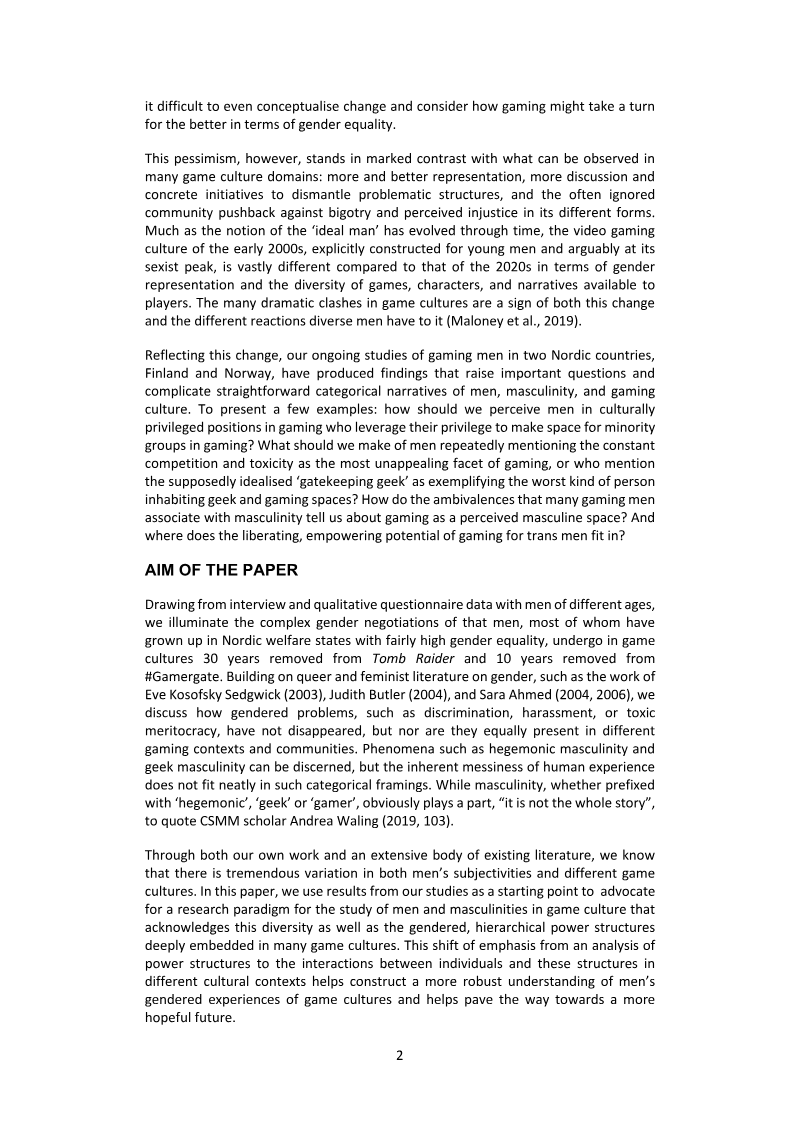
The author argues that men's lived and embodied experiences in gaming remain underexplored. The study asks for a more hopeful account of men's capacity for positive social change.
Tom Legierse's autoethnographic study examines masculinity through the lens of Kind Words, a cozy online game in which players exchange anonymous letters of encouragement. Its central thesis is that research on masculinity in gaming has concentrated heavily on structural power, harassment, and toxicity, leaving men's lived and embodied experiences underexplored. Drawing on post-structural, phenomenological, and affect-based frameworks, the author argues for a more hopeful account of men's capacity to drive positive social change. The approach is justified both by ethical concerns about involving other players and by the feminist value of reflexively situating the researcher as a cishet, White, middle-class man from Northern Europe.
The empirical core consists of roughly 40 sessions, or about 120 hours, of play between May and August 2024, with sent and received messages thematically coded. The most significant finding is a shift in the author's stance from an urge to "help," which is authoritative and outcome-oriented, toward a more unconditional yet contextually conditioned notion of care. This shift was shaped by time, space, emotional capacity, and the game's affective affordances, particularly anonymity and the low risk of emasculation. The study frames this engagement as a search for hope against the author's own experiences of toxic masculinity in sports and competitive gaming. It concludes that the game's transformative potential resides less in the game itself than in how it moves the player.
The analysis also documents important tensions. Emotional engagement within the game's affective space enabled forms of expression not readily found in other gaming contexts, yet kindness and care proved unstable: some responses felt misunderstood, and others reproduced neoliberal ideals of individual responsibility. Ultimately, the author argues that post-structuralist and phenomenological approaches capture the contradictions in men's gendered performances and their potential for change more fully than structuralist frameworks. Grounded in Connell's concepts of hegemonic, hybrid, and caring masculinities, the work contends that positive, emotionally open masculinities exist within gaming culture and merit study alongside its better-documented toxic forms.

DiGRA · 2026

DiGRA · 2026



DiGRA · 2026



DiGRA · 2026



DiGRA · 2026



DiGRA · 2026



DiGRA · 2026



DiGRA · 2026

DiGRA · 2026



DiGRA · 2026



DiGRA · 2026

DiGRA · 2026
DiGRA · 2026