1 free read left. Create a free account for unlimited reading + AI research.
Create free account
TouchTen: How we Doubled Iteration Speed Using SaaS Back End
Key insights
6 takeaways- 01TouchTen reduced overall development time by approximately 25% by offloading backend infrastructure to the service provider XtraLife.
- 02Leveraging a Backend-as-a-Service (BaaS) model allowed TouchTen to maintain a bi-weekly sprint cycle, facilitating rapid concept validation and market responsiveness.
- 03Outsourcing backend requirements like cloud saves, user profiles, and live operations allows studios to redirect internal resources exclusively toward core gameplay and user experience.
- 04Using pre-built, modular tools for features like leaderboards and event scheduling eliminates the technical debt and high costs associated with building custom server infrastructure.
- 05XtraLife supports over 200 live games and processes 500 million API calls monthly, providing the necessary scale to handle growth from 10,000 to 500,000 daily active users.
- 06The integration of third-party backend services enables smaller development teams to compete with larger organizations by lowering the cost of experimentation and failure.
Ask AI about this video
Transcript
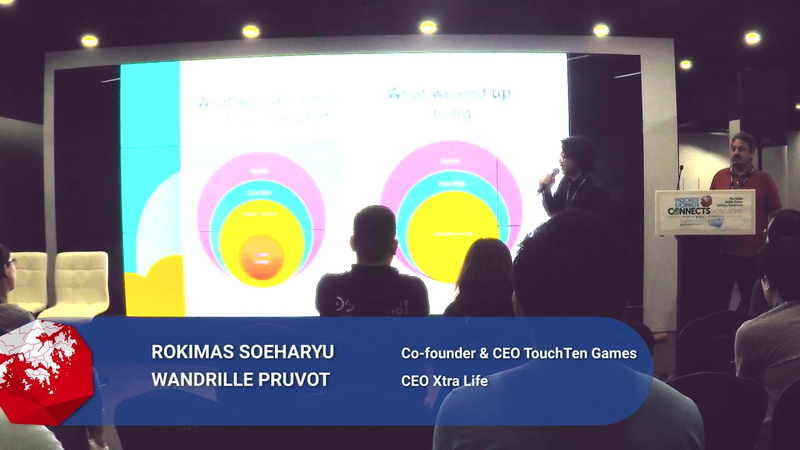
[Music] first of all I just want to thank everyone for being here and also a big thank you for the pocket gamers team for putting this together can we have a big round of applause for the pocket gamers team really for putting together this awesome conference thank you very much [Applause] my talk today I'm covering about how a touched and we are a mobile game company we how do we double our iteration speed by working with back-end as a service provider and through the course of my talk I will be introducing my good friend one drill who is from extra life CEO of extra life who's providing a
really awesome set of features for developers so without further ado I'll start touch 10 + + extra life has has a long friendship even though we're from different countries different continent we speak the same language we are believers of innovation and we're both you know has been in game industry for a while a little bit of background for myself when we started touch 10 we didn't have a lot of budget we didn't have a big team what we have is a strong passion in games and we are moving quickly on market opportunities so moving fast has been really important for our company and we started off with this game called sushi chain what happened was that back then in 20 2009
we saw in the market there was a lacking of game for about food about sushi and we had to move quickly to fill in that gap because if we didn't move quickly somebody else will I would have missed the opportunity so that's how we started oh it's just a chain moving quickly on that we're able to develop our game in two months and get a lot of users to play our game because simply there was no other game that covers this you know delicious fresh food here Susi so along the years we've been moving quickly on different opportunities and last year we did something different last year we we identified the women mobile gamers as a really key market and so we started making this game called royal garden tails and that's where you know the context of this talk will we'll talk about the way we work is that we
build measure and learn iteratively we build our game iteratively every two weeks so every two weeks we're pushing new version of our game to the player and as we build we learn as we build we we understand our users through user interviews over here we do play test and then we also use data analysis using bigquery and using tableau to really look into the data and improve our game from from that and also we use market research what we know is that when we iterate faster we're able to achieve better results so this is a chart showing my our games our previous games for six months download and for six months revenue on the right when we are able to iterate quickly with our latest game Royal Garden tales here in orange
we were able to achieve much more and so we already know that moving fast is key in this industry but sometimes moving fast is not that easy especially when we're trying to build a back-end for our game we're a bunch of people that are really passionate about gamers we love the the UX of a game and the game design in the front end of a game but the back end is a whole nother animal altogether so that's what we have discovered ok we realize that when we're trying to build a back-end team it's quite problematic first of all we need a dedicated team the team here involves finding back-end engineer from an engineer network engineer sdk engineer these are some of the most rare pokemon
that you can find right and then it also presents a management bottleneck because not only you have to find these people but also our management team have to manage them our city you have to divide his time and their time between the front end team and the back end team and also scaling up is a problem so some of you might know that you know a back-end setup that works for 10k da you might not work for 100k da for 500k da u so scaling it up is a challenge as well and one thing we realize is that oftentimes when we're doing our Sprint's so we do our game development through Sprint's and when we do our sprint with we think of it like okay we'll spend some time building the core gameplay and then we look into like okay let's build some live-up elements let's build some social element we end up doing a lot of at the
time when we're trying to build our own back-end is actually we're doing this we're doing a lot of time spent on building the infrastructure all the backend stuff and then layering live ops and social on top of it and this kind of situation is a problem because what we want to do is to improve the gameplay for the players we want to build the best experience with the players and that's a big problem so for us we're very fortunate we're very lucky to have a friend who can help solve this problem and that's where extra life comes in and here's where I would like to introduce one drill who's the CEO extra life to share a little bit about extra life or what extra life is and please take it away wonder so to get back I'll do a draw the parallel between
the previous presentation I'm on to you about contra is metagame is so important for your revenue and everything but to build all the infrastructure and all the backend and everything is kind of a big job and that's what Rocky's dimensioning here so that's what we provide actually our extra life has been set up seven seven years ago nine eight years ago in 2011 and what we want to be is a back end as a service meaning that everything you have to do to improve your meta game for a lot of players and all the tools we'll all the leaderboards all the live ops all the events and everything we provide the tools to build that and what we what we believe is that we help the game companies to reduce their development costs and time by 25% because we already have a lot of tools that are readily available and ready to scale so that's that's very something that could help you build and build fast
just to give you a rough idea we have about 10 million players on the platform so far 200 live games and 500 million API calls every month on the platform so to give you a rough idea and what we believe as well is since all these tools are ready we give the game developers the right to fail because if your game is a failure and many of them will be but that's fine you don't have spent a lot of money a lot of time building something that you cannot choose again so that's what we do we have three main lines of products the back end features so everything you need to build the Klan's the team the leader boards the achievements all the inventory the naughty game push notification and the events and live ups but we also do real-time multiplayer software and we also have location-based
server that will help you build pokemons go like games without building the server with that so that's the three kind of services we do and Ally froakie mentioned and explained how we work together on their on their game yes so one of the key partnerships that we did with Extra Life is actually on this live ups game mechanics in one of our sprint we have decided to start implementing our live ups and if we were to do this alone we would have taken double the time to build this and so if you were to take anything away from this presentation today is that when you can partner up why don't we partner up you know why don't why do it alone when you can work together with a partner and then maybe in the end of the partnership you can make a friend right so that's that's what our been my experience in
this case when we're coming into one of sprint number eight here we're building this challenge we're building this LiveOps front-end user experience and when we partner with extra life in parallel and they're super responsive team at that and and they're they're a very talented team at that in parallel working together with us to build the scheduler dashboard for the live up so here is actually a calendar of events that we can just use the dashboard to quickly create events and and so again if we were to do this alone we would have done one sprint here and then one more sprint here and basically take double the time and so by working with a good friend a partner you really can save time and you really can learn a lot of things so moving on we
are building new things and we're putting a plug here for my next game called my pet cafe which is going to be the first ever puzzle game that feature you know all the most fun cats and dogs popular cats and dogs and we're doing cool things here with with extra life as well so really quickly this game is about managing your pet cafe and collecting your most favourite cats and dogs your best friends and then doing so by playing match three game and just to give you a preview of some of the things that we're doing here is that you see this cafe over on the on your left we want players to be able to visit each other's cafe and so to that end we're building a visit a friend system for that right and then also here with with
the pets and the cafe we want to be able for players to have an opinion or do you like this cafe or not and so we're building a voting system on this so the beautiful thing about working with extra life is that when we build all this that future partners that engage with us engage with extra life we'll be able to use some of these features like it's built in a modular way that you can reuse it and I hope that you know some of you can actually make use of it and benefit from it so if you don't mind me sharing about extra life so they are absolutely a you know really brilliant team of back-end experts so I've had the chance to meet with one drill and his team as they're super smart and they're super responsive there and they care and you know really
they helped us build a custom user experience so by working on that project they had to customize the workflow they have to customize the back-end workflow and they did that wonderfully and they're really trying to do that and last but not least definitely working with with a bit partner like extra life can really seem like you're extending your team you're making your team you're having your own back-end team and you're learning from them and you're gaining from them even though they are working remotely even though they're they're from another company and so again I would say that the take away from my talk today is that if you can partner up you don't have to do it alone you don't have to build everything on your by yourself you can partner up you can gain learning from your partner you can save time and maybe you can make a good
friend out of it so that's the end of my talk this is our details and if you have any questions I'll be happy to take them thank you very much so do we do we have time for some question so does anyone have any questions guys yeah let's go give you a mic the the pricing structure for extra life so we that's why pricing structure is made for people to be able to fail so we're free up to 1 million active users per month and we believe that when you have 1 million monthly active user per month you might be able to pay us or you probably have a monetization problem but but that's and afterwards we we charge $500 per million active users and of
course all the backends do exist so any more questions on that No thank you very much guys that was great thank you [Music]
Summary
The mobile game developer TouchTen, in partnership with the backend-as-a-service provider XtraLife, demonstrates that leveraging external infrastructure solutions significantly accelerates iteration cycles and improves competitive outcomes in the mobile gaming market. By offloading complex backend requirements—such as cloud saves, user profiles, live operations, and social features—to a specialized partner, developers can redirect internal resources toward core gameplay design and user experience. This strategic shift allows studios to maintain a rapid, bi-weekly sprint cycle, which is essential for validating game concepts and responding to market trends.
The primary challenge for many studios is the high cost and management burden of building and scaling proprietary backend infrastructure. Recruiting specialized engineers and managing the technical debt associated with scaling from 10,000 to 500,000 daily active users often creates bottlenecks that impede development. XtraLife addresses these hurdles by providing a modular, scalable platform that supports over 200 live games and processes 500 million API calls monthly. This partnership model effectively functions as an extension of the internal team, reducing overall development time by approximately 25 percent.
The collaboration between TouchTen and XtraLife highlights the importance of modularity in game development. By utilizing pre-built tools for leaderboards, event scheduling, and real-time multiplayer, studios can implement complex meta-game features without the overhead of custom server development. This approach not only facilitates faster time-to-market but also provides a safety net for developers, allowing them to experiment with new game mechanics and fail quickly without significant sunk costs. Ultimately, the integration of third-party backend services enables smaller teams to compete with larger organizations by focusing on iterative, data-driven improvements to the player experience.
















Comments