VideoTenjin
Inside Vietnam’s Mobile Gaming Industry | Flappy Bird, Hybrid-Casual Games & D2C Payments
9 Jul 202646 min video
Transcript
OneSoft is a group of four studios. There were were four guys who founded the studio, but they had different views how to manage it, and they decided to split into four different studios, and everyone needs a CEO one studio, and all of four of them are successful, and together they have like a really big
Hi everyone. Welcome to another episode of Airline 111. I'm Roman from Tangent, and I'm joined by Maxon. Hi Maxon.
Hi Roman, and hi everyone.
In today's video, we'll talk about Vietnam. There are a lot of things changing, and of course, like everyone knows that Vietnam is booming both in terms of like gaming, and especially like mobile gaming now. Maxon has a very unique perspective because he moved to Vietnam around like 10 years ago.
Um, but I'll let the Maxon quickly introduce himself first.
Yeah, my name is Maxon Pugovsky. I'm game producer, and they moved to Vietnam yes, 10 years ago. I worked at Gameloft Saigon studio here in Vietnam, and after leaving Gameloft, I stayed in Vietnam and worked remotely in international game development companies. And recently, I joined Point2Web, a performance ads agency, and I'm growth and partnerships lead, and I'm working with Vietnamese game development studios and helping them grow their audience.
Super, exactly. And I've asked Maxon to prepare some slides for us. Maxon, you can just share, and I already seen the slides. There are plenty of data points there, like super fresh data that I am sure will be interested for everyone.
Yeah, I would like to talk about two points today. One is like what is the most interesting and everybody heard about it
that mobile game dev is booming in Vietnam and also a little bit about Vietnam as a market for mobile games which is pretty misunderstood and not really known in the West currently. Uh so why Vietnam matters? Because Vietnam is not only an outsourcing destination as people used to think in game development. Now Vietnam is producing lots of lots of mobile games and also mobile applications for the whole world. And right now Vietnamese studios, they understand that they they in transition from big download scale into the revenue scale. They want to get more from each download which they generate.
We have a quick question Maxim like about the outsourcing. Is it still like big? Like how big is it? Is it?
Outsourcing is a massive here. There are lots of outsourcing companies and I will be touching this later on. So for
outsourcing not only mobile, also for PC games and consoles. So we will get to this also.
Okay. Okay. Okay. Super. Thank you.
Uh yeah. There will be two topics. Like Vietnam as mobile game dev powerhouse and also domestic market. What players are playing here and on what they are spending money. And how to get those money from players. That's the biggest the most tricky part. Uh so game production and mostly mobile game production in Vietnam. So here some data points from recent report prepared by GameGeek and Partners. So the biggest number here probably like almost 5 billion downloads. Now in 2025 was number two market by export of mobile games. Only Chinese developers generated more downloads. And uh you can see to that the points suggest that that like 84% of those downloads are on
Android and just 5% of them are in USA in tier one market. And among top 10 countries which are downloading Vietnamese games, USA is the only tier one countries. The rest are like I would say tier three countries like in Latin and Middle East and so on. So it's more like the games which Vietnam currently produces they are more more monetizing on advertisement rather than on purchases. And you we will see later that revenue per download is not so high. But by number of publishers Vietnam is among top five. And like USA, China, Pakistan above Vietnam in this rating.
And yeah, most of the games which were produced last year they are in simulation, puzzle or arcade genres. Yeah, those genres which do not have
very deep systems and do not generate so many in-app purchases.
I wonder why it's uh the US is the only one tier tier one country in the list.
Because this is like US is usually is like the most important market and when developers they invest in user acquisition, they would first of all target US players and then they would target like other tier one countries. But because they do not have so much huge budgets for user acquisition, they would not invest everything like in tier one countries. They distribute it more evenly in other territories where they can get lower CPIs.
Yeah, yeah, yeah, yeah. I thought about those KPIs, too. But, the other thing I feel like, at least, that there is some kind of a best practices from like the best teams, and the other teams are following it. Is it
It also could be so because there's the
biggest companies on the market, they have their like sophisticated user acquisition teams, and mid-tier studios, they also be building their user acquisition teams, and maybe they are not have so robust processes. And uh smaller teams, they would go to mid and big studios and accuse work with them as publishers. So, it's like internal publishing in Vietnam. When small studios they do not have their own resources for UA or for hiring UA managers, they would uh their successful games published with other Vietnamese studios.
Got it. Thank you. We can
Yeah. So, how did Vietnam get to this? Yeah, why Vietnam is now number two in downloads of games on the global market? So, let's look back a little bit uh into history. So, Vietnam had, like, from the middle of 20th century, a strong polytechnical education. A lot of engineers were trained here.
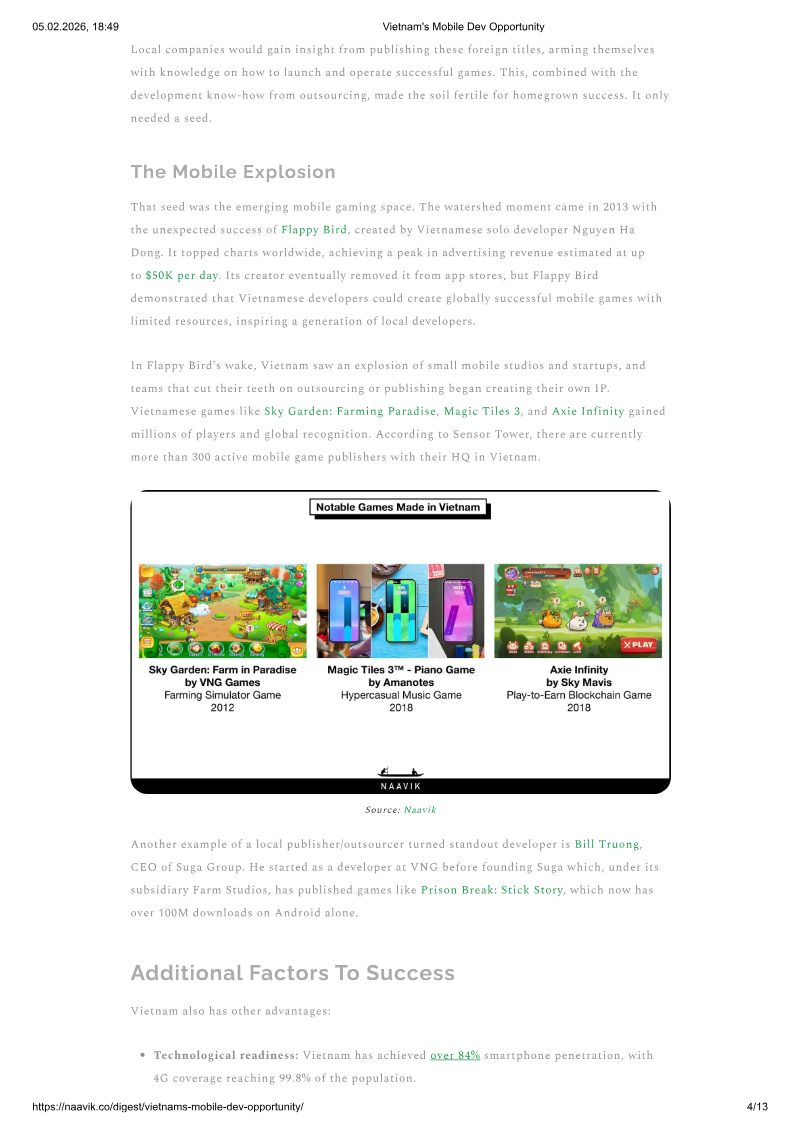
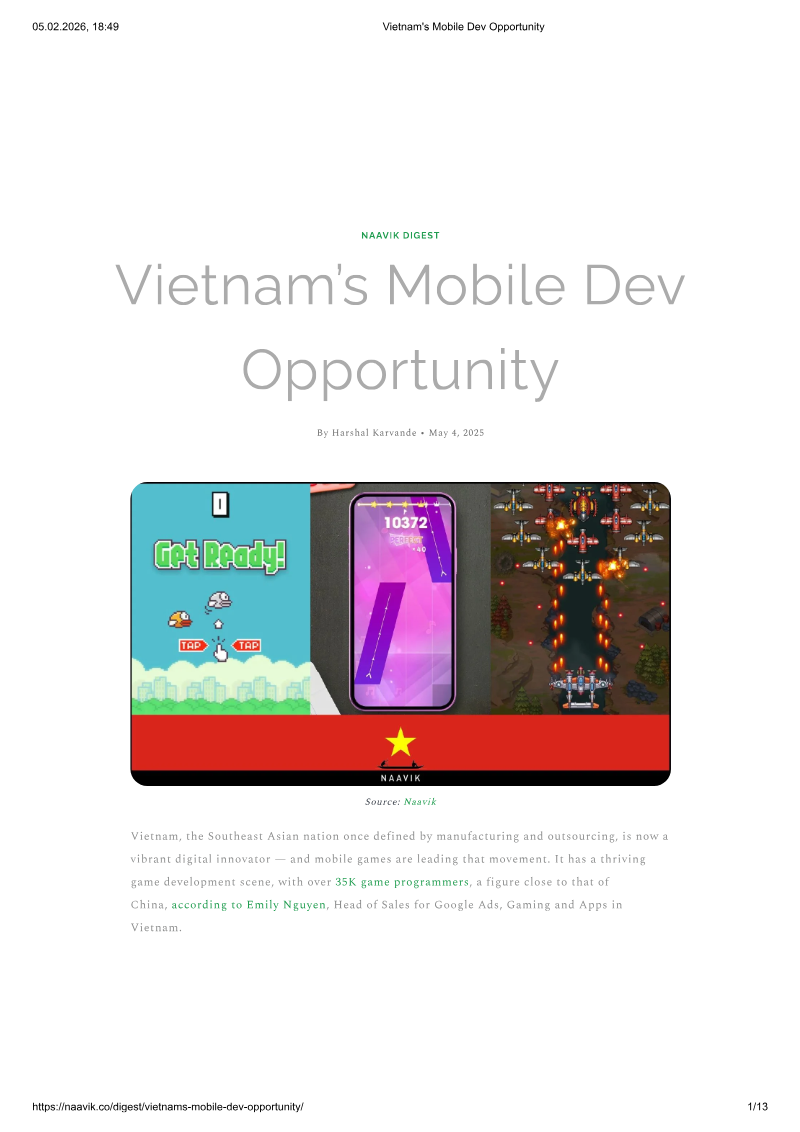
And right now, uh the latest data is that every year there 50,000 technical graduates are joining the workforce. So, it's a huge uh number from my point of view. And yeah, so many of them are software engineers. And in like around 2000 uh year, the outsourcing began rising. So, a lot of companies started to software outsourcing, and uh engineers here where they they were learning international standards of work. And very important moment for the market was Flappy Bird, this addictive game which uh many uh may remember. It was uh, released in 2013 and it was made by Vietnamese guy in a couple of days. So, he, uh, made a lot of money, he panicked, he removed the game from stores. So, this is a big, uh, was a big story around it, but he inspired the whole generation of people working in
like software companies and game development companies, which were few at that, uh, time. They realized, "Hey, I can go and create my own like company, release games and earn money." So, a lot of studios were starting after that. When people, uh, gather together several like, two, three, uh, four people and start doing games. And because cost of living in Vietnam is low and the salaries are also still low compared to other countries, the studios could, like, last on their own money or take money from relatives. And the, uh, most of the studios here do not have any, uh, like, external capital. So, they founders are the owners and they do not need to report to anyone, they do not need to, like, chase the exit and so on. It's like very, I think, unique for this market because the cost of living and salaries in other countries, they
just do not allow this. You cannot, like, very few people would can, uh, have funds to run company of several people for 1 year, for example, until you get start getting some revenue. And, uh, there was hyper casual boom, where a lot of studios became started to make copycat games and release them with international publishers. And, this ended, uh, with IDFA and, the shift from to hybrid casual, uh, started. And now there're a lot of studios, medium and big, like uh this head counts about 150 people, who have like build uh the processes uh for production, for repeated uh successful releases, and user acquisition. And they're now pretty good in creating uh hybrid casual games.
But the next step uh is ahead uh for Vietnamese mobile game developers. And uh here we can look at top publishers and top grossing. I'm not sure if it's very well if you see it well. Now on the screen the uh numbers are uh a bit small. So, I would show here that like top companies, for example, OneSoft uh is a group of companies. They had uh their revenue per download is just 14 cents. And the top company in grossing rating, which earned like 50 uh 95 million last year, uh they have a revenue per download 24 cents. So, it's because those genres, hybrid casual, puzzles, uh arcade simulation, they do not have a deep gameplay, and they the players do not spend a lot of money there on in-app purchases.
So, this is the next challenge, the next step in development for Vietnamese uh studios to make and create uh games with deeper gameplay, with more original gameplays, and more original uh stories, meta games, something more unique, rather than copying already what is on the market. And uh
That That That's a very interesting that you said that, because I was just also at the event in Berlin, and what I heard from the local devs is that like that Vietnam is getting this bad rap now. Like similar to China that the games or concepts of games like being copied. Is this how it's perceived in Vietnam or
I think here in Vietnam people pretty aware about this. So whenever you do something successful others will copy will copy you very quickly. Either it's a creative like creative everybody is copying like
something not only in Vietnam everybody is money monitoring the market and every good idea and creative copied immediately by everyone. But for the gameplay yes it was a reputation of Vietnam for long time that they have very good production skills and like can reconstruct game and create a similar game and iterate a little bit on it. So this is a the like challenge now for Vietnamese like a Vietnamese industry to come up with products which generate more revenue which have deeper gameplay and which stimulate players to spend money inside the games. Not just or not only watch ads.
Got it.
And here I also put like some companies which like you should know from Vietnam. For example OneSoft is a group of four studios. There were there were four guys who founded the studio. But they had
different views how to manage it and they decided to split into four different studios and everyone is a CEO of one studio. And all of four of them are successful. And together they have like really big like head count. And they are like very independent. They do not have any uh, external investment and as I heard they're not really acceptable of someone buying as a more a stake in the company at this point. So, this is more like a this is very, I think, Vietnamese approach to be owner of your own company and to be the like main boss who tells like yourself and others what to do and not to have somebody above you who is like investors or board of directors who will tell you what to do. And other ball of games here of of
studios here are very successful and they are bootstrapped. So, they have some investors, probably maybe some friends and relatives at early stages or some maybe unpublic entities, but in most cases the like founding team usually is like 100% owners of the studio.
What about genres like I'm talking about match three, I don't know, merger, idle
So, I it is like harder for Vietnamese studios to work in these genres, so there are not big successful games in those casual games which require like deeper meta games, more complicated level design in terms of how like difficulty change during the lifetime of the user. So, in top charts there no such no games
in this casual genres. And this is like part of this challenge for Vietnamese companies to start like be able to produce these games on a competitive level.
Uh, but even those studios, do they specialize like for example I don't know Amanotes does this I think they do music.
Amanotes is very specialized
Yeah yeah yeah.
using games so but I think they are only very specialized
Yeah.
studio so Amanotes is like world leader in music games and this is something what they like part of their culture they have a lot of people playing music instruments and they try to hire people who know something about music and they have like a stage in their studio and they have different performances like uh you know Amanotes got talent or something like that
Yeah yeah.
and they are when I saw videos they are on a pretty good level you wouldn't say
Okay yeah.
some corporate you know this corporate events they
Yeah yeah.
funny stuff on stage but because they are like into this into music into performance they do it much better than average company
Yeah yeah yeah of course.
So yeah but I wouldn't say that other companies are specialized in so it's hybrid casual everybody from hyper casual move to hybrid casual now hybrid casual puzzles is what companies trying to do and to make those uh games more sophisticated more complex so players stay longer they start like spend on meta and so on.
Got you.
Uh okay. I think let's see what I got next here yeah this like two interesting deals important for the market I would say uh which happened like around half a year ago the first like at the start of
life cycle of company the public publicly announced venture capital deal the seed investment into Pantera Global it's a studio in Hanoi so they get investment of one and half million dollars and uh that's probably the first such publicly announced deal. So, I think it's important and everybody anticipated that hey, the other deals should follow. And the second deal is the Huhu Games. It's a big casual games company in Saigon. So, they sold 67% stake to NCSoft, to Korean big Korean game development and publishing company, which is known for RPGs, MMORPGs. And the new strategy for NCSoft to develop a casual games portfolio and direction. And the Huhu was one of big acquisitions
for them. And I would say that they bought actually Singaporean parent company. And it's a standard in Vietnam. So, every almost every studio has like a some legal entity, usually the parent company is in Singapore or Hong Kong. And if a studio is interested in getting some investment, it means that very Vietnamese legislative field is not so developed and any international institutional investors, they can invest into Singaporean or Hong Kong company, but not in Vietnamese company where they would not be able to actually follow for the term sheet and protect the investment. So, this like two other the size of the deal is 105 million and I think I missed to write this on the slide. So, 67% of the company was sold for 105 million dollars. Huge money.
Huge.
So, and these two deals, they show like
what you can get at entry and actually what you can get on exit. So, I think it gives a lot of founders in Vietnam like understanding and benchmark what you can ask
Yeah, yeah, yeah, yeah.
on different stages of the company. And about the HuHu, it's important to see that their 33% stake stays with founders, and founders stay in the company to develop it. So, it was hosting a panel discussion and had, like, a person from HuHu Games and investor into Pantera. And it was important for HuHu to be, like, in charge, to stay in charge. And they accepted this investment only because uh, they saw that NC Soft will allow them to develop faster together than what they could do it on their own. Like, all these founders of game companies in Vietnam, they don't want to exit from the business. They don't want, like, to go on a live on an island or on a yacht. Cuz the
companies already successful, so they have their cars, they have their, like, apartments or houses. And they just love this stuff they do.
Yeah, yeah, yeah.
Just cash out is not appealing to most of them.
Interesting. Yeah, yeah, so super interesting. And I guess it's also like a cultural aspect.
Yes, yes. And it's, like, they're hard working and they have fun doing what they do, and they so don't know what they will be doing if they like sell their, like, their child company.
Yeah, yeah.
Okay. So, this is like what I was already talking about about the next challenge and transition for Vietnamese companies, which, like, the market understands and realizes. So, from, like, this hyper casual, now hybrid casual games with big volume of downloads internationally to go to games with a deeper gameplay, with
meta, with lots of live ops events, where companies can earn more from each download from each player. So, and how would this like transition could happen? So, yeah, usually you can these companies will just continue doing what they do and learn by doing, but also I see there could be helpful external consultants and partners like going to web I wrote, but not only going to web. Like for example, Google is inviting consultants from Europe who work with game studios here on the ground for like 3-6 weeks and they like like ops and monetization and they are doing it already the second year in a row. So, it's I think it's a like great example how like platforms or these like big ecosystem players like Google can help Vietnamese game development studios grow.
[snorts]
And when I also talk to studios, they
say that they're not very interested in like venture capital or in just in financial investment because they don't feel it gives a lot to them. They're now looking into partnership with global gaming companies like example of NCSoft and VNG games when they can get some like expertise from the investor not only the money. They are open on one hand they are open to hiring international talent in design and product also like art directors, but I see that it's very hard for them to build this like to make it happen. Most many probably most of the studios, they do not have a many English speaking employees. So, it's pretty hard for them to hire a foreigner who will be English speaking and build like working workflow how is that person could do work with a local team when there's a language
barrier. So, I don't see this happening yet, but I heard that yeah, people are interested. Some studios are really interested to hire game designer from Turkey. And like yeah, Turkey is a big in match three and puzzles, so they would love that to get that magic a bit also. But how they will build like workflow in collaboration inside that's a question for me and I would be interested to see how this happens. And also user acquisition in tier one countries, yeah, to get into higher RPDs, uh like from uh studios need to shift from just tier three countries where most of the downloads now coming from. And as like member of Point Web at performance agency, I can talk more about uh scalable UA and what companies can do. So, first step is like diversification
of channels, not only like usually everybody uses Google, Unity, AppLovin, but finding like hidden gems of traffic in tier one countries, that's what can help user acquisition teams keep their budgets under control. Example here like News Break and Snapchat which not many companies now in Vietnam using, but which have good tier one countries. Like News Break is USA local news app with 40 million monthly users. What could be also increasing creative output when uh teams use like studios use not only internal teams, but also use solutions like platforms where can they generate like creatives based on templates like playables or with gen AI agencies which bring new perspectives and new ideas. So, to increase creative output and number of ideas which
could be tested at once. And also like media buying and for um like targeting tier one countries and more compliant like a lot of studios they love different tricks. So, like try try to find some exploits. And I say like maybe use some suggestive creatives which then caught by platforms and the ad accounts are blocked and so on. So, I think that to be more like mature in targeting and media planning uh to get more like audience which can pay more. Yeah, let's go. Also mm going from like bootstrapped mobile game studios which grew from small to big. There also other like types of companies, game companies here,
other segments. For example, here are like international companies which open their production here and focusing here mostly on mobile games. Like French companies, Korean are very active and from Japanese I know Koei Tecmo. There also smaller studios opened by I don't know Indian, Turkish, Singaporean companies. They are not so public. They are not like big, but probably there are more which I didn't hear about. So, and beyond this segment, who else is making games? So, this outsourcing is massive here. There are lots of outsourcing companies. They are like the biggest from Virtuos, like Sparks and Glass Egg. They have like 500, 600 people each and they working on triple A games and also on Hollywood movies. So, it's like a really great school for artists here, and a lot of people would
like uh happy to work there because they can work on top games on a global scale. Gear Games is like premium outsourcer for mobile games. They're working with top mobile studios from the West. And I I didn't just several here, but there are much, much more of them, and they are not very actively advertising themselves on the internal market. So, like uh discover more and more sourcing studios which you never heard about, but they have like a couple of hundred people working there.
[snorts]
Uh so, those PC indies, actually from among three logos which I have there, only Archmage is a real indie. So, they made action RPG, and according to their analytics, sold 400,000 copies of the game, which is not bad. And Ray Winstone and Solis, these are actually also unreal outsourcing companies which
are working on their first on their own products. Ray Winstone released a horror game, The Scourge, with some like Vietnamese topics there, and according to external analytics, they sold 40,000 copies. And Solis is now working on zombie shooter, which is in closed beta, and it's like double A level of production. But, yeah, their main business is outsourcing. And Roblox is like a new emerging platform for developers here. Here a couple of studios like Reka Studios Saigon with 30 or more than 30 people. Reverse, it's they are in Da Nang and in Paris. It's like double French-Vietnamese company. Uber Studio in Saigon. and there are much more when they go to Roblox meetups here. There a lot of people are coming who are doing something on Roblox, but small teams which are not
even have any kind of studio. They just doing something together.
Yeah. Got it. I have a question. Since you mentioned the Roblox as a kind of a new opportunity and new market, we've seen we have seen like globally a lot of game devs are switching actually to non-gaming. Do you see any of this like specifically for mobile? Do you see any of this in Vietnam?
Yes, when I'm now currently in Hanoi on business trip, I was at yesterday at Unity Day here. And when I talk to studios here, and if game studio working on both games and apps, they would dedicate maybe 60% or 70% of the team to apps. So, a lot of studios there only games, but when they discover that they can do also applications. Here a lot of in Hanoi a lot of like studios which are making utility applications. Either like with
monetization on subscriptions or with monetization on advertisement. So, I see this shift is happening and here in in Hanoi it's pretty active. I didn't encounter such like application utility studios mainly in Saigon, but in Hanoi it's an active more of trend.
Got it.
Okay. So, let's go. I also wanted to talk about labor force because this is what I think makes Vietnam unique and allows Vietnamese companies be so successful on global market. So, here I'm like first it's a low salaries compared to other territories where you would like for example in Eastern Europe where you can outsource uh software production. And these are salaries from like a LinkedIn post of recruiter. So, of course some people can earn more than these, but this is what is now market uh salaries. For example,
you see it's a specialist $1,200 per month or junior dev maximum $1,200 and some or less. If it's Unity team lead, it's $2,000 per month. So, you can see this uh like would be considered very low low salaries in other markets, but here you can hire a team with these salaries and it makes development in Vietnam very competitive compared to other territories. Also, Vietnamese uh developers are very hungry. So, they want they are very hard working. Thanks to this, they want their games to succeed. They want to earn money. So, they are really like they are hustling. They love hustle and they are trying to find different ways how to maximize profit from their games, from their product. So, yeah. And that's why they are sophisticated technically. They
work fast and they want to earn on their game. What I was encountering that juniors when they just coming from school where they everybody controls them coming from university when nobody controls them, they could be lost on their own and they can just go playing games or watching YouTube. So, they need some time to understand like this like to get this work ethics and to also like be able to work independently. So, also what is I think when Western companies come to Vietnam and where they can get some mistakes and misunderstanding. It's a different communication culture than in the West. So, in East Asia people are not so direct and so, for example, in usually people don't say no directly. They will show you some signals that they disagree, but if you cannot read them, you can think that everything is
okay. And they usually people say, "Yes, we can do it." even if they cannot do it and you will figure it out later on. And also in Vietnamese is paternalistic culture, so in like not in software development, but in other like traditional companies, boss is always right and people don't say no to boss. They do not challenge what boss says and if something goes wrong, boss boss would probably blame employees in this. But in software development, I see a bit different culture, more like open and more collaborative. I think that's why young people really love to work in IT and in game development because it's very different from Vietnamese corporations. And but still to like especially when there's work with foreign clients or in
international companies, it takes time to create culture and people voice their concerns when they disagree, when they can bring up problems and not to hide them. So, I think this is like the could be the biggest obstacles in communication when Western companies like collaborate with Vietnamese developers. To be aware about this and like bring it to something like together to meet Western style and uh Asian style communication.
Yeah, yeah, absolutely. I had this like I went to Vietnam twice already and I definitely like had this kind of revelation.
Yes, yeah. So, also it takes time to establish relationship. First of all, people want to establish relationship and understand who you are personally and then work talk about business.
Yeah.
Pretty aggressive just to meet and start talking about business and like hey, why? Why? Yeah, I don't know who you
are. How can I trust you when you are talking about business?
Yeah, yeah, yeah.
Yeah. So, I think this is yeah, that was about the first part about mobile game development. And and as a game development not only mobile, but something very interesting and not I think it's overlooked in the West the Vietnam as domestic market where you can actually earn money on your games. So, this is a estimations from also one report by Gamota, one of the publishers here in Vietnam. So, the size of market is last year around 800 million. That's in-app purchases which attract by tools like App Magic and Sensor Tower which are going through Google Play and App Store and other like more traditional ways, but also local. Local payments are very big in Vietnam and I will will show it here
on next slides and they are not tracked by those services which we used we are using to estimate markets. The number of game is is 54 million among 101 million population. So, it's something about 50%. And uh pretty high share of iOS. So, you would think that Vietnam maybe is a developing country and also people don't have so much income uh to buy iOS, but I see that there are a lot of second-hand iPhones sold here. And probably when in China second hands are sold, they many of them would end up in Vietnam. Cuz there are a lot of people who can afford to buy a brand new iPhone, but this 43% tells about the big second-hand market also. And interesting the most interesting about payers actually this 800 million they are more formed by high payers. So, here in Vietnam a lot of whales who spend like tens of thousands dollars per month on their favorite
games. And um
Yeah, the for me there's a 7-10% paying users is crazy.
Well, I I think that the report is taking it from their internal data because they are publishers they publish games internally. So,
Yeah, yeah.
in this, but I cuz I don't have this data like on my own dashboard.
And what is a local? Is this D2C? Like
Yeah, D2C.
Okay.
So, on the left.
Yeah.
Direct to customer. So, it was popular in Vietnam even before like IDFA and then everybody globally started to dodge payments to Apple and Google because here it was problematic. Not everybody had cards, Visa, MasterCard, and a lot of cards from local bank system called Napas. So, and Apple and Google could not accept them. So, right now only like 15% of payments
on like game market goes through traditional like in-app purchases in App Store and Google Play. And players, they prefer their local payment systems. And they buy through web shops which local publishers operate for long time. So, only like Also, there's regulations. So, actually the current market is similar to Chinese. That it regulations were adopted started, I think, in 2013. But, they were not enforced for some time. And I think around 2019, for example, Supercell removed their games from Vietnamese stores. Because there was more like more enforcement. And here's the number of 1,080 games last year were removed because they did not have a license to be published in Vietnam. So, actually there like now when you publish
a game for Vietnam in the App Store, there's a like a field that you need to put your license number. And get it to get it, you actually need a local partner. Because license for the game in Vietnam, they like Okay, they require that you identify users. And if they are below 18 years old, there are limitations on time how much they can play. So, you need to keep data on servers inside Vietnam. The payment local payments need to be enabled, not only like Visa and MasterCard. And special developer accounts need to be used. So, this I I think this 15% is important to know because when like a company has like old game with enough purchases and they earn some money in Vietnam. And they think, "Okay, do we need to publish in Vietnam or no? This is This is Well, we don't earn so much." But, actually they're earning only 15% of what what's
possible.
But, there must be like local publishers that
Yes.
will take care of
are they.
Yeah.
Here on the right side there's a like potential local publishing partners in Vietnam. So, usually they uh have like some kind of revenue share based on those direct-to-customer payments. So, they and they can take even maybe even less than 30% or around 30% like the like Apple and Google, but they unlock the whole market. But, uh here is like a table a chart with uh most popular genres. So, this is a share of like of payments. And you can see that this are like games with like competitive or with deep meta and with really like high ceiling of how much you can spend like 4X uh or MMORPG. Actually, there is no like the sky is the limit how much you can spend very
often. And so, they are like mid-core hardcore games. And those companies like Garena, Gamota, VNG Games, so in their portfolio, there's a lot of Korean, Chinese, Japanese games. So, they are appealing by style and by gameplay uh to Vietnamese players. And there are not many Western games. But, I think this is more not gap of not because like Vietnamese players don't want to play in Western games, but I think there's a gap in like in communication uh between Vietnamese and publishers and Western game developers because it's easier to go from Vietnam to go to China Joy and to Tokyo Game Show and to Taiwan and Korean events and like mingle with game developers there than to fly over to Europe or to United States and meet uh Western game developers and the same for the like people from the West, they would fly to local events and connect
with people in Asian markets only play like very targeting like fi- finding partners or finding some business opportunities here. So, I think there's a lack of communication between like East Asia and the West and um like because of distance and also because of cultural gap as you said about this previously with communication with game developers. So, I think it's harder also for Vietnamese publishers to find common language with Western game developers. So,
Yeah, it seems like Roblox made it happen somehow. Where was there like
Yeah.
resources?
Um but there are very few like
exactly.
Western games in this in Vietnam. And I think that because um Western developers also do not realize the size of the market. They look at the sales in-app of in-app purchases in
Google and Apple and they see it's a little bit, but it's just 15% potential of this market. Yeah, so I think it's kind of a summary. Yeah, so in mobile game development, the industry is aware that they need to shift from like download scale and advertisement-based monetization to in-app purchases and uh like we can help here on the market with UA scale. Like my company Plan to Web. And uh for like Western developers of mobile games, I think that they should pay attention to Vietnam's market where can like earn money. So, I know from one of the publishers that the record game it's earned like in several years Vietnam 50 million dollars. It's like for each genre. But this is like I think interesting
like market for any company of any size. So, yeah, with uh like local co-publishing partners, local direct-to-customer payments are unlocked, and that's how game developers can earn on mobile market in Vietnam.
Yeah, it's really a hidden gem, as you as you put it. Like, I don't I at least I haven't seen a lot of people talking about it at all. Like, I think that they are the the first one. So
Yeah. Yeah, I also realized I realized it also a long time ago by like meeting more people talking to
Cool. Did you have uh the last let's place?
Yeah, that's it. That's my contact.
Uh I think yeah, thanks so much. A lot of cool stuff here. We'll make sure to put all the links in the description, so it's convenient for the audience to find you.
We will also ask all of our viewers to leave their questions in the comment section under this video. Of Of course, give us a like. This will give us a good signal that you like this kind of video, and we'll produce more videos like this. Uh we'll ask Maxon to answer your questions, too. Uh lastly, uh thanks a lot, Maxon. A lot of cool insights. I learned a lot. Um yeah, thanks a lot for coming.
for hosting, inviting me for this talk.
Yeah. Always. All right, then. Have a good one. Cheers.
Okay. Bye-bye.
Auto-generated captions from YouTube — names and numbers may be misheard.
Key insights
7 takeaways · ~3 min read- 01Vietnam is a top-five global publisher by volume, with nearly 5 billion mobile game downloads and a strong focus on simulation, puzzle, and arcade genres.
- 02The industry is primarily bootstrapped, with founders retaining ownership and avoiding external capital, which allows studios to prioritize long-term development over rapid exits.
- 03Most Vietnamese mobile games currently monetize through advertisements rather than in-app purchases, resulting in a reliance on tier-three markets in Latin America and the Middle East rather than tier-one countries.
- 04The market faces a regulatory environment similar to China's; in the last year alone, 1,080 games were removed from Vietnamese app stores for failing to meet local licensing requirements.
- 05Local market value is often underestimated by Western developers because it relies heavily on D2C payment systems and web shops rather than standard App Store or Google Play billing.
- 06Vietnam’s competitive advantage stems from a low-cost labor force and strong production skills, though studios are now actively seeking to hire international talent to improve gameplay depth and monetization in mid-core and hardcore genres.
- 07Cultural differences in communication—specifically the preference for building personal relationships before business discussions and a tendency to avoid voicing direct disagreement—remain significant hurdles for Western companies collaborating with Vietnamese developers.
Ask AI about this video
Cite this video
Citation
Generating citation…

















Comments